
Carrier Invoice Verification: Why Freight Companies Outsource AP Audit
Why Does Freight AP Get Less Attention Than It Deserves?
In freight operations, the revenue conversation dominates. DSO reduction. Shipper billing accuracy. Accounts receivable (AR) collections. These metrics get tracked, reported on, and optimized, because they directly affect cash coming in the door.
The payables side (specifically, carrier invoice audit) tends to get less strategic attention. It’s treated as a processing function: invoices come in, someone checks them, payments go out.
But carrier invoice errors are one of the most consistent and least visible sources of margin erosion for freight brokers, 3PLs, and trucking companies. At scale, the accounts payable (AP) audit function either protects margin on every load or quietly bleeds it.
What Does Carrier Invoice Verification Actually Involve?
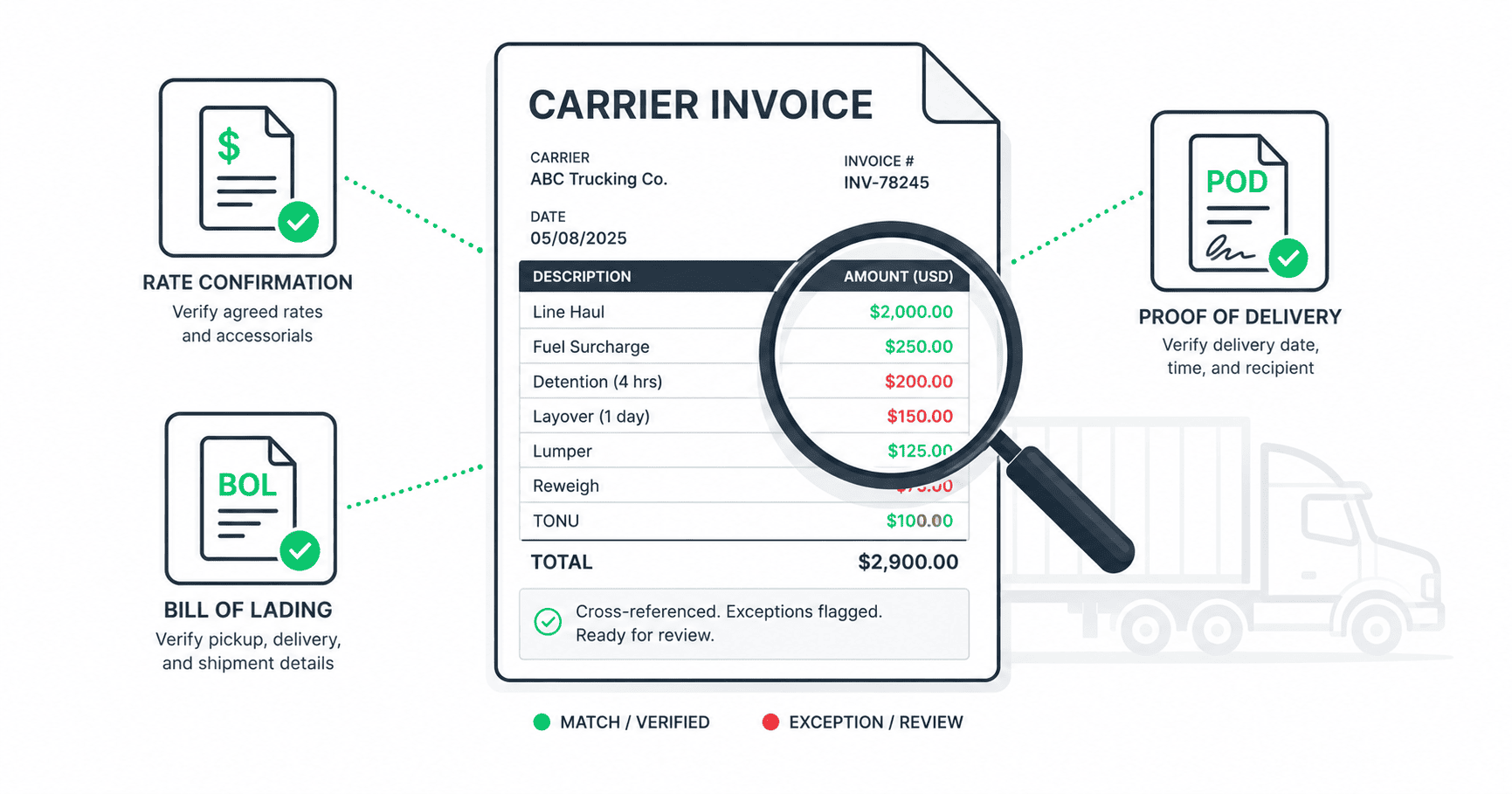
When a carrier submits an invoice for a completed load, that invoice needs to be verified against multiple data points before payment is approved.
The invoiced freight rate should match the agreed rate on the rate confirmation. This sounds straightforward, but rate cons sometimes have multiple line items: a base rate, a fuel surcharge, and specific accessorial terms. The carrier invoice needs to match all of them, not just the total.
Then there’s accessorial charge validation. Did the rate confirmation include detention, layover, or other accessorial terms? If so, are the charges on the carrier invoice consistent with those terms? Are there accessorial charges on the invoice that weren’t part of the agreement: charges the broker didn’t authorize?
The carrier invoice should also be cross-referenced against the POD and BOL. Was the load delivered to the correct destination? Do the dates match? Is the load number consistent across all documents? Mismatches can indicate anything from a simple data entry error to a double-billed load.
Duplicate detection matters too. Carriers sometimes submit the same invoice through multiple channels: email and a carrier portal, for example. Or they resubmit an invoice with a slightly different invoice number after the first was already processed. Without a systematic check, both get paid.
And fuel surcharges need their own line of scrutiny. They’re calculated based on published indices and agreed-upon formulas. The math should match. On high-volume lanes, even a small per-load discrepancy adds up across hundreds of loads.
Each of these checks is individually simple. The challenge is doing all of them, on every invoice, at volume.
Where Do Carrier Invoice Errors Hide?
Carrier invoice errors aren’t typically the result of bad intent. They’re the result of complexity, speed, and imperfect systems on both sides of the transaction.
Multi-stop and partial loads create the most frequent rate discrepancies. The rate con may show a total, while the carrier invoices per-stop. Reconciling these requires manual attention and a clear understanding of what was actually agreed to.
Unauthorized accessorial charges are another common issue. A carrier adds a detention charge or a lumper fee that wasn’t pre-authorized. It may be legitimate (the driver was held at the receiver), but it wasn’t part of the agreed rate. Without verification, it gets paid automatically, and the cost may not be recoverable from the shipper if it wasn’t billed through.
Duplicate submissions happen more often than you’d expect. A carrier submits via email on Tuesday and through the carrier portal on Wednesday. Different invoice numbers, same load, same charges. Both hit the AP queue and both get processed.
Fuel surcharge calculation errors are the quiet ones. The per-load difference between the correct calculation and an incorrect one might be $15 to $40. That doesn’t jump off the page. But if one load in ten carries that error, across 3,000 loads a month that’s $4,500 to $12,000 a month, or $54,000 to $144,000 a year, in potential overpayment from a single error type.
And then there are carrier-paid accessorials that get billed to the broker anyway. Some rate confirmations specify that certain charges (lumper fees, scale tickets) are carrier-paid. If the carrier includes them on their invoice, and the AP team doesn’t catch the specific rate con language, the broker pays a charge they weren’t supposed to.
Why Can’t In-House AP Teams Verify Every Invoice?
The reason these errors persist isn’t that AP teams don’t know how to verify invoices. It’s that they don’t have the capacity to verify every invoice thoroughly.
At a freight brokerage processing 2,000 to 4,000 loads per month, the carrier invoice volume is substantial. Each invoice requires pulling the rate confirmation, comparing line items, checking documentation, and flagging exceptions. That’s 10 to 20 minutes per invoice when done carefully, longer for complex loads with accessorials or multi-stop routing.
At 3,000 invoices per month, that’s 500 to 1,000 hours of verification work monthly. A single full-time employee working 40 hours a week provides roughly 170 productive hours per month. You’d need about three to six people doing nothing but carrier invoice verification to cover that volume thoroughly.
Most brokerages don’t have that. They have one or two people who handle carrier invoices alongside POD retrieval, shipper billing, and whatever else comes across their desk.
So the team triages. High-dollar invoices get scrutinized. Smaller ones get a quick glance. The $35 fuel surcharge error passes through. The duplicate $900 invoice gets paid twice. The unauthorized $400 detention charge gets approved because nobody had time to pull up the rate con and check the accessorial terms.
Over a year, those small misses compound. In our experience, freight companies running AP verification without a dedicated, systematic process overpay carriers by 1 to 3% of total payables. On a $20 million annual carrier spend, that’s $200,000 to $600,000 in margin erosion, not from bad rates but from processing errors.
Why Is Carrier Invoice Verification One of the First Functions Freight Companies Outsource?
Carrier invoice verification is one of the first back-office functions that freight companies move to a dedicated external team. There are a few reasons it lends itself to outsourcing more naturally than other functions.
Mode mix raises the stakes. A 3PL checking carrier invoices across several modes has more rate structures to reconcile and more places for a mismatch to hide, which is why invoice audit is often the first function handed off in 3PL back-office operations.
The work is standardized. Every load follows the same lifecycle: rate confirmation, dispatch, delivery, carrier invoice, verification, payment. The verification steps are consistent across loads, across carriers, across customers. A team trained in freight AP workflows can execute these checks systematically without needing deep institutional knowledge of the brokerage’s customer relationships.
Volume is the core challenge, more than complexity. Individual invoice verification isn’t complicated. It’s the sheer number of invoices that overwhelms in-house teams. A dedicated external team provides the capacity to verify every invoice, not just the ones that survive the triage process.
The ROI is directly measurable. Unlike some operational improvements where the payback is indirect, AP audit savings are concrete. Every overcharge caught, every duplicate stopped, every unauthorized accessorial flagged. These are dollars that would have left the account. Most freight companies that implement systematic carrier invoice verification identify recoverable overpayments within the first 30 days.
And it frees in-house capacity for higher-value work. When in-house staff aren’t spending their time on line-item invoice matching, they can focus on carrier relationship management, exception resolution, payment scheduling, and cash flow planning: the strategic work that an experienced AP professional should actually be doing.
What a Good AP Audit Process Looks Like
Whether a freight company builds the capacity in-house or brings in an external team, certain elements should be non-negotiable.
Every carrier invoice gets verified, not just the high-dollar ones. The errors that compound are the small, repetitive ones that triage skips.
Rate confirmation matching happens on every line item. Not just the total: the base rate, fuel surcharge, and each accessorial charge verified individually against the rate con terms.
There’s a systematic process for catching duplicates: invoices submitted through multiple channels or resubmitted under different invoice numbers for the same load.
Each accessorial charge gets checked against the rate con to confirm it was pre-authorized. Anything that wasn’t gets flagged before payment.
When a discrepancy is identified, there’s a defined escalation workflow: documenting the issue and routing it to the right person for resolution, not just rejecting and hoping the carrier fixes it.
And the process produces data. How many invoices processed, how many discrepancies identified, what dollar amount was caught, what categories of errors show up most. That data informs carrier performance evaluation and future rate negotiations.
How AP Audit Connects to the Bigger Picture
Carrier invoice verification doesn’t exist in isolation. It connects to the broader post-dispatch pipeline in ways that affect both margin and cash flow.
When carrier invoices are verified quickly and accurately, payment cycles become predictable. Carriers get paid on time, which strengthens the relationship and makes them more responsive when the brokerage needs capacity. Fewer payment disputes mean less back-and-forth consuming staff time.
On the shipper side, accurate carrier cost data feeds into accurate shipper billing. If the broker doesn’t know the true carrier cost on a load (because the invoice was paid with unverified accessorials), the shipper invoice may not include charges that should have been billed through. The margin on that load shrinks without anyone noticing.
And accurate AP data matters to cash flow planning as much as DSO does on the receivables side. You can’t optimize cash flow if your payables data is unreliable.
ClearLane’s carrier invoice verification includes rate confirmation matching, accessorial validation, duplicate detection, document cross-referencing, and compliance checks on every invoice, every load. It’s part of the full post-dispatch pipeline: POD retrieval, AP audit, pre-billing revenue recovery, shipper billing, AR management, and bookkeeping.
Questions Worth Asking About Your AP Process
If you’re running a freight brokerage, 3PL, or trucking company and want to evaluate where your carrier invoice verification stands, these are the metrics that will tell you:
What percentage of carrier invoices are verified against the rate confirmation before payment: every line item, not just the total?
How many duplicate carrier invoices were caught last quarter? How many were discovered after payment?
What’s your average carrier invoice processing time from receipt to payment approval?
When was the last time someone audited a sample of paid carrier invoices to check for overpayments?
Does your AP team have the capacity to verify every invoice, or are they triaging by dollar amount?
The revenue side of freight operations gets the attention. The payables side protects the margin. Both deserve a dedicated process.
Rate mismatches deserve their own attention: contract rate discrepancies are the quietest margin leak in freight billing, because each one looks like a rounding error until they are added up.
Frequently Asked Questions
Carrier invoice verification is the process of checking every carrier invoice against the rate confirmation before payment, comparing the base rate, fuel surcharge, and each accessorial charge line by line to catch overcharges, duplicates, and unauthorized charges.
In our experience, freight companies running AP verification without a dedicated process overpay carriers by 1 to 3% of total payables. On $20 million in annual carrier spend, that’s $200,000 to $600,000 in margin erosion from processing errors.
The most common errors are rate discrepancies on multi-stop loads, unauthorized accessorial charges not in the rate confirmation, duplicate invoice submissions through different channels, fuel surcharge calculation errors, and carrier-paid charges billed to the broker.
Thorough verification takes 10 to 20 minutes per invoice for standard loads and longer for complex loads with accessorials or multi-stop routing. At 3,000 invoices per month, that’s 500 to 1,000 hours of verification work monthly.
The work is highly standardized (same verification steps on every load), volume is the core challenge (more than complexity), the ROI is directly measurable (every overcharge caught is dollars saved), and it frees in-house staff for higher-value work like carrier relationship management and cash flow planning.
Audit each carrier invoice against the rate confirmation before payment, confirming the linehaul rate, fuel surcharge, and any accessorials match what was agreed, and that no charge is duplicated. Smaller logistics companies often can’t review every invoice in-house at volume, which is why carrier invoice verification is one of the first functions they outsource to a dedicated team.
A freight audit is the process of verifying that carrier invoices match the agreed rates, accessorials, and terms before payment is issued. Pre-payment auditing catches errors before money leaves your account; post-payment auditing recovers overpayments after the fact.
Questions about your carrier invoice verification process? Talk to our team to see how ClearLane handles AP audit for freight companies. Or email us at info@getclearlane.com.
Running the audit in-house for now? Work from the free freight invoice audit checklist, or size the stakes with the AP overpayment calculator.