
How Freight Brokers Lose Revenue Before the Invoice Goes Out
There’s a number that doesn’t show up on most freight brokers’ P&L statements: the revenue that was earned but never billed.
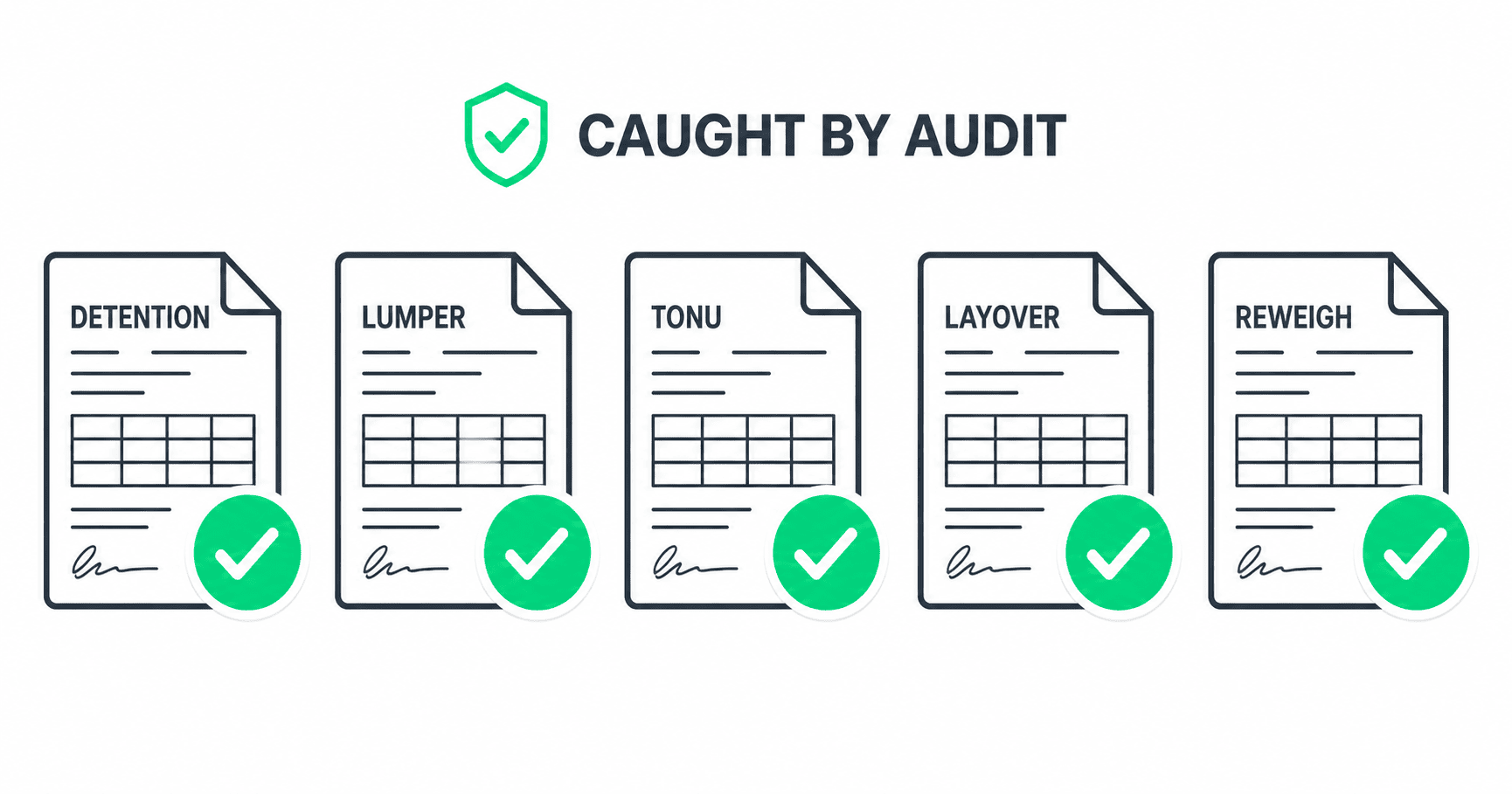
Not bad debt. Not disputes. Not write-offs. Revenue that was legitimately earned on a load (detention time, lumper fees, TONU charges, accessorial services) that never made it onto the shipper invoice in the first place.
We plan around freight invoice error rates of 2% to 5% of total billing volume. For a brokerage moving 2,000 loads a month at an average load value of $1,000, even the conservative end of that range represents significant money leaving the operation every month. That isn’t because anyone made a bad decision. It’s because the process between dispatch and billing has structural gaps that let charges fall through.
This post breaks down where those gaps form, why they persist, and what the pre-billing audit process is designed to catch.
Why Does Revenue Get Lost Between Dispatch and Billing?
Every brokered load generates two parallel workflows. Dispatch manages the operational side: booking carriers, coordinating pickups and deliveries, handling exceptions in real time. Billing manages the financial side: collecting documentation, building invoices, submitting to shippers, and chasing payment.
The problem is that these two workflows often run on different timelines with different information. Dispatch is moving fast. A driver calls in with a three-hour detention situation at a consignee’s dock. Dispatch notes it, maybe updates the TMS, maybe sends a quick message to operations. But the billing team doesn’t build that invoice for another 24 to 72 hours. By then, the detention detail may not have made it into the file cleanly.
This isn’t a people problem. It’s a process architecture problem. The information that dispatch captures in the moment doesn’t always transfer to the billing file in a structured, auditable way. When it doesn’t, the billing team invoices based on what’s in front of them, which is usually the original customer rate without the accessorial charges that accrued during execution.
What Are the Five Most Common Places Revenue Sits Uncaptured?
The pre-billing audit process exists specifically to close these gaps. Here are the five most common places revenue sits uncaptured before an invoice goes out:
Detention at delivery. The driver waited two, three, sometimes four hours at a consignee dock. Depending on the customer contract terms, detention kicks in after a free time window, usually one or two hours. The driver knows it happened. Dispatch probably knows. But the signed detention log, the driver’s timestamp notes, or the warehouse check-in/check-out record hasn’t made it into the billing file. Without that documentation attached to the load, the billing team has no basis to add the charge. The detention revenue evaporates.
Detention is one of the most commonly disputed and missed charges in freight billing. The challenge isn’t that brokers don’t know detention is billable. It’s that the documentation chain between the driver, dispatch, and billing breaks down under volume.
Lumper fees. A driver arrives at a warehouse and pays $200 to $400 for lumper services to unload the freight. The driver has a receipt, usually a photo on their phone or a paper slip from the warehouse. If that receipt doesn’t get matched to the load file and flagged for passthrough billing to the shipper, the broker absorbs the cost instead of billing it back. On high-volume accounts with frequent warehouse deliveries, missed lumper passthroughs add up fast.
TONU (Truck Ordered Not Used). A shipper books a load. A carrier is dispatched. Then the shipper cancels, sometimes after the truck is already en route to pickup. If the rate confirmation includes a TONU clause, the broker owes the carrier a cancellation fee, and if the shipper contract has one too, the broker has the right to bill the shipper. But cancellations are chaotic. Dispatch is already rebooking or reassigning. The TONU billing flag doesn’t always get set in the TMS. The carrier gets paid, the shipper doesn’t get billed, and the broker eats the cost.
Layover charges. A driver arrives for a Monday morning pickup. The shipper isn’t ready and pushes it to Tuesday. That’s a layover, and if the shipper contract has a layover provision, it’s billable. But catching it requires someone to notice that the actual pickup date doesn’t match the scheduled pickup date. When billing is processing hundreds of loads, date mismatches aren’t always flagged unless there’s a specific audit step looking for them.
Contract rate discrepancies and reweigh adjustments. The BOL says 10,000 pounds and the scale ticket says 14,000. The freight class changes, the carrier bills at a higher rate, and unless the billing team catches the weight discrepancy and adjusts the shipper invoice accordingly, the broker absorbs the difference. Similarly, when a shipper’s contracted rate includes specific terms for fuel surcharges, minimums, or accessorial schedules, manual invoice preparation can miss those adjustments, especially when the billing team is working from rate confirmations that don’t always reflect every contract nuance.
Why Do These Revenue Gaps Persist Even at Well-Run Brokerages?
These aren’t exotic problems. Every freight ops professional reading this has seen all five. The question is why they persist even in well-run brokerages.
Three structural reasons:
First, volume. A broker moving 1,500 to 5,000 loads per month can’t manually audit every load file for accessorial completeness without capacity set aside for it. The billing team is under pressure to get invoices out quickly to keep DSO low. Speed and thoroughness are in tension, and speed usually wins.
Second, information fragmentation. The data needed to catch these gaps lives in multiple places: the TMS, dispatch notes, driver communications, warehouse receipts, carrier invoices, rate confirmations, BOLs. No single screen shows a billing clerk everything they need to verify accessorial completeness on a load. They’d need to cross-reference three or four systems and documents per load to catch every charge.
Third, the incentive structure. Billing teams are measured on invoice throughput and DSO. They’re not typically measured on revenue capture completeness. If a billing clerk processes 150 invoices in a day and misses detention charges on eight of them, nobody notices the missed revenue. But if they slow down to audit every load and invoice volume drops, that gets noticed immediately.
These three forces (volume pressure, fragmented information, and misaligned incentives) create a systemic condition where revenue leakage is the default, not the exception.
What Does the Pre-Billing Audit Process Check on Every Load?
A pre-billing audit is exactly what it sounds like: a structured review of every load file before the invoice goes to the shipper. The audit step sits between “load delivered, POD received” and “invoice generated and sent.”
The audit checks five things on every load:
Accessorial completeness. Were there detention events, lumper charges, layover situations, or TONU cancellations on this load? If yes, is the documentation in the file and is the charge included on the draft invoice?
Customer rate accuracy. Does the invoice match the customer rate? Are fuel surcharges calculated correctly? Are contracted minimums or maximums applied?
Weight and classification verification. Does the BOL weight match the carrier’s invoice weight? If there’s a discrepancy, has the shipper invoice been adjusted?
Documentation completeness. Is the signed POD in the file? Are all carrier documents (BOL, rate confirmation, carrier invoice) present and matched?
Carrier cost vs. shipper billing reconciliation. Does the margin on this load make sense given the customer rate and the rate confirmation terms? A negative or near-zero margin on a load that should have been profitable is a signal that a charge was missed.
This process doesn’t require new technology. It requires a workflow step, the capacity to staff it, and the discipline to execute it consistently across every load. The brokers who run this process before invoicing consistently capture revenue that would otherwise be lost.
How Much Revenue Can a Pre-Billing Audit Recover?
The numbers vary by operation, but the pattern is consistent. We plan around freight invoice errors and missed charges running between 2% and 5% of total billing for brokerages without a structured pre-billing audit process.
For a brokerage billing $2 million per month, 5% in missed charges represents $100,000 per month in revenue that was earned but never invoiced. Over a year, that’s $1.2 million.
Even at the conservative end, say 2% to 3%, a $2 million monthly billing operation is looking at $40,000 to $60,000 per month in recoverable revenue. That’s not a rounding error. That’s the difference between a tight year and a comfortable one.
The pre-billing audit doesn’t create new revenue. It captures revenue that already exists in the operation but isn’t making it onto invoices.
How Should Freight Companies Start Measuring Their Revenue Gap?
If you’re running a freight brokerage and you don’t currently have a pre-billing audit step, here are three questions worth measuring:
What percentage of your loads have accessorial charges added after the initial rate confirmation? Pull a sample of 100 recent loads and check how many had detention, lumper, TONU, or layover events that did or didn’t make it onto the shipper invoice. That gap percentage is your starting baseline.
How long does POD retrieval take on average? The longer the gap between delivery and POD receipt, the longer the gap between delivery and invoicing. Every day of delay pushes DSO higher and increases the chance that accessorial details get lost.
What’s your current DSO, and how does it compare to the industry range? Industry data shows the average freight broker runs DSO between 45 and 65 days. If you’re above that range, billing cycle delays and missed charges are likely contributing factors.
These three data points (accessorial capture rate, POD retrieval time, and DSO) give you a clear picture of how much revenue might be sitting uncaptured in your operation.
For a fast first estimate, the revenue leakage calculator turns monthly loads and average load value into an annual dollar range in about thirty seconds.
ClearLane builds back-office operations for freight brokers, including POD retrieval, invoice audit services, pre-billing revenue recovery, and accounts receivable (AR) management designed to compress DSO and capture every dollar earned.
Want to see what a pre-billing audit looks like for your operation? Talk to our team about your billing workflow.
Or email us at info@getclearlane.com.
Frequently Asked Questions
Curious what handing this off would cost? ClearLane’s scoped, managed-service pricing scales with your operation.
A pre-billing revenue audit is a structured review of every load file before the shipper invoice goes out, checking for missed accessorial charges (detention, lumper, TONU, layover), customer rate accuracy, weight discrepancies, documentation completeness, and carrier cost versus shipper billing reconciliation.
We plan around 2-5% of total billing for brokerages without a structured pre-billing audit. For a brokerage billing $2 million per month, that’s $40,000-$100,000 per month in revenue that was earned but never invoiced.
The documentation chain between the driver, dispatch, and billing breaks down under volume. The driver knows about the detention, dispatch may know, but the signed detention log or timestamp documentation doesn’t always make it into the billing file in a structured format the billing team can act on.
Bad debt is revenue that was invoiced but never collected. Missed revenue is revenue that was earned but never invoiced in the first place: charges like detention, lumper fees, and TONU that should have been on the shipper invoice but weren’t. Missed revenue can’t be collected later because it was never billed.
Accessorial capture rate (percentage of loads with post-rate-con charges that made it onto the invoice), average POD retrieval time (longer delays increase the chance accessorial details get lost), and DSO compared to the industry benchmark of 45-65 days.
Three structural forces work against them: volume pressure (speed wins over thoroughness), information fragmentation (data lives across multiple systems), and incentive misalignment (teams are measured on throughput and DSO, not revenue capture completeness).