
7 Levers to Reduce DSO at Your Freight Brokerage
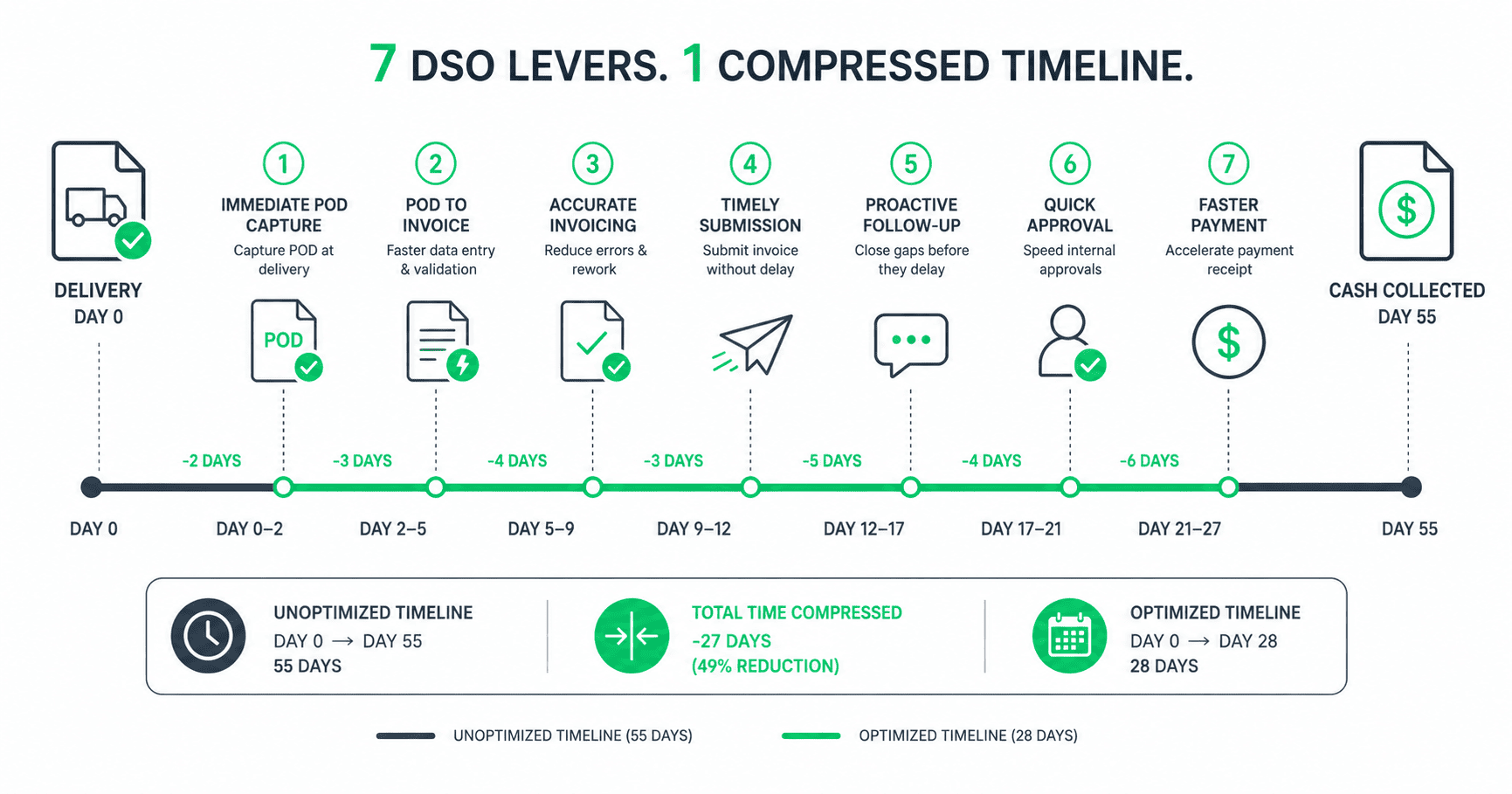
Days Sales Outstanding measures one thing: how long it takes from delivery to cash in the bank. For freight brokerages, that number carries more weight than in most industries, because brokers pay carriers on short terms (often Net 15 or Net 30) while collecting from shippers on longer cycles (Net 30 to Net 45, sometimes Net 60).
That gap between paying out and collecting is the cash conversion squeeze that defines freight brokerage finance. And DSO is the metric that tells you how wide that gap really is.
DSO varies widely across B2B industries. For freight brokerages specifically, the range typically falls between 45 and 65 days depending on customer mix, billing speed, and collection practices. A common rule of thumb is that a DSO more than 50% above standard payment terms warrants serious investigation. If your terms are Net 30 and your DSO is sitting at 52, that 22-day gap is where your working capital is trapped.
This post breaks down the seven operational levers that actually move DSO in a freight brokerage (ranked by effort and impact) and explains the mechanics behind each one.
How Does the DSO Timeline Work in Freight Brokerage?
Before getting into the levers, it helps to understand the DSO timeline specific to freight brokerage. Every load follows the same financial lifecycle:
Day 0: Load delivers. The clock starts.
Day 0-3: POD retrieval. The billing team can’t invoice without proof of delivery. If the POD takes three days to retrieve, the invoice is already three days late before anyone touches it.
Day 3-5: Invoice preparation. The billing team pulls the load file, verifies rates, attaches documentation, and prepares the shipper invoice. If they’re running a day or two behind because of volume, add that to the timeline.
Day 5-7: Invoice submission. The invoice goes to the shipper via email, customer portal, or EDI. Portal and EDI submissions sometimes require specific formats, PO numbers, or documentation that adds another round of back-and-forth if anything is missing.
Day 7-37: Payment terms. If the shipper’s terms are Net 30, the 30-day clock starts when they receive a clean, undisputed invoice. Not when the load delivered. Not when the POD came in. When the invoice lands in their system without errors.
Day 37+: Collection. If the shipper doesn’t pay on time, the accounts receivable (AR) team follows up. The speed and consistency of that follow-up determines whether DSO settles at 42 days or drifts to 58.
Every lever below targets a specific segment of this timeline. Some compress the front end (delivery to invoice). Some tighten the middle (invoice quality). Some accelerate the back end (collections). The brokerages with the lowest DSO work all three segments.
What Are the Seven Levers That Reduce Freight DSO?
Not every lever requires the same effort, and the DSO impact varies. Here are all seven, ranked by the order that produces the fastest results.
How Does Faster POD Retrieval Reduce DSO?
Where it hits the timeline: Day 0-3. Effort: Medium. DSO impact: 2-3 days.
POD retrieval is the single biggest gate in the freight billing cycle. The invoice can’t go out without it. If the average POD takes three to five days to retrieve, the billing cycle doesn’t even start until Day 3 to 5, and that’s before anyone opens the load file.
The mechanics of fast POD retrieval are straightforward but require discipline: automated carrier outreach triggered by delivery confirmation in the TMS, escalation tiers at 8 hours, 12 hours, and 24 hours for non-responsive carriers, a named owner responsible for the retrieval queue (not spread across the billing team as a side task), and OCR processing on POD attachments so data extraction doesn’t wait for manual review.
Moving POD turnaround from a 3-day average to under 24 hours typically compresses DSO by 2 to 3 days on its own, without changing anything else in the billing or collections process. That alone is often worth more than any single downstream improvement.
The key insight: POD retrieval is a volume function, not a judgment function. It doesn’t require the same expertise as invoice preparation or dispute resolution. It requires consistent, systematic follow-up across hundreds or thousands of loads per week. This is one of the functions that scales well with dedicated capacity, whether that’s an in-house specialist or a dedicated external team.
Why Does Same-Day Invoicing After POD Matter for DSO?
Where it hits the timeline: Day 3-5. Effort: Low. DSO impact: 2-5 days, depending on how long invoices queue today.
Once the POD is in the system, how fast does the invoice go out? Research from Credit Pulse indicates that invoicing within 24 hours of delivery reduces DSO by 5 to 8 days compared to brokerages that batch invoices weekly or let them queue up. Weekly batching is the worst case: where invoices queue for a few days rather than a week, expect the 2-5 days above.
The goal: every load invoiced the same business day the POD arrives. POD in by 3pm, invoice out by 5pm.
What slows this down in practice isn’t usually the invoice itself. It’s the queue. If the billing team is processing yesterday’s PODs while today’s are coming in, and also handling dispute responses and customer portal resubmissions, the fresh invoices sit until there’s bandwidth. Same-day invoicing requires either enough capacity to process the daily volume without a backlog, or a workflow that separates new invoice prep from rework and dispute handling.
Batching invoices (saving them up for a weekly or bi-weekly billing run) is one of the most common DSO inflators in freight. It feels efficient because the billing team processes in bulk. But every day an invoice sits waiting for the next batch run is a day added to DSO that the brokerage never recovers.
How Do Pre-Billing Error Checks Prevent DSO Inflation?
Where it hits the timeline: Day 5-7 (and prevents Day 37+ disputes). Effort: Low. DSO impact: 7-14 days on each dispute it prevents; the portfolio-wide effect depends on your dispute rate.
Every disputed invoice resets the DSO clock on that load. A shipper who receives an invoice with a rate mismatch, a missing accessorial, or an incorrect PO number doesn’t pay and call later. They reject it and send it back. The billing team then has to research the issue, correct the invoice, and resubmit. That cycle adds 7 to 14 days per disputed load, and during that time, the payment terms haven’t even started.
Error rates compound through volume, not through longer disputes. A higher invoice error rate raises the share of invoices that get disputed, and each of those adds 7 to 14 days. At a 10% error rate, twice as many invoices are stuck in that cycle as at 5%.
A pre-billing review step (a second set of eyes on every invoice before it goes to the shipper) is designed to catch these before they create disputes. The review confirms the rate matches the rate confirmation, all accessorials (detention, layover, TONU, lumper) are captured correctly, documentation is complete and attached, the billing format follows the customer’s specific requirements (PO numbers, reference numbers, submission method), and there are no duplicate entries or transposed load numbers.
This is the single operational step that separates mid-tier billing from top-tier billing. It costs minutes per load. It saves days of DSO per disputed invoice, and prevents the credibility damage that makes the next invoice harder to collect too.
Why Do Customer Billing Profiles Reduce Payment Delays?
Where it hits the timeline: Day 5-7. Effort: Medium. DSO impact: 2-4 days.
Shippers change their billing systems more often than you’d expect. A customer that accepted emailed PDF invoices last year may have moved to Coupa, Ariba, or a custom portal. Some require EDI 210 transmissions. Some need separate PODs per load. Some want consolidated statements, and the invoice sits in limbo unless it’s formatted to their current specification.
The fix is building and maintaining a billing profile for every active customer that documents submission method (email, portal, EDI), required documentation (which attachments, which formats), reference number conventions (PO, PRO, BOL: which one goes where), cutoff dates for monthly billing runs (miss the cutoff and the invoice sits until next month’s cycle), and the named contact for invoice questions or disputes.
This information changes. Shippers update portal requirements, change accounts payable (AP) contacts, and shift cutoff dates. A quarterly review of each customer’s billing profile catches these changes before they cause rejected invoices.
The brokerages that maintain current billing profiles avoid the most common source of “clean” invoices that still don’t get paid on time: the invoice was correct, but it was submitted to the wrong place, in the wrong format, or past the customer’s processing deadline.
How Does Weekly AR Review Improve Collections?
Where it hits the timeline: Day 37+. Effort: Medium. DSO impact: 5-7 days.
Most brokerages generate an aging report monthly. By the time a 60-day invoice shows up on a monthly report, it’s already been missed for three or four natural follow-up windows. Cash that was collectable at Day 35 becomes a write-off risk at Day 65.
Weekly aging reviews do the heavy lifting. Every week, the AR function pulls aging by bucket (0-30, 31-60, 61-90, 90+). Every bucket has a defined collection action: first reminder, phone call, escalation, dispute review. Every aging invoice has a named owner for follow-up. Every weekly review has a documented outcome before the next week’s review.
In our experience, first contact within 48 hours of a missed payment collects far more often than a first call made two weeks late. The shift from monthly to weekly reviews typically pulls DSO down 5 to 7 days within 60 days of implementation, not through more aggressive collection tactics but through more consistent ones.
How Does Faster Dispute Resolution Lower DSO?
Where it hits the timeline: Day 37+ (prevents 60-90+ day aging). Effort: Medium. DSO impact: 3-6 days.
A disputed invoice is worse than an unpaid invoice. An unpaid invoice is money owed. A disputed invoice is money owed with a reason the shipper believes they don’t have to pay, and every day it sits unresolved reinforces that belief.
The speed of resolution matters more than the method. A dispute process that works has these characteristics: every dispute acknowledged within 24 hours (even if the resolution takes longer), a named owner with authority to resolve (not just flag), a documented response within 72 hours (credit memo, corrected invoice, supporting documentation), and a weekly review that tracks every dispute from open to resolved.
Most freight brokerages don’t have a formal dispute process. Disputes get handled by whoever has time, which means they sit until someone is free. The result isn’t just slower resolution; it’s inconsistent resolution. The same type of dispute gets handled differently depending on who picks it up and when.
Building a defined dispute workflow (with ownership, timelines, and documentation standards) compresses the resolution cycle from weeks to days. The DSO impact shows up directly in the 31-60 and 61-90 day aging buckets.
When Should Freight Brokers Renegotiate Payment Terms?
Where it hits the timeline: Structural (changes the baseline). Effort: High. DSO impact: 5-10+ days (long-term).
This is the structural lever. Your printed terms might say Net 30, but effective DSO tells you what your customers actually pay. If DSO is 52 days on Net 30 terms, the shippers are functionally operating on Net 52, regardless of what the contract says.
A real DSO reduction program eventually requires a commercial conversation:
Segment customers by payment behavior. Some pay early, some pay on time, and some pay chronically late. The approach for each group is different. Early and on-time payers get maintained: the relationship is working. Late payers get investigated: is the issue their AP process, a billing format problem on your end, or a deliberate cash management strategy on theirs?
Confirm late payment is operational, not financial. If a shipper is consistently 15 days late and the issue is that their AP department processes invoices bi-weekly, that’s a workflow problem that might be solved by submitting invoices on their cycle. If the shipper is late because they’re using your money as float, that’s a different conversation.
Renegotiate terms to reflect reality. For chronically late payers where the issue isn’t fixable, consider whether the pricing reflects the actual payment timeline. Net 30 pricing with Net 52 payment behavior means the broker is providing 22 days of free financing. Early-payment discounts (2/10 Net 30) can accelerate collection on high-volume accounts where the discount is worth the cash flow improvement.
This lever is the hardest because it requires commercial negotiation, not operational improvement. But it also caps the other six levers. Once your operations are tight, DSO is bounded by whatever your customers are willing to pay. Levers 1 through 6 bring DSO down to the operational floor. Lever 7 lowers the floor itself.
In What Order Should Freight Brokers Tackle DSO Levers?
Work them in the order above: POD retrieval, same-day invoicing, pre-billing error checks, customer billing profiles, then weekly AR review, because each early step removes a delay the later ones can’t fix. Freight brokerages that execute Levers 1 through 5 consistently tend to bring DSO from the mid-50s toward the mid-40s within 90 days. Levers 6 and 7 are the difference between good and great, but the first five are where the operational improvement happens.
How Much Working Capital Does DSO Improvement Free Up?
DSO isn’t an abstract metric. It translates directly to cash. Here’s what the math looks like for a mid-size freight brokerage:
A broker doing 3,000 loads per month with an average invoice of $1,000 generates $3 million in monthly revenue. At DSO 55, that broker has approximately $5.4 million sitting in accounts receivable at any given time. Drop DSO to 40, and AR drops to approximately $3.9 million. That’s $1.5 million in working capital freed up: cash that was already earned, already invoiced, just sitting in the receivables pipeline longer than it needed to.
That freed-up capital reduces reliance on credit lines, factoring, or other short-term financing. For brokerages using factoring (which typically costs 1.5 to 3.5% of invoice value), improving DSO enough to reduce factoring volume translates directly to margin improvement.
If you are pricing financing options while you work the DSO number down, the quick pay vs factoring calculator shows what each one costs on an annualized basis.
Why Do DSO Reduction Efforts Break Down at Scale?
None of these seven levers is technically hard. They all break down at the same operational edge: the place where volume outpaces capacity.
Scale is also where the model question arrives. A brokerage running a few hundred loads a month can hold these levers together on discipline alone. Past that, each lever needs somebody whose whole job it is, which is the argument for back-office operations built for freight brokers.
A billing team processing 1,500 invoices a month can probably maintain same-day invoicing, review every invoice before submission, and run weekly aging reports. The same team at 3,000 invoices starts slipping. The weekly review gets skipped because something urgent came up, the pre-billing check becomes a spot-check instead of a full review, and POD retrieval falls to whoever has bandwidth rather than a dedicated function.
That’s the real problem. DSO reduction is an operational capacity problem disguised as a finance problem. The levers are known. The discipline to execute them consistently at scale is what separates brokerages that run DSO in the 30s from those stuck in the 50s.
The choice is straightforward: either build enough internal capacity to execute all seven levers consistently at your current (and growing) load volume, or bring in dedicated teams that specialize in these exact workflows and can absorb the volume without the capacity constraints. Either path works. The path that doesn’t work is knowing the levers and not having the capacity to pull them.
ClearLane provides specialized back-office operations for U.S. freight brokers, including POD retrieval, carrier invoice verification, pre-billing revenue recovery audits, shipper billing, and AR management. Dedicated teams trained in freight workflows, TMS navigation, and billing documentation.
Want to see where your DSO stands relative to the industry? Calculate your DSO benchmark or download the pre-billing audit checklist to start closing the gap between dispatch and billing.
Or talk to our team to walk through your billing and AR workflow with someone who’s built these processes for freight brokerages running 1,000 to 8,000 loads a month.
Questions? Email us at info@getclearlane.com.
Frequently Asked Questions
Days Sales Outstanding measures how long it takes from load delivery to cash collection. For freight brokerages, DSO typically ranges from 45-65 days. Each day of DSO represents working capital trapped in the receivables pipeline.
Industry benchmarks run 45-65 days. Brokerages that execute the first five operational levers consistently tend to bring DSO from the mid-50s toward the mid-40s within 90 days.
The three fastest levers are POD turnaround under 24 hours (2-3 day DSO impact), same-day invoicing after POD receipt (2-5 days), and pre-billing error checks that prevent disputes (7-14 days saved on each dispute prevented). These are low-to-medium effort with immediate results.
For a broker doing 3,000 loads per month at $1,000 average invoice, dropping DSO from 55 to 40 frees approximately $1.5 million in working capital: cash that was already earned and invoiced, just sitting in receivables longer than necessary.
Because DSO reduction is an operational capacity problem disguised as a finance problem. The levers are known, but executing them consistently at scale requires either enough internal capacity or dedicated external teams. Volume outpacing capacity is where every lever breaks down.
POD retrieval is the single biggest gate in the billing cycle. The invoice can’t go out without it. Moving POD turnaround from a 3-day average to under 24 hours typically compresses DSO by 2-3 days on its own, without changing anything else.
The most effective levers are operational, not financial: retrieve PODs faster, invoice the same day the POD lands, run a pre-billing error check so invoices aren’t rejected, build customer billing profiles to prevent disputes, and follow a consistent AR review cadence. Tackle them in that order. The early steps remove delays that the later ones can’t fix.
Keep going: how to read an AR aging report and how one broker moved DSO from 58 to 41 days. The service behind it is accounts receivable outsourcing and collections.