
How Freight Back-Office Operations Scale: Bottlenecks, Costs, and the Three Approaches That Work
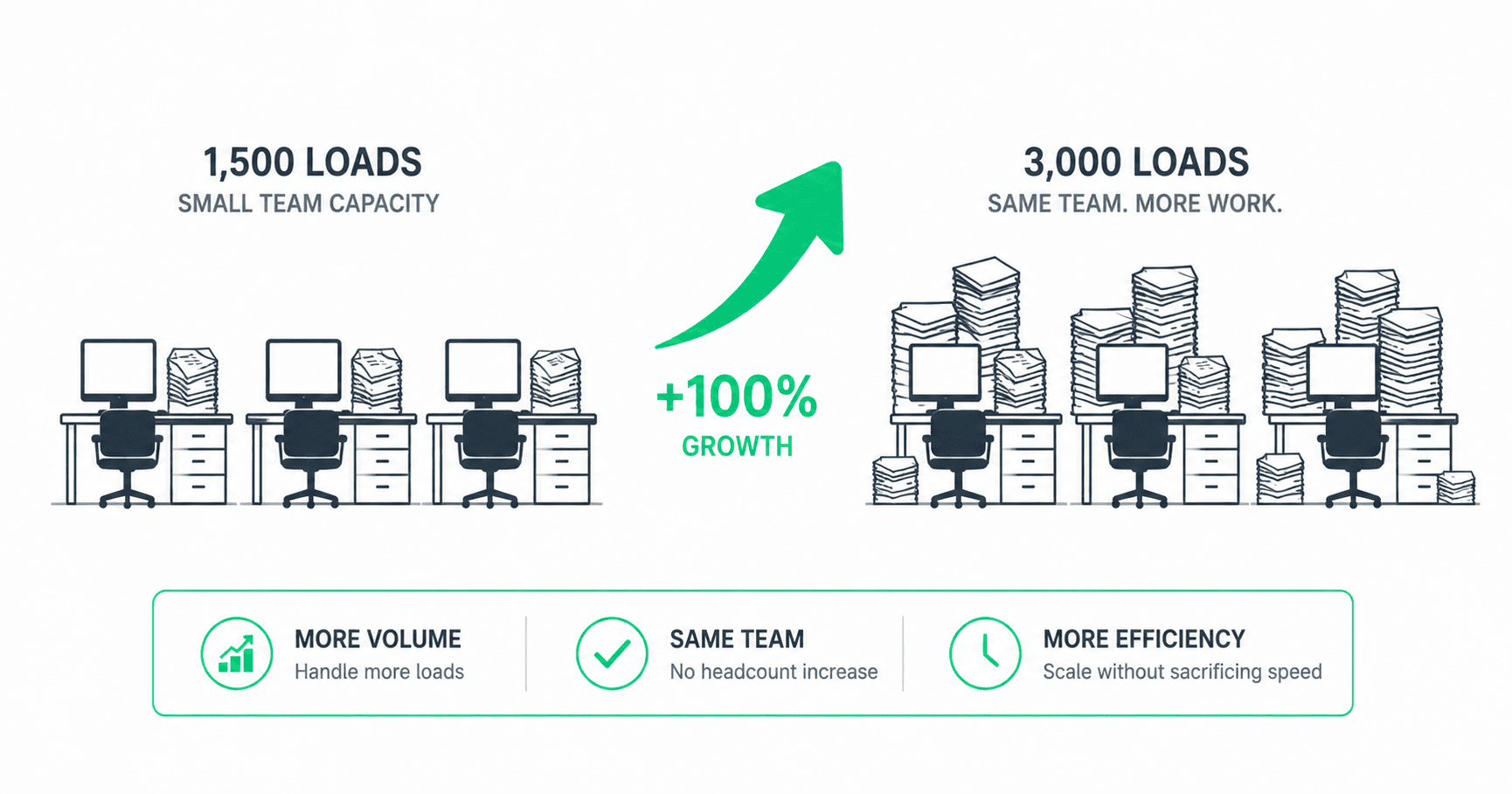
A freight brokerage at 1,500 loads a month typically runs with two or three people handling everything after dispatch: POD retrieval, carrier invoice verification, shipper billing, accounts receivable (AR) follow-up, compliance checks, and whatever else lands on their desk.
Then the brokerage grows to 3,000 loads a month. The load count doubled. The back-office team didn’t.
This is the scaling wall that mid-size freight brokers hit, usually somewhere between $15M and $40M in annual revenue. The front office is adding sales reps, dispatch capacity, and carrier relationships. The back office is held together by the same people who were there at half the volume, working longer hours and falling further behind.
This post walks through how freight back-office operations actually scale, where the bottlenecks form, and what the math looks like when you compare the common approaches to solving them.
Why Isn’t the Back-Office Bottleneck About Effort?
The people running back-office operations at a growing brokerage aren’t underperforming. They’re overloaded. There’s a difference.
At 1,500 loads per month, a three-person back-office team is carrying roughly 500 loads per person, each one touched several times: POD chase, carrier invoice check, shipper invoice prep, AR follow-up. That’s manageable. People know the customers, know the carriers, know where to look when something doesn’t match.
At 3,000 loads per month, those same three people are now processing double the volume. The work doesn’t just increase linearly. It compounds. More loads mean more exceptions, more carrier disputes, more missing PODs, more accessorial documentation to track down, more shipper invoices to prepare, more aging invoices to follow up on.
What happens next is predictable: the team triages. They prioritize high-dollar loads and let smaller ones sit. POD retrieval slips from 24 hours to 72 hours. Billing cycles stretch. DSO creeps up a few days each quarter. AR aging buckets that used to stay clean start showing 60- and 90-day balances.
None of this shows up as a single catastrophic event. It’s a slow degradation that only becomes visible when the cash flow tightens or a customer escalates a billing dispute that’s been sitting in someone’s inbox for three weeks.
What Does Optimization Actually Mean in Freight Back-Office Operations?
The word “optimization” gets thrown around a lot. In freight back-office operations, it comes down to three measurable things:
Cycle time. How many hours or days between delivery confirmation and the shipper invoice going out? Every day in that gap is a day added to DSO. The benchmark for a well-run freight billing operation is invoicing within 24 to 48 hours of delivery. Many growing brokerages run closer to 72 to 96 hours, not because the process is slow but because the team doesn’t get to it fast enough.
Accuracy rate. What percentage of invoices go out correct the first time: right rate, right accessorials, right documentation attached? Invoice disputes are expensive not just in the revenue at risk, but in the time they consume. Every dispute that comes back is a load the billing team has to touch a second or third time, pulling capacity away from processing new invoices.
Capture rate. What percentage of earned revenue actually makes it onto the invoice? This is the pre-billing audit question: whether detention, lumper fees, TONU, layover, and contract rate differences are being caught before the invoice goes out.
Optimization is improving all three simultaneously. And at scale, that requires either more people, better workflows, or both.
What Are the Three Approaches to Scaling Freight Back-Office Operations?
When a brokerage hits the back-office wall, there are essentially three paths. Each has real tradeoffs worth understanding.
Approach 1: Hire More In-House Staff
This is the most common first instinct. The team is overwhelmed, so you hire more people.
The math on in-house back-office hiring for freight brokerages looks something like this: a billing specialist or AR coordinator in most U.S. markets runs $45,000 to $65,000 in base salary. Add benefits, payroll taxes, workers’ comp, and overhead, and the fully loaded cost is typically $75,000 to $95,000 per person annually.
That’s the direct cost. The indirect costs are harder to quantify but equally real.
Recruiting time. Finding someone who knows freight terminology, understands TMS workflows, and can handle the volume takes 4 to 8 weeks in most markets. Freight back-office experience is a niche skill set. You’re not hiring a generalist accounts payable (AP) clerk. You’re hiring someone who knows what a BOL is, can navigate McLeod or TMW, and understands why a rate confirmation matters.
Training ramp. Even an experienced hire needs 30 to 60 days to learn your specific TMS setup, your customer billing requirements, your carrier payment workflows, and your internal naming conventions. During that ramp period, you’re paying full salary for partial output.
Management overhead. Each new hire adds coordination work: reviewing their output, answering questions, handling their time off and turnover. For a brokerage owner or operations manager who’s already stretched thin, adding direct reports to manage can create as many problems as it solves.
Turnover risk. Back-office positions in freight have significant turnover. The work is repetitive and detail-intensive. When someone leaves, you’re back to the recruiting and training cycle, plus the coverage gap in between.
The advantage of in-house hiring is direct control. Your people, in your systems, working your way. For brokerages that value tight cultural integration and hands-on management, this matters.
Approach 2: Build Better Processes and Tools
Some brokerages try to solve the scaling problem through process improvement and technology: TMS automation rules, OCR for document processing, automated billing triggers, carrier compliance monitoring dashboards.
This approach can absolutely improve efficiency. Automated carrier invoice matching, for example, can reduce the time spent on straightforward AP verification by 30 to 50%. Document management systems can reduce the time spent chasing PODs by organizing retrieval workflows and escalation rules.
But process improvement has limits at scale:
Exceptions still require humans. Freight is an exception-heavy business. Rate confirmation discrepancies, accessorial disputes, missing documentation, detention time verification. All of these require someone who understands the context to make a judgment call. Automation handles the routine; humans handle the exceptions. As load volume grows, the total number of exceptions grows with it.
Technology requires setup and maintenance. TMS automation rules need to be built, tested, and maintained. Every time a customer changes their billing requirements or a carrier starts invoicing differently, the rules need updating. Someone has to own this.
Process improvement doesn’t create capacity. Better processes make existing capacity more efficient, but they don’t add capacity. If your three-person team is at 120% utilization, making them 20% more efficient brings them back to 100%, which is still no headroom for growth.
Process improvement is essential, but it’s a multiplier on existing capacity, not a substitute for it.
Approach 3: Outsource Specialized Functions
The third approach is bringing in dedicated teams to handle specific back-office functions: POD retrieval, carrier invoice verification, shipper billing prep, AR follow-up, carrier compliance monitoring, or all of the above.
Outsourcing in freight back-office operations, or logistics business process outsourcing, works differently than outsourcing in generalist settings. The workflow is standardized enough (every load follows the same lifecycle: book → dispatch → deliver → document → bill → collect) that specialized teams can execute consistently across brokerages. But freight-specific knowledge is non-negotiable. A team that doesn’t know the difference between a BOL and a POD, or can’t navigate the difference between a detention charge and a layover charge, will create more problems than they solve.
The economics of specialized outsourcing typically run below fully loaded in-house costs for equivalent capacity. That’s not because the work is done less carefully. It’s because dedicated operations teams can achieve utilization rates that a small in-house team can’t. A three-person in-house billing team has to cover vacations, sick days, and turnover gaps. A dedicated outsourced operation absorbs those through team depth.
The operational advantages center on two things: immediate capacity (no 4-to-8-week recruiting cycle, no 30-to-60-day training ramp) and scalability (adding capacity for volume spikes without permanent headcount). For brokerages in growth mode (adding lanes, signing new customers, onboarding carriers), the ability to scale back-office capacity in weeks rather than months can be the difference between supporting growth and choking on it.
The risks of outsourcing are real and worth naming. Loss of direct oversight. Dependency on a third party for mission-critical workflows. Communication overhead. Data security considerations. These are legitimate concerns, and any broker evaluating outsourcing should weigh them against the status quo, which, for a team that’s already underwater, has its own set of risks.
What Back-Office Model Do Most Growing Brokerages End Up Building?
In practice, most mid-size brokerages that successfully scale their back-office operations end up with some combination of all three approaches.
The pattern usually looks like this: an in-house operations manager or controller who owns the workflow and manages quality, process improvements and TMS automation that handle the routine volume, and specialized external teams that provide the capacity to handle the workload at scale.
The in-house leadership provides the freight knowledge, customer relationship management, and strategic oversight. The process and technology layer handles the repeatable work. The external capacity handles the volume.
This hybrid model lets the brokerage grow from 2,000 to 5,000 loads per month without a proportional increase in in-house headcount, and without the quality degradation that comes from an overwhelmed team trying to do everything.
The pattern repeats often enough to be worth treating as a model rather than a workaround. What it looks like in practice is laid out in back-office operations for freight brokers.
What Metrics Tell You Whether Your Back Office Is Keeping Up?
If you’re running a freight brokerage between $10M and $80M in revenue and wondering whether your back office is keeping up with your growth, here are the metrics worth tracking:
Invoice cycle time. Measure delivery-to-invoice in hours. If you’re consistently above 48 hours, you have either a POD retrieval bottleneck or a billing team capacity issue, possibly both. Track this monthly and watch the trend.
DSO trend line. A single DSO snapshot isn’t as useful as the trend over 6 to 12 months. If DSO is creeping up by 2 to 3 days per quarter, that’s a back-office capacity signal. Industry benchmarks for freight broker DSO run 45 to 65 days, but the trend matters more than the number.
Back-office cost per load. Divide your total back-office labor cost by monthly load count. This gives you a unit economics baseline. As load volume grows, this number should decrease (economies of scale) or hold steady (maintaining capacity). If it’s increasing, your cost structure is scaling faster than your load count, which is the opposite of what growth should look like.
Exception rate. What percentage of loads require manual intervention beyond the standard workflow? Carrier invoice discrepancies, missing PODs past 48 hours, billing disputes, compliance flags. If your exception rate is above 15 to 20%, that’s where your team’s time is going, and it’s the clearest indicator of where process improvement or additional capacity would have the most impact.
Team utilization. This one is qualitative. Are your back-office people consistently working overtime? Are they triaging instead of processing? Are lower-priority tasks (compliance monitoring, aging AR follow-up, carrier onboarding verification) getting deferred? If yes, you’re running at or above capacity, and growth will make it worse.
These metrics also travel upward. Owners who are no longer in daily operations, and boards reviewing performance quarterly, need the same numbers packaged for a different audience, which is what owner and board reporting covers.
How Should Freight Companies Start Improving Back-Office Operations?
Freight back-office operations don’t have to scale linearly with load count. The brokerages that grow efficiently figure out which work requires in-house expertise, which work benefits from process automation, and which work is better handled by dedicated specialist teams.
The question isn’t whether your back office needs to change as you grow. It’s whether you change it proactively or wait until DSO, billing errors, or AR aging force the conversation.
If you’re running a freight brokerage between 1,000 and 8,000 loads a month and thinking about how your back-office operations need to evolve, these two starting points will give you the clearest picture:
Measure your invoice cycle time for the next 30 days. Track delivery-to-invoice on every load. The number will tell you whether you have a capacity problem, a process problem, or both.
Calculate your back-office cost per load. Total back-office labor cost divided by monthly load count. Compare it to where you were 6 months ago. The trend tells the story.
ClearLane provides specialized back-office operations for U.S. freight brokers, including POD retrieval, carrier invoice verification, pre-billing revenue recovery audits, shipper billing, carrier compliance monitoring, and AR management. Dedicated teams trained in freight workflows, TMS navigation, and billing documentation.
Want to see how your back-office operation compares? Calculate your DSO benchmark or talk to our team to walk through your current workflows with someone who knows freight billing inside and out.
Questions? Email us at info@getclearlane.com
Frequently Asked Questions
Curious what handing this off would cost? ClearLane’s scoped, managed-service pricing scales with your operation.
Freight back-office workload doesn’t scale linearly with load count. It compounds. More loads mean more exceptions, more carrier disputes, more missing PODs, and more invoices to prepare. A team that was appropriately sized at 1,500 loads per month is typically about 50% short at 3,000 loads, before the extra exception volume is counted.
Hire more in-house staff (direct control but high cost and slow ramp), build better processes and tools (improves efficiency but doesn’t create capacity), or outsource specialized functions (immediate capacity at lower cost but requires managing a third-party relationship). Most successful brokerages use a hybrid of all three.
A billing specialist or AR coordinator costs $45,000-$65,000 in base salary. Add benefits, payroll taxes, workers’ comp, recruiting, training, and overhead, and the fully loaded cost is typically $75,000-$95,000 per person annually.
Specialized outsourcing typically comes in below fully loaded in-house cost for equivalent capacity, because the in-house number carries recruiting, training, turnover, and coverage gaps. The right comparison is your fully loaded cost, not base salaries.
Invoice cycle time (delivery-to-invoice in hours), DSO trend line (over 6-12 months), back-office cost per load, exception rate (percentage of loads requiring manual intervention), and team utilization (overtime, triage patterns, deferred work).
For the AP side specifically, the free freight invoice audit checklist turns the audit step into a standard any hire can follow.