
POD Chase Best Practices: Getting Proof of Delivery in Under 24 Hours
Why Is POD Retrieval the Most Important Step in Freight Billing?
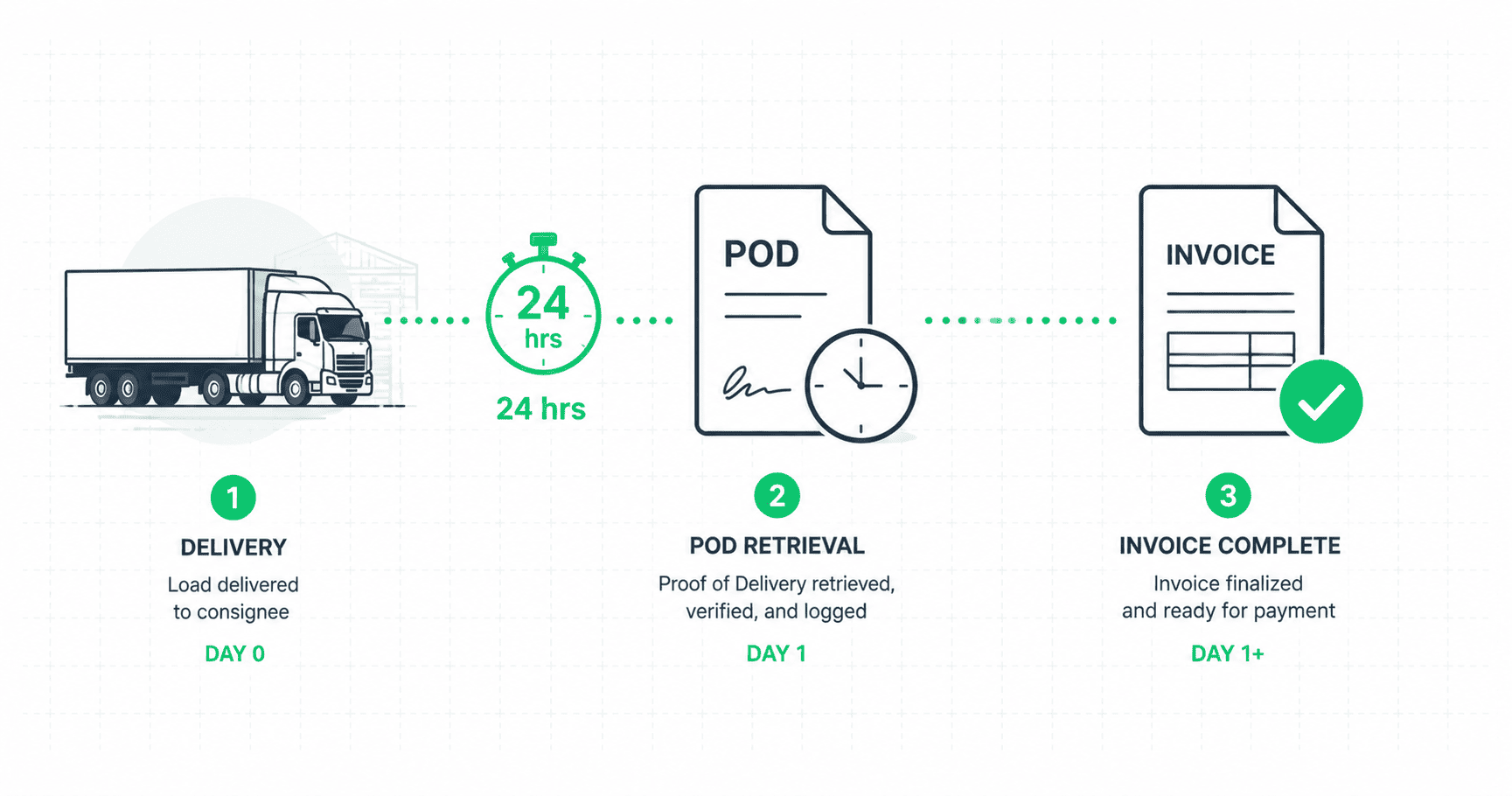
In freight back-office operations, proof of delivery is the document that starts everything. Until the POD is in hand, the shipper invoice can’t go out. Until the invoice goes out, the payment clock doesn’t start. Until the payment clock starts, the cash sits with the customer instead of in the broker’s account.
This makes POD retrieval the single most time-sensitive task in the post-dispatch pipeline. And yet, at most growing freight brokerages, it’s also one of the most inconsistent.
The benchmark for a well-run operation is POD retrieval within 24 hours of delivery confirmation. Many mid-size brokerages (especially those in growth mode) run closer to 48 to 72 hours on average, with some loads stretching past a week. That delay doesn’t just affect one invoice. It pushes back the entire billing cycle and adds directly to DSO.
At a brokerage doing $4 million in monthly billings, each day of billing delay represents roughly $130,000 in receivables that are outstanding longer than they need to be. Over the course of a year, a consistent 48-hour POD delay versus a 24-hour turnaround ties up meaningful working capital: money that could be covering carrier payments, funding growth, or reducing factoring dependency.
Why Does POD Retrieval Get Harder as Freight Companies Scale?
At 500 loads a month, POD retrieval is manageable. The team knows the carriers. They know which ones email PODs automatically, which ones post to a portal, and which ones need a phone call. The volume is low enough that each load gets individual attention.
At 2,000 to 4,000 loads a month, the dynamics change. The carrier mix is broader. There are more portals to check, more email threads to monitor, more phone calls to make, and more loads competing for the same team’s time. The people doing POD retrieval are almost always the same people doing billing, accounts receivable (AR) follow-up, and carrier compliance work.
What happens is predictable. The team starts triaging. High-value loads get chased first. Loads with responsive carriers get their PODs quickly. Loads with carriers who are slow to upload documents (the ones that actually need the most follow-up) get pushed to the bottom of the list. A day goes by, then two, then five. The POD eventually arrives, but by then the billing delay has already happened.
The issue isn’t effort or skill. It’s capacity. POD retrieval at scale is a volume game, and most back-office teams don’t have the headcount to chase every load every day.
What Does a 24-Hour POD Retrieval Process Look Like?
Getting POD turnaround consistently under 24 hours requires a defined process with clear escalation steps. The structure matters more than the tools. Here’s what the workflow looks like when it’s built to handle volume.
The clock starts at delivery confirmation. The moment a load shows as delivered in the TMS (whether that’s a status update from the carrier, a GPS confirmation, or a driver check call), the POD chase begins. Not the next morning. Not when someone gets around to it. Immediately, or as close to immediately as the team’s workflow allows.
The first step is checking the carrier’s document portal or email. Many carriers (especially larger ones) upload PODs to their portal or send them via automated email within a few hours of delivery. A well-organized team checks these sources first, because a significant percentage of PODs are already available and just need to be downloaded, verified, and uploaded to the TMS.
If the POD isn’t available within the first four to six hours, the first outreach goes to the carrier. This is usually an email or a message through the carrier’s communication channel. The request is simple: load number, delivery date, request for signed POD. Nothing complicated, but it needs to go out same-day.
If there’s no response within 12 to 16 hours, the follow-up escalates. A phone call or a second email, referencing the original request. This is where the time gets lost, not because the first request didn’t go out, but because nobody followed up when it went unanswered.
At 24 hours without a POD, the escalation moves up. The carrier’s dispatcher or operations contact gets a direct call. If the brokerage has a carrier relationship manager, they get looped in. The tone isn’t adversarial. It’s operational. The load delivered, the documentation is needed, and there’s a billing timeline to meet.
Beyond 24 hours, the load gets flagged as an exception. It stays on a daily follow-up list until the POD is retrieved. Exception loads get reported, not just chased, so that patterns become visible. If the same carrier consistently delivers late PODs, that data feeds into carrier performance evaluation and future lane decisions.
The Verification Step Most Teams Skip
Retrieving the POD is only half the task. The other half is verifying it.
A POD that’s retrieved but not verified can cause as many problems downstream as a POD that’s late. The verification checks are straightforward but they need to happen before the document gets uploaded to the TMS and passed to billing.
Does the POD match the load number on the BOL and rate confirmation? Are the delivery date and time consistent with what’s in the TMS? Is there a legible signature from the receiving party? Is the document complete (not a partial scan, not a blurry photo, not a different load’s paperwork)? These same documents are also critical for carrier invoice verification on the accounts payable (AP) side. A bad POD creates problems in both directions.
These checks take 30 to 60 seconds per document when done consistently. But at volume, with the team rushing to clear the POD queue, they get skipped. A bad POD gets uploaded, billing prepares the invoice, and the shipper rejects it because the documentation doesn’t match. Now you have a billing dispute that adds roughly 12 days to the payment cycle (often more), all because verification was skipped to save a minute.
How Do Carrier Communication Patterns Affect POD Retrieval Speed?
One of the biggest variables in POD retrieval speed is carrier responsiveness, and that varies wildly.
Carriers sit on the other side of this exchange with the same problem in reverse: documents to collect from drivers before their own invoices can go out (see back-office operations for trucking companies).
Large national carriers tend to have automated POD processes. Documents show up in portals within hours of delivery. The retrieval is more of a download-and-verify task than a chase.
Mid-size regional carriers are inconsistent. Some have portals, some don’t. Some email PODs proactively, some wait to be asked. Response times to requests range from hours to days depending on the carrier’s own back-office capacity.
Owner-operators and small fleets are the most variable. Some are excellent: they take a photo of the signed POD at the receiver and text it to dispatch before they pull out of the lot. Others don’t respond to requests for days because they’re driving and don’t have someone handling paperwork while they’re on the road.
The point is that a POD retrieval process can’t treat all carriers the same. The workflow needs to account for these differences, routing high-response carriers through the quick-check process and routing slow-response carriers through a more aggressive follow-up cadence from the start. Waiting 24 hours to escalate on a carrier who historically takes three days to respond is a built-in delay.
Tracking carrier response times over a few months of data gives the team a baseline. Which carriers consistently deliver PODs within four hours? Which ones always need a follow-up call? Which ones require escalation to their operations manager before anything moves? This data turns POD retrieval from a reactive chase into a structured process where escalation timing is matched to carrier behavior.
How Do POD Delays Affect DSO and Cash Flow?
The impact of slow POD retrieval extends well beyond the individual load. It creates a cascade through the billing pipeline that affects DSO, AR aging, and staff capacity.
Billing can’t start until the POD is in hand. If the average POD takes 72 hours instead of 24, every invoice in the pipeline is delayed by two days. Across 3,000 loads per month, that’s 3,000 invoices going out two days later than they should. At an average invoice value of $1,000, that’s $3 million in billings hitting the clock 48 hours late, every month.
The delay also compresses the billing team’s work. When PODs arrive in waves (because follow-up happens in batches rather than continuously), the billing team gets hit with spikes. They process as many as they can, the rest wait until tomorrow, and the delay compounds further.
And when invoices go out late, AR follow-up shifts later too. The 30-day payment terms start 48 hours later, which means the payment arrives 48 hours later, which means the AR team is chasing invoices that wouldn’t have been overdue if the POD had arrived on time.
This is why POD retrieval has an outsized impact on overall cash flow. It’s not just one step in the process. It’s the step that sets the pace for everything that follows.
Building the Process vs. Doing the Work
Most freight companies understand what good POD retrieval looks like. The hard part is execution at scale.
Building the process means defining the escalation cadence, setting up carrier communication templates, creating exception tracking, and establishing verification standards. This is the design work, and it’s usually a one-time investment.
Doing the work (the daily volume of checking portals, sending requests, making follow-up calls, verifying documents, uploading to the TMS, and chasing exceptions) is where the capacity bottleneck lives. And it’s the reason growing brokerages either need to add headcount specifically for POD retrieval or bring in a dedicated team to handle it.
The volume is what makes this function a natural fit for specialization. POD retrieval follows a consistent workflow on every load. The steps are the same. The escalation cadence is the same. The verification checks are the same. What changes is the carrier and the specific communication required, but the process framework is repeatable across thousands of loads.
A dedicated POD team (whether in-house or outsourced) can achieve retrieval rates that a shared back-office team can’t, simply because they’re not splitting their time between POD chasing and five other functions.
Metrics Worth Tracking
If you’re evaluating your POD retrieval process, these are the numbers that tell the story.
Average POD turnaround time, measured from delivery confirmation to verified POD uploaded in the TMS. Track this weekly. If it’s above 24 hours consistently, you either have a process issue or a capacity issue.
POD retrieval rate at 24 hours. What percentage of loads have a verified POD within 24 hours of delivery? The target for a well-run operation is 85% or higher. Below 70% signals a systemic problem.
Exception rate. What percentage of loads require more than two contacts to retrieve the POD? High exception rates point to either carrier quality issues or insufficient follow-up discipline.
Carrier-level response times. Which carriers consistently deliver PODs fast? Which ones always require escalation? This data should feed into carrier scorecards and relationship management decisions.
Impact on invoice cycle time. Track the correlation between POD turnaround and billing delay. If your invoices are going out 72 hours after delivery, and your PODs are arriving at 48 hours, the gap between POD arrival and invoice submission is the billing team’s processing time, and that’s a separate capacity question.
The freight industry talks a lot about visibility on the front end: tracking loads in transit, monitoring ETAs, updating customers. POD retrieval is the visibility problem on the back end. Knowing where the document is and how long it’s been outstanding matters just as much as knowing where the truck is.
ClearLane’s POD and document chase service targets retrieval within 24 hours of delivery confirmation, with verification and TMS upload included, as part of the full post-dispatch pipeline.
Frequently Asked Questions
Yes. POD stands for proof of delivery, the signed document confirming a shipment was received at the delivery location. In freight, the POD is the trigger for invoicing: until it’s in hand, the shipper invoice can’t go out, which makes retrieval speed a direct driver of DSO.
POD retrieval is the process of obtaining the signed proof of delivery document from the carrier after a load delivers. The POD confirms delivery and is required before the shipper invoice can be prepared and submitted.
The benchmark for a well-run operation is POD retrieval within 24 hours of delivery confirmation. Many growing brokerages run closer to 48-72 hours, which directly adds days to the billing cycle and inflates DSO.
At most freight brokerages, POD retrieval is handled by the same team that does billing, AR, and compliance. The function gets triaged: high-value loads first, everything else when time allows. The delay is usually a capacity problem more than a process problem.
Every hour a POD sits uncollected is an hour the shipper invoice can’t go out. At a brokerage doing $4 million in monthly billings, each day of billing delay represents roughly $130,000 in receivables outstanding longer than necessary.
The target for a well-run operation is 85% or higher. Below 70% signals a systemic capacity or process issue that needs attention.
Want to see how your POD process compares? Talk to our team to walk through your current workflows. Or download the pre-billing audit checklist to see what a structured review process looks like. Questions? Email us at info@getclearlane.com.