
Rate Volatility and Its Hidden Impact on Billing Accuracy for 3PLs and Freight Brokers
How Does Rate Volatility Affect Freight Billing Accuracy?
The freight industry conversation about rate volatility focuses on the obvious impacts: transportation costs for shippers, margins for brokers, revenue for carriers. These are important and well-covered.
What doesn’t get discussed is what rate volatility does to the billing and payment process. And for freight brokerages and 3PLs, the billing accuracy impact of volatile rates is a real operational problem that directly affects cash flow, margin, and staff capacity (for what accuracy is worth, see how a trucking company raised billing accuracy from 91% to 99%).
When rates are stable (as they were through much of the recent soft market), the billing process is largely mechanical. The rate on the rate confirmation matches what’s in the TMS. The fuel surcharge follows a predictable formula. The carrier invoice matches the agreed rate. Exceptions are rare, and the billing team moves quickly through high volumes with relatively few errors.
When rates become volatile (spot rates moving weekly, contract rates being renegotiated mid-cycle, fuel surcharges adjusting) every one of those stable assumptions breaks down. And the billing team absorbs the complexity.
Where Do Rate-Related Billing Errors Come From?
Rate volatility affects billing accuracy through several specific mechanisms. Each one is manageable individually. Together, they compound into a significant increase in billing exceptions, disputes, and manual work.
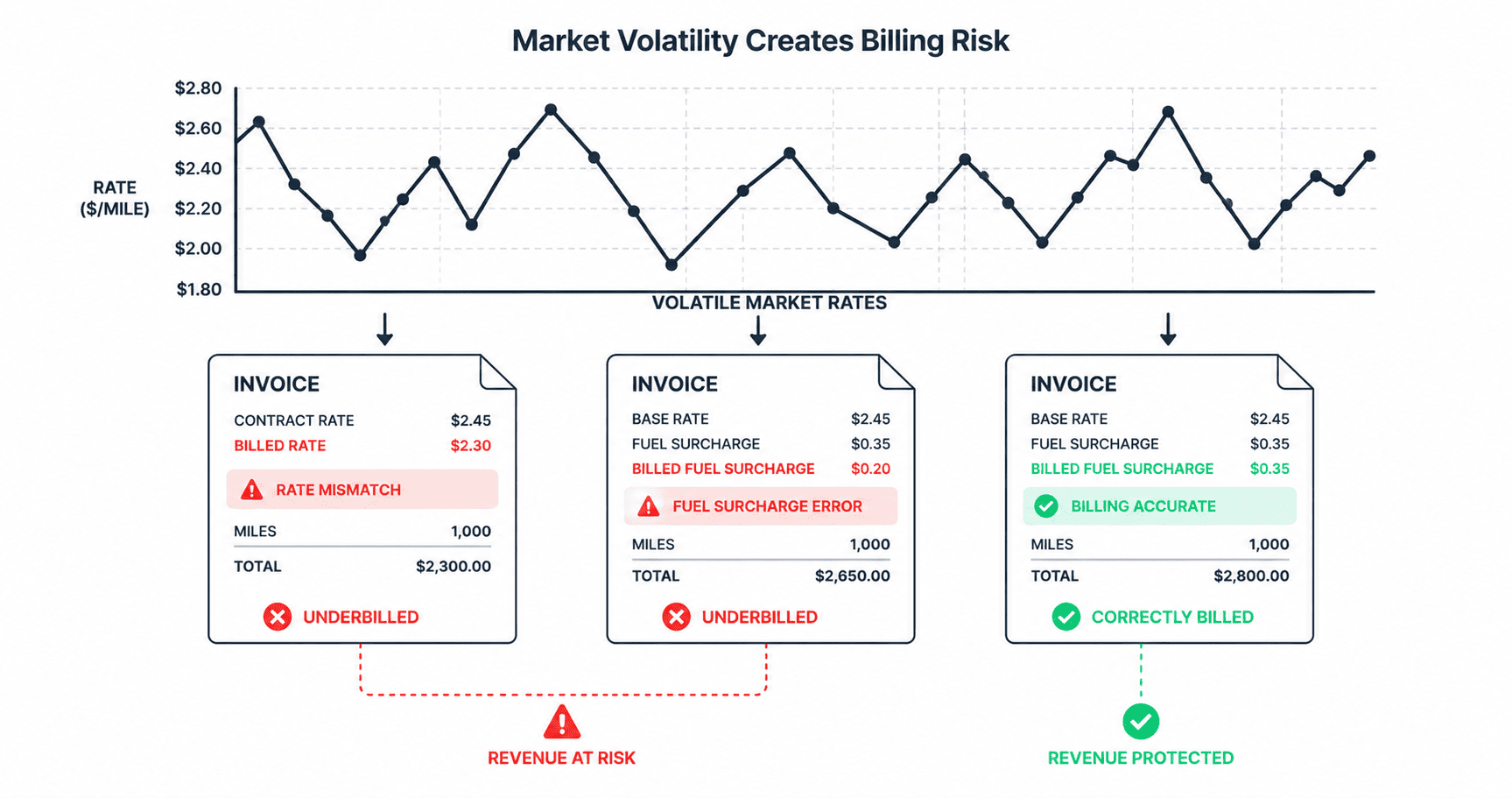
TMS rate data goes stale faster. Most TMS platforms auto-populate rate fields from the most recent load on the same lane. During stable markets, this is efficient. The rate hasn’t changed, so the auto-populated data is correct. During volatile markets, the rate may have changed since the last load. A spot rate that was $2.15/mile last Tuesday might be $2.38/mile this Tuesday. If the billing team doesn’t catch the difference, the shipper invoice goes out at the old rate, either underbilling (margin loss) or overbilling (dispute).
Fuel surcharge calculations become a moving target. Fuel surcharges are typically calculated based on the DOE national average diesel price, applied through a formula specified in the customer contract. When diesel prices are stable, the surcharge changes infrequently and the billing team can apply the same calculation for weeks at a time. When diesel prices swing (as they have recently, climbing significantly in a short period), the surcharge calculation changes weekly or even more frequently. Each change requires the billing team to use the correct period’s diesel average, and the correct formula for each customer (different shippers may use different fuel surcharge tables).
Mid-cycle contract adjustments create data integrity issues. When rates are renegotiated between formal contract periods (which happens more frequently in tightening markets), the new rate needs to be entered in the TMS, communicated to the billing team, and applied to all loads from the effective date forward. If the communication is by email and the TMS update is delayed, loads get billed at the old rate. If some loads get the new rate and others don’t, the billing is inconsistent, and the shipper’s accounts payable (AP) team will catch the inconsistency.
Carrier invoice verification becomes more complex. On the payables side, the same rate volatility that complicates shipper billing also complicates carrier invoice verification. Carrier invoices need to be matched against rate confirmations that may have been issued at different points in a rapidly changing market. A carrier invoice that looks wrong might reflect a rate that was correct when the load was booked but has since changed. Or it might reflect a legitimate rate error. Distinguishing between the two requires pulling the specific rate confirmation for that load and comparing line by line, work that takes longer when rates are changing frequently.
How Much Does Rate Volatility Increase Billing Exceptions?
The clearest measure of rate volatility’s impact on billing is the exception rate: the percentage of invoices (both shipper and carrier) that require manual intervention beyond the standard workflow.
During stable markets, a well-run freight billing operation might see exception rates of 3 to 5%, meaning 3 to 5% of invoices have a discrepancy that requires research and resolution. At 3,000 invoices per month, that’s 90 to 150 exceptions.
During volatile markets, the exception rate can double or triple. Rate discrepancies, fuel surcharge calculation differences, and mid-cycle contract adjustments all generate exceptions. A 10 to 15% exception rate at 3,000 invoices per month means 300 to 450 exceptions, each requiring 15 to 30 minutes of research and resolution.
The math is straightforward: 300 to 450 exceptions at 15 to 30 minutes each equals 75 to 225 hours of additional manual work per month. That’s roughly half a person to more than one full person’s worth of capacity consumed by rate volatility-driven exceptions, on top of the regular billing workload.
For a back-office team that was already running at or near capacity during the stable market, this additional workload either requires overtime (unsustainable), hiring (takes 8-16 weeks), or outsourcing additional capacity (faster but requires a provider relationship).
How Do Rate-Driven Billing Disputes Affect DSO?
Rate volatility doesn’t just create more work. It creates more billing disputes, which directly increase DSO.
When a shipper receives an invoice with a rate that doesn’t match their records (whether because the broker billed at an old rate, used the wrong fuel surcharge period, or didn’t reflect a mid-cycle adjustment), the invoice gets disputed. The dispute process follows the same lifecycle as any billing error: rejection, research, correction, resubmission, payment clock restart. Each dispute adds 10 to 14 days to the payment cycle.
If the invoice dispute rate increases from 3% to 8% because of rate volatility, that’s an additional 150 disputed invoices per month at a 3,000-load brokerage. The DSO impact is measurable. At an average invoice of $1,000 and 12 additional days per disputed invoice, that’s $150,000 in receivables outstanding 12 days longer than they should be, every month.
On the carrier side, rate discrepancies that result in overpayment are margin erosion that’s difficult to recover. Asking a carrier for a refund on an overpayment that was already processed is possible but time-consuming and relationship-straining. Most brokerages don’t have a systematic process for identifying and recovering carrier overpayments, which means the margin loss is permanent.
What the Billing Team Needs in Volatile Markets
The operational response to rate volatility isn’t a new process. It’s more capacity for the existing processes, plus tighter verification at specific points.
Rate verification on every invoice. During stable markets, spot-checking rates against the agreed rates may be sufficient. During volatile markets, every invoice should be verified against the specific rate agreed for that load: the customer contract or load tender for the shipper invoice, the rate confirmation for the carrier invoice. Not the rate in the TMS field (which may be stale), not the rate from the last load on that lane (which may have changed), but the actual rate document for that specific shipment.
Fuel surcharge audit at billing. The fuel surcharge calculation should be verified against the current DOE average and the customer-specific formula before the invoice goes out. This check adds 2 to 3 minutes per invoice but prevents disputes that add two weeks.
System updates when rates change. When a mid-cycle contract adjustment is negotiated, the TMS rate data should be updated before the next load on that lane is billed, not after. This requires coordination between the team negotiating rates and the team managing TMS data, which in turn requires a defined communication process.
Pre-billing audit with rate verification. The pre-billing audit (the quality gate between invoice preparation and submission) should include explicit rate verification during volatile periods. Checking every invoice against the current customer rate and fuel surcharge table is the last opportunity to catch a rate discrepancy before it becomes a dispute.
The Capacity Question
All of these verification steps require time. In a stable market, the billing team has that time because exceptions are rare. In a volatile market, the billing team has less time because exceptions are consuming their capacity, precisely when more verification is needed.
This is the fundamental tension that rate volatility creates in back-office operations: the market conditions that demand more careful billing are the same conditions that consume the capacity needed to be more careful.
The resolution is additional capacity, either through in-house hiring (with the associated 8-16 week timeline and cost structure) or through a dedicated external team that can absorb the increased verification workload without the recruiting and training delay.
ClearLane’s billing and AP audit include rate verification on every invoice (shipper and carrier) as a standard part of the post-dispatch pipeline. When rate volatility increases the verification workload, the dedicated team absorbs the additional complexity without reducing throughput on standard billing.
Frequently Asked Questions
When rates move frequently, TMS auto-populated rate data goes stale, fuel surcharge formulas change between billing periods, and mid-cycle contract adjustments may not reach the billing team. Each creates invoice errors that trigger disputes.
Exception rates can double or triple, from 3-5% during stable markets to 10-15% during volatile periods. At 3,000 invoices per month, that means 300-450 exceptions requiring 15-30 minutes of manual research each.
If the dispute rate increases from 3% to 8% at a 3,000-load brokerage, with each dispute adding 12 days, the DSO impact is roughly 0.6 days across the portfolio, approximately $60,000 in working capital at about $36 million in annual revenue (3,000 invoices a month at $1,000 each).
Rate verification against each load’s rate documents on every invoice (not just TMS data), fuel surcharge audits at billing, immediate system updates when rates change, and a pre-billing audit with explicit rate verification.
Seeing more billing exceptions than usual? Talk to our team to see how ClearLane handles rate verification during volatile markets. Or email us at info@getclearlane.com.
Market context: what a tightening market does to back-office load and the mid-year 2026 freight market check. See carrier invoice audit and accounts payable (AP).