
The Anatomy of a Billing Error: How One Wrong PO Number Costs 14 Days
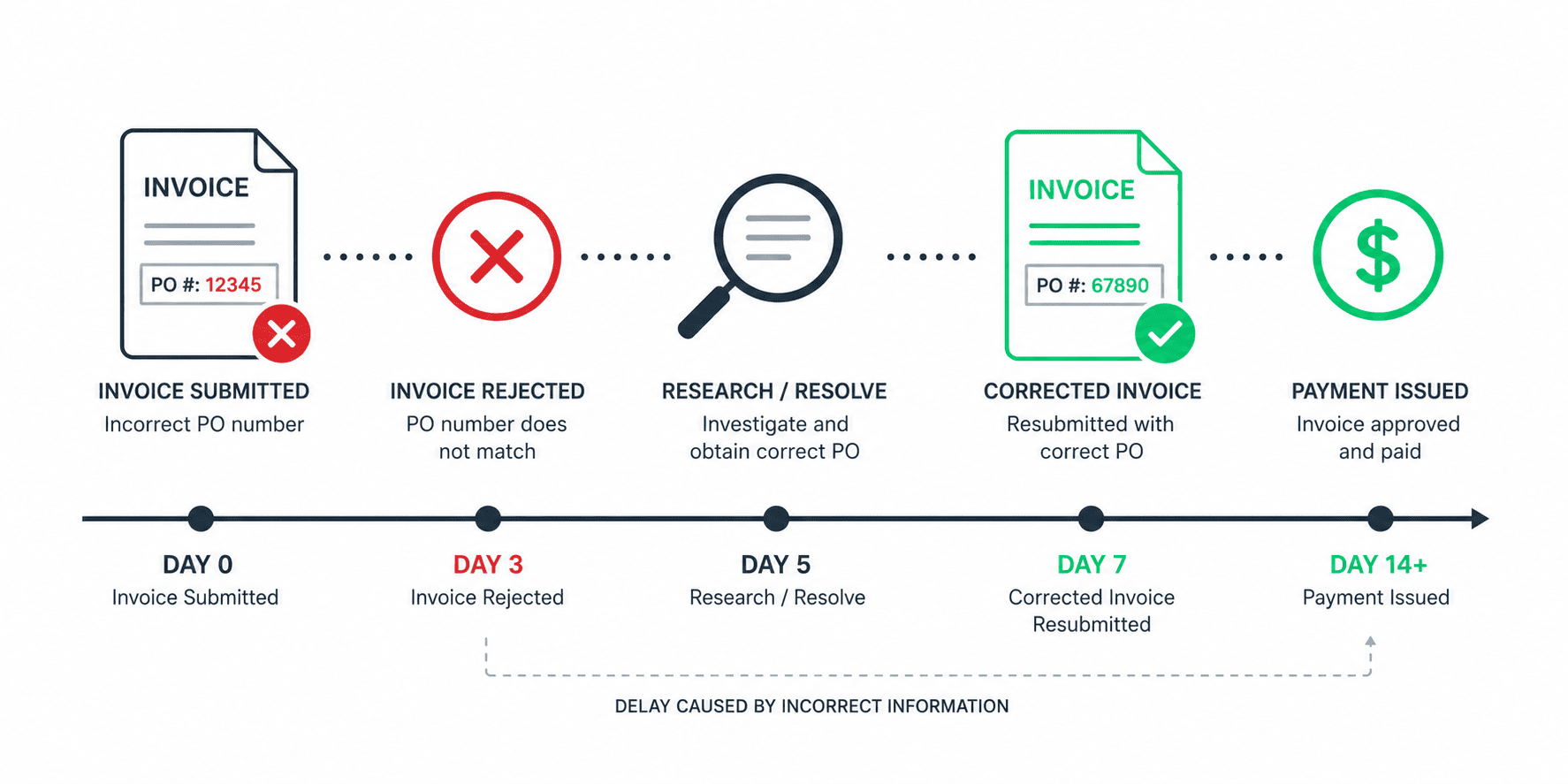
How Does a Single Billing Error Cost 14 Days?
Billing errors in freight don’t announce themselves. They happen quietly: a wrong PO number copied from a previous load, a transposed digit in a reference field, an outdated billing address, a missing piece of backup documentation. The invoice goes out. Nobody notices until the shipper’s accounts payable (AP) system kicks it back.
The error itself takes seconds to create. The cost of that error plays out over days and weeks.
This post traces the lifecycle of a single billing error (one wrong PO number on one shipper invoice) from the moment it happens to the moment the payment finally arrives. The goal isn’t to be dramatic about a data entry mistake. It’s to show how the mechanics of billing disputes work in freight, why even small errors have an outsized impact on cash flow, and where in the process the error can be caught before it becomes a 14-day payment delay.
How Does a Wrong PO Number Get on a Freight Invoice?
A billing specialist at a freight brokerage is preparing shipper invoices. They’re working through a queue of 40 loads that delivered yesterday. Each invoice requires pulling the load tender, attaching the POD, entering the correct shipper billing information: PO number, reference numbers, billing entity, rate, and any accessorial charges.
On load #23, the billing specialist enters the PO number. The TMS auto-populates the field from the load record. But the PO in the system is from a previous load on the same lane. The shipper issues a new PO for each shipment, and the sales team entered the old PO when booking this load. The billing specialist doesn’t catch it. There’s no reason to: the field is populated, the format looks right, and there are 17 more invoices to get through before the end of the day.
The invoice goes out. Amount: $3,200. Rate: correct. Accessorials: correct. POD: attached. PO number: wrong.
Days 1-3: The Rejection
The shipper’s accounts payable system is automated. When an invoice arrives, the system matches the PO number against open purchase orders. If the PO doesn’t match, the invoice gets flagged and routed to a dispute queue. No human reviews it at this stage. The system does the matching, and a non-match is an automatic rejection.
The dispute notification goes back to the brokerage, usually by email, sometimes through a billing portal. It lands in a general inbox or a dispute queue. Depending on how many disputes are coming in and who’s monitoring that inbox, it might get reviewed the same day. More often, it sits for one to three business days.
During this time, the invoice isn’t in the shipper’s payment cycle. It’s not aging toward payment. It’s sitting in a rejected status, and the clock isn’t running.
Days 3-7: Research and Correction
The billing team picks up the dispute. They pull the load file, compare the PO on the invoice to the PO on the shipper’s dispute notification, identify the mismatch, and track down the correct PO number. This usually means checking the original load tender, the shipper’s portal, or contacting the shipper’s logistics coordinator.
Once the correct PO is confirmed, the billing specialist prepares a corrected invoice. Depending on the brokerage’s process, this might require a supervisor’s review or a formal invoice revision with a new invoice number. The corrected invoice gets submitted to the shipper.
Total time from error to corrected resubmission: five to seven business days, typically. Not because any individual step takes that long, but because each step involves a queue: the dispute sits in the brokerage’s inbox, the research sits in the billing specialist’s task list, the corrected invoice sits in the review queue.
Days 7-14+: The Payment Cycle Restarts
Here’s where the real cost appears. The corrected invoice enters the shipper’s AP system as a new submission. The payment terms (typically net 30) start from the resubmission date, not from the original invoice date.
So a $3,200 invoice that should have been paid 30 days after delivery is now going to be paid 30 days after the corrected invoice was submitted, which was seven days after the original submission, which was one to two days after delivery.
Total time from delivery to payment: roughly 39 to 44 days instead of 31 to 32 days. That’s 7 to 13 days of additional DSO on that single load, caused by a wrong PO number.
For one invoice, $3,200 tied up for an extra two weeks doesn’t feel catastrophic. But billing errors don’t happen one at a time.
How Much Do Billing Errors Cost a Freight Company Each Month?
At a freight brokerage processing 3,000 loads per month, even a 2% billing error rate means 60 invoices per month going through the dispute cycle. If the average invoice is $1,000 and the average dispute adds 12 days to the payment cycle, that’s $60,000 in receivables outstanding 12 days longer than they should be, every month.
Over a year, that pattern ties up working capital consistently. It’s not a one-time event; it’s a permanent drag on cash flow that exists as long as the error rate exists.
And the 2% number is conservative. In our experience, freight brokerages without a systematic pre-billing review process run error rates between 3% and 8%, depending on how you define “error.” If you count wrong PO numbers, missing documentation, incorrect rates, wrong billing entities, and missing accessorial charges, the total error rate at a high-volume brokerage without a pre-billing audit can be meaningful.
The error categories that drive disputes most frequently are:
PO number mismatches: the most common, because PO fields are often populated from load records that may have outdated or incorrect data.
Missing or incorrect backup documentation: the shipper requires a signed POD, a BOL, or a lumper receipt attached to the invoice. If any document is missing or doesn’t match, the invoice gets kicked back.
Rate discrepancies: the invoiced rate doesn’t match the rate the shipper has on file. This happens when rate changes are communicated verbally or by email and don’t make it into the TMS before billing.
Wrong billing entity: large shippers sometimes have multiple billing entities, and the invoice needs to go to the specific entity that issued the PO. If the invoice goes to the wrong entity, it gets rejected even if everything else is correct.
Missing accessorial documentation: detention, layover, or other charges are included on the invoice but the supporting documentation (driver notes, signed detention receipts) isn’t attached. The shipper approves the base rate and rejects the accessorial pending documentation.
Each of these errors follows the same lifecycle: submit, reject, research, correct, resubmit, restart the payment clock. The time cost is roughly the same regardless of the error type.
Where in the Process Can Billing Errors Be Caught Before Submission?
The billing error described above (a wrong PO number) could have been caught at several points before the invoice went to the shipper.
At load booking, the sales or operations team could have verified the PO against the shipper’s tender or portal. This is where the wrong PO entered the system, and it’s the earliest possible catch point. In practice, this rarely happens because the booking team is focused on getting the load covered, not on billing data accuracy.
At POD verification, the person uploading the POD to the TMS could cross-reference the shipper’s PO against the load tender. This sometimes happens at brokerages where POD and billing are handled by the same person, but it’s not standard.
At invoice preparation, the billing specialist could verify every PO against the shipper’s records before the invoice goes out. This is where a pre-billing audit catches the error, but it requires a defined verification step in the workflow, not just eyeballing the invoice before hitting send.
The pre-billing audit is the last line of defense. It’s the step where someone (or a dedicated team) reviews every invoice for data accuracy, documentation completeness, rate correctness, and billing information before the invoice is submitted to the shipper. A pre-billing audit catches the PO error before it becomes a 14-day dispute. It catches the missing lumper receipt before it becomes a rejected accessorial charge. It catches the rate discrepancy before it becomes a 30-day research project.
The reason this step doesn’t exist at many brokerages is capacity. The billing team is already stretched processing the invoice volume. Adding a verification step before submission requires either slowing down the billing cycle (which defeats the purpose) or adding capacity specifically for the audit function.
The Economics of Prevention vs. Resolution
The math on billing error prevention is straightforward. Catching an error before the invoice goes out costs a few minutes of verification time. Resolving a dispute after the fact costs days of elapsed time, hours of staff time, and weeks of delayed payment.
A pre-billing audit that checks every invoice for the five most common error types (PO accuracy, documentation completeness, rate correctness, billing entity, and accessorial documentation) adds roughly 5 to 10 minutes per invoice to the billing cycle. At 3,000 invoices per month, that’s 250 to 500 hours of audit work monthly.
That’s real capacity: roughly two to three full-time equivalents dedicated to pre-billing review. Most brokerages don’t have that headcount available, which is why the audit either doesn’t happen or happens selectively (only on high-dollar invoices, only for certain customers).
ClearLane’s pre-billing audit covers every invoice, every load. The audit checks PO numbers, rate accuracy, documentation completeness, billing entity, and accessorial charges before the invoice goes to the shipper. The goal is simple: zero disputes from preventable errors.
The cost of the audit is measurable. The cost of the errors it prevents is also measurable. The difference is the ROI. For most brokerages processing more than 1,000 loads per month, the math works decisively in favor of catching errors upstream.
One Error, One Lesson
One wrong PO number. Thirty seconds to create. Fourteen days to resolve. $3,200 tied up for two extra weeks.
That’s the anatomy of a billing error. Not a system failure. Not negligence. Just a data field that auto-populated wrong and nobody caught it before the invoice went out.
The fix isn’t better people. It’s a better process: specifically, a verification step between invoice preparation and invoice submission that catches the error before it becomes a dispute.
Frequently Asked Questions
A freight billing error is any inaccuracy on a shipper invoice that triggers a dispute or rejection, including wrong PO numbers, incorrect rates, missing documentation, wrong billing entities, and unauthorized accessorial charges.
Catch supplier billing errors by auditing each carrier invoice against the rate confirmation before payment, checking linehaul rate, fuel surcharge, accessorials, and duplicate charges. The same discipline applies to your own shipper invoices before they go out: matching the PO number and reference numbers is the highest-impact check there, since a wrong PO is one of the most common causes of shipper-side payment rejection.
Each billing dispute typically adds about 12 days to the payment cycle. The corrected invoice enters the shipper’s payment system as a new submission, restarting net 30 payment terms from the resubmission date.
PO number mismatches are one of the most common causes of freight billing disputes. They occur when the TMS auto-populates a PO from a previous load on the same lane instead of the current shipment’s PO.
A pre-billing audit is a verification step between invoice preparation and invoice submission where every invoice is checked for PO accuracy, rate correctness, documentation completeness, billing entity, and accessorial charges before going to the shipper.
The target is 98% or higher first-pass accuracy. Below 95%, the investment in a pre-billing audit and customer billing templates pays for itself through dispute reduction alone.
Questions about your billing accuracy? Talk to our team to see how ClearLane’s pre-billing audit catches errors before they become disputes. Or email us at info@getclearlane.com.