
Back office for logistics companies: what changes by company type
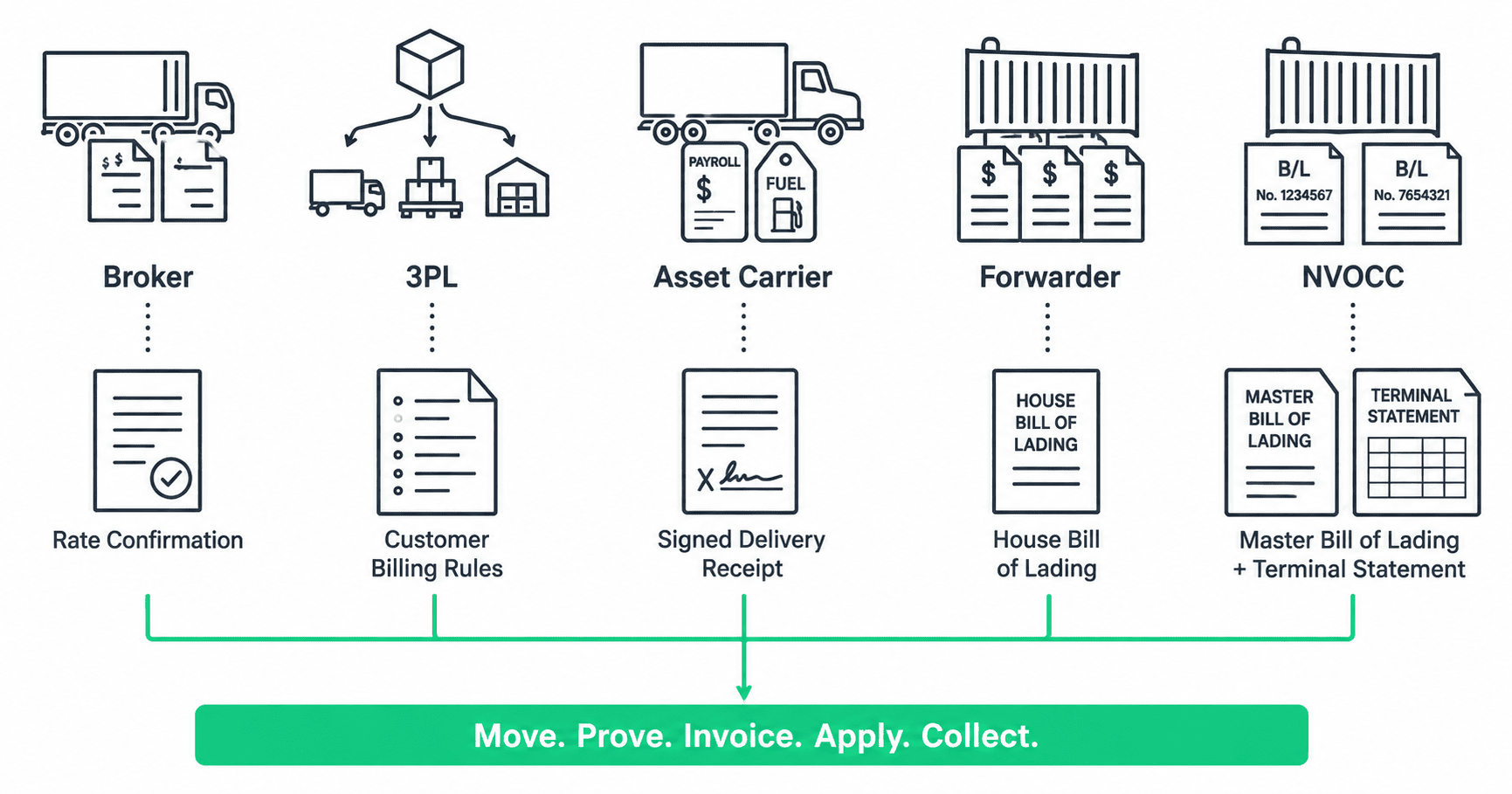
“Logistics company” covers five businesses that look similar from outside and run almost nothing the same way once the freight is delivered. A brokerage, a 3PL, an asset carrier, a freight forwarder and an NVOCC all move goods. What lands on the back-office desk afterwards differs enough that a process built for one will fail on another.
This is a walk through what changes by company type, what stays constant, and which function usually comes off the desk first.
What counts as a logistics company?
In practice the term covers any business that arranges or performs the movement of freight for someone else. That includes property brokers arranging truckload capacity, third-party logistics providers managing freight across modes, asset-based trucking companies running their own equipment, freight forwarders consolidating international shipments, and non-vessel operating common carriers issuing their own bills of lading against space bought from ocean lines.
The word matters because it is what these companies call themselves. The question that matters operationally is narrower: what document proves the charge, and who owes whom.
Why does the back office change by company type?
Three variables drive nearly all of the difference.
The first is what the company sells. A broker sells capacity it does not own, so its cost is a carrier invoice. An asset carrier sells its own equipment, so its cost is fuel, drivers and maintenance. A forwarder sells a door-to-door movement assembled from several purchased legs.
The second is how many parties touch one shipment. A dry van truckload has one carrier and one invoice. An international consolidation can have an origin trucker, a customs broker, an ocean carrier, a destination terminal and a final-mile carrier, each billing separately, each on a different timetable.
The third is what proves a charge. Domestic truckload settles on a rate confirmation and a signed proof of delivery. Ocean freight settles on a bill of lading, an arrival notice, and terminal records that arrive days after the container has moved.
What does a freight broker back office handle?
The brokerage desk is built around a single reconciliation: what the carrier invoiced against what the rate confirmation authorized. Every load produces one purchase and one sale, and the margin sits between them.
The work is carrier invoice receipt and audit, accessorial verification against the rate confirmation, dispute handling to credit, and shipper invoicing once the delivery document is in hand. Because the margin per load is thin and the volume is high, small percentage errors compound quickly. A brokerage running 3,000 loads a month at an average $1,000 load value is reconciling $3M of purchases against $3M of sales every month, on documents that arrive out of order.
Record-keeping is also regulated. Property brokers are required to keep a record of each transaction under 49 CFR Part 371, which sets out what has to be retained and for how long.
How is a 3PL back office different?
A 3PL carries everything a brokerage does, plus multiplicity. The same company may run truckload, less-than-truckload, parcel and warehousing for different customers, each with its own billing rules.
That produces the defining problem: there is no single billing process. One customer wants a consolidated weekly invoice by cost center. Another wants per-load invoices submitted through a portal with a purchase order number that must match exactly. A third takes electronic invoices and rejects anything with the wrong reference qualifier. The rules live in customer agreements, and the desk has to hold all of them at once.
LTL adds reweigh and reclass corrections, where the carrier revises the bill after the fact and the customer invoice has to follow. Warehousing adds storage and handling charges that accrue rather than trigger on an event.
What changes for a trucking company?
An asset carrier flips the model. It is not buying transportation. It is selling its own, so the cost side is payroll, fuel, maintenance and equipment rather than carrier invoices.
The back office concentrates on the receivable. Getting invoiced quickly after delivery, getting paid on terms, and working the aging. Many carriers also factor some or all of their receivables, which introduces a notice of assignment and changes where payment must be remitted. That has to be reflected on the invoice and honored by the customer accounts payable department, or the invoice gets paid to the wrong party.
Detention, layover and truck ordered not used are earned by the truck sitting still, and they are the charges most often left off the invoice because proving them requires arrival and departure timestamps nobody captured at the time.
What does a freight forwarder back office add?
A forwarder assembles one door-to-door movement out of several purchased legs, then bills the customer once. The back office has to hold the shipment file together across all of them.
On the buy side that means co-loader invoices, agent debit and credit notes, terminal and container freight station charges, customs and inspection fees, and multi-currency settlement where a lane was quoted in one currency and settled in another. On the sell side it means one invoice that has to carry every recoverable cost from every leg, with the house bill of lading reference the customer will match against.
The failure mode is specific and expensive: a cost captured on the buy side that never makes it onto the sell side. It does not show up as a dispute. It shows up as margin that quietly did not arrive. More on this on the freight forwarder back office page.
What is different about an NVOCC?
An NVOCC sits in the most unusual position of the five. It bills its customer as a carrier, issuing its own house bill of lading, while buying space from the ocean carrier as a shipper against a master bill.
That means the same container generates a sales document and a purchase document that reference different bill numbers, and reconciling them is a matching exercise before it is an accounting one. Layered on top are demurrage and per diem, which accrue by the day against free time that varies by port, by carrier and by contract. Those charges arrive late, apply to containers that have already moved on, and have to be allocated back to the right shipment and the right party. See the NVOCC back office page for how that runs.
What stays the same across all five?
Underneath the differences, the sequence is identical. Something moves. A document proves it moved. An invoice goes out referencing that document. Money comes back and gets applied. Anything unpaid gets worked.
Every one of these businesses fails in the same place too: the gap between delivery and invoice. Whether the missing item is a signed delivery receipt, a terminal statement or an agent debit note, the effect is the same. The invoice waits, days sales outstanding climbs, and the cash sits with the customer instead of the business.
The vocabulary differs by company type. The arithmetic does not. Terms and definitions across all five models are collected in the freight and logistics glossary.
Which function should come off the desk first?
Whichever one is currently delaying the invoice. That is nearly always the right first answer, because it is the only function whose delay directly converts into working capital tied up.
For brokers and 3PLs that is usually document chase or carrier invoice audit. For asset carriers it is usually accounts receivable and collections. For forwarders and NVOCCs it is usually the cost side, because the sell invoice cannot be assembled until every purchased leg has landed.
The comparison between running these functions in-house and handing them off to a logistics BPO provider, one function at a time or as a whole desk, is worked through in our comparison of in-house and outsourced back office.
Which document proves the charge?
Every dispute eventually reduces to one question: what evidence supports this line. The answer changes by company type, and knowing it is most of the job.
For a broker or 3PL, the rate confirmation is the contract for that load. It authorizes the linehaul rate and, critically, whether an accessorial was agreed in advance. A detention charge with no arrival and departure timestamps is not a charge. It is an assertion. A lumper fee without the receipt cannot be passed through. Fuel surcharge has to trace to the agreed index and the correct week, not the week the invoice was cut.
For an asset carrier, the signed delivery receipt starts the clock, and the detention record has to come from something contemporaneous: gate logs, driver check-in and check-out, or telematics. Reconstructing detention two weeks later from memory does not survive a customer challenge.
For a freight forwarder, the house bill of lading is the customer-facing document and the reference the customer will match against. Behind it sit the master bill, the co-loader invoice, the agent debit note, terminal and container freight station charges, and customs entry records. Each one has its own reference format, and none of them arrive at the same time.
For an NVOCC, the house bill goes out, the master bill comes in, and terminal records arrive later still. Free time is defined in the contract, so demurrage and per diem can only be validated against the specific agreement covering that container, not a general rule.
Carrier authority and safety status sit behind all of it and can be checked directly through FMCSA SAFER.
Where does margin actually leak, by company type?
The leaks are specific, and they are not the same leak wearing different clothes.
Brokerages lose it on accessorials that were earned and never billed. Detention happened, the driver waited, nobody captured the timestamps, and the charge dies quietly. They also lose it in the other direction, paying carrier invoices that were never checked line by line against the rate confirmation.
3PLs lose it on rejected invoices. The invoice was correct, but the reference field did not match what the customer portal expected, so it bounced. It sits in a queue nobody owns while the aging clock runs. Multiply by several customers with different rules and it becomes structural.
Asset carriers lose it to slow invoicing. The delivery document is the trigger, and every day between delivery and invoice is a day of financed working capital that nobody charged for.
Forwarders lose it to costs that arrive after the customer invoice has already gone out. The agent debit note lands three weeks later, the invoice is closed, and rebilling a customer for a charge they were never told about is a conversation most people avoid having.
NVOCCs lose it to per diem and demurrage absorbed rather than passed on. The charge is real, the container genuinely sat, but the allocation back to the responsible party was never made and the deadline to dispute passed.
Each of these has the same shape: a real charge, correctly earned, that fails at the documentation step rather than the commercial one.
Does volume change the answer?
It changes the sequencing, not the functions. A company running 200 loads a month and one running 6,000 both need the same work done. The difference is where it breaks first.
At low volume the desk is usually one person doing everything, and the constraint is coverage. The work stops when that person is on vacation or leaves. At higher volume the constraint becomes consistency: the process exists but exceptions accumulate faster than anyone can clear them, and the aging report starts carrying balances nobody has looked at in weeks.
Neither problem is solved by working harder at the same process, which is why the useful question is not how much volume justifies handing a function off, but which function is already the bottleneck.
Frequently asked questions
The set of functions that run after freight is dispatched: document retrieval, carrier invoice audit and accounts payable, customer billing, accounts receivable and collections, carrier compliance, and bookkeeping. It is the administrative side of moving freight, as distinct from sales and dispatch.
Yes. A property broker arranges transportation it does not perform, which places it inside the logistics category alongside 3PLs, asset carriers, freight forwarders and NVOCCs. The back-office work differs from the others mainly because a broker reconciles a carrier invoice against a rate confirmation on every load.
A forwarder assembles a door-to-door movement from purchased legs and bills the customer once, so the challenge is capturing every leg cost onto one invoice. An NVOCC issues its own house bill of lading as a carrier while buying against a master bill as a shipper, so the challenge is matching two documents with different reference numbers, plus demurrage and per diem that accrue after the fact.
Whichever function is delaying the invoice, because that delay converts directly into working capital tied up. For brokers and 3PLs that is usually document chase or carrier invoice audit. For asset carriers it is usually accounts receivable. For forwarders and NVOCCs it is usually the cost side.
No. What the company sells, how many parties touch one shipment, and what document proves a charge all change by company type. A process built for domestic truckload will not handle co-loader invoices, house and master bill matching, or per diem accruing against free time.
Run the back office as one desk
ClearLane runs outsourced back-office operations for logistics companies: freight brokers, 3PLs, trucking companies, freight forwarders and NVOCCs. Specialists work inside the system you already run. Request a demo or email us at info@getclearlane.com.