
In-House vs Outsourced Back-Office: An Honest Comparison for Freight Companies
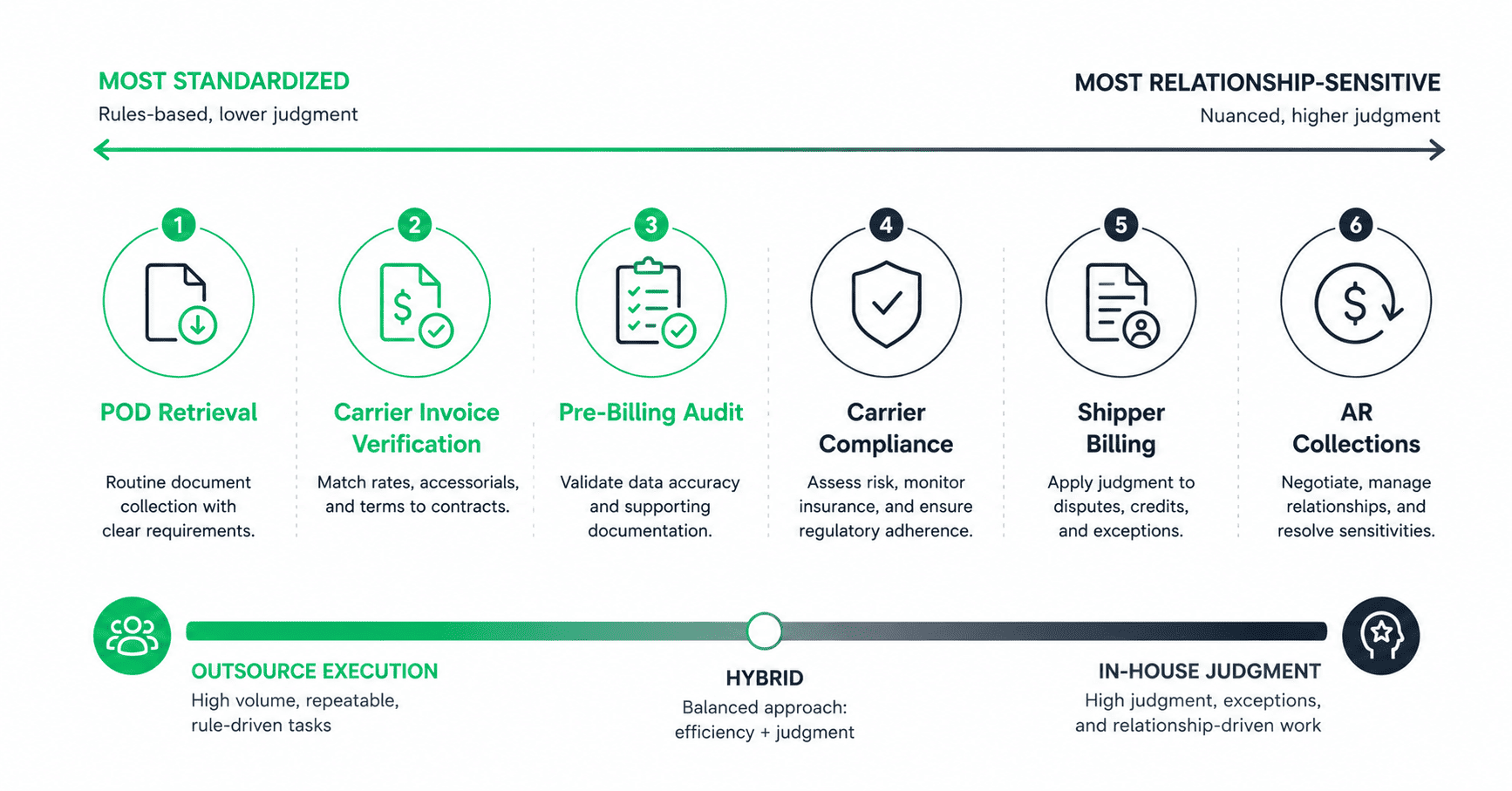
How Do In-House and Outsourced Models Compare Across All Freight Back-Office Functions?
Over the past several weeks, we’ve published detailed comparisons of in-house versus outsourced models for four specific back-office functions: POD retrieval, carrier compliance, bookkeeping, and accounts receivable (AR) collections. Each comparison examined the specific tradeoffs, cost structures, and operating models for that function.
This post pulls those comparisons together into a comprehensive framework for evaluating the full back-office: all the functions that sit between load delivery and cash collection. The goal isn’t to argue that outsourcing is always better or that in-house is always better. Both models work. The question is which model works better for which function at which stage of growth.
What Are the Six Core Functions in the Freight Back-Office Pipeline?
The freight back-office pipeline includes six core functions, each with different characteristics that affect the in-house vs outsourced decision.
POD retrieval is the most standardized function. The workflow is the same on every load: check portal, request document, follow up, verify, upload. The quality of the output depends on consistency and speed, not on judgment or relationship management. The volume scales linearly with load count.
Carrier invoice audit is data-matching work. Each carrier invoice is compared against the rate confirmation for rate accuracy, accessorial authorization, documentation completeness, and duplicate detection. The workflow is systematic and rules-based. Exceptions require judgment, but the routine work is standardized.
Pre-billing revenue audit is a review function. Every shipper invoice is checked for missed accessorial charges, rate accuracy, documentation completeness, and billing information correctness before submission. The audit is systematic (the same checklist on every invoice), but catching missed charges requires thoroughness and attention to detail.
Shipper billing is the most customer-specific function. Different shippers have different billing requirements, portals, documentation formats, and submission processes. The billing team needs to know each customer’s specific requirements to prepare and submit invoices correctly.
AR collections is the most relationship-sensitive function. The person following up on a past-due invoice is communicating with a customer the brokerage wants to retain. Tone, timing, and context matter.
Carrier compliance monitoring is the function most easily deprioritized. It’s important but rarely urgent. The consequences of falling behind are delayed rather than immediate, which makes it uniquely vulnerable to being deferred when the team is busy.
The Pattern Across Functions
Looking across all six functions, a consistent pattern emerges in the comparison data.
Functions that are highly standardized and volume-dependent outsource most naturally. POD retrieval and carrier invoice verification fit this profile. The workflow is the same on every load. Quality depends on throughput and consistency. Adding volume doesn’t require adding judgment. It requires adding capacity. A dedicated external team provides that capacity at lower cost per unit than in-house hires, with built-in coverage for absences and the ability to scale with volume.
Functions that require customer-specific knowledge benefit from documented processes. Shipper billing is customer-specific, but the requirements for each customer can be documented in standardized templates. Once documented, the billing work can be executed by any trained team member, in-house or outsourced, without requiring institutional memory. The documentation effort is a one-time investment that makes the function transferable.
Functions that are relationship-sensitive benefit from a split model. AR collections requires both consistent execution (the structured cadence) and relationship judgment (knowing how to handle key accounts). The split (outsourced execution on the routine cadence with in-house oversight on strategic accounts) provides both.
Functions that are easy to deprioritize benefit from dedicated accountability. Carrier compliance monitoring always gets deferred when the shared team is busy. Outsourcing it to a dedicated team that has no competing priorities ensures the monitoring cadence runs regardless of what else is happening in the operation.
How Should a Freight Company Decide What to Outsource?
For freight companies evaluating the in-house vs outsourced question, or comparing logistics outsourcing services, the decision framework comes down to four variables for each function.
Is the function capacity-limited? If the current team doesn’t have enough bandwidth to execute the function consistently (measured by turnaround time, error rates, or coverage gaps), adding capacity is the priority. Whether that capacity is in-house or outsourced depends on the other three variables.
Is the function standardized enough for external execution? If the workflow follows a consistent, documentable process that can be replicated by a trained team, it can be outsourced without losing quality. If the function requires deep institutional knowledge that can’t be documented, it may need to stay in-house.
Does the function involve customer or carrier relationships that benefit from in-house ownership? If the function includes direct communication with customers about sensitive topics (billing disputes, payment discussions, relationship management), in-house ownership or oversight adds value. If the function is internal-facing (document processing, data verification, compliance checking), the relationship consideration doesn’t apply.
Is the function being deprioritized because of competing demands? If a function consistently falls behind, not because the team isn’t capable, but because other urgent work takes priority, that function needs dedicated capacity. Whether that’s a dedicated in-house hire or an outsourced team depends on cost, speed-to-capacity, and the other variables above.
There is a seventh function sitting above these six. Reporting to owners, lenders, and prospective buyers draws on all of them, and it is the one function where independence from the people producing the numbers is the entire point. See ownership and transaction reporting.
What Back-Office Model Works Best for $10M-$80M Freight Companies?
Most freight companies between $10 million and $80 million in revenue that successfully scale their back-office operations end up with a hybrid model that looks something like this:
In-house: an operations manager or controller who owns workflow quality, manages customer relationships for key accounts, handles strategic exceptions, and oversees the outsourced team’s performance. This person provides the judgment, relationship management, and strategic oversight that can’t be outsourced.
Outsourced: a dedicated team that handles the execution volume across the pipeline: POD retrieval, carrier invoice verification, pre-billing audit, shipper billing (using documented customer templates), carrier compliance monitoring, and routine AR collections cadence.
The in-house person manages the work. The outsourced team does the work. The split gives the brokerage the benefit of both models: the judgment and control of in-house ownership and the capacity and consistency of dedicated external execution.
This hybrid model lets a brokerage grow from 2,000 to 5,000 loads per month without a proportional increase in in-house headcount, because the execution capacity scales through the outsourced team while the management overhead stays constant.
The Cost Comparison at Scale
For a brokerage processing 3,000 loads per month, the cost comparison between the two models is meaningful.
To see your own in-house number, the back-office cost calculator turns headcount and expected replacements into a fully loaded annual range; benefits and employer taxes add roughly 45% on top of base wages, and benefits alone run about 30% of total compensation per BLS Employer Costs for Employee Compensation.
The fully in-house model: a four-person back-office team at a fully loaded cost of $75,000 to $95,000 per person annually. Total: $300,000 to $380,000 per year. Plus turnover costs (estimated at $27,500 to $41,250 per departure), coverage gaps during absences (several weeks a year at reduced capacity), and management overhead (15-30% of the operations manager’s time).
The hybrid model: one in-house operations manager (fully loaded cost: $85,000 to $110,000 depending on seniority and market) plus an outsourced team priced below the equivalent in-house capacity cost. The outsourced component for 3,000 loads per month typically runs less than two equivalent in-house hires. Total: the in-house manager plus the outsourced service, often comparable to or less than the fully in-house model, with greater capacity, no coverage gaps, and built-in scalability.
ClearLane’s pricing is structured for the hybrid model, providing the full post-dispatch pipeline (POD retrieval, carrier invoice verification, pre-billing audit, shipper billing, carrier compliance, and AR management) at a predictable monthly cost that scales with load volume.
Making the Transition
For freight companies considering the shift from a fully in-house model to a hybrid, the transition process typically takes 30 days from engagement to full production. The discovery phase documents existing workflows, customer requirements, and carrier communication patterns. The ramp period transitions functions one at a time, with supervised production and defined quality checkpoints.
The most common starting point is POD retrieval: it’s the most standardized function, the easiest to transition, and the one where results (faster turnaround, measurable DSO impact) are visible fastest. Carrier invoice verification and compliance monitoring typically transition next. Shipper billing and AR follow last, as they require more customer-specific documentation.
Questions to Guide the Decision
If you’re evaluating your current back-office model, these questions help identify where the in-house model is working and where it’s reaching its limits:
Which functions are consistently falling behind? Measure turnaround time, error rates, and coverage gaps for each function. The functions with the worst metrics are the ones that need capacity, and are the strongest candidates for outsourcing.
Which functions get deprioritized when the team is busy? The functions that consistently lose the triage battle are the ones where dedicated capacity (in-house or outsourced) will have the most impact.
Which functions require customer relationship judgment? Those functions benefit from in-house oversight, even if the execution volume is outsourced.
Where does turnover create the most disruption? Functions that suffer most from staff departures, because of institutional knowledge loss, training ramp time, or coverage gaps, are the ones where outsourced team depth provides the most operational resilience.
What’s the team’s utilization rate? If the back-office team is consistently working overtime, the model is at capacity. Growth will make it worse unless capacity is added, and the speed of adding that capacity (8-16 weeks for in-house hiring vs. 4-5 weeks for outsourced onboarding) matters when the business is growing now.
Frequently Asked Questions
Most freight companies between $10M and $80M benefit from a hybrid model: in-house strategic oversight (an operations manager who owns quality) with outsourced execution capacity (a dedicated team handling the daily volume of POD, AP, billing, compliance, and AR).
POD retrieval is typically the first function outsourced: it’s the most standardized, the easiest to transition, and results (faster turnaround, measurable DSO impact) are visible fastest. Carrier invoice verification and compliance monitoring usually follow.
Outsourced teams typically cost less than equivalent fully loaded in-house capacity once you factor in salary, benefits, recruiting, training, turnover, coverage gaps, and management overhead. The honest comparison starts from your fully loaded number, not base salary.
One in-house operations manager who owns workflow quality and customer relationships, plus an outsourced team handling execution across the pipeline. The in-house person manages the work; the outsourced team does the work.
The common fears are losing control of customer relationships, data leaving the TMS, quality dropping without oversight, and vendor lock-in. They are legitimate concerns, and they are addressable: work should happen inside your own system, under scoped access you can revoke, with documented SOPs you own and accuracy reporting you can audit.
Running the in-house vs outsourced numbers for your own operation? Talk to our team to walk through it. Or email us at info@getclearlane.com.
Run the numbers yourself in the in-house back-office cost calculator, or see engagement scopes.