
Drayage Billing: 5 Accessorials That Get Missed Between Port and Warehouse
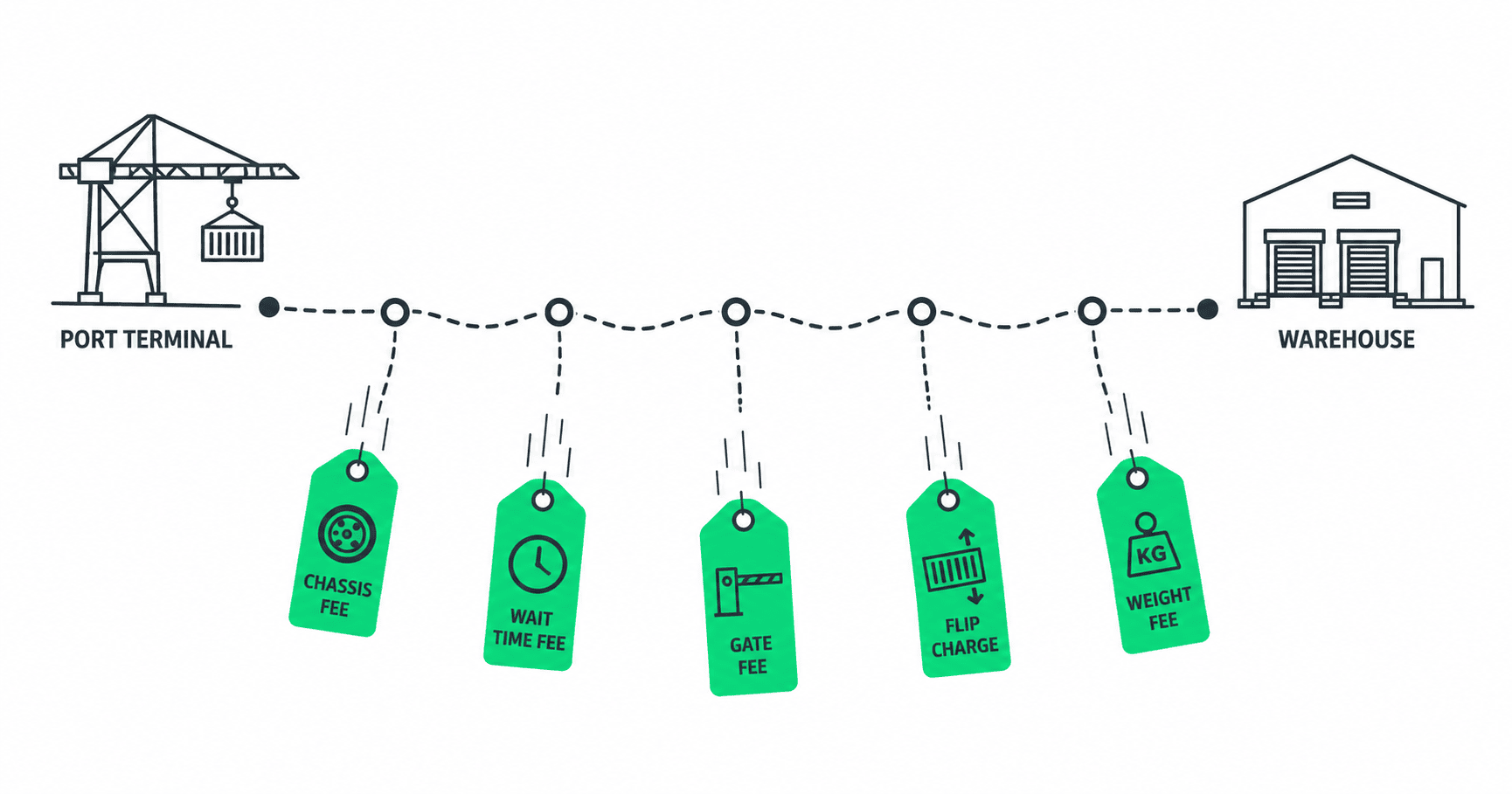
Why Do Drayage Billing Accessorials Get Lost Between Port and Warehouse?
A drayage move looks simple on paper. Pick up a container at the port terminal, deliver it to a warehouse, return the empty. The rate confirmation covers a line haul rate and maybe a fuel surcharge. The invoice goes out, the load closes, and billing moves on.
But between gate-out and delivery, five distinct accessorial charges can accrue. They come from different sources: steamship lines, chassis providers, port authorities, terminal operators. They hit at different times, some weeks after the move is complete. And they require documentation that does not flow naturally to the billing team.
The result is a structural gap in drayage billing. The base rate gets invoiced. The accessorials do not. Each one might be $75, $150, $300 on a single load. Across a month of volume, the leakage compounds into real margin erosion. The billing workflow was never built to capture charges that arrive after the invoice is already out the door.
1. Per Diem: The Charge That Shows Up After the Load Is Closed
Per diem is the daily fee a steamship line charges when an import container is not returned within the allowed free time. Every container that leaves the terminal starts a clock. The steamship line provides a window (commonly 4 to 7 calendar days) to deliver the freight, strip the container, and return the empty. Once that window closes, daily charges begin accruing.
Per diem gets missed because of timing. The steamship line does not bill in real time. That invoice often arrives weeks or months after the container was returned. By then, the load is closed in the TMS. Rebilling requires pulling up the old load, matching the container number, verifying free time, and issuing a supplemental invoice. At $150 per day across dozens of containers per month, the unbilled revenue adds up fast.
We cover the full per diem capture process in a dedicated post on per diem charges in drayage billing. The short version: tracking free time at dispatch, alerting before expiration, and running a disciplined match-back against steamship line invoices will recover the majority of what currently gets absorbed.
2. Chassis Fees and Chassis Splits: Rates That Change Without Warning
Every intermodal container needs a chassis to move over the road. That chassis might come from a steamship line, a leased chassis from an intermodal equipment provider (IEP) like DCLI or TRAC, or the motor carrier’s own fleet. Each source has its own fee structure, and those fees are not static. IEPs publish rate schedules that vary by port, region, and chassis type. A chassis that cost $22 per day in January might cost $28 per day in July. If dispatch books a load using last quarter’s rate and nobody updates the TMS, the difference becomes a cost the carrier absorbs.
The Chassis Split Problem
A chassis split happens when the container and the chassis are not co-located. The driver picks up the container at one terminal and has to go to a separate chassis pool to get the chassis, then return to mount the container. That extra move generates additional fees, gate charges, and sometimes tolls. Dispatch knows about the split because the driver calls it in. But that information does not always reach billing. The cost gets buried in operating expenses.
Chassis billing is complex enough that we are covering it separately in an upcoming post on chassis fees and splits. The key point here: chassis costs are the accessorial most likely to be billed at the wrong amount, because the rate on file is often outdated.
3. Port Congestion Surcharges: Temporary Fees That Appear and Disappear
When a port experiences high volume, extended vessel queues, or operational delays, terminal operators or port authorities impose a congestion surcharge on drayage moves. It applies per container and can range from $50 to $300 depending on the port and the severity of the congestion.
The billing challenge is that congestion surcharges are temporary and inconsistent. A port might impose one for two weeks during peak season, drop it when volume normalizes, then reinstate it three months later when a labor action creates a backlog. There is no fixed schedule. The announcement might come as a terminal advisory, a port authority bulletin, or an update buried in a tariff portal.
Dispatch typically knows about congestion because the drivers are sitting in it. But knowing the port is congested and knowing there is a billable surcharge in effect are two different things. Someone needs to monitor port advisories, confirm which surcharges are active, and flag every load that moved through a congested terminal during the surcharge period. When nobody does that, the carrier pays the surcharge on the terminal’s invoice but never passes it through to the customer.
The fix is systematic. Maintaining a current log of active surcharges, tagged by terminal and effective date, allows billing to cross-reference loads without researching each one individually. Some TMS platforms allow surcharge rules at the port level so they auto-populate during active periods. A shared spreadsheet updated weekly is better than nothing.
4. Clean Truck Fees and Pier Pass Fees: Environmental and Infrastructure Charges
Several major ports assess environmental compliance and infrastructure fees on drayage moves. The most well-known are at the ports of Los Angeles and Long Beach, where the Clean Truck Fee Rate (CTFR) and PierPass Traffic Mitigation Fee (TMF) apply to nearly every container movement. The CTFR funds clean truck programs and is assessed per loaded container. PierPass charges a fee on containers moved during peak hours to incentivize off-peak appointments.
These fees apply at specific ports, not universally. A carrier moving containers through Houston, Savannah, or New York/New Jersey will not see the same charges. That regional specificity is part of why they get missed. A billing team processing loads across multiple ports might not have every port-specific fee schedule memorized. If the system does not flag the charge, it does not appear on the invoice.
Clean truck and pier pass fees are billed separately from the base dray rate. They do not appear on the rate confirmation unless someone adds them. The carrier pays these fees directly at the gate or on a monthly terminal invoice. On a single container, the amount might be $35 to $100. On a carrier running 200 loads a month through LA/Long Beach, that is $7,000 to $20,000 per month in fees that should be passed through but are not.
The fix is mechanical. Every load touching a port with known environmental or infrastructure fees should have those fees auto-populated in the billing system. A carrier invoice audit process that cross-references terminal receipts with customer invoices will catch the gaps.
5. Demurrage: The Terminal Charge with a Short Billing Window
Demurrage is often confused with per diem, but it covers a different piece of the timeline. Demurrage accrues when a container sits at the marine terminal beyond the allowed free time before being picked up. Per diem starts after pickup. Demurrage covers the period the container is still at the port, waiting for a driver.
The terminal or steamship line sets free time for import containers (usually 3 to 5 days from vessel discharge). If the container is not picked up within that window, demurrage accrues daily. Rates vary, but $150 to $350 per day is typical. Some lines escalate the rate the longer the container sits.
Why Demurrage Gets Missed Differently Than Per Diem
Demurrage and per diem share the same root cause for billing gaps (the charge arrives after the invoice is out), but demurrage has an additional problem: the documentation requirements are tighter and the dispute windows are shorter. The Federal Maritime Commission issued an interpretive rule under the Ocean Shipping Reform Act of 2022 establishing requirements around demurrage billing. Charges must be issued within 30 days, and the billed party has 30 days to dispute. If the steamship line’s demurrage invoice arrives 25 days after the charge accrued and your billing team takes two weeks to process it, the customer’s dispute window is nearly closed before they even see the supplemental invoice.
The FMC’s demurrage and detention guidance provides the regulatory framework, but the practical challenge is operational. When the steamship line sends a demurrage invoice, someone needs to match it to the customer load within days. Match the container number to the TMS record. Verify the charge against published free time. Confirm the vessel discharge date and actual pickup date. If the charge is valid and the rate confirmation allows pass-through, issue the supplemental invoice immediately. A demurrage charge that sits in an inbox for three weeks is a demurrage charge that gets absorbed.
The Structural Problem Behind All Five
These five drayage billing accessorials share a common pattern. The charges originate from entities outside the carrier’s billing system. Steamship lines send per diem and demurrage invoices. Chassis providers send usage fees. Port authorities and terminal operators assess congestion surcharges and clean truck fees. Each source has its own billing cycle, its own documentation format, and its own timeline.
The carrier’s billing team is working from the TMS. The TMS has the load, the rate confirmation, and whatever accessorials were known at dispatch. It does not automatically know that a congestion surcharge was active at the terminal on the day of pickup. It does not know the current chassis rate from the IEP. The billing gap is not a people problem. It is a data flow problem.
Closing that gap starts with a pre-billing audit checklist. It forces billing to check for each of these five accessorials before marking a load as invoiced. That one change, checking before the invoice goes out rather than catching charges after, is the difference between recovering accessorial revenue and absorbing it.
What the Capture Process Looks Like in Practice
A working accessorial capture process for drayage has three components. First, a charge registry: a maintained list of every accessorial that could apply, along with current rates, the source entity, and the conditions under which it applies. Chassis rates by provider. Active port surcharges by terminal. Free time schedules by steamship line. Clean truck and pier pass fees by port. This registry needs updates quarterly at minimum, monthly if your operation touches high-volatility ports.
Second, a pre-billing hold. Before any drayage invoice is finalized, billing checks the load against the charge registry. Did this load move through a port with an active congestion surcharge? Was the chassis provided by an IEP, and at what rate? Were there clean truck or pier pass fees? Each question takes seconds to answer if the registry is current.
Third, a post-billing reconciliation cycle. Per diem and demurrage invoices from steamship lines often lag by weeks. A weekly review of incoming charges, matched back to customer loads, catches what the pre-billing hold missed. Any charge not on the original invoice triggers a supplemental invoice. The faster this cycle runs, the less revenue gets lost.
This is the same structure that applies to missed accessorial charges across all freight modes. Drayage just has more external billing sources than a typical truckload or LTL move, which makes the capture process more involved.
Frequently Asked Questions
Per diem, chassis usage fees and chassis splits, port congestion surcharges, clean truck and pier pass fees, and demurrage. All five originate outside the carrier’s billing system and arrive on a different timeline than the base dray rate.
Demurrage accrues when a container sits at the marine terminal beyond free time before being picked up. Per diem accrues when a container is out on the street and not returned within free time after pickup. Demurrage is a pre-pickup charge. Per diem is a post-pickup charge. Both are billed by the steamship line, but they cover different windows and different locations.
Chassis fees vary by provider, port, region, and chassis type. The rates change periodically, and dispatch does not always pass the current rate to billing. Chassis splits add charges that may not get recorded as billable accessorials. When the rate in the TMS does not match the actual rate from the chassis provider, the customer gets billed at the wrong amount or the charge gets dropped entirely.
Pull 90 days of invoices from your external billing sources: steamship line per diem and demurrage invoices, chassis provider statements, terminal fee receipts. Compare those totals against the accessorial revenue you billed to customers over the same period. The gap is your leakage.
Not necessarily. A pre-billing audit checklist and a current charge registry will close the majority of gaps. Some TMS platforms support accessorial tracking natively. For operations without system support, a disciplined manual process recovers most of the lost revenue. Most leakage happens because no process exists, not because the existing process is flawed.
Questions about accessorials slipping between the port and the warehouse? Request a demo to see how ClearLane catches missed drayage charges before billing. Or email us at info@getclearlane.com.