
Per Diem Charges: Why They Get Missed and How to Capture Every One
What Are Per Diem Charges in Drayage?
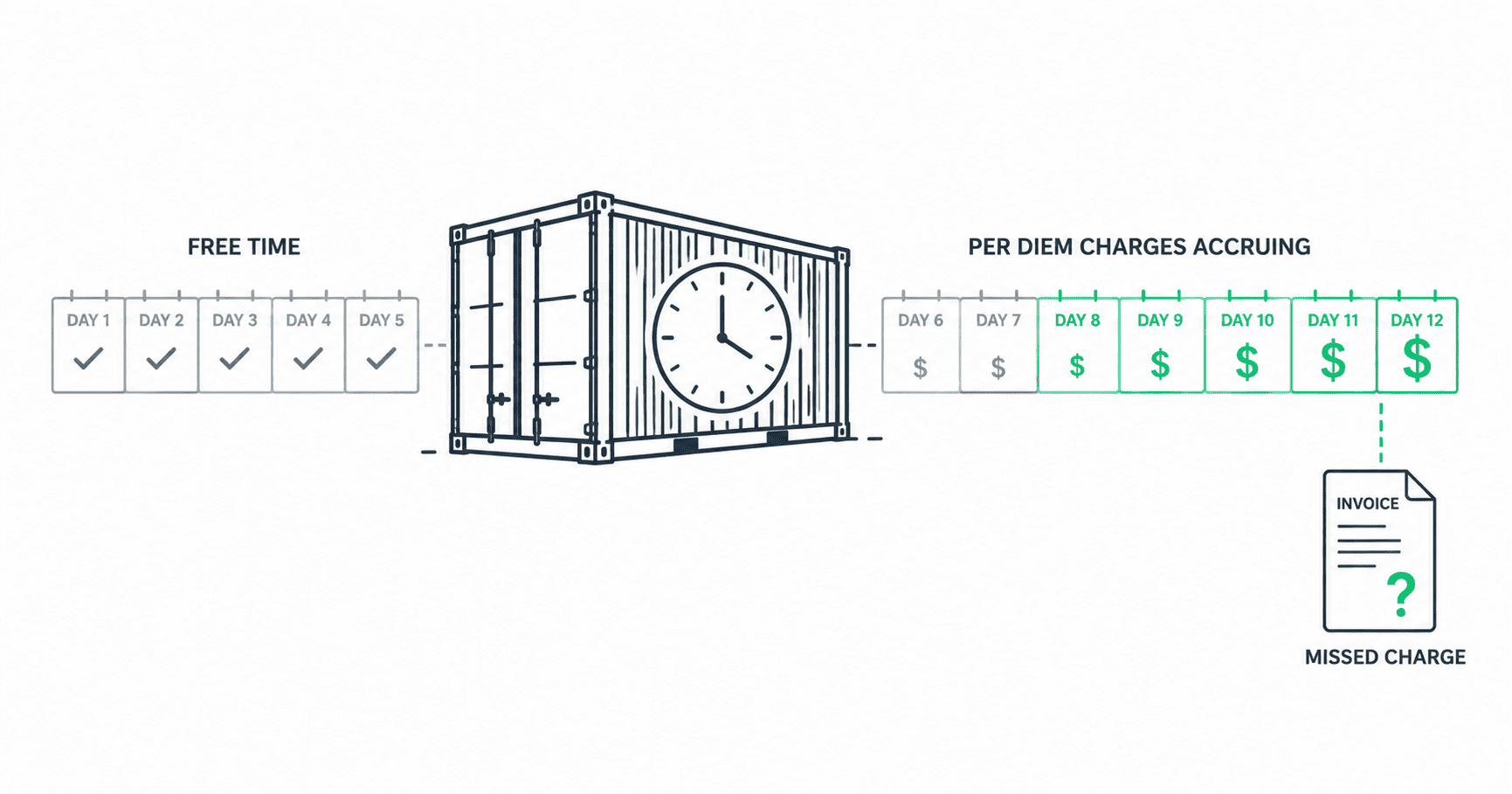
Per diem is the daily fee a steamship line charges when an import container is not returned to the port or designated depot within the allowed free time. Every container pickup starts a clock. The steamship line gives you a window (typically 4 to 7 calendar days, depending on the line and the contract) to deliver the freight, strip the container, and return the empty. Once that window closes, per diem starts accruing. Every additional day the container sits at a warehouse, a yard, or in transit back to the terminal adds another charge.
It is not the same as demurrage, which applies when a container stays at the marine terminal beyond the allowed free time before pickup. And it is different from driver detention, which covers wait time at a shipper or receiver facility. Per diem specifically covers the period between gate-out at the port and gate-in when the empty is returned. All three charges exist in the same ecosystem, but they hit the billing cycle at different times and from different directions. That timing difference is where the problems start.
For drayage carriers and brokers, per diem is one of the most common accessorial charges to fall through the cracks. The dollar amounts add up quickly. A single container held two days past free time at $150 per day is $300. Multiply that across 40 or 50 loads a month and the leakage gets serious.
Why Do Per Diem Charges Get Missed in Drayage Billing?
The core problem is a timing gap. The steamship line does not bill per diem in real time. It bills weeks (sometimes months) after the container is returned. By the time that invoice arrives, your billing team has already invoiced the customer for the original drayage move. The load is closed in the TMS. Everyone has moved on.
That gap creates a chain of missed handoffs.
The Invoice Is Already Out the Door
Most drayage billing teams process invoices within a few days of delivery. The customer’s rate agreement covers the line haul, fuel surcharge, and any accessorials that were known at the time of dispatch. Per diem is almost never known at that point because the container has not been returned yet, or the free time window has not expired. So the invoice goes out clean, and the per diem charge is born after the fact.
Rebilling a customer for a charge that was not on the original invoice takes effort. It requires pulling up the closed load, matching the steamship line’s per diem invoice to the correct container number, confirming free time, and issuing a supplemental invoice. Many billing teams skip it because the manual work does not feel worth it on a single container. Across hundreds of containers, though, the write-offs compound.
Free Time Varies by Steamship Line and Contract
There is no standard free time. One steamship line might allow four days. Another gives seven. Some lines offer extended free time on certain trade lanes or for high-volume accounts. The billing team would need to check each steamship line’s tariff or contract to know whether a specific container is accruing per diem on any given day. Without a system that tracks free time by line and container, the only way to know is to wait for the bill.
And waiting for the bill is how charges get missed.
Container Return Data Does Not Flow to Billing
Gate-out and gate-in timestamps are the two data points that determine whether per diem applies. Gate-out is usually captured when the driver picks up the container at the port terminal. Gate-in is captured when the empty is returned. But that gate-in data often lives in a different system, or it comes back on a driver’s paperwork that gets filed without anyone cross-referencing it against billing.
If your billing team does not have visibility into when the empty was actually returned, they cannot proactively bill per diem. They are entirely dependent on the steamship line’s invoice to trigger the charge. That is a reactive process, and reactive processes have gaps.
Nobody Owns the Match-Back
The steamship line sends a per diem invoice that lists container numbers and charges. Someone needs to take that invoice, match each container to the original customer load in the TMS, verify the charge against the steamship line’s free time schedule, and then create a supplemental invoice or debit memo for the customer. In many operations, nobody is specifically assigned this task. It falls to whoever opens the mail, or it sits in an accounts payable (AP) inbox until someone gets around to it.
The match-back step is where most per diem revenue dies. Not because people do not care, but because the workflow does not exist.
How Much Per Diem Revenue Is Your Operation Losing?
The honest answer for most drayage operations is: you probably do not know. Per diem leakage is hard to measure because the charges you miss are the ones you never billed. They do not show up in your revenue reports. They show up in your costs (when the steamship line invoices you) but never get passed through to the customer.
One way to estimate the gap: pull three months of steamship line per diem invoices from AP. Total them up. Then compare that number against the per diem charges you actually billed to customers over the same period. The difference is your leakage.
In our experience, operations that have never run this exercise often find that most of their per diem costs went unbilled. At 60% to 80% unbilled, every $10,000 in per diem charges the steamship lines send you means $6,000 to $8,000 absorbed as cost rather than passed through as revenue.
Operations that have a capture process in place typically recover 90% or more. The gap between “no process” and “disciplined process” is significant. It is one of the fastest ways to improve margin on drayage moves without changing rates or volume.
What Does a Per Diem Capture Process Look Like?
A working capture process has four parts: tracking, alerting, matching, and billing. Each one addresses a specific failure point in the chain.
Tracking Free Time by Container
Every container that leaves the port needs a record of its steamship line, the applicable free time window, and the gate-out date. This data comes from the BOL, the steamship line’s tariff or contract, and the terminal gate ticket. When these three data points are captured at dispatch (or shortly after), you have everything you need to calculate when per diem starts accruing.
Some TMS platforms support per diem tracking natively. Others require a parallel spreadsheet or a bolt-on tool. The method matters less than the discipline. If nobody enters the free time window at the time of dispatch, everything downstream breaks.
Alerting Before Free Time Expires
A good capture process includes alerts that fire when a container is approaching the end of its free time. Two days before expiration is a common trigger. This alert goes to dispatch or operations so they can prioritize the empty return and reduce or avoid the per diem charge entirely.
This step is about cost avoidance, not just cost recovery. The cheapest per diem charge is the one that never accrues. When dispatch knows a container is about to start costing $150 a day, they will find a way to get the empty back to the terminal.
Matching Steamship Line Invoices to Customer Loads
When the steamship line’s per diem invoice arrives, someone needs to match each container number to the corresponding customer load. This is a per diem reconciliation step. It uses the same load-file discipline as a pre-billing audit, but it happens after the original invoice has gone out, so it needs its own owner. The match requires looking up the container number in the TMS, confirming the customer, verifying the charge against the known free time, and flagging any discrepancies.
Discrepancies happen more often than you would expect. Steamship lines sometimes apply the wrong free time, bill for days the container was already returned, or double-bill containers. Without a match-back process, those errors get paid without question.
Billing the Customer Promptly
Once the charge is verified and matched, the supplemental invoice needs to go out fast. The longer you wait, the harder the conversation with the customer becomes. If you bill per diem within a week of receiving the steamship line invoice, customers expect it. If you bill it three months later, you get pushback.
The customer contract should include language that covers per diem pass-through. If the customer agreed to the load under terms that include per diem responsibility, billing it is straightforward. If the customer contract is silent on per diem, you have a harder conversation, but you still need to have it. Absorbing the cost as a default is not a sustainable billing practice.
Where Per Diem Fits in the Bigger Accessorial Picture
Per diem is one piece of a larger accessorial billing challenge in drayage. Chassis usage fees, port congestion surcharges, overweight charges, and detention at shipper and receiver all follow similar patterns. They accrue outside the normal billing window, they require documentation that does not always flow to billing, and they are easy to write off one at a time.
The difference with per diem is that the data trail is cleaner. Container numbers are unique identifiers. Steamship lines publish their free time schedules. Gate-out and gate-in records exist at the terminal level. The information is available. The challenge is building a workflow that brings it together before the billing window closes.
The ocean carrier’s published tariff is a useful reference point for confirming steamship line free time policies, though individual contracts often modify published tariffs. Always verify free time against the specific contract or booking confirmation for each shipment.
Measuring Your Per Diem Capture Rate
Once you have a process in place, you need a metric. The per diem capture rate is simple: total per diem billed to customers divided by total per diem charged by steamship lines, expressed as a percentage.
A capture rate below 50% means more than half of your per diem costs are being absorbed. That is common for operations without a dedicated process. A rate between 50% and 80% means charges are being caught, but the process has gaps (often the match-back). A rate between 80% and 95% indicates a working process with room for improvement. Above 95% means the process is mature and the remaining gap is likely disputed charges or timing lag.
Track this metric monthly. It will tell you whether your process is holding or degrading. Seasonal pressure (peak shipping season volume, chassis shortages) tends to push capture rates down because the billing team gets stretched. Watching the trend helps you staff appropriately.
A thorough pre-billing audit checklist can help standardize what gets checked on every load, so per diem and other accessorials do not slip through when volume picks up.
Frequently Asked Questions
Demurrage applies when a container sits at the marine terminal or port beyond the allowed free time before it is picked up. Per diem applies after the container leaves the terminal and is not returned within the allowed free time. Demurrage is a terminal-side charge. Per diem is a street-side charge. Both are billed by the steamship line, but they cover different time periods and different locations.
Under the Uniform Intermodal Interchange and Facilities Access Agreement (UIIA), the ocean carrier bills per diem to the motor carrier that took the container out on interchange. Brokers are not billed directly by the steamship line: the drayage carrier passes the charge through to them. Whether it then passes through to the shipper or consignee depends on the customer contract and the terms of the move. If the customer contract includes per diem pass-through language, the customer is responsible.
Rates vary by steamship line and trade lane. Common per diem rates range from $75 to $250 per container per day. Some lines use a tiered structure where the daily rate increases the longer the container is held. Five days past free time at $150 per day is $750 on a single container.
Yes. If you have gate-in documentation showing the container was returned within free time, you can dispute the charge. Disputes require proof of return (terminal gate-in receipt with timestamp). Some steamship lines also allow disputes based on documented equipment issues, such as a container that was returned but rejected due to damage that was pre-existing.
Track free time by container starting at dispatch. Set alerts for containers approaching free time expiration. Prioritize empty returns on containers nearing their deadline. Work with your warehouse and delivery partners to strip containers faster. On the billing side, include per diem pass-through language in every customer contract so recovery is straightforward when charges do accrue.
Questions about your per diem capture rate? Request a demo to see how ClearLane catches missed accessorials before billing. Or email us at info@getclearlane.com.