
Freight Back-Office Outsourcing Companies: How to Evaluate Them
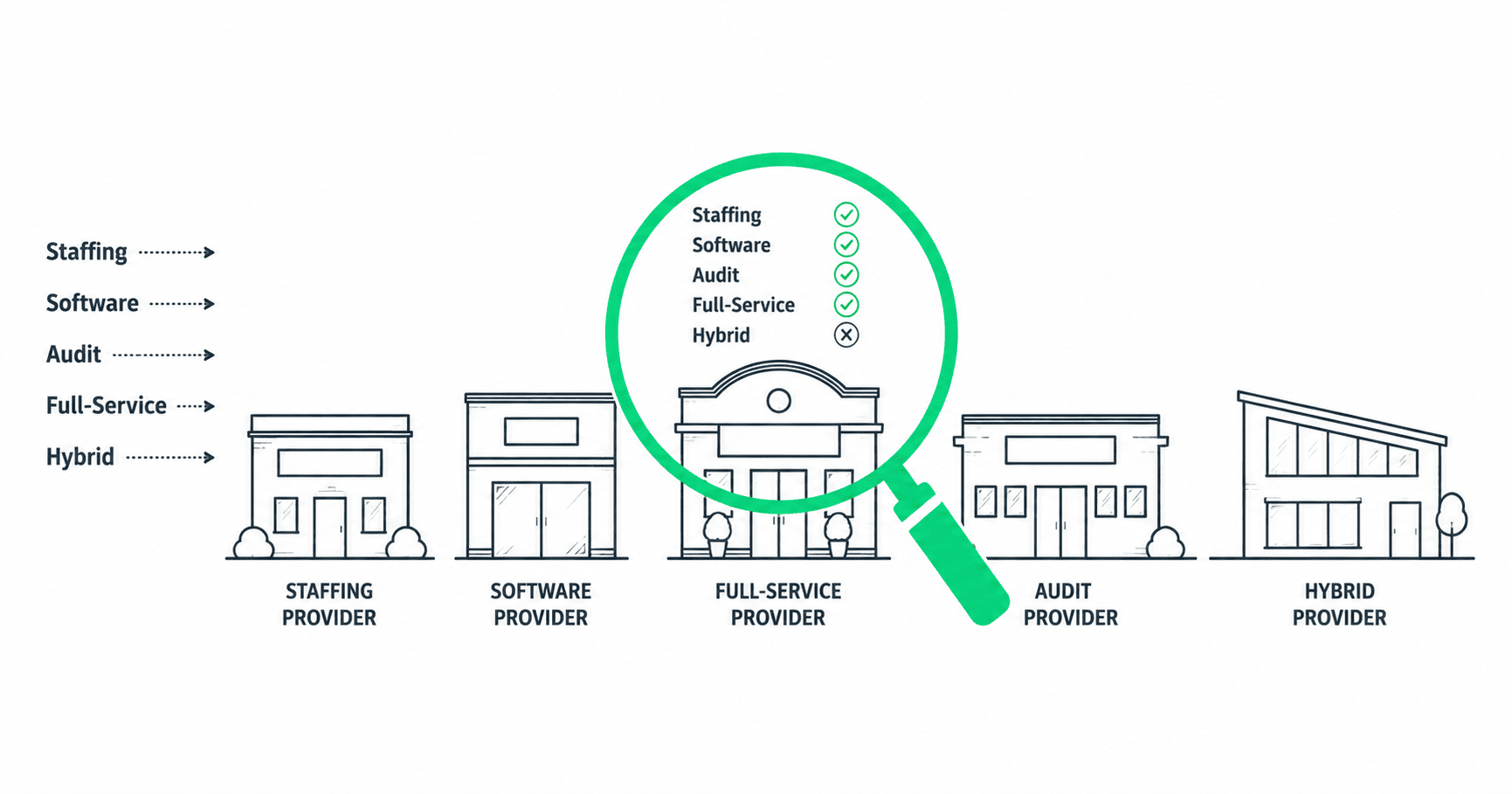
Search for freight back-office help and you get a wall of companies that all claim the same thing. Some are staffing firms. Some are software vendors. Some audit freight bills for shippers and have nothing to do with your side of the load. Picking wrong costs months of onboarding time and a stack of billing errors that lands on your desk anyway.
This guide sorts the market into categories, names the providers worth knowing, and gives you the evaluation criteria that actually separate them. ClearLane is on the list. We built it, so read our entry with that in mind and hold it to the same standard as everyone else.
What does freight back-office outsourcing actually cover?
The freight back office is everything that happens after the load moves: POD retrieval, carrier invoice verification, shipper billing, accounts receivable (AR) follow-up and collections, carrier compliance monitoring, and bookkeeping. A full-service partner runs all of it inside your TMS. Narrower providers take one or two pieces.
Before comparing companies, decide which of those functions you are actually trying to hand off. Industry benchmarks put a fully loaded back-office employee at $75,000 to $95,000 per year, and companies operating without a structured pre-billing audit leave 2-5% of billable revenue uncaptured. Those two numbers define the problem you are hiring someone to solve: fixed cost and leaked revenue.
What types of providers are in this market?
- Freight-specialized operations partners. Teams trained on freight documents and workflows that run your processes inside your TMS. Output-based: you buy completed work, not seats.
- Staffing and seat providers. You interview and manage dedicated remote staff placed by the vendor. Cheaper per hour, but training, SOPs, and quality control stay on your plate.
- General BPO firms. Large outsourcers that serve many industries. Scale is strong; freight fluency is usually not. Expect to write the playbook yourself.
- Freight audit and payment companies. They audit carrier invoices after the fact, mostly for shippers. Useful for a different problem than a broker back office. More on this distinction below.
- Software and automation vendors. Tools that automate document capture or invoice matching. They speed up a team; they do not replace one.
Which companies should be on your shortlist?
Names come up repeatedly in this space. Positioning summaries below are based on how each company publicly describes itself; verify scope and fit on your own calls.
- DDC FPO. A long-established freight process outsourcing provider. Broad menu across the freight document lifecycle and used to high volumes.
- Lean Solutions Group. A staffing-model provider popular with brokerages. You get dedicated people who work as your employees; management and process design stay with you.
- Cass Information Systems and CTSI-Global. Freight audit and payment providers that serve primarily shippers. Strong at post-payment audit and freight spend analytics, not at running a broker or carrier billing desk.
- Trans Audit. A post-audit specialist that recovers overcharges from carrier invoices after payment, again mostly for shippers.
- ClearLane. Our model: dedicated freight-trained teams that run POD chase, AP and invoice audit, shipper billing, AR, compliance, and bookkeeping inside your existing TMS, with a pre-billing revenue audit on every load and scoped, managed-service pricing that scales up or down with your freight.
How do you compare providers once you have a shortlist?
- Freight fluency. Ask what a TONU is, how they handle a reweigh, where detention documentation usually breaks down. Vendors who serve twelve industries will reach for a script.
- Where the work happens. Inside your TMS, or on their platform? If your data has to leave your system, ask how you get it back when you leave.
- Output or seats. Are you buying completed, quality-controlled work, or renting people you still have to manage and train?
- Accuracy standards and reporting. Ask for the number and how it is measured. Weekly reporting should be standard, not an add-on.
- Revenue capture, not just cost. Cost savings get all the attention, but the 2-5% of billable revenue that goes uncaptured without a pre-billing audit is usually the bigger number. Ask every vendor how they catch missed accessorials before invoicing.
- Scope flexibility. You should be able to start with one function and expand, and to scale down in a soft market without a penalty.
Provider types at a glance
| Provider type | What you actually buy | Fits when | Watch out for |
|---|---|---|---|
| Freight-specialized operations partner | A team running your workflows inside your TMS | You want a function owned end to end | Scope creep in either direction if the engagement is loosely defined |
| General BPO / staffing firm | Trained-by-you people, billed per seat | You have strong SOPs and management capacity to spare | Freight fluency; ask them what a TONU is on the first call |
| Freight audit and payment company | Shipper-side invoice checking | You are a shipper auditing carrier bills | Wrong side of the transaction for brokers and carriers |
| Software vendor | Tooling that flags; your team still works the queue | Your desk has capacity and needs speed | The exception queue nobody staffed |
| Freelancers / VAs | Hours from an individual | Task-level overflow at low volume | The function still lives in your head, and leaves with them |
Whichever row you pick, the record-keeping obligation stays yours: 49 CFR Part 371 puts broker transaction records on the broker regardless of who does the clerical work, so a provider’s document discipline is a compliance question, not just a quality one. Before any demo call, model your in-house baseline with the in-house back-office cost calculator so quotes land against a real number.
What should you ask on the demo call?
Five questions do most of the work: Which TMSs do you already operate in daily? What happens in the first two weeks of onboarding? Who owns the SOPs you build for my account? What is your invoice accuracy target and how do you report against it? What does a volume drop of 30% do to my bill?
The answers separate operators from resellers quickly. For reference, here is how ClearLane answers the onboarding question, and here is the full math on what in-house staffing costs if you are still weighing that option.
Frequently Asked Questions
Pricing models vary by provider type. Staffing providers charge per seat per month. Freight audit firms typically take a percentage of recovered charges. Operations partners like ClearLane price on volume, so the cost scales with your freight rather than a fixed headcount. Compare any quote against the fully loaded $75,000 to $95,000 annual cost of each in-house back-office hire.
It depends on what you want to own. A staffing provider gives you people; you keep responsibility for training, SOPs, and quality control. An operations partner delivers completed work against defined accuracy standards. Brokerages with strong internal process leadership often do well with seats. Teams that want the process problem solved usually want an operations partner.
Generally no. Freight audit and payment firms are built to verify carrier invoices after the fact, mostly for shippers. Billing, POD retrieval, AR follow-up, and carrier compliance are operational workflows that need a team working inside your TMS daily.
Start with one painful, measurable function such as POD chase or carrier invoice verification. Set a 60-day benchmark: document turnaround time, invoice accuracy, and how much missed revenue the pre-billing audit catches. Expand only when the numbers hold.
Want to see what a freight-specialized back office looks like on your loads? Request a demo. Or email us at info@getclearlane.com.