
The True Cost of In-House Back-Office Staffing for Growing Freight Companies
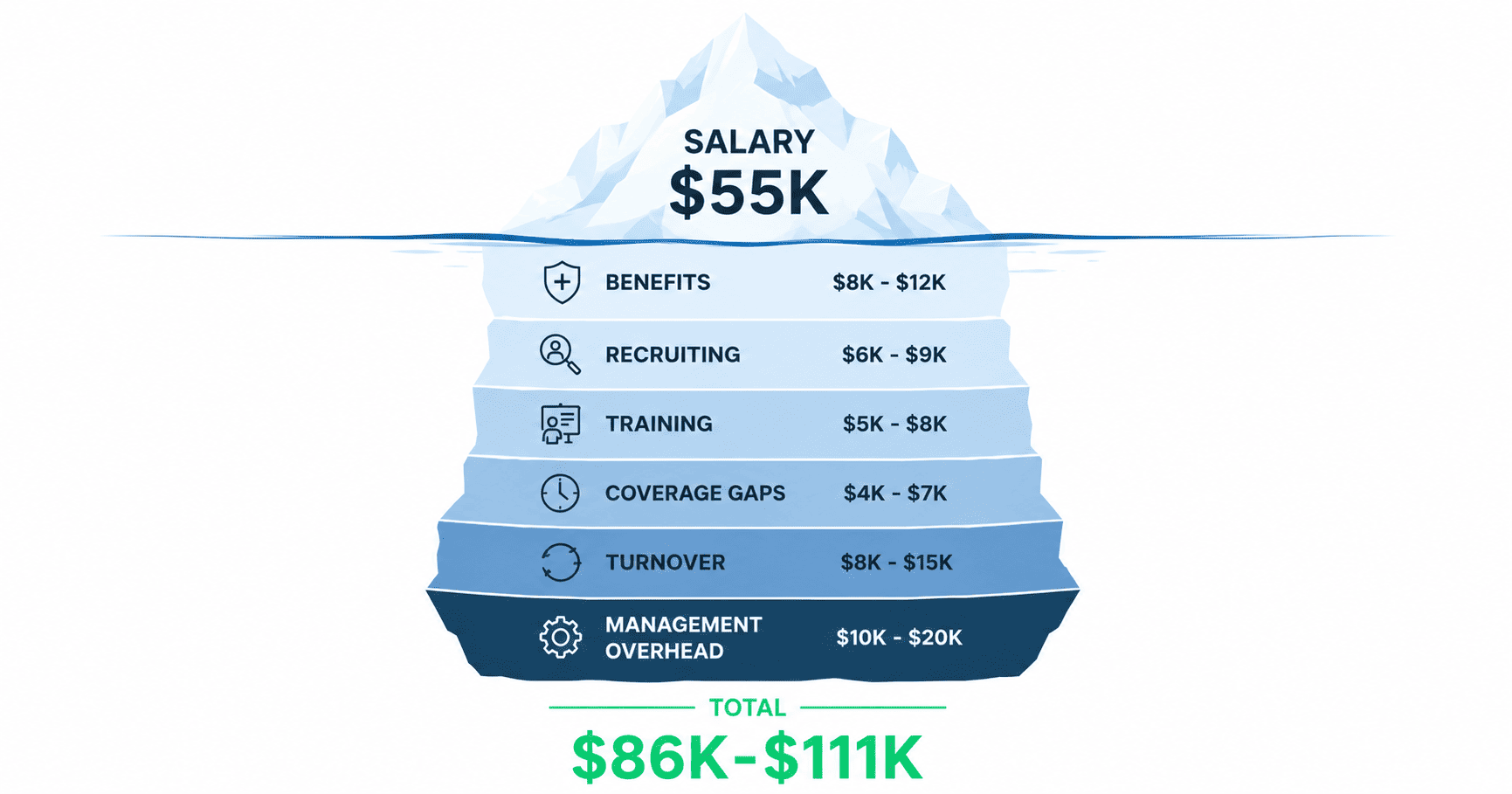
Why Does a Freight Back-Office Hire Cost More Than the Salary?
When a freight brokerage or 3PL decides to hire for a back-office role (billing specialist, accounts receivable (AR) coordinator, accounts payable (AP) clerk, carrier compliance analyst), the first number they look at is the salary. In most U.S. markets, that number ranges from $45,000 to $65,000 depending on experience, location, and the specific role.
That number is real and it matters. But it’s roughly 60-70% of what the hire actually costs. The rest is spread across line items and time periods that don’t show up on a single budget line. That means the total cost of in-house back-office staffing is consistently underestimated.
This post breaks down the full cost structure of in-house back-office hiring for freight companies, including the costs that are real but less visible, and provides a framework for comparing that cost to the alternatives.
The Direct Costs
These are the costs that show up on budget spreadsheets and are relatively easy to calculate.
Base salary is the starting point. For freight back-office positions (billing specialists, AR coordinators, AP clerks), the range in most U.S. markets runs $45,000 to $65,000 annually. Major metro areas and specialized roles (someone who knows McLeod, TMW, or MercuryGate deeply) skew toward the higher end.
Benefits add 20-30% on top of base salary. Health insurance, dental, vision, 401(k) matching or contributions, PTO accrual, and any other benefits the company offers. For a $55,000 base salary, benefits typically add $11,000 to $16,500 annually.
Payroll taxes are an additional 7.65% (employer portion of Social Security and Medicare), plus state unemployment taxes that vary by state. On a $55,000 salary, that’s roughly $4,200 in payroll taxes.
Workers’ compensation insurance varies by state and role classification but typically adds $500 to $1,500 annually for back-office positions.
Equipment and workspace costs include a computer, monitors, software licenses, desk space, and any other physical infrastructure. For an office-based role, this is typically $3,000 to $5,000 in the first year and $1,000 to $2,000 annually thereafter. For remote roles, the initial equipment investment is similar but ongoing workspace costs are lower.
Total direct cost for a $55,000 base salary hire: roughly $72,000 to $82,000 annually. That’s the direct cost only. The fully loaded cost adds recruiting, training, coverage gaps and management time, and it’s the number that should be used for any staffing-versus-outsourcing comparison.
How Much Does It Cost to Recruit a Freight Billing Specialist?
Finding someone who can do freight back-office work effectively is harder than hiring for a generalist administrative role. The skill set is specific: the person needs to understand freight terminology (BOL, POD, rate confirmation, accessorials), navigate a TMS, handle high-volume data entry with accuracy, and ideally have experience with freight billing, AP, or AR.
That’s a niche skill set. It narrows the candidate pool significantly.
Recruiting for this type of role typically takes four to eight weeks in most markets. The cost of recruiting includes either agency fees (typically 15 to 25% of first-year salary for contingency recruiters) or internal recruiting time: job postings, resume screening, interviews, background checks.
For a $55,000 position, agency recruiting costs run $8,250 to $13,750. Internal recruiting costs are harder to quantify but typically represent 40-60 hours of staff time across HR, hiring managers, and interview participants (conservatively $3,000 to $5,000 in loaded labor cost).
And the recruiting cost is paid every time the position turns over. It’s not a one-time investment. It recurs with every departure.
How Long Does It Take a New Freight Back-Office Hire to Reach Full Productivity?
Even an experienced hire needs 30 to 60 days to reach full productivity in a new freight back-office role. Every brokerage has its own TMS configuration, customer billing requirements, carrier payment workflows, internal naming conventions, and exception handling processes. None of that transfers from the previous employer. It has to be learned.
During the training ramp, the new hire is producing at roughly 40-60% of full capacity. They’re doing work, but they’re doing it slowly, with more errors, and requiring more supervision. The company is paying full salary for partial output.
On a $55,000 annual salary, two months of reduced productivity represents roughly $4,500 to $5,500 in effective cost: salary paid minus productive output received.
And the training ramp creates a secondary cost: the time of the person doing the training. Whoever is onboarding the new hire (showing them the TMS, walking them through customer requirements, reviewing their work) is spending their own productive time on training instead of on their regular work. That time cost is real and typically unmeasured.
Coverage Gaps
In-house staff take vacations, get sick, have personal days, and occasionally quit with limited notice. Each of these events creates a coverage gap where the work either doesn’t get done or gets redistributed to team members who are already busy.
For a three-person back-office team, PTO alone creates roughly 30-45 days per year of reduced capacity across the team. Add sick days and personal days, and the total coverage gap is typically 40 to 60 days annually, roughly 5 to 8% of the team’s combined working days.
During those gaps, two things happen. Either the remaining team members absorb the extra work (which means overtime, fatigue, and increased error rates) or the work waits (which means PODs sit uncollected, invoices go out later, AR follow-up gets delayed, and DSO creeps up).
Neither outcome is free. The overtime costs money. The delayed work costs cash flow.
What Does Back-Office Turnover Cost a Freight Company?
Back-office positions in freight have meaningful turnover rates. The work is repetitive, detail-intensive, high-volume, and doesn’t always offer a clear path to advancement. Industry turnover for these roles runs higher than the company-wide average at most freight organizations.
When someone leaves, the company incurs the recruiting cost again ($3,000 to $13,750 depending on method), the training ramp again (30-60 days of reduced productivity), and a coverage gap between the departure and the new hire’s start date (typically two to six weeks where the team is short-staffed).
The total cost of a single turnover event for a $55,000 back-office position (including recruiting, training, and productivity loss during the transition) is typically estimated at 50 to 75% of the annual salary. That’s $27,500 to $41,250 per departure.
If a three-person back-office team experiences one departure per year (which is conservative for positions with high turnover), that’s an annual cost of $27,500 to $41,250 that sits outside the staffing budget but is directly caused by the staffing model.
Management Overhead
Each in-house hire adds management work. Someone needs to review their output, answer questions, handle scheduling, conduct performance reviews, manage time-off requests, and address any workplace issues that arise.
For a brokerage owner or operations manager who’s already running at capacity, adding direct reports to manage can create as many problems as it solves. The management time doesn’t show up as a line item on the back-office cost analysis, but it’s real time that gets pulled from other priorities: carrier relationships, customer management, business development, strategic planning.
The management overhead per employee varies widely depending on the person and the role, but a reasonable estimate is 5-10% of the manager’s time per direct report. For a three-person team, that’s 15-30% of someone’s capacity dedicated to supervision and coordination of back-office operations.
What Is the True Fully Loaded Cost of an In-House Back-Office Employee?
For a single back-office hire at $55,000 base salary, the first-year total cost looks roughly like this:
Base salary: $55,000. Benefits and taxes: $16,000 to $22,000. Recruiting: $3,000-$13,750. Equipment and workspace: $3,000-$5,000. Training ramp productivity loss: $4,500-$5,500. Management overhead (estimated share): $5,000-$10,000.
Total first-year cost: $86,500 to $111,250.
To run this math on your own team, the back-office cost calculator turns headcount and expected replacements into a fully loaded annual range.
In subsequent years, the recruiting and equipment costs drop out, but the risk of turnover (and its associated costs) is ongoing. A reasonable annual steady-state cost for one in-house back-office employee is $75,000 to $95,000 when all factors are included.
For a three-person team, that’s $225,000 to $285,000 annually, with the expected turnover already included. Each departure beyond that adds another $27,500 to $41,250.
The Comparison Framework
The right comparison isn’t between the salary of an in-house hire and the price of an outsourced service. It’s between the fully loaded cost of the in-house staffing model (including all the costs above) and the total cost of the alternative, measured against the same output.
The key questions for the comparison:
What is the fully loaded cost per load for your current back-office operation? Divide your total back-office labor cost (including all the indirect costs) by your monthly load count. That gives you a unit cost that you can trend over time and compare against alternatives.
What capacity are you actually getting? A three-person team at $225,000 to $285,000 provides roughly 470 to 485 productive person-hours per month (170 hours per person x 3 = 510, minus the 5 to 8% lost to PTO and coverage gaps). Is that enough for your current volume? If the team is consistently working overtime, the effective hourly cost is higher than the calculation suggests.
What happens when volume increases by 50%? If you go from 2,000 to 3,000 loads per month, the in-house model requires another hire. That means another recruiting cycle, another training ramp, and a four-to-eight-week delay before capacity actually increases. Can your growth timeline absorb that delay?
What happens when volume decreases? If a major customer reduces shipments and your load count drops by 20%, the in-house team’s cost doesn’t decrease. Salary is a fixed cost. A specialized external team can typically scale capacity in both directions.
ClearLane’s pricing provides a predictable monthly cost for the full post-dispatch pipeline: POD retrieval, carrier invoice verification, pre-billing audit, shipper billing, carrier compliance monitoring, AR management and bookkeeping. No recruiting cycle. No training ramp. No coverage gaps from PTO or turnover. Full capacity from the first month.
The Decision Isn’t Always Either/Or
Some freight companies keep an in-house operations manager or controller who owns the workflow and quality standards, and bring in specialized teams for the execution capacity. Others outsource specific functions (AP audit, POD retrieval, compliance monitoring) while keeping shipper billing in-house because of customer relationship sensitivity.
The right model depends on the company’s size, growth rate, customer mix, and management capacity. But whatever model a freight company chooses, the decision should be based on the full cost picture, not just the salary line.
Frequently Asked Questions
For a $55,000 base salary hire, the first-year fully loaded cost is approximately $86,500 to $111,250, including benefits, payroll taxes, recruiting, training ramp, equipment, and management overhead.
Recruiting a qualified back-office hire with freight experience typically takes 4 to 8 weeks. The niche skill set (TMS navigation, freight terminology, billing workflows) narrows the candidate pool significantly.
Even an experienced hire needs 30 to 60 days to reach full productivity, learning the specific TMS setup, customer billing requirements, carrier payment workflows, and internal processes. During this period, the company pays full salary for roughly 40-60% productivity.
Outsourced teams typically cost less than fully loaded in-house equivalents for the same capacity, because the in-house number carries recruiting, training, turnover, and coverage gaps that a dedicated team absorbs. Run the comparison on your own fully loaded cost, not the base salary.
The total cost of a single turnover event is typically 50-75% of annual salary ($27,500-$41,250 for a $55,000 position), including recruiting, training, and productivity loss during the transition.
Weighing these staffing numbers against the cost of errors? The AP overpayment calculator shows what unaudited carrier invoices add to the bill.
Want to see how the numbers compare for your operation? Talk to our team to walk through your current back-office cost structure. Or email us at info@getclearlane.com.