
Freight forwarder accounts payable: what actually gets checked
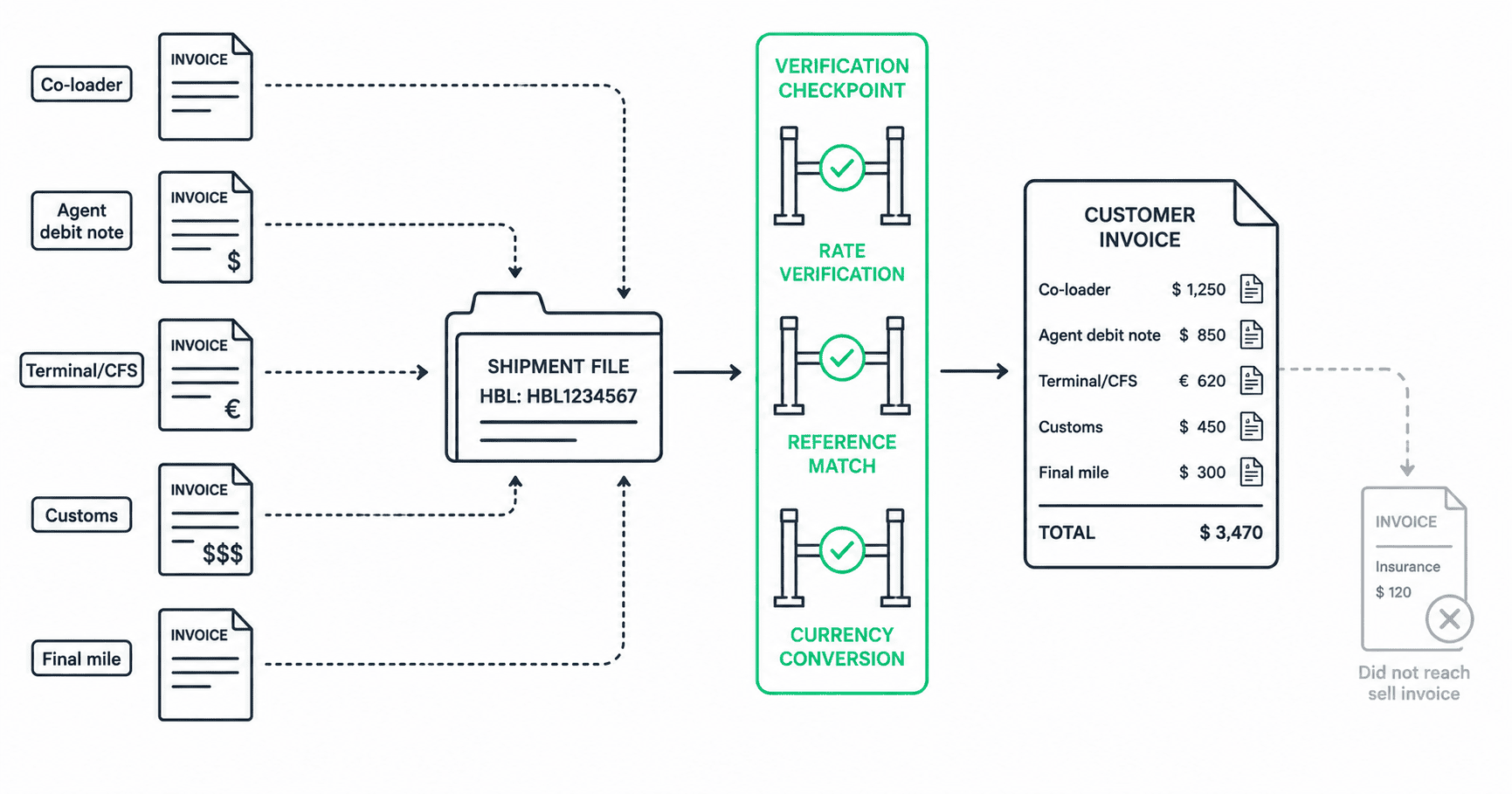
Freight forwarder accounts payable is not carrier invoice audit with more paperwork. It is a different reconciliation. A domestic broker checks one carrier invoice against one rate confirmation. A forwarder checks a stack of invoices from parties that never dealt with each other, in more than one currency, against a shipment file that is still open.
This is what actually has to be verified, and where the money goes missing.
Why is forwarder accounts payable different?
Three structural differences do most of the work.
Start with the absence of a purchase order. Domestic freight settles against a rate confirmation. International freight settles against a booking, a quotation, a tariff, and in some lanes a contract rate that applies only to a specific commodity on a specific service. The reference document is different for almost every charge type on the same shipment.
Then there is timing. The ocean carrier bills near sailing. The origin trucker bills within days. The destination terminal bills after the container has been picked up. The overseas agent may bill weeks later. The shipment file has to stay open long enough to catch all of it, and closed quickly enough to bill the customer.
And the parties are not all vendors. An agent is a counterparty, not a supplier. Money moves in both directions, and the net position is what settles.
What is a co-loader invoice and how is it checked?
A co-loader is another consolidator whose container the forwarder buys space in, rather than booking a full container directly. The co-loader issues a bill for the space used, and that bill has to be checked against the booking rather than simply approved.
What gets verified: the rate against the booking confirmation, the chargeable weight or measurement against what was actually tendered, whether the charge basis is per cubic metre, per revenue ton or per container, and whether origin and destination charges were quoted as included or as separate line items. Chargeable weight is where most disagreements live, because the co-loader recalculates from the measured cargo and the forwarder quoted from the customer declaration.
The second check is that the co-loader bill maps back to the right house bill of lading. One co-loaded container can carry consignments for several customers, and the cost has to split across them before any of it reaches an invoice.
How do agent debit and credit notes work?
An overseas agent handles the other end of the movement. Depending on the lane and the terms, the agent may collect from the consignee, pay local charges, or both. What passes between forwarder and agent is a debit note or a credit note rather than a conventional invoice.
These are the hardest documents in forwarder accounts payable, for a plain reason: they net. A single agent statement can contain charges owed to the agent, charges owed by the agent, profit share on collect shipments, and adjustments to shipments settled months earlier. Approving the net figure without reconciling the underlying lines means accepting whatever the agent calculated.
The checks that matter are matching each line to a house bill, confirming the profit split against the agency agreement for that lane, confirming that collect charges were actually collected, and confirming that any adjustment references a shipment that exists and has not already been adjusted.
What has to be verified on terminal and CFS charges?
Container freight station, terminal handling and port charges are billed by parties the forwarder did not book directly, on schedules that vary by facility.
Terminal handling charges should match the published tariff for that terminal and that container size. Container freight station charges for consolidation and deconsolidation are usually per cubic metre or per revenue ton, and the basis has to match what was quoted. Storage and demurrage accrue against free time that is defined by the specific contract covering the container, not by a general rule at that port.
Free time is where the largest recoverable amounts sit, because these charges arrive after the container has moved on and after the customer invoice may already have gone out. The reference detail on what each accessorial is and what proves it is collected in the accessorial charge reference.
How does multi-currency settlement go wrong?
A lane quoted in one currency and settled in another produces a variance that is nobody fault and still costs money.
The four common failures: converting at the rate on the payment date rather than the rate agreed in the quotation, using a different rate for the cost than for the corresponding revenue on the same shipment, absorbing bank charges on international transfers without allocating them to the shipment, and holding a payable in a foreign currency across a period end without revaluing it.
None of these are large individually. Across a few hundred shipments a month in volatile currency pairs, the aggregate is a real number, and it is invisible unless cost and revenue are compared at the shipment level in the same currency.
What about customs and duty disbursement?
Where the forwarder or its customs broker advances duty and tax on behalf of the importer, that money is a disbursement rather than a cost. It moves through the accounts as a pass-through and has to be recovered in full.
The verification is narrow but unforgiving: the entry number on the invoice matches the entry filed, the duty amount matches the CBP entry summary, the disbursement fee matches the agreement, and the amount recovered from the customer equals the amount advanced. A disbursement that is billed at the wrong figure is not a margin problem, it is a cash problem, because the forwarder has already paid it.
How does forwarder accounts payable connect to the customer invoice?
This is the connection that determines whether the shipment is profitable, and it runs one way: no cost captured means no charge recovered.
The sell invoice is assembled from the buy side. Every co-loader charge, agent debit, terminal fee and disbursement that belongs to a shipment has to be sitting in that shipment file before the invoice goes out. A cost that lands after the invoice has been issued has three possible fates: it gets rebilled, which requires a conversation the customer did not expect; it gets written off; or it sits unallocated and quietly reduces the margin on a shipment that looked fine.
This is why forwarder accounts payable cannot be run as a payment function. It is the input to billing. How the two sides run together is covered on the freight forwarder back office page, and the differences between forwarder work and other logistics models in back office for logistics companies.
What does a working process look like?
Four things, in order.
First, a shipment file that actually holds costs. Every incoming charge is coded to a house bill on arrival, not at month end. An invoice that cannot be matched to a shipment goes into an exception queue with an owner, not into a folder.
Second, a close rule. A defined point at which a shipment is considered cost-complete and can be billed, with a documented exception for lanes where agent notes routinely arrive late. Without this, either the invoice waits indefinitely or it goes out incomplete.
Third, verification before approval rather than after payment. Recovering an overpayment from an overseas agent is materially harder than declining to pay it. Disputes raised before settlement get resolved. Disputes raised after settlement become negotiations.
Fourth, cost and revenue compared per shipment. In one currency, at the shipment level. Anything else measures the department rather than the movement, and margin leaks at the movement level. The vocabulary across all of this is collected in the freight and logistics glossary.
What does the ocean carrier invoice itself need checking for?
The carrier bill is the largest single line on most shipments and the one most often approved on sight because it comes from a major line and looks authoritative.
The base ocean freight should match the contracted rate for that commodity, that service and that period. Rates are frequently agreed per service contract with validity windows, and a sailing that slips past a window can be billed at a different rate than the one quoted to the customer. Bunker adjustment and currency adjustment factors are formula-driven and should reconcile to the published factor for the sailing month, not the invoice month.
Then the surcharges: peak season, congestion, low sulphur, war risk, equipment imbalance. Each is legitimate in the right circumstances and each is worth confirming applied to that lane on that sailing. Detention and demurrage on the carrier bill are separate from terminal storage and are governed by the carrier own free time, which is why the same container can generate two storage-type charges from two parties with two different clocks.
How should exceptions be handled?
Most forwarder accounts payable volume is straightforward. The work concentrates in a minority of shipments, and how those are handled decides the result.
An exception needs three things to be workable: a named owner, a reason code, and an age. Without a reason code, the queue cannot be analysed and the same failure repeats. Without an age, items that will never resolve sit alongside items that will, and both look equally urgent.
The reason codes that matter in practice are narrow: no matching shipment, rate differs from booking, chargeable weight differs, duplicate of an already-processed invoice, currency or conversion query, and awaiting supporting document. Five or six codes cover the overwhelming majority, and the distribution across them tells you which upstream process is actually broken.
A dispute raised inside the carrier or agent window is a negotiation with leverage. The same dispute raised after settlement is a request for goodwill. That difference is worth more than any efficiency gain in the approval workflow.
What about duplicate and double-billed charges?
Duplicates are more common in forwarding than in domestic freight, and not because anyone is behaving badly. The same charge can legitimately reach the desk twice through different routes: once on the agent statement and once directly from the terminal, or once on the carrier bill and once on the co-loader bill where the co-loader passed it through.
Detection needs matching on shipment reference plus charge type plus amount, not on invoice number, because the two arrivals will carry different invoice numbers from different parties. A pure invoice-number check will miss every one of these.
The related risk is a charge that is genuinely payable twice, once to each of two parties, where only one of them actually incurred it. Resolving that requires going back to which party the terminal contracted with, which is a question the invoice itself will not answer.
Frequently asked questions
The process of receiving, validating and settling the costs of an international shipment: ocean or air carrier invoices, co-loader bills, overseas agent debit and credit notes, terminal and container freight station charges, customs entries and duty disbursements. Unlike domestic carrier invoice audit, it involves several parties billing on different timetables against different reference documents.
Against the booking confirmation rather than the invoice itself. The rate, the chargeable weight or measurement, the charge basis, and whether origin and destination charges were quoted inclusive all have to match what was booked. The bill also has to be split back to the correct house bills of lading, since one co-loaded container can carry several consignments.
A charge raised by an overseas agent for work performed at the other end of a movement. It commonly nets against amounts the agent owes, including profit share on collect shipments, so a single agent statement can contain charges in both directions plus adjustments to older shipments. Each line should be matched to a house bill before the net figure is approved.
Usually through four failures: converting at the payment date rate rather than the quoted rate, using different rates for cost and revenue on the same shipment, absorbing international bank charges without allocating them, and holding foreign currency payables across a period end without revaluation. Individually small, meaningful in aggregate.
No. The customer invoice is assembled from the costs captured on the buy side, so any cost that lands after invoicing is either rebilled, written off, or absorbed. Treating accounts payable as a payment function rather than an input to billing is what allows margin to leak on shipments that looked profitable.
Run the forwarder desk as one file
ClearLane runs outsourced accounts payable and billing for freight forwarders and logistics companies, inside the system you already use. Request a demo or email us at info@getclearlane.com.