
How Trucking Companies Get Paid Faster: Invoicing, POD, and Detention
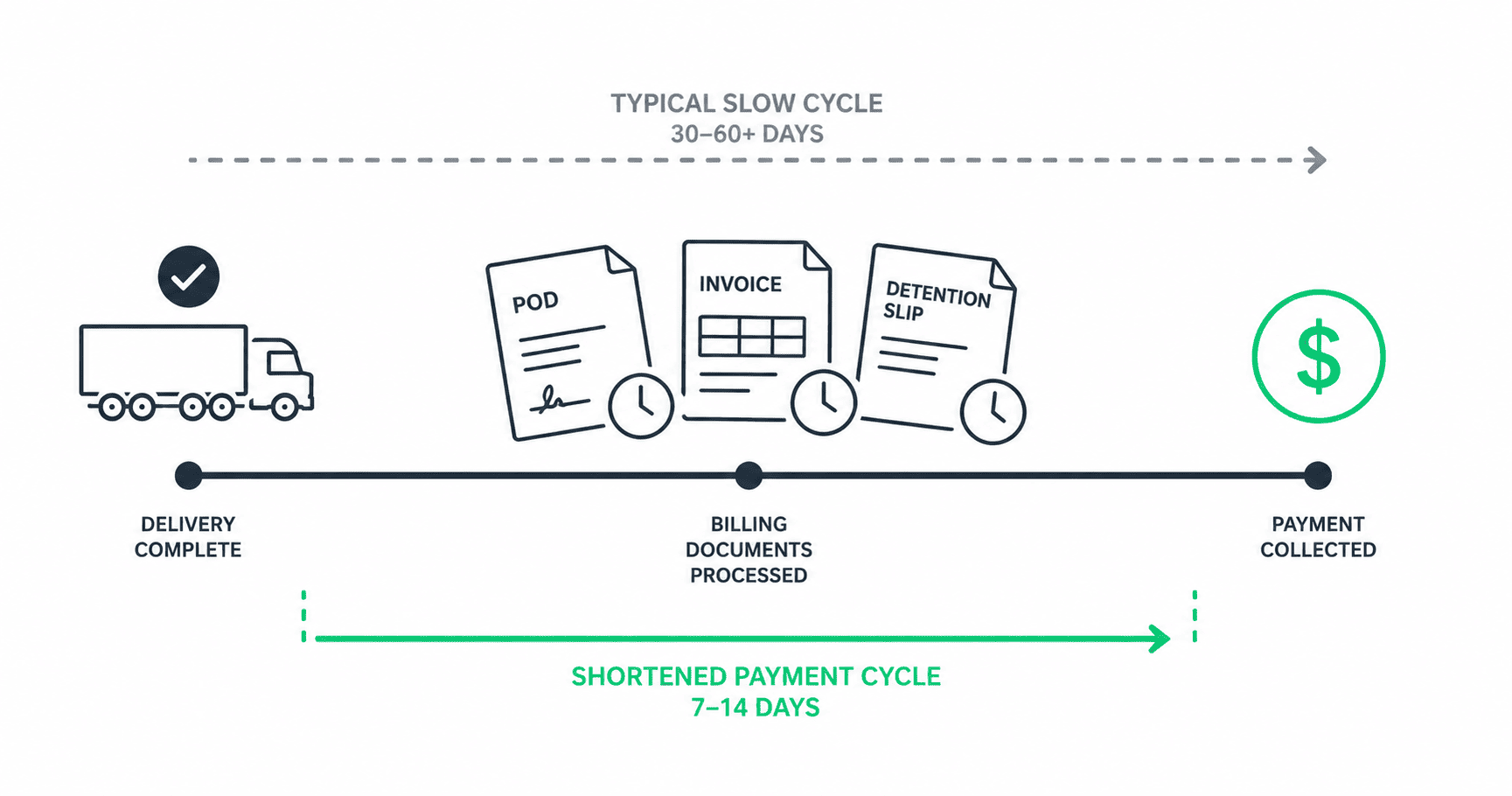
For a trucking company, the load is the easy part. The freight gets delivered, the driver moves on, and then the money takes weeks to show up. That gap between delivering and collecting is where carriers feel the squeeze, because fuel, payroll, and truck payments do not wait for a broker’s 30-day cycle. The good news is that most of the delay is process, not fate. Here is how trucking companies get paid faster without selling off margin to do it.
Why does invoicing the day of delivery get you paid faster?
The single biggest lever is the gap between delivery and a complete, submitted invoice. Most of that gap is the document. A broker or shipper will not pay without a signed POD, so if the POD takes three days to come off the truck and reach billing, the invoice is already three days late before anyone touches it. Tightening POD retrieval so the document is in hand the day of delivery is the difference between billing same-day and billing next week.
The invoice itself has to be clean: correct rate, the load and reference numbers the payer expects, and the POD attached. A clean invoice gets processed. An invoice with a missing number or no POD gets set aside, and nobody calls to tell you. It just sits. On the volume a busy carrier runs, a few days shaved off every invoice adds up to a meaningful shift in when cash actually lands.
How do you bill the detention and accessorials you earned?
Detention, layover, and other accessorials are real revenue, and they are some of the most commonly left on the table. The reason is documentation. A detention charge is only collectible if it was recorded when it happened, with arrival and departure times, gate records, or driver notes. If that backup is not captured at the dock, the charge is effectively gone by the time billing gets to the load. Our guide on capturing detention charges walks through where that breakdown happens and how to close it.
A short pre-billing review catches these before the invoice goes out. The question to ask on every detained or delayed load is simple: did we document it, and did we bill it? When the answer is no, that is margin the company earned and then gave away. Over a year, unbilled detention alone can add up to more than a truck payment.
How should you submit invoices so payers accept them the first time?
Brokers and shippers each have their own intake. Some take email, some require a portal, some want specific paperwork bundled with the invoice. Matching that on the first try avoids the back-and-forth that adds days. A correctly submitted invoice starts the payment clock. A rejected one restarts it, and the rejection often does not come with a phone call, so it can sit for a week before anyone realizes the invoice never landed.
When should you follow up on an unpaid freight invoice?
Once invoices are out, someone has to watch them. Receivables that are tracked and worked get paid faster than receivables nobody is following. That means knowing what is outstanding, which invoices are approaching terms, and which payers consistently run late, then following up on a steady cadence instead of waiting for the money to appear. This is the same DSO discipline brokers use, applied to a carrier book of payers. The carriers who get paid fastest are not the ones with the friendliest customers. They are the ones who follow up like clockwork.
Can you get paid faster without factoring?
Plenty of carriers reach for factoring or quick pay to bridge the gap, and sometimes that is the right call. But both trade a slice of every invoice for speed. Before paying that fee on every load, it is worth asking how much of the delay is actually the billing process: slow PODs, missed accessorials, invoices submitted wrong, and no follow-up. Tightening those costs nothing per load and shortens the same gap factoring is paid to bridge. For many carriers, fixing the process first means needing factoring on far fewer loads.
What does a clean back office look like for a carrier?
Put it together and the pattern is simple. PODs come off the truck and reach billing the day of delivery. Invoices go out clean, with every earned accessorial documented and billed. Each one is submitted the way that specific payer requires. And someone works the receivables on a steady cadence until they are paid. None of it is complicated. It just has to happen consistently, on every load, which is exactly what falls apart when dispatch and drivers are also expected to handle the paperwork.
Frequently Asked Questions
On standard broker or shipper terms, payment often lands somewhere in the 30 to 45 day range after a clean invoice is submitted, and longer when the invoice goes out late or gets rejected. The clock does not really start until a complete invoice with the POD attached reaches the payer, which is why closing the gap between delivery and invoicing matters so much.
Get the POD to billing the day of delivery, send a clean invoice with the right references attached, document and bill every detention and accessorial charge, submit each invoice the way that payer requires, and follow up on receivables on a steady cadence. Most of the delay carriers feel is process, and all of those levers are free to pull.
Factoring is selling your open invoices to a third party for immediate cash, minus a fee, usually on an ongoing basis, though spot factoring of single invoices also exists. Quick pay is a broker or shipper option to pay you sooner than terms in exchange for a discount. Both trade margin for speed. They can be worth it, but tightening your own billing process shortens the same wait without giving up a slice of every load.
In almost all cases, yes. Most brokers and shippers will not release payment until a signed proof of delivery is attached to the invoice. That is why slow POD retrieval is one of the most common reasons a carrier invoice sits unpaid, and why getting the document off the truck quickly is the highest-value habit in the whole billing cycle.
Detention is billable when it is documented at the time it happens, with arrival and departure times, gate or check-in records, or driver notes. The charge is then added to the invoice with that backup attached. Without the documentation, the charge is usually uncollectible, so capturing it at the dock, not at billing, is what makes detention actually recoverable.
It is typically priced by volume and scales with load count, so the cost tracks the work rather than a fixed salary, and it usually comes in below the cost of an equivalent in-house administrative hire once benefits and turnover are counted.
Keep the trucks moving and the cash moving too
Drivers and dispatch should not be buried in invoicing and POD chasing. ClearLane runs the back office for trucking companies: invoicing brokers and shippers, POD submission, detention and accessorial claims, and the follow-up that gets invoices paid. Request a demo to see how it would fit your operation. Or email us at info@getclearlane.com.