
Detention Charges: Why They Get Missed and How to Capture Every One
Why Are Detention Charges the Most Commonly Missed Accessorial?
Of all the accessorial charges that freight companies fail to capture on shipper invoices, detention is the most frequent. Not because the charge is complicated. The calculation is usually straightforward (hours beyond free time multiplied by an hourly rate). And not because the information doesn’t exist. The driver knows, dispatch knows, and the event is documented somewhere in the load file.
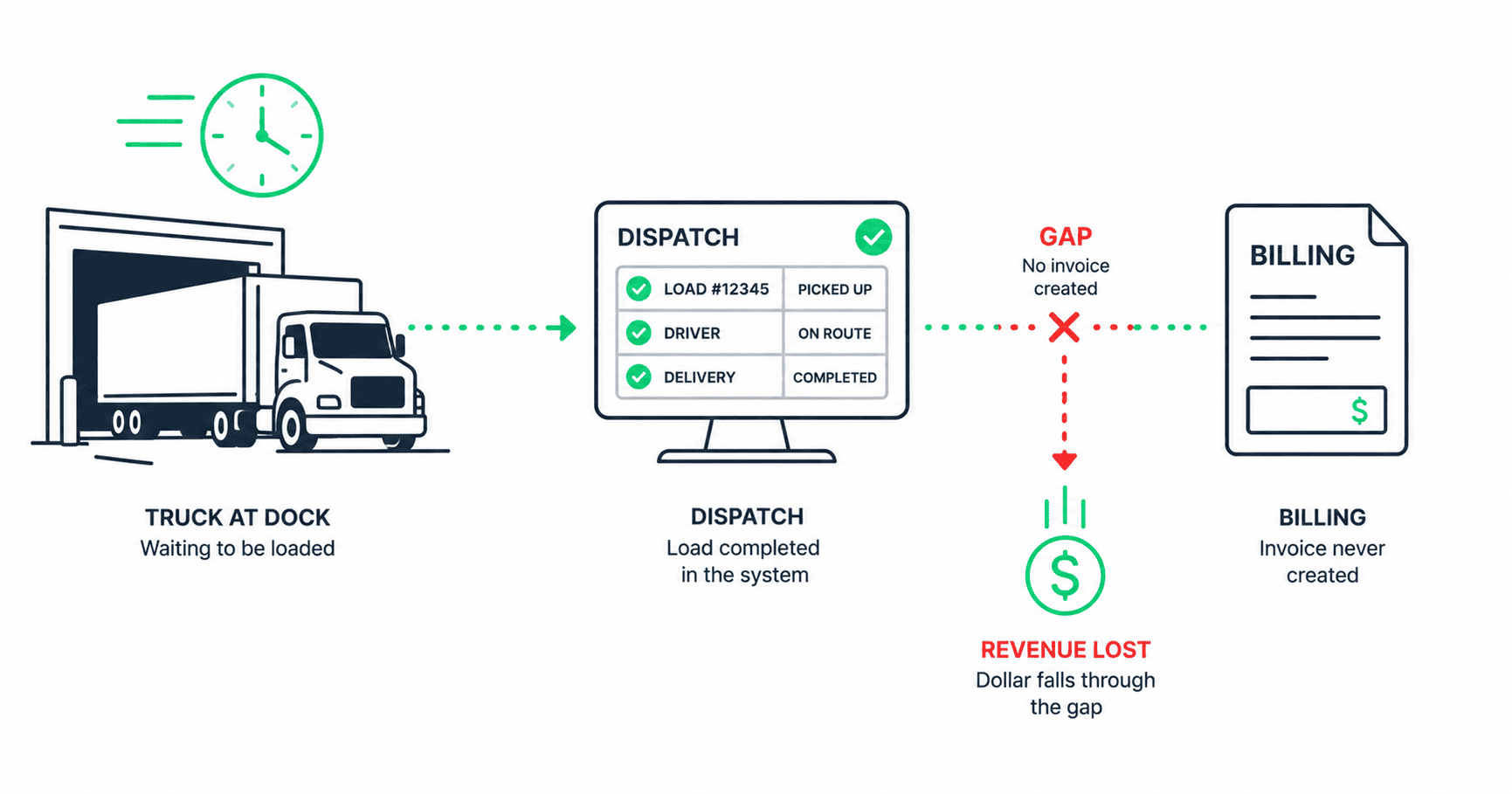
Detention charges get missed because of a structural gap in how information flows between dispatch and billing. The people who know about the detention event are not the people who build the invoice. And the information doesn’t always travel between them in a format that results in the charge appearing on the shipper invoice.
This post traces the detention charge from the moment it’s incurred to the moment it should appear on the invoice, identifies the specific points where it falls off, and describes what a reliable capture process looks like.
How Does a Detention Charge Get Incurred?
Detention occurs when a driver arrives at a shipper or receiver and is held beyond the agreed-upon free time window. The free time window is specified in the customer contract, typically two hours for loading or unloading, though it varies by contract and customer.
When the driver exceeds the free time, detention charges begin accruing. The rate is also specified in the customer contract, commonly $50 to $100 per hour, sometimes with a daily cap. The detention charge is billable to the shipper under the terms of the agreement.
The driver experiences the detention in real time. They’re sitting at a dock, waiting for a door assignment, waiting for product to be staged, waiting for paperwork to be processed. They know exactly how long they’ve been there, and they typically communicate the delay to dispatch through a phone call, text message, or TMS status update.
This is the point where the detention event is fully known and documented, at least informally. The driver knows the arrival time, the dock-in time, and the departure time. Dispatch has been told about the delay. The charge is calculable.
Where in the Process Do Detention Charges Get Lost?
The detention charge falls off the invoice through a series of handoff failures, none of which are dramatic, and all of which are predictable at volume.
The first failure point is documentation format. Dispatch receives the detention information in whatever format is fastest in the moment: a phone call, a text message, a verbal update. The dispatcher may log it in the TMS as a note, or they may not if they’re handling multiple loads simultaneously. The information exists, but it’s in dispatch’s world, in formats that the billing team may not systematically check.
The second failure point is the lack of a trigger mechanism. When the billing team pulls a load to prepare the shipper invoice, they work from the customer contract and the POD. The contract shows the base rate and the detention terms (rate per hour, free time window). But the contract doesn’t tell them whether detention actually occurred on this load. That information is in dispatch notes, driver check calls, or TMS status entries: sources the billing team doesn’t always review for every load.
If the TMS has a specific detention field that’s populated at dispatch level, the billing team will see it. If the detention information lives in a general notes field, a communication log, or outside the TMS entirely, it’s invisible to the billing workflow unless someone actively looks for it.
The third failure point is time pressure. Even if the billing team knows to check dispatch notes for detention events, doing so on every load takes time. At 3,000 loads per month, checking each load for potential detention adds 3 to 5 minutes per load, or 150 to 250 hours of additional work monthly. The billing team, already stretched processing the base invoice volume, doesn’t have that bandwidth. They process the base rate and move on.
The result: the detention charge, which was earned, documented, and billable, never makes it onto the shipper invoice. The margin on that load is permanently lower than it should be.
What Documentation Process Captures Detention Charges Consistently?
Capturing detention charges consistently requires building a documentation chain that connects the driver’s experience to the billing team’s workflow. The chain has four links, and each one needs to be reliable.
The driver documents the detention event at the time it happens. This means recording arrival time, dock-in time, free time expiration, and departure time. Some brokerages use driver apps or TMS mobile tools for this. Others rely on driver check calls where dispatch records the times. The key is that the times are captured contemporaneously, not reconstructed from memory days later.
Dispatch enters the detention data into a structured field in the TMS. Not a general note. Not a text message. A specific detention field that captures: the facility, arrival time, dock-in time, departure time, free time per the customer contract, and billable hours. This structured entry is what makes the detention event visible to the billing team. General notes don’t trigger billing actions; structured fields do.
The billing team checks the detention field as part of the standard invoice preparation workflow. This check should be systematic: part of the process on every load, not just loads where someone suspects detention occurred. The pre-billing audit is where this check happens most reliably, because the audit is specifically designed to catch billable charges that might otherwise be missed.
Supporting documentation is attached to the invoice. Shippers who pay detention charges want to see evidence: arrival and departure times, free time window reference from the customer contract, and the calculation showing billable hours. Without this documentation, the detention charge may be disputed, and defending a charge you can’t document creates more work than capturing it in the first place.
How Much Revenue Do Freight Companies Lose from Missed Detention?
The financial impact of missed detention depends on the brokerage’s load profile, lane mix, and customer base. But some general planning figures are useful for sizing the problem.
In our experience, detention events occur on roughly 10 to 20% of loads at a typical freight brokerage, meaning the driver is held beyond free time at the shipper or receiver. Not all of these result in billable detention charges (some are below minimum thresholds, some are within customer-specific tolerances), but a significant portion are billable under the customer contract terms.
If a brokerage is processing 3,000 loads per month and detention occurs on 15% of loads (450 loads), with an average billable detention charge of $100 per event, the total monthly detention revenue should be roughly $45,000. If the capture rate is 70%, meaning 30% of billable detention charges are missed, that’s $13,500 per month in lost revenue, or $162,000 annually.
At a 60% capture rate, the annual loss is $216,000. At 50%, it’s $270,000.
These are not extreme scenarios. For brokerages where the dispatch-to-billing handoff for detention is informal (notes-based rather than structured-field-based), a 50 to 70% capture rate is common. The charges aren’t being intentionally skipped. They’re simply not making it through the documentation chain.
Common Objections and Realities
Several common objections come up when freight companies consider tightening their detention capture process.
“Our customers won’t pay detention.” Some won’t, and the customer contract should reflect that. But many shipper contracts include detention terms that the shipper agreed to. The charge is contractually authorized. Not billing it is leaving contracted revenue on the table. If a shipper consistently refuses to pay contractually agreed detention, that’s a rate negotiation issue, not a billing process issue.
“Detention charges damage customer relationships.” Billing what the contract specifies shouldn’t damage a relationship. What damages relationships is surprise charges without documentation. When detention is billed consistently, with clear documentation, shippers can manage it internally, often by addressing the operational issues causing the delays. Inconsistent billing (sometimes you charge, sometimes you don’t) is what creates friction.
“It’s not worth the effort for $75 or $100 per load.” On a single load, maybe. Across 450 loads per month with detention events, the aggregate is significant. And the effort to capture detention consistently is almost entirely about building the documentation chain: a one-time process improvement that pays off on every subsequent load.
“Our TMS doesn’t have a detention field.” Most modern TMS platforms have accessorial charge fields or customizable fields that can be configured for detention tracking. If the TMS genuinely can’t accommodate a structured detention field, a simple tracking spreadsheet that the dispatch team populates and the billing team reviews can close the gap. The process matters more than the tool.
Building the Capture Process
For freight companies that want to improve detention capture rates, the implementation is straightforward:
Configure a structured detention field in the TMS. This is a one-time setup that makes detention events visible to the billing team. The field should capture arrival time, dock-in time, departure time, and billable hours.
Train dispatch to populate the field on every load where detention occurs. This is the behavioral change that matters most. Dispatch needs to enter the data in the structured field, not just log it in a note. The habit takes two to three weeks to establish if it’s reinforced consistently.
Add detention verification to the pre-billing audit checklist. Every invoice gets checked for potential detention, not just loads where the field is populated. The audit team should also check dispatch notes and driver communication logs for detention events that dispatch may not have entered in the structured field.
Attach supporting documentation to every detention charge. Arrival and departure times, free time reference, calculation of billable hours, and any relevant communication with the facility.
Track the capture rate monthly. Measure how many loads had detention events versus how many invoices included detention charges. The ratio tells you whether the documentation chain is working.
The pre-billing audit checklist on the ClearLane site includes detention verification as one of the standard audit checks. ClearLane’s pre-billing audit service checks every load for missed detention before the invoice goes to the shipper.
Frequently Asked Questions
Detention is the charge when a truck driver is held beyond the agreed free-time window at a shipper or receiver facility. Demurrage is the equivalent term in ocean and intermodal freight for container holding charges at a port or terminal. In truckload brokerage, detention is the relevant term. It’s billed per hour beyond free time per the customer contract.
Detention information lives in dispatch (driver check calls, text messages, TMS notes) but the invoice gets built in billing. The charge gets lost in the handoff because the information doesn’t travel from dispatch to billing in a structured, actionable format.
At a brokerage processing 3,000 loads per month with detention on 15% of loads and a 30 to 50% miss rate, the annual loss from missed detention alone is approximately $162,000 to $270,000.
Configure a structured detention field in the TMS (not a general note), train dispatch to populate it on every detention event, and include detention verification in the pre-billing audit checklist on every load.
Many shipper contracts include detention terms that the shipper agreed to. Not billing the charge means leaving contracted revenue on the table. Billing consistently with clear documentation is professional. Inconsistent billing creates more friction than consistent billing.
Detention is typically billed at $50 to $100 per hour after a free-time window (usually two hours for loading or unloading), with the exact rate and free time specified in the customer contract or rate confirmation. Some contracts add a daily cap. Because the terms live in those documents, the billable charge is only captured if the detention event is documented and flagged before the invoice goes out.
Questions about your detention capture rate? Talk to our team to see how ClearLane catches missed accessorials before billing. Or email us at info@getclearlane.com.
Related reading: rate volatility and billing accuracy. The charges are defined in the accessorial charge reference, and caught by the pre-billing revenue recovery audit.