
NVOCC back office: house bills, master bills, demurrage and per diem
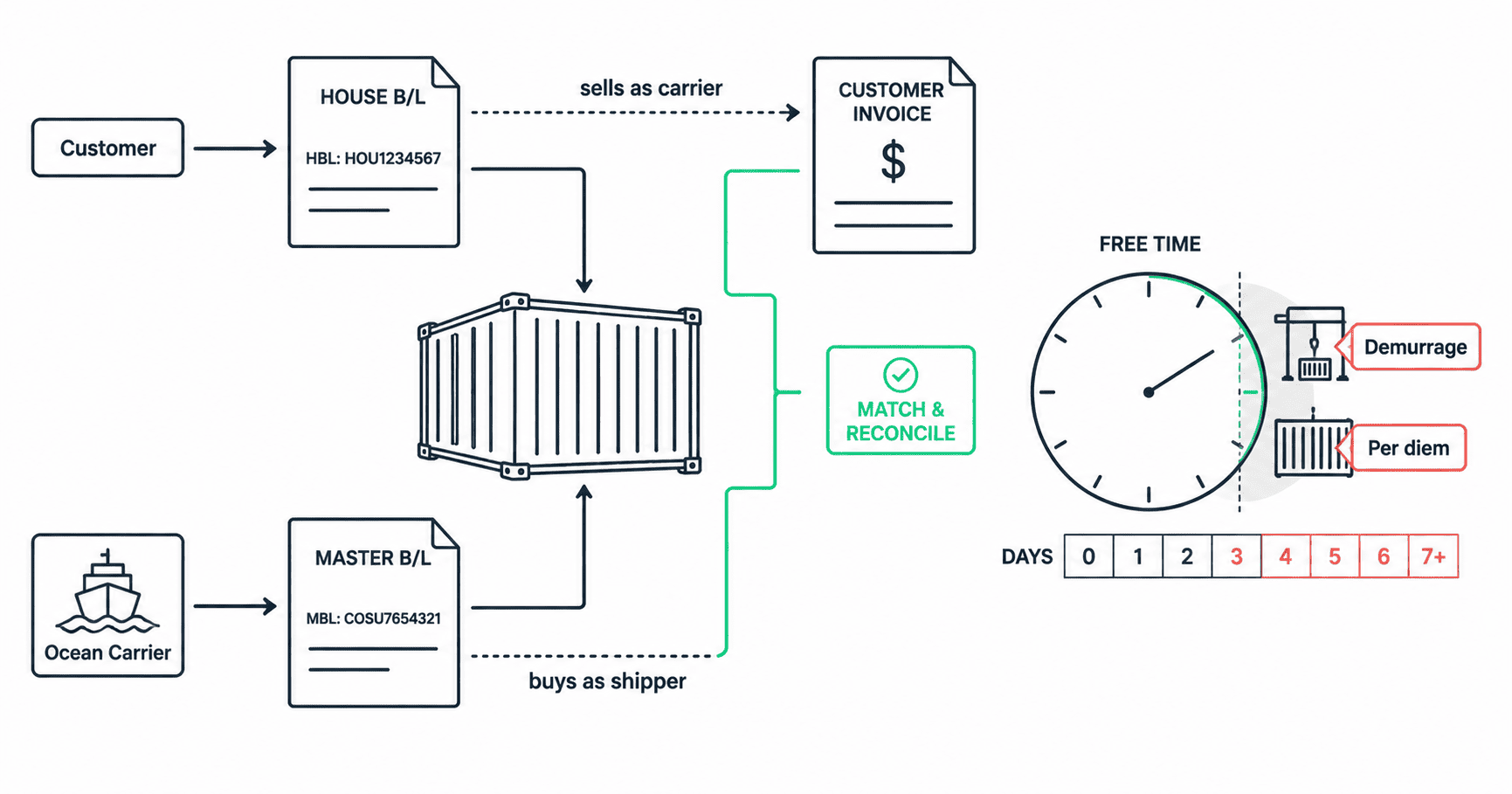
An NVOCC occupies a position no other logistics business does. It sells as a carrier and buys as a shipper, on the same container, at the same time. The customer receives a house bill of lading issued by the NVOCC. The ocean line issues a master bill to the NVOCC. Two documents, two reference systems, one box.
Everything difficult about the NVOCC back office follows from that, plus a second problem: the charges that decide profitability arrive after the container has already moved.
What does an NVOCC actually sell?
Transportation it does not operate. The NVOCC contracts with the shipper as the carrier, takes on carrier liability, and issues its own bill of lading. It then buys the physical movement from an ocean carrier under a service contract, appearing on that contract as the shipper.
The commercial model is the spread between the two. Space is bought in volume at contracted rates and sold in smaller units at higher rates, with the margin coming from the difference plus whatever local charges are handled. That makes accurate cost capture existential rather than administrative: the margin is the arithmetic between two documents, so if one side is incomplete, the margin figure is wrong rather than merely late.
Why is matching house and master bills so difficult?
Because they are not designed to match. The house bill exists for the NVOCC and its customer. The master bill exists for the ocean carrier and the NVOCC. They carry different numbers, different party names, and in consolidation, a different relationship entirely: one master bill covers many house bills.
That one-to-many relationship is where the work is. A single forty-foot container might carry consignments under eight house bills. The ocean freight arrives as one charge against the master. Allocating it back across eight house bills requires a basis, usually chargeable weight or measurement, and that basis has to be the same one used to quote each customer. If the container was quoted per cubic metre and the carrier billed per container, the allocation is a calculation rather than a lookup.
Local charges complicate it further, because some apply to the container and some apply to the consignment. Terminal handling is per container and gets allocated. A destination delivery order fee is per house bill and does not.
How do demurrage and per diem actually work?
These two get used interchangeably and are not the same charge.
Demurrage is charged for a container sitting inside the terminal beyond its free time, before it has been picked up. It is a terminal or carrier charge for occupying space.
Per diem, sometimes called detention, is charged for a container held outside the terminal beyond its free time, after pickup and before return. It is a charge for holding the carrier equipment.
A single container can incur both, sequentially, from the same carrier, under two separate free time allowances. Free time is defined in the service contract, varies by port, by carrier, by container type and sometimes by commodity, and is measured in calendar or working days depending on the agreement. There is no general rule that can be applied without reading the contract covering that container.
The operational problem is timing. These charges accrue while the container is in motion or sitting at a customer facility, and they are invoiced afterwards, often well after the NVOCC has already billed its customer for the shipment.
Who actually owes the demurrage?
This is the question that decides whether the charge is a cost or a pass-through, and it is answered by facts, not by the invoice.
If the container sat because the consignee did not collect it, the charge belongs to the consignee. If it sat because customs held it for examination, the answer depends on the terms agreed and often on who was responsible for the entry. If it sat because documentation was late, the answer depends on who was late. If it sat because the terminal had no appointment availability, that is frequently a shared or absorbed cost depending on the contract.
Establishing which applies requires the container timeline: discharge date, availability date, last free day, pickup date, return date. Reconstructing that timeline weeks later, from an invoice that states only an amount and a container number, is the single most common reason legitimate charges get absorbed instead of recovered.
What has to be checked on the ocean carrier invoice?
The base ocean freight should reconcile to the service contract rate for that commodity, that service and that validity period. Service contracts have windows, and a sailing that slips past one can be billed at a different rate than the one used to quote the customer.
Bunker adjustment and currency adjustment factors are formula-driven and should match the published factor for the sailing month rather than the invoice month. Surcharges for peak season, congestion, low sulphur fuel and equipment imbalance are each legitimate in the right circumstances and each worth confirming applied to that lane on that sailing.
Ocean transportation intermediaries operating as NVOCCs are licensed and bonded through the Federal Maritime Commission, and published tariff and service contract rules sit behind these charges. Requirements for licensing and financial responsibility are set out in 46 CFR Part 515.
How does the NVOCC accounts receivable side differ?
The NVOCC bills as a carrier, which changes the collection dynamic. Freight can be prepaid or collect, and on collect shipments the money is often gathered at destination by an agent rather than by the NVOCC directly. That introduces a settlement step between the customer paying and the NVOCC receiving.
It also introduces leverage most logistics businesses do not have. A carrier holds the cargo. Release of the delivery order can be conditioned on payment, which is a materially stronger position than chasing an unpaid invoice after delivery. Using it is a commercial decision, but the mechanism exists and it changes how aging should be worked. The general mechanics of working an aging ledger are covered in accounts receivable management.
What does a working NVOCC back office look like?
The shipment file is the container plus the house bills. Costs code to whichever level they belong at, and allocation runs on a stated basis rather than a judgement call made at month end.
Free time gets tracked forward rather than reconciled backward. Last free day is known when the container discharges, not when the demurrage invoice arrives. That is the difference between a charge that gets passed on with evidence and a charge that gets absorbed.
The container timeline is captured as it happens. Discharge, availability, last free day, pickup, return. Five dates, recorded contemporaneously, resolve the large majority of demurrage and per diem disputes.
And margin is measured per house bill. Not per container and not per month, because a container can be profitable overall while carrying two consignments that lost money. How this compares with other logistics models is set out in back office for logistics companies, and the ocean-specific terms are defined in the freight and logistics glossary.
What are the local charges, and who bills them?
Ocean freight is the headline number and rarely the complicated one. The complexity sits in local charges at both ends, billed by several parties on different schedules.
At origin: export haulage, terminal handling, container freight station consolidation where the shipment is less than container load, documentation and bill of lading fees, export customs clearance, and any inspection or fumigation the commodity requires.
At destination: terminal handling again, delivery order and release fees, deconsolidation for consolidated cargo, import customs entry, duty and tax disbursement, chassis charges in markets where the chassis is separate from the container, and final delivery.
Each one arrives from a different party. The terminal bills the party that contracted with it, which may be the carrier rather than the NVOCC, in which case it appears as a pass-through on the carrier invoice instead of as a direct bill. The same charge can therefore reach the desk by two different routes on two different documents, which is the mechanism behind most duplicate payments in this business.
How should chargeable weight disputes be handled?
Less than container load pricing runs on chargeable weight: the greater of actual weight or volumetric weight, calculated on an agreed conversion. The customer declares. The consolidator measures. The two frequently disagree.
The disagreement matters twice, because the NVOCC quoted the customer on the declared figure and is billed by the co-loader or carrier on the measured figure. If the measured figure is higher and the customer invoice already went out on the declared figure, the difference comes straight out of margin.
The workable approach is to hold the customer invoice until the measured figure is confirmed on lanes where discrepancies are common, and to state in the quotation that pricing is subject to remeasurement. Neither is complicated. Both require knowing which lanes and which customers produce the variance, which requires recording it rather than absorbing it.
What happens when a container is rolled?
A rolled container is one that does not load on its booked sailing, usually because the vessel is overbooked or a weight restriction applies. It goes on the next available service.
The back-office consequences are practical. Free time may or may not restart depending on the carrier and the reason. The service contract rate that applied to the booked sailing may not apply to the actual one if a validity window closed in between. Storage can accrue while the container waits. The customer expected an arrival date that will now be missed, and any charge arising from that miss has to be attributed.
None of this is exotic and all of it is invisible if the only record is a booking and an invoice. It is another argument for the container timeline being a maintained record rather than something assembled later from documents.
Frequently asked questions
The functions that run after an NVOCC books a container: matching house bills of lading to the master bill, allocating ocean freight and local charges across consignments, validating carrier invoices against the service contract, tracking free time so demurrage and per diem can be recovered, billing customers, and collecting on prepaid and collect terms.
Demurrage applies to a container sitting inside the terminal beyond its free time, before pickup. Per diem, also called detention, applies to a container held outside the terminal beyond its free time, after pickup and before return. The same container can incur both, sequentially, under two separate free time allowances.
On a stated basis, usually chargeable weight or measurement, and it has to be the same basis used to quote each customer. One master bill can cover many house bills, so a single ocean freight charge has to split across all consignments in the container. Charges that apply per house bill rather than per container are not allocated.
It depends on why the container sat. Consignee delay in collection normally makes it a consignee charge. Customs examination, late documentation and terminal appointment availability each fall differently depending on the terms agreed. Answering it requires the container timeline: discharge, availability, last free day, pickup and return.
Because the charge arrives after the customer has already been invoiced, and reconstructing who caused the delay from an invoice showing only a container number and an amount is difficult weeks later. Capturing the container timeline as it happens is what makes the charge recoverable.
Run the container file as one desk
ClearLane runs outsourced back-office operations for NVOCCs and ocean logistics companies, inside the system you already use. Request a demo or email us at info@getclearlane.com.