
Why 3PL Billing Gets Complicated: EDI, Multiple Modes, and Customer Rules
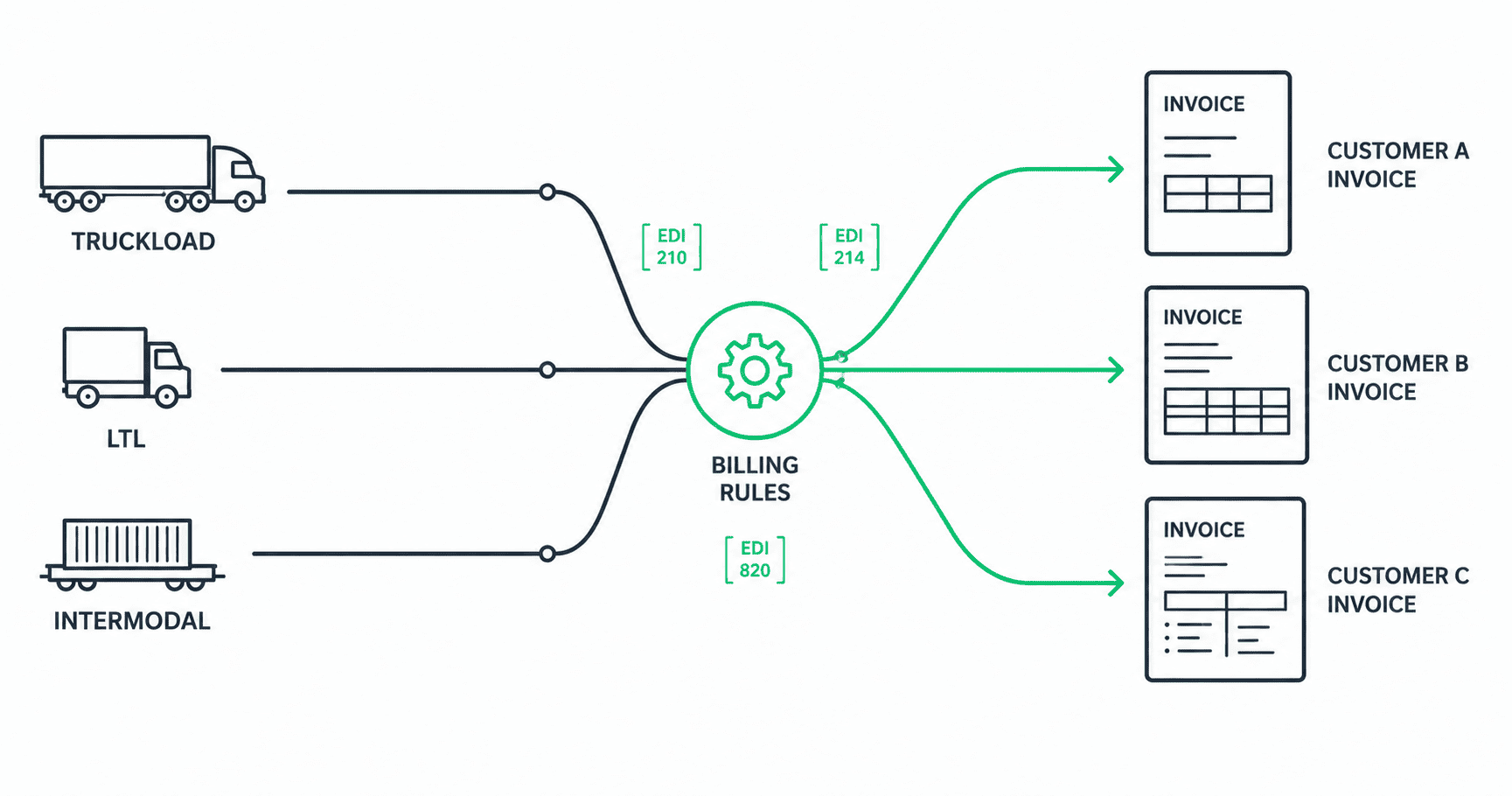
A freight broker bills a fairly consistent transaction: cover the load, deliver it, invoice the shipper, pay the carrier. A 3PL rarely has it that simple. Between multiple modes, dozens of customers, and customer-specific rules layered on top of everything, 3PL billing carries complexity a standard broker workflow never has to deal with. Here is where that complexity actually comes from, and why it is so easy to lose money in.
One customer, one rulebook. Now multiply that
Every 3PL customer tends to want invoices their own way. Different reference fields. Different backup documents attached. Different timing: weekly versus per load versus monthly. Different rules on which accessorials are billable and which get absorbed. On its own, each rulebook is manageable. The problem is that a 3PL runs ten to thirty of them at once, and the billing team has to know which rules apply to which load before the invoice goes out.
Picture two customers on the same lane. One pays detention automatically with a driver timestamp. The other requires a signed warehouse document and will reject anything without it. Bill them the same way and half of those invoices come back. A rejected invoice does not just cost the rework. It resets the clock on getting paid for that load, which is how billing complexity turns directly into higher DSO.
EDI and portals instead of email
Plenty of 3PL customers will not accept an emailed PDF invoice at all. They require submission through EDI or their own vendor portal, each with its own format and required fields. Getting EDI billing right means mapping each customer specification and submitting a complete, correctly coded invoice the first time. A single missing or mismatched field (a wrong code or a blank reference) can bounce the entire submission, and the load sits unbilled until someone notices and fixes it.
This is one of the quieter sources of 3PL billing delay. The work was done and the load delivered, but the invoice never cleared the portal, so the cash never started moving. Nobody rejected it in a way that lands in your inbox. It simply did not go through, and it stays invisible until someone audits what should have billed against what actually did.
Multiple modes, multiple sets of accessorials
A single 3PL move can touch ocean, rail, drayage, a warehouse, and final-mile trucking. Each leg brings its own documents, deadlines, and accessorials. Drayage carries chassis fees and per diem. Ocean and rail bring demurrage when free time runs out. Warehouse handling brings handling and lumper-type charges. Every one of those is billable, and every one is easy to miss when the charge happens on a different leg than the one the billing team is looking at.
The discipline that protects margin here is the same one that protects it for a broker: check the file for every billable charge before the invoice goes out, not after. The difference for a 3PL is simply that there are more legs, more documents, and more places for a charge to hide. A charge caught before invoicing is revenue. The same charge caught a month later is an awkward rebill that the customer may or may not accept.
Auditing the carrier and vendor side too
Complexity cuts both ways. Just as customer invoices have to be built correctly, the carrier and vendor invoices coming in have to be checked before they are paid. Carrier invoice audit matters more, not less, when a single shipment involves several providers, because that is more invoices to verify against what was actually agreed and delivered. On a multi-party move, an unaudited overcharge on one leg is easy to lose in the shuffle of everything else that shipment touched.
What getting it wrong actually costs
It is worth being specific about the price of all this complexity, because it does not show up as one big number. It shows up as a rejected invoice here, a missed accessorial there, a carrier overpayment buried in a multi-leg shipment, an invoice stuck in a portal for two weeks. Each is small. At the volume a 3PL runs, they compound into real margin and real delay. The 3PLs who feel it most are usually the ones growing fastest, because volume multiplies every one of these small misses.
Keeping it clean at volume
The 3PLs that bill cleanly are not the ones with simpler customers. They are the ones with a repeatable process: customer rules documented and applied consistently, a pre-billing review that catches missed accessorials across every leg, accurate EDI and portal submission, and steady follow-up on what is outstanding. None of that is exotic. It is disciplined shipper billing applied to a more complicated set of moves.
The reason it is worth getting right is that complexity is exactly where margin leaks. For a closer look at how delay alone drives the cash side of this, see our breakdown of the levers that reduce DSO. The same principles apply to a 3PL, with more moving parts to keep in order.
Frequently Asked Questions
A broker usually bills one consistent transaction per load. A 3PL often manages multiple modes, warehouses, and customer-specific rules at once, so a single shipment can carry charges and documents from several legs, each with its own deadline. More legs and more customer rules mean more places for a billable charge to be missed or an invoice to be rejected.
EDI, or electronic data interchange, is a standardized electronic format many larger shippers require instead of emailed invoices. The 3PL submits invoice data through EDI or the customer portal with specific codes and reference fields. If a required field is missing or miscoded, the submission can bounce, so accurate mapping to each customer specification is what keeps EDI invoices from getting stuck.
The reliable approach is to document each customer rulebook (which references they require, which backup documents, which accessorials are billable, and how often to invoice), then apply it consistently on every load. When those rules live only in one person’s memory, invoices get billed wrong and rejected. When they are documented and built into the billing process, rejections drop.
Detention, demurrage, per diem, chassis fees, and lumper fees are the usual suspects. They tend to slip because the charge happens on a different leg than the one billing is focused on, or because the supporting document arrives late. A pre-billing review of the full shipment file is what catches them before the invoice goes out.
Pricing is generally scope-based and scales with load count, so the cost tracks the work instead of a fixed salary. For most 3PLs it runs below the fully loaded cost of an equivalent in-house team, with no hiring or turnover to manage.
Yes, but not by working harder at the same manual process. Accuracy at volume comes from a repeatable system: documented customer rules, a pre-billing audit on every load, correct EDI and portal submission, and consistent AR follow-up. The 3PLs that stay clean at scale are the ones that built the process, not the ones with the most people.
Make complex billing boring
3PL billing will always be more involved than broker billing. It does not have to be a source of leakage. ClearLane runs the back office for 3PLs with the customer-specific rules, multi-modal accessorials, and EDI submission handled as routine work. Request a demo to see how it would fit your book. Or email us at info@getclearlane.com.