
What Revenue Are Freight Companies Losing Before the Invoice Goes Out?
There’s a category of financial loss at freight companies that doesn’t appear on any report: revenue that was earned but never billed. This isn’t bad debt or write-offs. It’s revenue that should have been on the shipper invoice and wasn’t: charges that were legitimate, documented somewhere in the load file, and missed during the billing process.
This revenue doesn’t show up as a loss because it was never recorded as income. There’s no line item for “detention charges we forgot to bill” or “fuel surcharge difference we didn’t catch.” The money simply never enters the financial system.
Industry benchmarks suggest that freight companies operating without a structured pre-billing audit process leave 2-5% of billable revenue uncaptured. On a $30 million book of business, that’s $600,000 to $1.5 million annually. On a $50 million book, it’s $1 million to $2.5 million.
A pre-billing revenue audit is the process designed to catch that revenue before the invoice goes to the shipper. This post explains how the audit works, where the revenue hides, and why this one step has a direct, measurable impact on margin.
What Does a Pre-Billing Revenue Audit Check?
A pre-billing audit happens after invoice preparation and before invoice submission. It’s a review step where someone (or a dedicated team) examines every shipper invoice against the full load file to verify that the invoice captures all billable charges.
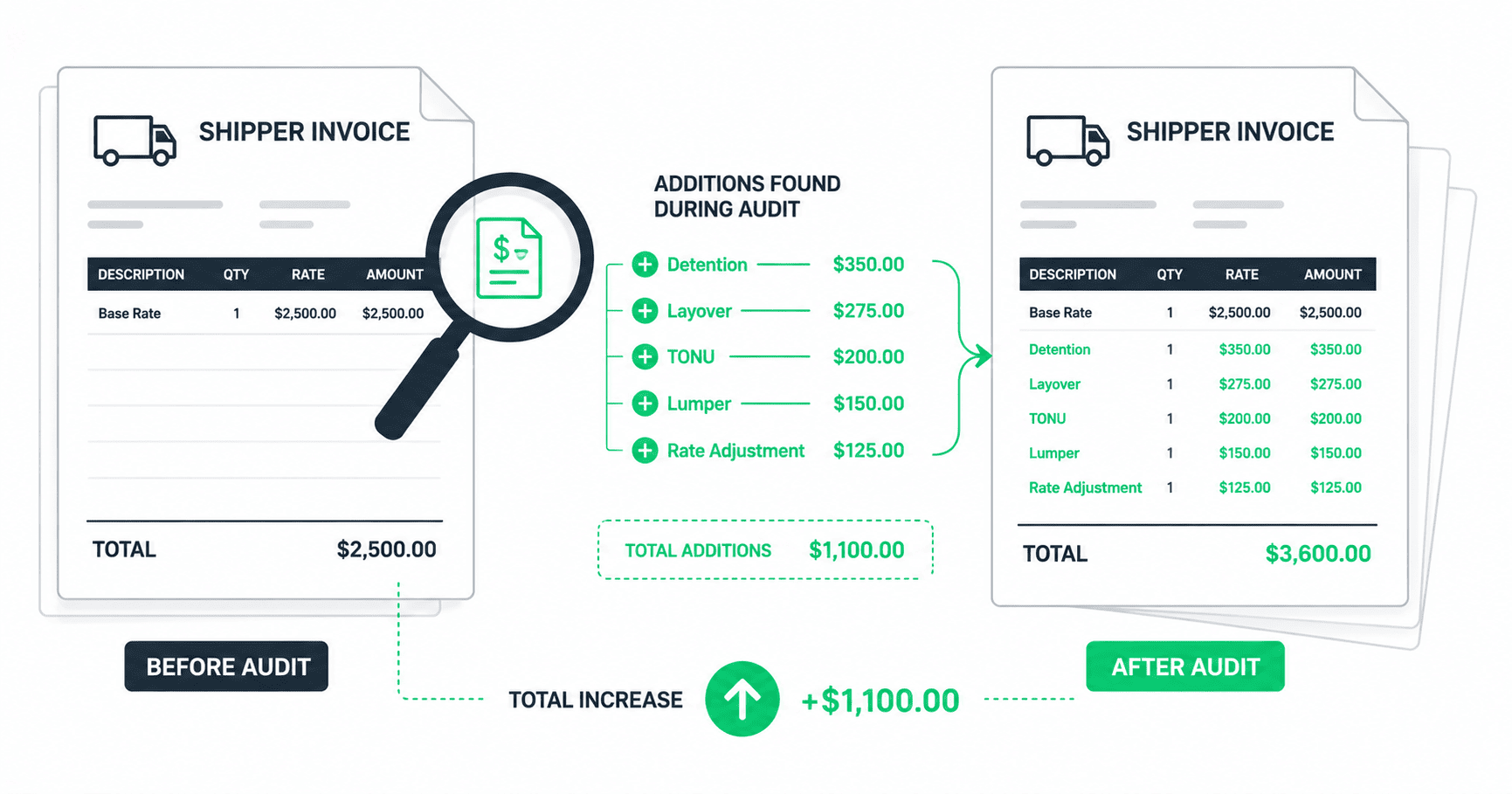
The audit checks five categories of revenue that routinely fall through the cracks between dispatch and billing.
Detention charges. When a driver is held at a shipper or receiver beyond the free time specified in the rate confirmation, the waiting time is billable. The information about the delay typically lives in dispatch: driver check calls, text messages, TMS notes. For the detention charge to make it onto the shipper invoice, that information needs to travel from dispatch to billing in a format the billing team can act on. The pre-billing audit checks dispatch notes and driver documentation against the rate confirmation’s detention terms to identify billable detention that isn’t on the invoice.
Layover charges. When a driver can’t deliver or pick up on the scheduled day and has to wait overnight, the layover is typically billable under the rate confirmation terms. Like detention, layover information lives in dispatch communications and may not reach billing in a structured format. The audit checks for loads where delivery or pickup was delayed and cross-references against the rate con’s layover provisions.
TONU (Truck Ordered Not Used). When a carrier is dispatched to a pickup and the load cancels or isn’t ready, the TONU fee is billable to the shipper per the rate confirmation terms. TONU events are documented in dispatch but can easily fall off the billing radar because the load didn’t actually move. Billing workflows are built around loads that did move.
Lumper fees. When a driver pays a lumper fee at a warehouse for loading or unloading, that fee is typically reimbursable and billable to the shipper. The documentation (a lumper receipt) needs to be attached to the billing file. If the receipt doesn’t make it from the driver’s paperwork to the billing team, the charge doesn’t make it onto the invoice.
Contract rate discrepancies. Rate confirmations specify a freight rate, fuel surcharge formula, and any accessorial terms. When rates change between loads on the same lane (a new contract rate, an updated fuel surcharge table), the billing team may use the previous rate if the TMS auto-populates from the last load. The pre-billing audit compares the invoiced rate to the current rate confirmation to catch any differences.
Why Do Accessorial Charges Get Missed Between Dispatch and Billing?
The pattern is the same across all five categories: the charge is earned, the information exists somewhere in the load file, but it doesn’t reach the billing team in a format that gets it onto the invoice.
The root cause is the handoff between dispatch and billing. Dispatch operates in real time, managing drivers, handling exceptions, solving problems as they happen. The information about detention, layover, TONU, and other events gets logged in whatever format is fastest in the moment: a TMS note, a text message, a verbal update, a scanned receipt.
Billing operates on documentation. To put a charge on a shipper invoice, the billing team needs a clear record: the charge type, the amount, the supporting documentation, and the rate confirmation terms that authorize it. If the dispatch information doesn’t arrive in that format, the billing team doesn’t have what they need to include it.
At a well-staffed brokerage with low volume, the billing team has time to dig through dispatch notes, check TMS comments, and piece together the documentation for each accessorial charge. At 2,000 to 4,000 loads per month, that level of investigation per load isn’t feasible. The billing team processes the base rate (which is always clear and documented) and moves to the next invoice. The accessorial charges that require additional research get left behind.
This isn’t a failure of effort or attention. It’s a capacity problem. The billing team is processing hundreds of invoices per week. Each invoice with a potential accessorial charge requires 10 to 20 minutes of additional research: checking dispatch notes, finding documentation, verifying rate con terms, and adding the charge to the invoice. Across a few hundred loads per month with accessorial potential, that’s 30-60 hours of additional work monthly. Most billing teams don’t have that bandwidth.
How Does a Pre-Billing Audit Recover Revenue?
A pre-billing audit adds a dedicated review step to the billing process. The audit team reviews every invoice, not just the ones that obviously have accessorial charges, against the full load file before the invoice goes to the shipper.
The review includes checking dispatch notes and driver communication logs for evidence of detention, layover, TONU, or lumper events. Cross-referencing any identified events against the rate confirmation terms to confirm they’re billable. Verifying that the invoiced rate matches the current rate confirmation. Confirming that all supporting documentation is attached. And adding any identified billable charges to the invoice before submission.
The revenue captured by this process is direct and measurable. Every detention charge added, every layover charge captured, every rate discrepancy corrected. These are dollars that would have been permanently lost without the audit. They’re not recoverable after the invoice goes out. Once a shipper invoice is submitted at the base rate, you can’t go back 30 days later and add a $400 detention charge. The revenue window closes at billing.
This is what makes the pre-billing audit different from a post-billing review or an accounts receivable (AR) analysis. Post-billing reviews can identify patterns and improve future processes, but they can’t recover revenue that was never billed. The pre-billing audit catches revenue in the only window where it can still be captured: before the invoice goes out.
What Is the ROI of a Pre-Billing Revenue Audit?
The return on a pre-billing audit is straightforward to calculate because the captured revenue is concrete.
A brokerage doing $30 million in annual revenue, processing 2,500 loads per month at an average of $1,000 per load, with a 3% unbilled revenue rate, is leaving roughly $900,000 per year on the table. If a pre-billing audit captures even half of that (a conservative estimate for a well-run audit process), that’s $450,000 in annual revenue recovered.
The cost of the audit depends on how it’s staffed. Adding dedicated in-house capacity for pre-billing review requires one to two FTEs at a fully loaded cost of $75,000 to $95,000 each. An outsourced audit as part of a broader post-dispatch service typically costs less for equivalent coverage because it’s bundled with other billing functions.
Either way, the math works in the same direction: the cost of the audit is a fraction of the revenue it recovers. The ROI is typically 3:1 to 5:1 or higher, depending on the brokerage’s load profile and accessorial frequency.
And the revenue recovery isn’t a one-time benefit. It recurs every month, on every load, as long as the audit process is in place. The $450,000 in the example above isn’t found once. It’s captured month after month, because the same revenue leaks happen on a percentage of loads every billing cycle.
The Pre-Billing Audit Checklist
Whether you build the audit capability in-house or bring in a dedicated team, the checklist for each invoice is the same:
Does the invoice include all detention charges supported by dispatch documentation and rate con terms?
Does the invoice include any applicable layover charges?
Has the TONU log been checked for loads that cancelled after dispatch?
Are all lumper fee receipts attached and billed through?
Does the invoiced freight rate match the current rate confirmation, not the rate from the previous load on the same lane?
Is the fuel surcharge calculated per the current formula, not the previous period’s rate?
Is the correct PO number, billing entity, and reference information on the invoice?
Is all required backup documentation (POD, BOL, accessorial receipts) attached?
The pre-billing audit checklist on the ClearLane site provides a more detailed version of this framework that you can use to evaluate your current billing process or to build an audit workflow.
Where This Fits in the Pipeline
The pre-billing audit isn’t a standalone function. It sits between invoice preparation and invoice submission: the last quality gate before the invoice goes to the shipper.
Upstream, it depends on POD retrieval and document completeness. The audit can only check documentation that’s available. If the POD hasn’t been retrieved, the lumper receipt hasn’t been uploaded, or the dispatch notes haven’t been entered into the TMS, the audit has less to work with.
Downstream, it directly affects billing accuracy, dispute rates, and DSO. An invoice that goes out complete (with the correct rate, all accessorial charges, and full documentation) gets paid faster than an invoice that triggers a dispute or requires supplemental documentation after the fact.
ClearLane runs a pre-billing revenue recovery audit on every load as part of the full post-dispatch pipeline. The same transaction data feeds into bookkeeping and reconciliation so the financial records stay current without a separate handoff. The same team handling POD retrieval, carrier invoice verification, and shipper billing also runs the pre-billing check, which means the audit has access to every document in the load file, including dispatch notes, carrier communications, and rate confirmation details.
Frequently Asked Questions
A pre-billing revenue audit is a review performed on every shipper invoice before submission, checking for missed accessorial charges (detention, layover, TONU, lumper fees, and contract rate discrepancies) that would otherwise be permanently lost once the invoice goes out.
Industry benchmarks suggest 2-5% of billable revenue goes uncaptured without a structured pre-billing process. On a $30 million book of business, that’s $600,000 to $1.5 million annually in charges that were earned but never billed.
The five main categories: detention charges from driver wait times, layover charges from overnight delays, TONU fees from cancelled loads, lumper fee receipts that didn’t reach billing, and contract rate discrepancies where the invoiced rate doesn’t match the current rate confirmation.
Once a shipper invoice is submitted at the base rate, the revenue window closes. You generally can’t go back 30 or 60 days later and add a detention charge or lumper fee. The charge had to be on the original invoice.
The ROI is typically 3:1 to 5:1 or higher. The cost of the audit is a fraction of the revenue it recovers. A brokerage doing $30 million annually with a 3% unbilled revenue rate can recover $450,000 or more per year.
Want to see how much revenue might be sitting uncaptured in your billing process? Request a demo to walk through the pre-billing audit with the ClearLane team. Or download the pre-billing audit checklist to evaluate your current process. Email us at info@getclearlane.com.