
Contract Rate Discrepancies: The Silent Margin Killer in Freight
Why Are Contract Rate Discrepancies the Least Visible Margin Leak?
Missed detention charges are visible: either the charge is on the invoice or it isn’t. Missing documentation is visible: the shipper rejects the invoice and tells you what’s missing. Wrong PO numbers are visible: the automated system kicks the invoice back immediately.
Contract rate discrepancies are different. They’re invisible in the normal billing workflow because the numbers on the invoice look right. The rate field is populated. The amount is reasonable. The invoice processes normally. The shipper pays. The load closes.
The problem is that the rate was wrong. Not dramatically wrong, but wrong by $20 or $35 or $50. And the wrongness came from a system behavior (TMS auto-population) interacting with a timing issue (the rate changed between loads), and nobody had a reason to question a number that looked plausible.
This makes rate discrepancies the least visible but potentially most persistent category of margin erosion in freight billing. Detention, layover, lumper fees, and truck ordered not used (TONU) are missed-event problems: an event happened and the charge was left off. Rate discrepancies are wrong-number problems: every load gets billed, but some get billed at the wrong amount. The per-load impact is smaller. The frequency is higher. And the aggregate is significant.
How Do Contract Rate Discrepancies Enter the Billing System?
Contract rate discrepancies enter the billing system through several mechanisms, all of which are predictable and preventable.
TMS auto-population from previous loads is the most common source. Most TMS platforms store rate data at the lane level and auto-populate rate fields when a new load is booked on the same lane. This is efficient: it saves the booking team from manually entering the rate on every load. But it means the rate in the TMS is whatever the rate was on the last load, not necessarily the rate on the current contract.
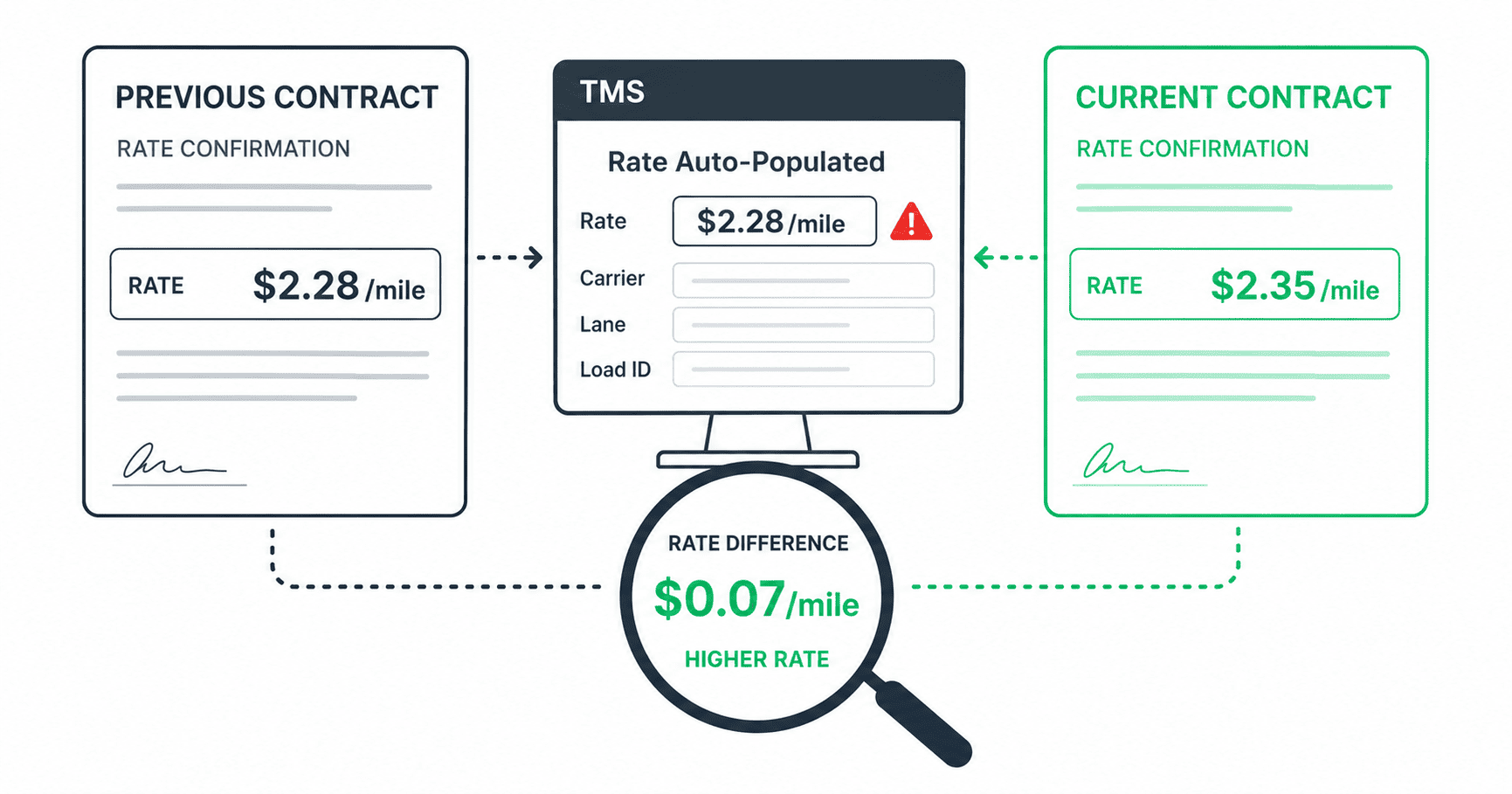
When a shipper contract renews with a rate increase, say, from $2.28 to $2.35 per mile on a specific lane, the new rate applies to all loads from the effective date forward. But the TMS doesn’t automatically update the lane-level rate data. Someone needs to enter the new rate. If the new rate is communicated by email, entered in a contract management system, or simply agreed verbally, it may not make it into the TMS until someone realizes the discrepancy.
In the meantime, every load on that lane gets booked and billed at the old rate. The TMS auto-populates $2.28. The billing team sees $2.28. The invoice goes out at $2.28. The shipper pays $2.28, and the brokerage leaves $0.07 per mile on the table.
Fuel surcharge formula changes create the same pattern. Shipper contracts specify a fuel surcharge calculated on a defined formula, typically tied to the DOE national average diesel price with a lookup table that translates the diesel price into a per-mile surcharge. When the formula or the lookup table changes between contract periods, the TMS may continue calculating on the old formula until someone updates the system.
The per-load difference on a fuel surcharge formula change is typically $10 to $40, depending on the load length and the magnitude of the formula change. On a 600-mile load, a $0.02/mile difference in the fuel surcharge calculation is $12. Across 3,000 loads per month, if even 10% are affected by a stale fuel surcharge formula, the monthly impact is $3,600, or $43,200 annually.
Accessorial rate changes are another source. Customer contracts include terms for detention, layover, and other accessorial charges, typically expressed as a dollar amount per hour or per day. When these rates change between contracts (detention goes from $50/hour to $75/hour, for example), the billing team may apply the old rate because that’s what’s in the TMS or in their reference material.
Minimum charge adjustments are easy to miss. Some customer contracts include minimum charges: a minimum linehaul amount or a minimum fuel surcharge. When the minimum changes between contracts, loads that fall below the threshold may be billed at the old minimum rather than the new one.
How Do Rate Discrepancies Affect Both Shipper Billing and Carrier Payment?
Rate discrepancies affect both sides of the freight transaction: shipper billing and carrier payment.
On the shipper billing side, the brokerage underbills when the invoiced rate is lower than the current contract rate. The revenue loss is permanent: the shipper was willing to pay the contracted rate, and the brokerage billed less. The shipper doesn’t flag underbilling errors. They pay what’s invoiced.
On the carrier payment side, the brokerage overpays when the carrier invoices at a rate above the rate confirmation and the accounts payable (AP) team doesn’t catch the discrepancy. Carrier invoice rates that are close to the expected amount ($30 or $50 above the rate con) often pass through verification because they don’t trigger the threshold that prompts a closer look.
The two sides compound. On a single load, the brokerage might underbill the shipper by $35 (old contract rate instead of new) and overpay the carrier by $25 (carrier invoice slightly above rate con). The margin on that load shrinks by $60, not because the rate was bad, but because the billing and payment processes used the wrong numbers.
How Much Do Contract Rate Discrepancies Cost Annually?
The aggregate impact of rate discrepancies depends on how frequently rates change and how quickly those changes are reflected in the TMS and billing workflows.
At a brokerage processing 3,000 loads per month, consider a conservative scenario: 8% of loads per month have a rate discrepancy on the shipper billing side (the invoiced rate doesn’t match the current contract rate), averaging $30 per load. That’s 240 loads × $30 = $7,200 per month in shipper underbilling, or $86,400 annually.
On the carrier side, 5% of carrier invoices have an undetected rate discrepancy averaging $25 per load. That’s 150 loads × $25 = $3,750 per month in carrier overpayment, or $45,000 annually.
Combined shipper underbilling and carrier overpayment: roughly $131,400 annually. This is margin that’s lost to data accuracy alone: the gap between what was agreed and what was invoiced. The rates were fine. The market was fine. The numbers just didn’t match.
In volatile rate environments, where rates change more frequently due to market conditions, fuel price swings, or mid-cycle contract adjustments, both the frequency and magnitude of discrepancies increase. The same brokerage might see 12-15% of loads affected with higher per-load discrepancies, pushing the annual impact well above $200,000.
Why Standard Billing Processes Miss Them
The fundamental challenge with rate discrepancies is that they don’t trigger any exception in the standard billing workflow.
When the billing team prepares an invoice, they typically work from the rate data in the TMS. If the TMS shows a rate, the billing team uses that rate. There’s no automatic check against the current contract document. The TMS is assumed to be correct.
On the AP side, carrier invoice auditing typically focuses on matching the carrier invoice to the rate confirmation for that specific load. If the rate confirmation shows $2.28 and the carrier invoices $2.28, the match passes. The question of whether $2.28 is still the correct rate for this lane under the current contract doesn’t come up in the standard verification workflow.
The only way to catch rate discrepancies consistently is to add an explicit verification step: on every load, compare the invoiced rate (both shipper and carrier side) against the current contract rate or rate agreement for this lane and customer: not the TMS field, not the previous load’s paperwork, but the actual current terms.
The Pre-Billing Audit Fix
Rate verification should be part of the pre-billing audit checklist, the quality gate between invoice preparation and invoice submission.
For every shipper invoice, the audit verifies: does the invoiced base rate match the current contract rate for this lane and customer? Does the fuel surcharge calculation use the current formula and the correct reference period’s diesel average? Do the accessorial rates (detention, layover, etc.) match the current contract terms? If there’s a minimum charge, does the invoice meet it?
For every carrier invoice, the verification mirrors the shipper side: does the invoiced rate match the rate confirmation for this specific load? Are accessorial charges authorized and at the correct rate? Is the fuel surcharge calculated correctly?
This verification takes 3 to 5 minutes per invoice when done manually against the contract document. At 3,000 loads per month, with a shipper invoice and a carrier invoice on each load, that’s 6,000 invoices and 300 to 500 hours of verification work, roughly two to three FTEs dedicated to rate verification.
Most brokerages don’t have that capacity available within the billing team. That’s why rate verification is typically performed as part of a broader pre-billing audit service, where a dedicated team verifies rates alongside PO accuracy, documentation completeness, accessorial capture, and billing entity correctness on every invoice.
ClearLane’s pre-billing audit includes rate verification on every load, both shipper and carrier side, as a standard check. The audit team compares the invoiced rate to the current contract rate (and, on the carrier side, the rate confirmation), flags any discrepancy, and corrects it before the invoice goes out or the carrier payment is approved.
Frequently Asked Questions
Contract rate discrepancies occur when the invoiced rate doesn’t match the current contract rate, usually because the TMS auto-populated from a previous load on the same lane after the rate changed, or because a fuel surcharge formula was updated but the system wasn’t.
At a 3,000-load brokerage, combined shipper underbilling and carrier overpayment from rate discrepancies is approximately $131,000 annually under conservative estimates, and can exceed $200,000 in volatile rate environments.
They don’t look wrong: the number in the TMS appears plausible because it’s close to the correct rate. A $30 difference per load doesn’t trigger manual review in the way a $300 error would. The only way to catch them is systematic verification against the current contract rate on every load.
The audit compares every line item on the invoice (base rate, fuel surcharge, accessorial rates) against the current contract rate for that lane and customer, not the TMS auto-populated field, which may be stale.
Industry surveys generally put freight broker gross margin in the 13-18% range per load, with net margins in the low single digits after payroll and overhead. That is why rate discrepancies hurt so much: a leak worth even a few tenths of a percent of revenue can consume a meaningful share of actual profit.
Want to see where rate discrepancies are hiding in your invoices? Talk to our team to walk through it. Or email us at info@getclearlane.com.