
Lumper Fees, Layover, and Other Revenue Your Invoices Are Missing
What Accessorial Charges Get Missed Besides Detention?
Detention charges are the most commonly discussed missed accessorial in freight billing, and for good reason. They’re the most frequent, the highest-dollar, and the most straightforward to understand. Driver waits, charge accrues, charge should be on the invoice.
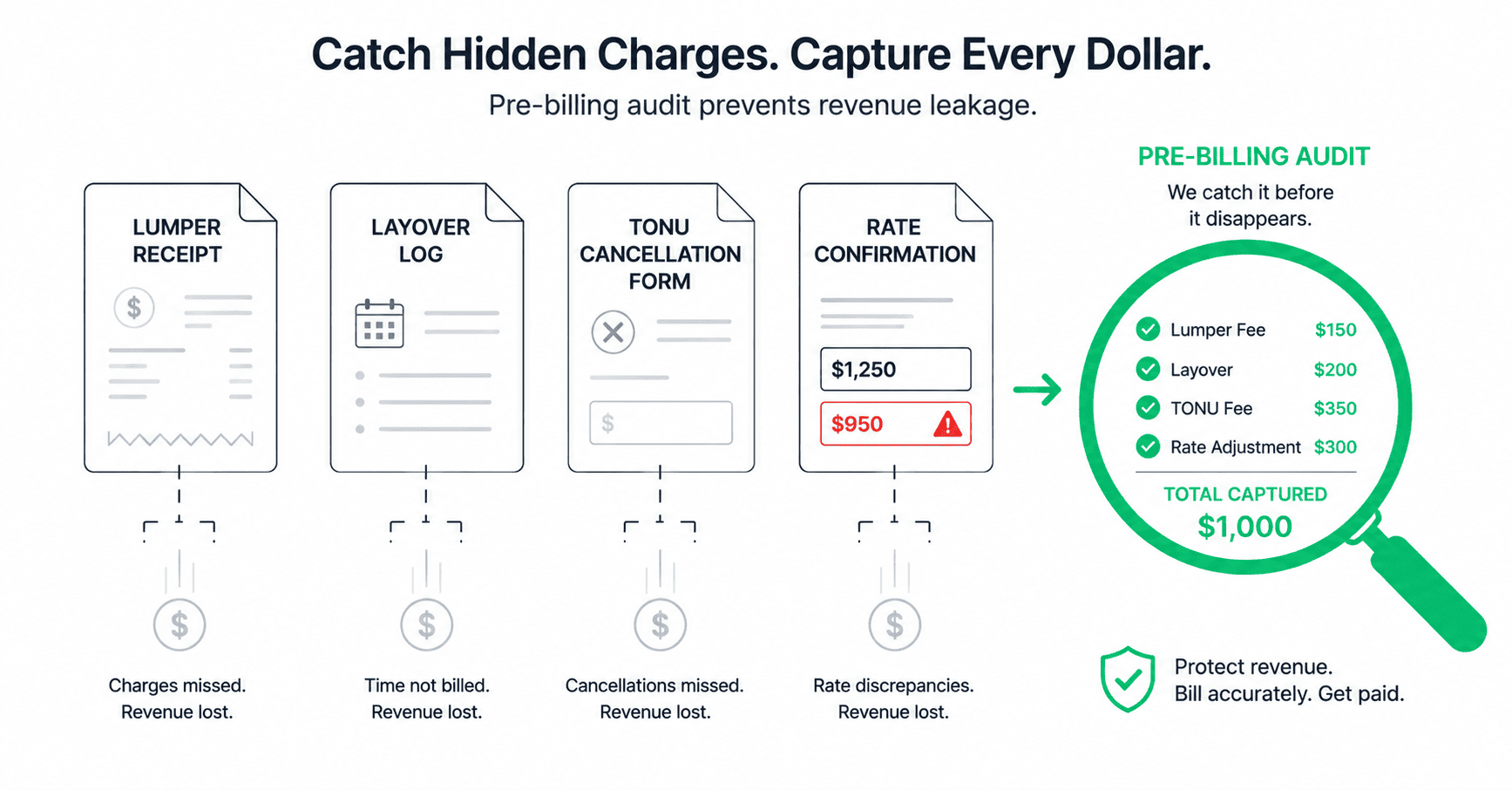
But detention is only one of several categories of billable revenue that routinely fail to make it onto shipper invoices. Lumper fees, layover charges, TONU fees, and contract rate discrepancies each follow a different path from the point where they’re incurred to the point where they should appear on the invoice. And each one gets lost in a different way.
This post covers the four non-detention accessorial charge types that freight companies miss most often, explains the specific documentation failure behind each one, and describes what it takes to capture them consistently.
Why Do Lumper Fees Get Lost Between the Driver and the Invoice?
A lumper fee is charged when a driver pays a third-party crew at a warehouse to load or unload freight. The fee is typically $100 to $400 per occurrence and is reimbursable to the driver and billable to the shipper under most customer contracts.
The documentation chain for lumper fees is physical. The lumper crew provides a receipt, often handwritten, sometimes a printed slip from a warehouse management system. The driver pays (either cash, a Comdata Comchek, or a third-party payment service) and receives the receipt. That receipt needs to travel from the driver’s cab to the billing team’s invoice file.
The failure point is almost always the physical handoff. The driver has the receipt. It goes into a pocket, a folder, or the glove compartment. If the brokerage has a process for drivers to photograph or scan receipts on-site (through a mobile app or a check-call process), the receipt enters the digital system near the point of transaction. If the process relies on the driver submitting paper receipts after delivery (mailing them, dropping them off, or handing them to a dispatcher), a percentage of receipts never arrive.
Without the receipt, the billing team has no documentation to support the charge. They may know a lumper was used (dispatch may have authorized the payment), but they can’t attach a receipt to the shipper invoice. So the charge gets left off. The driver was reimbursed for the lumper, the carrier was paid for the lumper, and the shipper was never billed for it. That’s margin loss equal to the full lumper fee amount on every load where the receipt doesn’t make it to billing.
The capture process requires closing the gap between the point of payment and the billing file. The most reliable method is same-day digital capture: the driver photographs the receipt at the warehouse and uploads it through a mobile tool or texts it to a designated number. The receipt enters the TMS or billing system the same day as the transaction, and the billing team can include it when preparing the invoice.
For brokerages that rely on paper receipt collection, a weekly reconciliation process helps: comparing loads where dispatch authorized lumper payments against the receipts in the billing file, and following up on any gaps before the shipper invoice goes out.
Layover: The Overnight That Doesn’t Get Billed
Layover charges apply when a driver can’t complete a pickup or delivery on the scheduled day and has to wait overnight, typically because the shipper or receiver wasn’t ready, the appointment was pushed, or a delay at a previous stop cascaded into the next one. The charge is specified in the customer contract, usually as a flat daily rate ($150 to $350 per day).
The documentation failure with layover is different from lumper fees. The information isn’t physical. It lives in dispatch communications. The dispatcher knows the driver couldn’t deliver on Tuesday and had to wait until Wednesday morning. That information is communicated through check calls, text messages, or TMS status updates.
The problem is that layover events often aren’t entered in a structured TMS field. Dispatch logs the delay as a note (“driver couldn’t deliver, rescheduled for tomorrow”) but doesn’t enter a formal layover event with the billable dates and rate. The billing team pulls the load to invoice. They see a completed delivery. The delivery date in the TMS shows Wednesday, which matches the BOL. There’s no indication that the driver was supposed to deliver Tuesday and waited overnight.
Without a structured layover flag, the billing team has no trigger to add the charge. The customer contract authorizes the charge. The delay happened. The driver waited. But the invoice goes out at the base rate because the layover event wasn’t surfaced in the billing workflow.
Capturing layover consistently requires the same approach as detention: a structured TMS field that dispatch populates when a layover occurs. The field should capture the original scheduled date, the actual date, the reason for the delay, and the applicable rate per the customer contract. The pre-billing audit then checks every load for layover events: not just loads where the field is populated, but also loads where the delivery date suggests a potential layover (delivery on a different day than originally scheduled).
Why Do TONU Charges Fall Out of the Billing Workflow?
TONU (Truck Ordered Not Used) is a cancellation fee charged when a carrier is dispatched to a pickup and the load cancels, isn’t ready, or can’t be loaded. The fee compensates the carrier for the deadhead and lost opportunity. It’s billable to the shipper under the customer contract terms, typically $150 to $500 per occurrence.
TONU has a unique documentation problem: the billing workflow is built around loads that moved. A load that cancels after dispatch may be marked as canceled or voided in the TMS, which means it may not appear in the billing queue at all. The billing team processes loads that have a delivery and a POD. A canceled load has neither.
The TONU fee exists in dispatch records. The dispatcher knows the carrier was dispatched, drove to the pickup, and the load canceled. The carrier will invoice the broker for the TONU fee. But the shipper billing side may not pick up the corresponding charge because the canceled load isn’t in the billing workflow.
Capturing TONU requires a separate process from the standard billing queue. The dispatch team or a dedicated audit function needs to maintain a TONU log: a record of every canceled load where a carrier was dispatched. Each entry on the TONU log should include the load number, carrier, cancellation reason, TONU amount per the rate confirmation, and the corresponding shipper billing status.
The pre-billing audit should cross-reference the TONU log against shipper invoices to ensure that every TONU charge paid to a carrier has a corresponding charge billed to the shipper. If the carrier was paid a TONU fee and the shipper wasn’t billed, that’s a direct margin hit.
Contract Rate Discrepancies: The Auto-Populate Trap
Contract rate discrepancies are the least visible of the missed revenue categories because they don’t involve a missing charge. They involve a wrong number.
The scenario: a brokerage moves freight on the same lane for the same shipper regularly. The shipper’s rate agreement for the most recent contract period specifies a rate of $2.35 per mile plus a fuel surcharge calculated on the current DOE average. The billing team pulls the load to invoice. The TMS auto-populates the rate field from the last load on this lane, but that load was under the previous contract, at $2.28 per mile. The billing team doesn’t catch the difference. The invoice goes out at $2.28 instead of $2.35.
On a 500-mile load, the difference is $35. Across 200 loads per month on lanes where rates recently changed, that’s $7,000 per month in underbilling, or $84,000 annually.
The same problem applies to fuel surcharge formulas. If the formula or the reference period changed between contract cycles, the TMS may be calculating the surcharge on the old formula. The per-load difference is small ($10 to $30), but the aggregate across thousands of loads is material.
Capturing rate discrepancies requires verifying the invoiced rate against the current customer contract rate on every load, not the rate in the TMS field (which may be stale). The pre-billing audit checklist should include this verification as a standard step: pull the current contract rate for this lane and customer, compare every line item (base rate, fuel surcharge, accessorial terms) against the invoice, and flag any difference.
How Much Revenue Do These Missed Charges Cost Annually?
Each of these four charge types (lumper fees, layover, TONU, and rate discrepancies) represents a smaller per-load amount than detention. But they occur frequently, and the aggregate revenue impact is significant.
To put a number on it for your own operation, the revenue leakage calculator converts monthly loads and average load value into an annual uncaptured-revenue range.
At a brokerage processing 3,000 loads per month, a reasonable estimate of the combined monthly impact might look something like this: lumper fees missed on 3% of loads at an average of $200 per occurrence ($18,000/month). Layover charges missed on 2% of loads at $200 per occurrence ($12,000/month). TONU fees missed on 1% of dispatched loads at $250 per occurrence ($7,500/month). Rate discrepancies on 5% of loads at $30 per load ($4,500/month).
Combined: roughly $42,000 per month, or $504,000 annually. These estimates will vary significantly by brokerage based on load mix, lane profile, and customer base, but the order of magnitude is consistent across mid-size freight operations.
Add detention misses (covered in the detention deep dive) and the total missed accessorial revenue is typically 2 to 5% of billings, the planning range we use in the pre-billing audit post.
One Audit, Five Charge Types
The common thread across all five charge types (including detention) is that the pre-billing audit is the last opportunity to catch them. After the invoice goes to the shipper, the charges are much harder to recover.
A pre-billing audit checks five things on every load: detention events in dispatch notes, lumper receipts in the documentation file, layover indicators in the delivery timeline, TONU entries in the cancellation log, and the invoiced rate against the current customer contract. That captures revenue that would otherwise be lost.
ClearLane runs this audit on every load before the invoice goes out. The same team handling POD retrieval, carrier invoice verification, and shipper billing also runs the pre-billing check, which means every document in the load file is accessible during the audit.
Frequently Asked Questions
Lumper fees (paper receipt handoff problem), layover charges (unstructured TMS field), TONU fees (canceled loads don’t enter billing queue), and contract rate discrepancies (TMS auto-populates old rates).
Combined monthly impact at 3,000 loads/month is roughly $42,000, or about $504,000 annually. Add detention misses and, in our experience, the total typically reaches 2-5% of billings.
The documentation chain is physical: a paper receipt from the warehouse needs to travel from the driver’s truck to the billing team’s file. Without same-day digital capture (driver photographs the receipt at the facility), a percentage of receipts never arrive.
A layover fee compensates a driver who cannot complete the scheduled pickup or delivery that day and has to wait overnight or until the next business day, usually because the shipper or receiver was not ready or the appointment was pushed. Like detention, layover is billable to the shipper under the customer contract, but it’s frequently missed because the delay lives in dispatch communications (check calls, texts, TMS notes) and doesn’t always reach the billing team in a structured format.
The audit reviews every load file against the customer contract before the invoice goes out, checking dispatch notes for detention/layover events, the documentation file for lumper receipts, the TONU log for canceled loads, and the invoiced rate against the current contract.
A lumper fee is a charge for third-party labor that loads or unloads a trailer at a warehouse or distribution center, most common in grocery and food-service receiving. The driver usually pays it at the dock and the charge passes back through the carrier to the broker or shipper.
Most facilities price by pallet count or by the trailer, and rates vary by market. A partial unload can run around $50 while a full trailer at a busy grocery DC can top $500. The receipt drives the math: without it, the pass-through usually cannot be billed.
The proof-of-payment document issued when the fee is paid. Billing teams need it to pass the charge through to the customer, which is why drivers should photograph the receipt before leaving the dock.
Sometimes. Some shippers allow driver unload or no-touch freight, and some carriers negotiate unloading into the linehaul rate. When the fee is unavoidable, the goal shifts to recovery: collect the receipt, bill the pass-through, and make sure it does not stall in the billing queue.
Want to estimate how much accessorial revenue your billing process might be missing? Talk to our team to walk through the pre-billing audit. Or download the pre-billing audit checklist to evaluate your current process. Email us at info@getclearlane.com.