
Freight Audit Companies vs a Full Back Office: Which Do You Need?
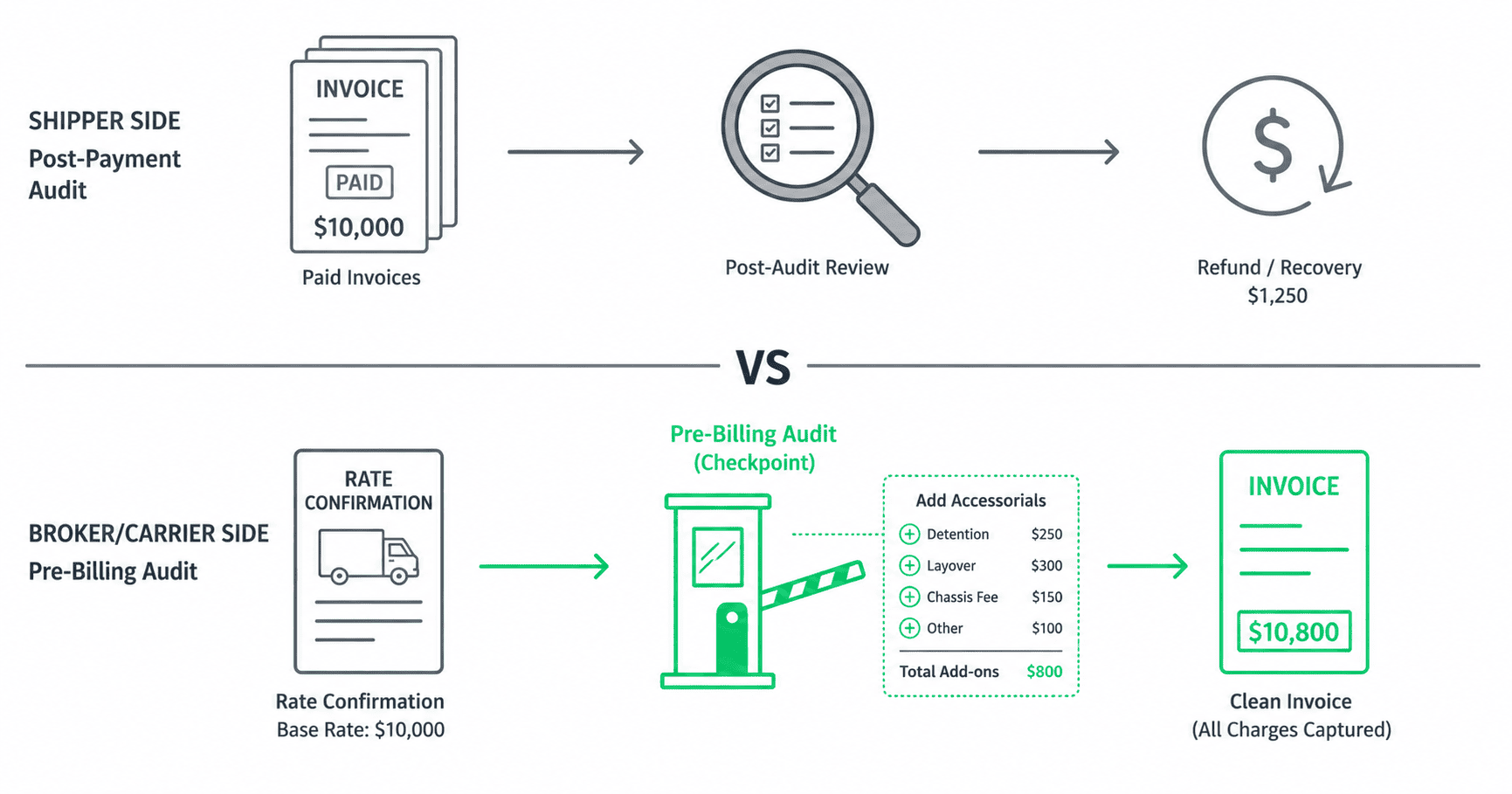
“Freight audit” means two very different things depending on which side of the load you sit on. The freight audit and payment guide breaks down both sides in detail. Shippers hire freight audit companies to check carrier invoices after the freight is paid. Brokers and carriers need something else entirely: a process that catches errors and missed revenue before the invoice ever goes out. Companies shopping for one often end up on sales calls with the other.
Here is the difference, who each type of provider actually serves, and how to tell which problem your operation has.
What do freight audit companies actually do?
Traditional freight audit and payment providers serve shippers. They take in carrier invoices, verify them against contracts and tariffs, flag overcharges, process payment, and report on freight spend. ClearLane runs that same cycle as managed freight audit and payment for shippers below the volumes the enterprise names require. Post-audit specialists go further back, re-examining paid invoices for recovery claims, usually working on a percentage of what they recover.
This is real, valuable work if you are a shipper paying thousands of carrier invoices against negotiated rate agreements. Import and export operations with ocean, air, and drayage invoices from a dozen vendors get similar value; that is why we built a dedicated freight AP audit workflow for importers and exporters.
What is a pre-billing audit, and why is it different?
A pre-billing audit runs on the other side of the transaction and at a different point in time: it reviews every load file before your invoice goes out. Rate confirmation against the customer invoice, POD attached and legible, and every accessorial documented and billed: detention, layover, TONU, lumper fees, reweighs, and permit charges. The full anatomy of the process is here.
The reason timing matters is simple: after-the-fact recovery is slow and adversarial, while pre-billing capture is just billing correctly the first time. Industry benchmarks put uncaptured revenue at 2-5% of billings for companies without a structured pre-billing process. On a $30 million book, that is $600,000 to $1.5 million a year that never becomes an invoice at all. No post-audit can recover money you never billed.
The two audits, side by side
Same word, opposite ends of the transaction:
| Freight audit company (shipper-side) | Pre-billing audit (broker-side) | |
|---|---|---|
| Who hires it | Shippers | Brokers, 3PLs, carriers |
| What gets audited | Carrier invoices you must pay | Your own invoice before it goes out |
| When it runs | After billing, often after payment | Before the invoice leaves |
| Money it protects | Overpayment recovery on freight spend | Detention, layover, TONU, lumper and rate discrepancies still billable |
| Typical outcome | Credits and refunds recovered later | Revenue captured on the original invoice |
| Representative names | Cass, CTSI-Global, Trans Audit | Managed back-office providers running your billing |
The timing row is the one that moves money. A shipper-side audit recovers an overcharge months after payment, minus the audit fee. A pre-billing catch goes out on the original invoice at full value, with no recovery cycle at all. On a brokerage moving 1,500 loads a month at a $1,000 average, even a 1% capture of otherwise-missed accessorials is $15,000 a month that never has to be chased. The charge categories involved are itemized in the accessorial charge reference, and the checks themselves in the pre-billing audit checklist. Recovery figures on this site are a share of accessorial-eligible charges, not of total revenue; the denominator is defined on the methodology page.
Which one does your operation need?
- You are a shipper paying carrier invoices against contracts: a freight audit and payment provider fits. Names like Cass Information Systems, CTSI-Global, and Trans Audit operate in that lane.
- You are a broker: you need both directions covered before money moves. Carrier invoice verification on the payable side so you do not overpay carriers, and a pre-billing revenue audit on the receivable side so customer invoices capture every earned charge.
- You are a carrier billing shippers or brokers directly: your leak is usually accessorial documentation. Wash-outs, detention at the rack, tarping charges. The fix is a billing process that assembles backup before invoicing, not an audit afterward.
Can one provider handle both sides?
For brokers and carriers, the audit is most effective when it is embedded in the billing workflow rather than bolted on afterward. The same team that chases the POD is the team that notices the detention timestamps while the driver notes are still fresh. Split those functions across vendors and the gap between them is where charges disappear. That is the design argument behind running audit, billing, and accounts receivable (AR) as one workflow instead of as separate services.
What does each approach cost?
Post-audit firms typically work on contingency, taking a share of recovered overcharges. Freight audit and payment providers price per invoice or per shipment. An embedded operations model like ClearLane prices on freight volume, which covers the audit plus the billing and collections work around it. When comparing, count both sides: what you save on overpayments and what you capture in previously unbilled revenue.
Can you run post-audit and pre-billing audit together?
Yes, and mature operations often do, because they cover different failure surfaces. The pre-billing audit protects revenue you are about to invoice; a post-audit sweep catches overpayments that already left, including historical ones a new process cannot reach back and fix. If you are sequencing, fix pre-billing first: prevention compounds every week it runs, while recovery is a one-time harvest that shrinks as your front-end process improves.
The practical division of labor: run continuous pre-billing and carrier invoice verification as part of daily operations, and commission a post-audit look-back once a year or after known turbulence, like a TMS migration or a billing team turnover. When the annual look-back starts coming home nearly empty, that is not a failed audit; that is the audit telling you the daily process works.
Frequently Asked Questions
Freight audit reviews carrier invoices after freight moves, and often after it is paid, to catch overcharges. A pre-billing audit reviews your own outbound invoices before they are sent, so missed accessorials and documentation gaps are fixed while the charges are still billable. One recovers money you overpaid; the other captures money you earned but never billed.
Brokers need the function, but in a different shape. A broker verifies carrier invoices against rate confirmations before paying, which is carrier invoice audit, and audits customer invoices before sending, which is pre-billing audit. Traditional shipper-side audit firms are not built for either workflow inside a brokerage TMS.
Industry benchmarks suggest 2-5% of billable revenue goes uncaptured without a structured pre-billing process, mostly detention, layover, TONU, lumper fees, and rate discrepancies. The capture rate depends on how disciplined dispatch notes and document collection are.
Yes, with a documented checklist and dedicated review time it is absolutely doable in-house. The constraint is usually capacity: a consistent audit on every load requires one to two FTEs at a fully loaded cost of $75,000 to $95,000 each. That is the build-vs-buy math, not a capability question.
No. Freight bill auditing is the shipper-side service: checking carrier invoices against contracts after the freight moves. A pre-billing audit reviews your own outgoing invoice before it leaves, so billable charges are captured rather than recovered.
Want to see what a freight-specialized back office looks like on your loads? Request a demo. Or email us at info@getclearlane.com.