
Freight Audit and Payment: What Gets Checked, Who Runs It, and What It Saves
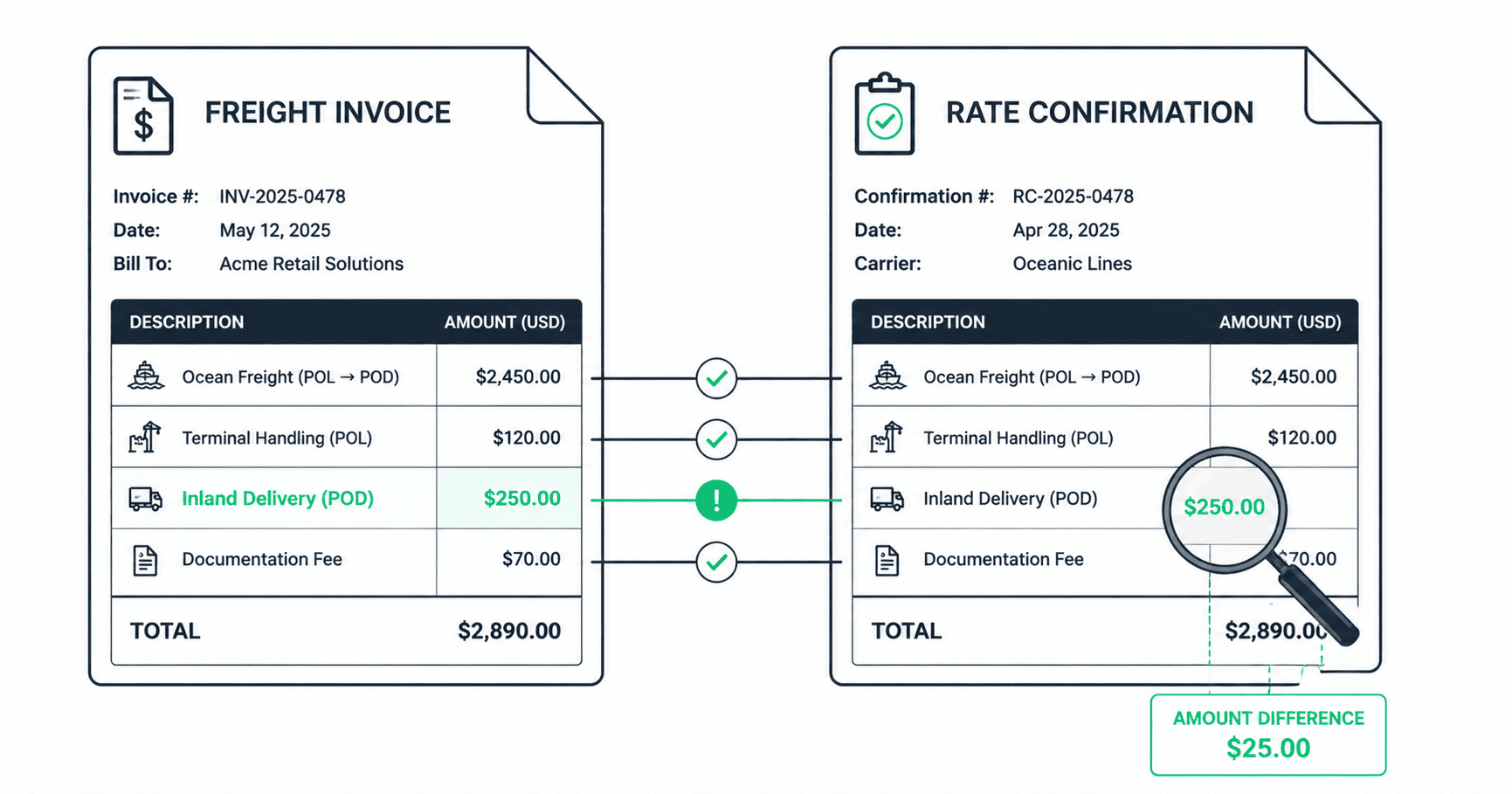
A freight audit is the process of verifying that a freight invoice matches what was actually agreed and what actually happened on the load. Every charge gets checked against the rate that was contracted, the services that were performed, and the documents that prove it. Done before payment, it stops overcharges from leaving your account. Done before your own invoice goes out, it stops earned revenue from going unbilled.
That second half surprises people. Most articles about freight auditing are written for shippers with big parcel and LTL spend. But the audit works in both directions, and for brokers, 3PLs, and carriers, the revenue side is often where the larger money sits. This guide covers both.
What is a freight audit?
A freight audit compares three things on every shipment: the invoice, the agreement, and the evidence.
The invoice says what the carrier wants to be paid. The agreement, usually a rate confirmation or contract tariff, says what was actually negotiated. The evidence, meaning the POD, timestamps, weight tickets, and receipts, says what actually happened. When all three line up, the invoice is clean. When they do not, the audit catches the gap before it becomes a payment.
The gaps are rarely dramatic. A fuel surcharge calculated on the wrong week’s index. A detention charge with no arrival and departure times behind it. The same load billed twice under two different pro numbers. An accessorial billed at the carrier’s list rate instead of the agreed one. Individually these are small. Across thousands of loads a year, they compound into real margin, which is why the audit is a standing process rather than a cleanup project.
What is freight audit and payment (FAP)?
Freight audit and payment is the shipper-side version of this work, usually run at enterprise scale. A FAP provider receives all of a shipper’s carrier invoices, audits them against contract rates, pays the carriers on the shipper’s behalf, and feeds the cleaned data into spend analytics. The large providers in this market are built for companies spending tens of millions a year on transportation across hundreds of carriers. Shippers below that tier are not locked out of the model: a managed desk can run freight bill audit and payment for shippers without the enterprise minimums.
That model solves a shipper’s problem. It does not map cleanly onto how a freight brokerage or a trucking company works, for one structural reason: a broker sits in the middle of two invoices. Money flows out to carriers and in from shippers, and both directions can leak.
On the payables side, the broker’s audit is a carrier invoice audit: every carrier bill checked against the rate confirmation before payment. On the receivables side, the audit runs before billing, catching detention, layover, TONU, and lumper charges that were earned on the load but never made it onto the shipper invoice. Freight operations call that a pre-billing revenue audit, and it recovers money that no payables audit will ever see, because the error is an invoice that was never sent.
So when you evaluate freight audit and payment services, the first question is not which provider. It is which side of the ledger you are trying to protect, because the enterprise FAP firms, the audit software vendors, and the managed freight-audit desks are each built for a different answer.
What does a freight audit actually check?
The checks vary by mode, but the core sequence is consistent. On the payables side:
Linehaul goes against the rate confirmation or contract rate, not against the invoice. The distinction matters because the invoice is the claim being tested, and it cannot be its own proof.
Fuel surcharge goes against the agreed formula and the right index week. Most surcharge schedules key off the Department of Energy’s weekly diesel price, so a surcharge is verifiable to the penny if you know which week and which base rate applies.
Accessorials go against their backup. Detention lives or dies on arrival and departure timestamps. A lumper fee needs the receipt, matched to the receiver rather than the carrier. A TONU needs the cancellation time against the rate confirmation. A charge without a document behind it is a claim, and claims get worked, not paid.
Duplicates go against payment history. Re-submissions under a second pro number, invoices that arrive weeks after the original was paid, and balance-due bills all get screened at the door. Federal law backs the audit here: under 49 U.S.C. 13710, a motor carrier has 180 days from receipt of the original bill to issue charges beyond what it first billed. A reweigh or balance-due invoice that shows up past that window is not just annoying. It may not be collectible.
LTL adds a layer of its own. Freight class and NMFC codes get verified against the BOL and the quote, reweigh certificates get compared to the original weight, and dimensional pricing gets checked against actual dimensions. Class-based billing has more fields that can go wrong per invoice than any other mode, which is why auditing LTL freight is its own discipline.
On the revenue side, the checks invert. Instead of asking whether a charge on an incoming invoice is supported, the audit asks whether every billable event on the load made it onto the outgoing one. Driver notes mention two hours at the dock; is detention on the invoice? Dispatch approved a lumper on the phone; did the receipt reach billing? The full list of checks in both directions is in the freight invoice audit checklist, which is free and printable by freight type.
What are freight audit and payment best practices?
Five practices separate audits that recover money from audits that generate reports.
Audit before money moves, in both directions. A pre-payment audit turns an overcharge into a correction. A post-payment audit turns it into a recovery, and recoveries succeed far less often because you are now asking a carrier to return money it already holds. The same logic applies to revenue: a charge caught before the shipper invoice goes out is billing, and one caught after is a rebill that ages your receivable and annoys your customer.
Audit every invoice, not a sample. Sampling assumes errors are random. Freight billing errors are not random; they cluster around specific carriers, specific lanes, and specific charge types. A sample audit finds the average. A full audit finds the pattern, and the pattern is where the money is.
Anchor every check to a document. Rate confirmation for the rate, timestamps for detention, receipts for lumpers, certificates for reweighs. An audit that relies on judgment rather than paper produces disputes that stall. An audit that attaches the proof produces disputes that close.
Work discrepancies to a conclusion. An exception that gets flagged and then paid anyway is worse than no audit at all, because it costs effort and saves nothing. Every held invoice should end in one of two states: paid correctly or formally credited.
Feed the findings back. If one carrier accounts for a third of your fuel-surcharge discrepancies, that is a conversation, not a coincidence. The audit’s byproduct is a clean dataset on who bills accurately, and that data should inform routing and negotiation. Auditing without acting on the pattern leaves the cheapest fix, prevention, on the table.
Should you outsource freight audit and payment or run it in-house?
The honest answer depends on volume and consistency, and the trade is worth laying out plainly.
In-house works when someone can genuinely check every invoice line by line, every day, including vacation weeks and surge months. A disciplined accounts payable (AP) clerk can hold that line at a few hundred loads a month. The failure mode is not skill but deadline pressure: when carriers need to be paid on time and the queue is deep, the line-by-line comparison is the first thing that quietly gets skipped, and skipped audits do not announce themselves. They show up two quarters later as margin that left without a trace.
Outsourcing buys consistency. A dedicated audit desk runs the same checks on every invoice regardless of what the week looks like, and it scales with load count instead of with a hiring plan. The evaluation question that cuts through most vendor marketing: ask any provider what they check before approving a detention charge, and listen for whether the answer includes timestamps and free time. A generalist BPO processes invoices. A freight-specialized desk defends them line by line. There is more on that distinction in our guide to verifying carrier invoices before payment.
Software is the third option, and it solves a different problem. Audit software flags exceptions well: rate mismatches, duplicates, missing fields. What it does not do is work the exception, which means calling the carrier, pulling the backup, and following the dispute until it resolves as a credit. If your team has capacity to work a queue, software multiplies them. If the queue is the problem, software gives you a better-organized backlog. Many operations land on a hybrid: software for detection, a managed desk for resolution.
A reasonable way to decide: under roughly 500 loads a month with a stable carrier base, in-house discipline plus a good checklist can hold. Past 1,000 loads, or with LTL and drayage in the mix, the error surface outgrows spare-time auditing and a dedicated desk starts paying for itself.
What does a freight audit save?
In our experience, carrier invoice discrepancies run in the low single digits as a share of AP spend. On 2 million dollars a month in carrier payments, even one percent is 240,000 dollars a year of overbilling exposure, and that is before the revenue side. Unbilled accessorials on the receivables side are harder to benchmark precisely because the evidence is an invoice that never existed, but on freight averaging 1,000 dollars a load, a single missed detention charge per hundred loads adds up quickly.
The savings arrive in three forms. Direct recovery: overcharges caught and credited, missed charges billed. Prevention: carriers bill more carefully when every invoice gets checked, an effect that shows up within a quarter. And cleaner cash flow: audited invoices produce fewer disputes, fewer short-pays, and a receivables ledger that ages more slowly, which matters in an industry where DSO already runs 45 to 65 days.
A freight audit is not a cost-cutting project. It is a control, the same way bank reconciliation is a control, and it earns its keep whether it is run by your own team with a checklist or by a dedicated desk on every load.
Auditing both directions of every load is what our desk does all day: the carrier invoice audit before payment goes out, and the pre-billing revenue audit before your invoice does. Talk to our team to see how it would run on your loads, or download the freight invoice audit checklist and run the checks yourself first. Questions about your back-office operations? Email us at info@getclearlane.com
Frequently Asked Questions
In practice they are the same check under two names. Freight bill audit is the traditional term from the shipper side, where carrier invoices are called freight bills. Both mean verifying invoiced charges against agreed rates and supporting documents before settlement.
A post-payment audit reviews invoices after money has moved and tries to recover errors. A pre-payment audit holds each invoice until it passes. A pre-billing audit is different from both: it reviews your own outgoing shipper invoices before they are sent, to catch earned charges like detention and layover that were never added. Payables audits protect spend; the pre-billing audit protects revenue.
It varies by model. Enterprise FAP providers typically price per invoice or as a percentage of freight spend. Managed audit desks scope to load volume. Revenue-side audits are often performance-based, priced against what they recover. Any structure should clear a simple bar: the audit needs to find more than it costs, and with typical error rates it usually does.
Continuously. Errors arrive with every invoice batch, and the 180-day federal window for supplemental billing means late charges can surface months after delivery. A quarterly cleanup catches history; a standing audit catches money while it is still correctable.
Yes, with a documented check sequence and the discipline to run it on every invoice. The freight invoice audit checklist on our resources page covers the full sequence, including LTL, reefer, and heavy-haul variants, and it is free with no email required.