
Freight Audit Software or a Managed Audit Desk: How Brokers Should Choose
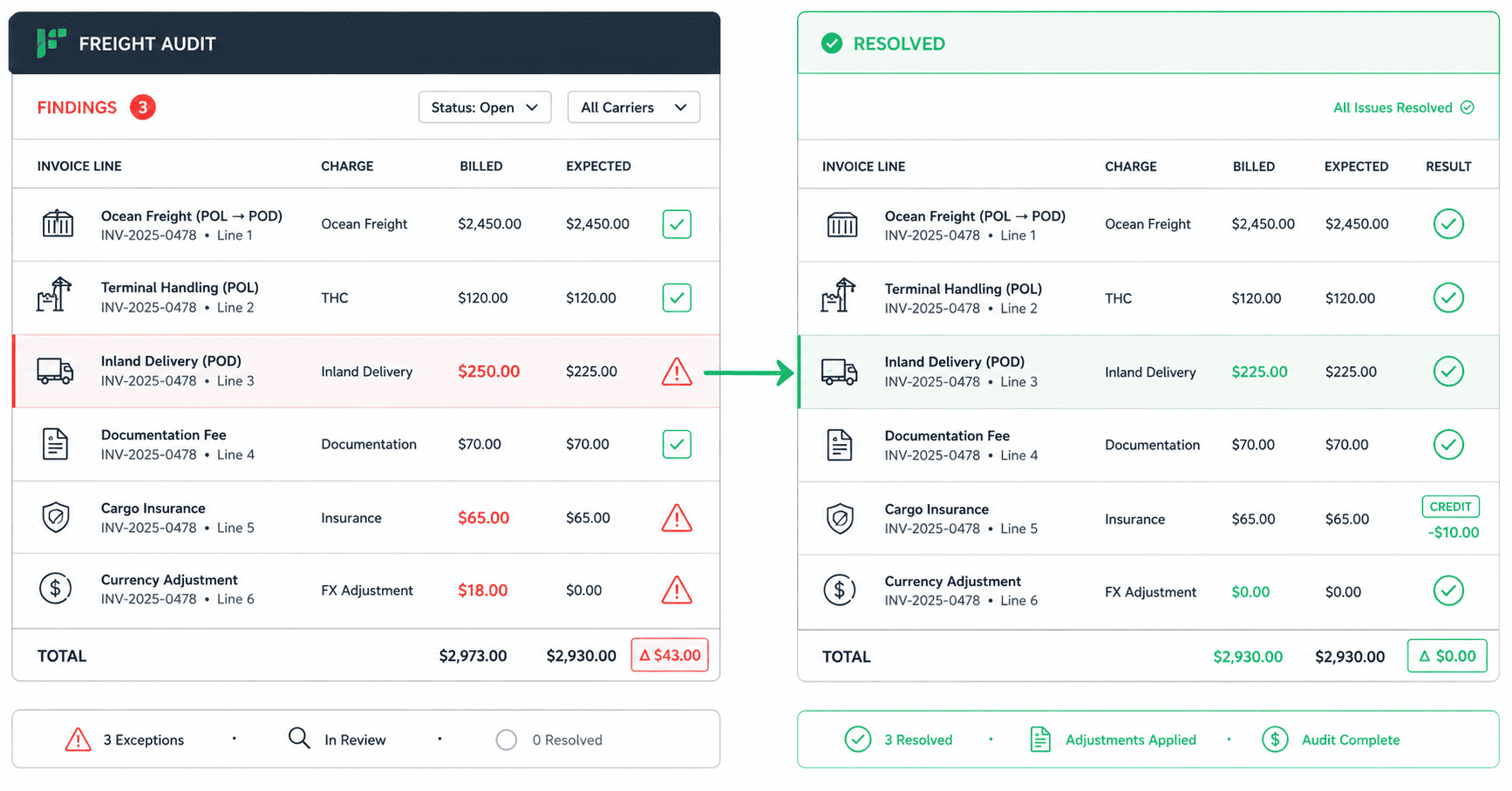
Freight audit software and a managed audit service get shopped as if they were the same product at two price points. They are not. Software answers the question: which of my invoices look wrong? A managed desk answers a different one: who is going to fix them? Buying one when you needed the other is how operations end up with a dashboard full of exceptions and the same margin leak they started with.
This post lays out what each actually does, where each wins, and how to decide. For the fundamentals of what a freight audit checks in the first place, start with the freight audit and payment guide.
What does freight audit software actually do?
Freight audit software is a detection engine. It ingests carrier invoices, usually by EDI 210 or portal scrape, and compares them against rated expectations: contract rates, fuel surcharge schedules, accessorial tables. When a line does not match, it flags an exception. Good systems also catch duplicates across pro numbers, track invoice status, and roll everything into spend dashboards that show which carriers and lanes generate the most errors.
That is real value. Detection at software speed scales in a way no clerk can match, and the pattern data alone can change carrier conversations. The enterprise end of this market, tracked on Gartner’s freight audit and payment category, is built around exactly this: high-volume shippers with dedicated logistics teams who need machine-scale checking across thousands of invoices a week. Most shippers sit below that tier. For them, the same cycle runs as a managed freight bill audit and payment desk rather than a software license.
What software does not do is resolve anything. An exception flag is a task, not a fix. Someone still has to pull the rate confirmation, request the missing lumper receipt, call the carrier about the duplicate, and follow the dispute until money actually moves. Software creates that queue. It does not work it.
What does a managed freight audit service do?
A managed audit desk runs the whole cycle: detection and resolution. Every carrier invoice gets checked against the rate confirmation before payment, and every exception gets worked to one of two endings: paid correctly or formally credited. The desk pulls the backup, raises the dispute with the carrier, and keeps the file so a carrier claiming an unpaid balance can be answered from the record. That is how our carrier invoice audit desk runs, inside the TMS the client already uses.
The trade is capacity for tooling. You do not get a self-serve dashboard to explore. You get invoices that are actually settled correctly, disputes that close, and a weekly report on what was caught and recovered. For most brokers and 3PLs, that output is the point of the exercise.
Where software wins
Software is the right buy when detection is the bottleneck and resolution is already staffed. If you have an accounts payable (AP) team with capacity that is currently eyeballing invoices manually, audit software multiplies them: it finds in seconds what they were finding by sampling, and they work the queue it produces. It also wins on pure invoice volume with simple rating, where most flags resolve without a human conversation, and in shipper-side environments where contract rates live in clean tariff tables the engine can rate against. Where nobody on that side has room to work the queue, freight audit and payment can run as a managed service instead.
The honest precondition: someone has to own the exception queue. Ask any team running audit software what their open-exception count looks like, and whether it is trending down. If nobody owns the queue, the software is measuring the leak, and measurement alone recovers nothing.
Where a managed desk wins
A desk wins when the errors that cost real money need paperwork and persistence rather than pattern matching. A detention charge is not settled by a flag; it is settled by arrival and departure timestamps, and by someone who knows that free time matters and where to find the driver notes. A lumper fee needs the receipt matched to the receiver. A double-brokered load needs a human who recognizes the remit-to change. These are the charges that generalist tools flag endlessly and nobody closes, and there is more on that distinction in our post on verifying carrier invoices before payment.
The desk also covers the direction software mostly ignores: revenue. Audit software looks at invoices you receive. It has no view of the detention your own dispatch agreed to by phone and never billed, because there is no document to rate against. Catching that requires a pre-billing review of the load file itself, which is process work, not software work.
And for operations under roughly a thousand loads a month, the desk usually wins on arithmetic alone: software license plus the staff time to work its queue tends to cost more than a scoped desk that does both.
Can you run both?
Yes, and larger operations often should. The clean division of labor: software for detection and reporting at scale, a desk for exception resolution and the revenue-side audit. If you already own audit software, the practical question is not whether to rip it out. It is whether every exception it raises ends the month as a correction or a credit. If the answer is no, the gap is resolution capacity, and that is a hiring or outsourcing decision rather than another license.
Whichever way you go, the checks themselves do not change. The freight invoice audit checklist lists all of them by freight type, free and printable, and it is a fair benchmark for evaluating what any tool or provider actually covers.
Frequently Asked Questions
Below roughly 500 loads a month, usually not on its own. The license cost plus the staff time to work the exception queue tends to exceed what a disciplined manual audit with a checklist recovers at that volume. Small operations get more from consistent process than from detection tooling.
Software is a tool you run: it flags exceptions and your team resolves them. A freight audit and payment (FAP) provider is an outsourced service for shippers that audits carrier invoices and pays carriers on the shipper’s behalf. A managed audit desk is the broker and carrier side equivalent: it audits and resolves, while payment release stays with you.
It replaces the audit workload, not the function. Payment release, carrier relationships, and credit decisions stay in-house. The desk does the line-by-line verification, dispute work, and reconciliation that AP teams skip first when volume spikes.
Ask what happens after a charge is flagged. Ask what they check before approving a detention charge, and listen for timestamps and free time. Ask whether they audit the revenue side of the load as well as the payables side. And ask for the open-exception trend from a current client. Detection numbers are easy to show; resolution numbers are the ones that pay.
If the exception queue is the problem, that is the problem we run: the carrier invoice audit desk checks every invoice before payment and works every discrepancy to a close. Talk to our team to see it on your loads. Questions about your back-office operations? Email us at info@getclearlane.com