
Freight Audit Software vs Managed Audit: Flags or Outcomes
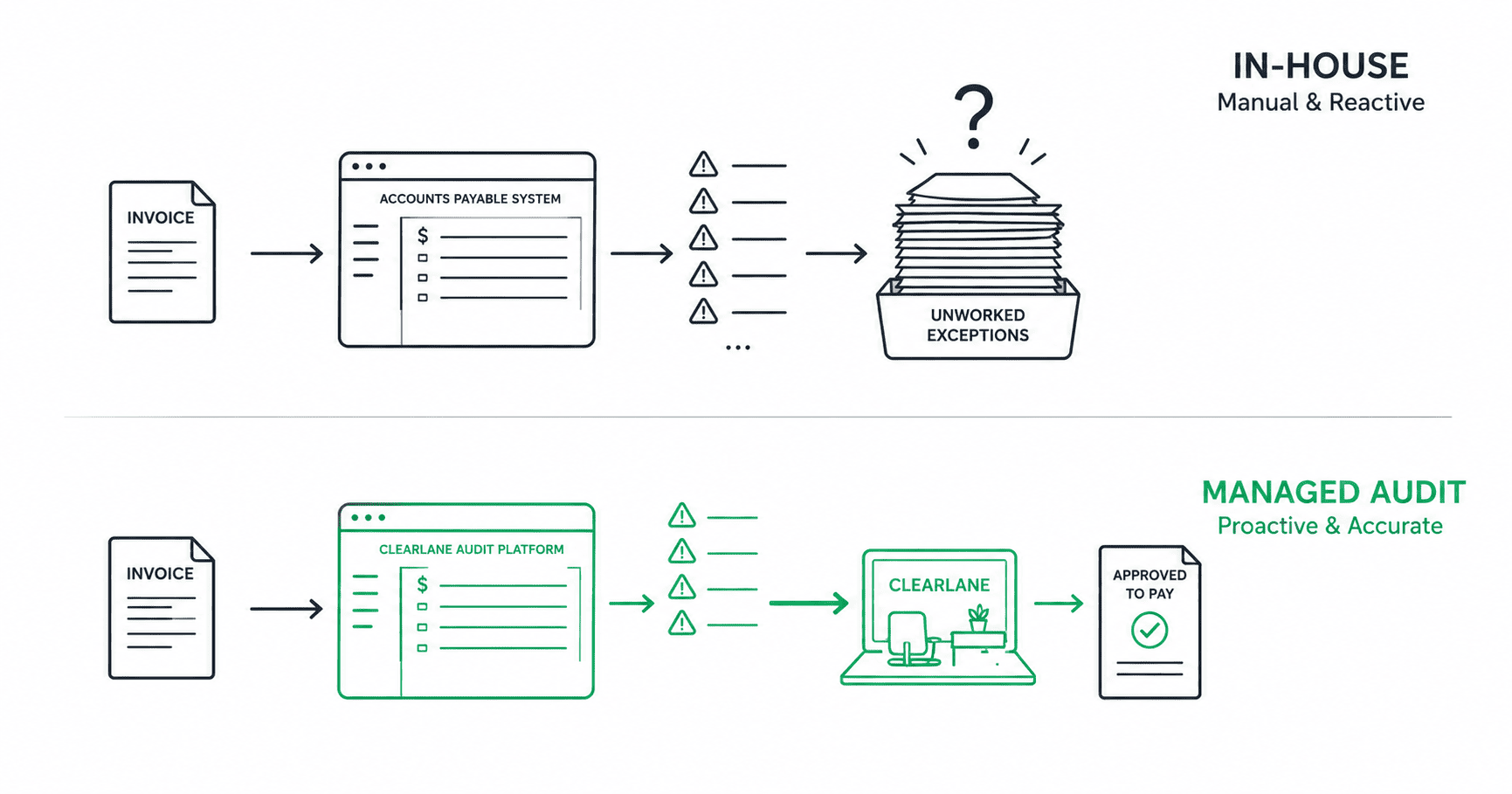
Every freight software demo ends the same way: the back office, automated. And the matching really is automated: rates compared, duplicates flagged, fields validated in seconds. Then Monday comes, the system has flagged 60 exceptions, and a human has to decide what to do about every one of them. This post is about the difference between automating the matching and owning the outcome, because that difference is where back offices actually stand or fall.
What does automation software genuinely do well?
Deterministic checks at scale. If the invoice says $2,140 and the rate confirmation says $2,090, software sees it instantly, on every load, without fatigue. Duplicate invoice numbers, missing PODs, unmatched load numbers: all caught. If your operation pays invoices with zero checking today, automation alone is a real upgrade, because the money leaking through unchecked paperwork is bigger than most owners think.
Where does the automation story stop?
At judgment. Software flags that detention was billed; it cannot know the driver actually waited four hours because the receiver lost the appointment. It flags a fuel surcharge variance; it cannot negotiate with the carrier about it. Every flag becomes a task for a person, and if nobody owns that queue, the flags age until they get approved out of exhaustion. That is automation in name and the same old bottleneck in practice, now with a subscription fee.
There is also the setup nobody demos: rate confirmations that live in email threads, accessorial rules that differ by shipper, and the documentation standards the matching depends on. Software assumes clean inputs. Freight rarely provides them.
What does a managed service do differently?
It owns the outcome. A managed carrier invoice audit uses matching tools too, but the deliverable is different: exceptions worked, disputes handled, and an approved-to-pay file at the end, at a 99%+ accuracy target. The team absorbs the judgment work that software creates. You review reporting instead of a queue.
The trade is cost and trust. A managed engagement costs more than a software seat, and it means letting a dedicated team inside your process, with the visibility and documentation that requires.
How should a freight company decide?
Ask one question: who works the exceptions? If you have a strong AP desk with spare capacity, software makes that desk faster, and it is the right buy. If the desk is already underwater, or does not exist, software will document your problem in dashboards without solving it. Then the choice is a dedicated exceptions desk in-house or a managed service that brings its own. Automation is a tool. The back office is a function. Buy the one you are actually missing.
What a real exception queue looks like
Picture Monday at a 2,000-load brokerage that went live with audit software last quarter. The system did its job over the weekend: 47 invoices flagged. Six duplicates, easy. Nine fuel surcharge variances, each needing the rate con pulled to see which week applies. Fourteen detention claims with no timestamps attached, which means emails to carriers. Eleven line-haul mismatches, half of which turn out to be legitimate reprices nobody logged. Seven flagged for remit-to changes that might be factoring switches or might be fraud, and those cannot wait.
Someone has to work all 47 before payment runs Thursday. If that someone has a full-time job already, the queue gets triaged by gut: obvious ones fixed, ambiguous ones approved. Within a quarter, the operation is paying invoices the software flagged, which is the exact behavior the software was bought to end. The tool did not fail. The staffing model behind it did.
Software vs managed audit, side by side
The comparison that matters is not features. It is who owns each step:
| Audit software | Managed audit service | |
|---|---|---|
| Deterministic matching | Yes, instant, every load | Yes, same tooling underneath |
| Exception judgment | Your team works the queue | The service works the queue |
| Carrier follow-up and disputes | Your team | The service |
| Cost shape | License fee plus the staff time nobody budgets | Engagement scope, exceptions included |
| When volume doubles | Queue doubles, headcount question returns | Absorbed by the engagement |
| When the AP person quits | Queue stops | Nothing changes |
| What you manage | A tool and the people using it | An outcome and a report |
Put numbers on the Monday queue above. Those 47 flagged invoices take a competent AP clerk 10 to 15 minutes each to work properly: pull the rate con, check the timestamps, call the carrier if needed. That is 8 to 12 hours of judgment work generated over one weekend, at 2,000 loads a month. The license fee bought the flagging. The working of the flags, roughly a quarter of a full-time role at this volume, is the cost that never appears in the demo. Run your own exposure through the AP overpayment calculator with your load count and carrier spend.
Neither model excuses you from documentation. Under 49 CFR Part 371, brokers keep transaction records either way; the difference is whether the record trail assembles itself as a by-product of a worked queue or has to be reconstructed later.
Questions to ask any freight audit software vendor
Four questions cut through most demos. Who works the exceptions the system flags, and what happens when that person is out? What percentage of our invoices will match automatically, given our documentation as it exists today, not as the demo assumes? What does the system do with charges that need judgment, like detention with partial paperwork? And what does setup require from our team in the first 60 days? Vendors with good answers are worth hearing out. Vendors who answer every question with a dashboard are telling you the queue is your problem.
Ask the same questions of a managed audit provider, or of a freight audit and payment provider, and the answers should name people, turnaround standards, and an accuracy target, not features. That difference is the whole comparison.
What do the two models actually cost?
Software pricing usually lands as a per-invoice fee or a monthly platform charge, and the sticker looks small next to a managed engagement. The sticker is not the cost. Add implementation (integration with your TMS, document mapping, rules setup, typically weeks of your team’s attention), then add the labor to work the exception queue, because that queue is the product. A $1,500-a-month platform that consumes half of an AP clerk’s time is really a $4,000-a-month decision.
A managed audit prices the function: team, process, and exception handling included. It costs more than the software sticker and usually less than software plus the loaded labor to run it properly, especially once you price coverage for vacations and turnover. The comparison that matters is total cost to reach an approved-to-pay file, not the line item on the invoice.
Frequently asked questions
Software catches what it can match: duplicates, exact rate mismatches, missing fields. It cannot judge whether a detention claim is legitimate, whether a lumper receipt is plausible, or which disputes are worth fighting. Automation narrows the pile; someone still has to work it.
For the matching step, software is instant and a managed team is not far behind. For the outcome, the comparison flips: automation hands you a queue of flagged exceptions, while a managed desk resolves them and delivers an approved-to-pay file. Speed to done is what matters.
No, and the strongest operations do not. Automation handles matching at scale; a dedicated team owns exceptions, disputes, and judgment. The mistake is buying software and assuming the exception queue will work itself.
Usually not as a separate purchase. A managed audit brings its own matching tooling and runs it inside your TMS and document stack. If you already own audit software, the service can work the exception queue it produces instead of replacing it.
Want the exceptions worked, not just flagged? Request a demo. Or email us at info@getclearlane.com.