
When Your Billing Team Becomes the Bottleneck: Signs and Fixes
How Do You Know If Your Freight Billing Team Is the Bottleneck?
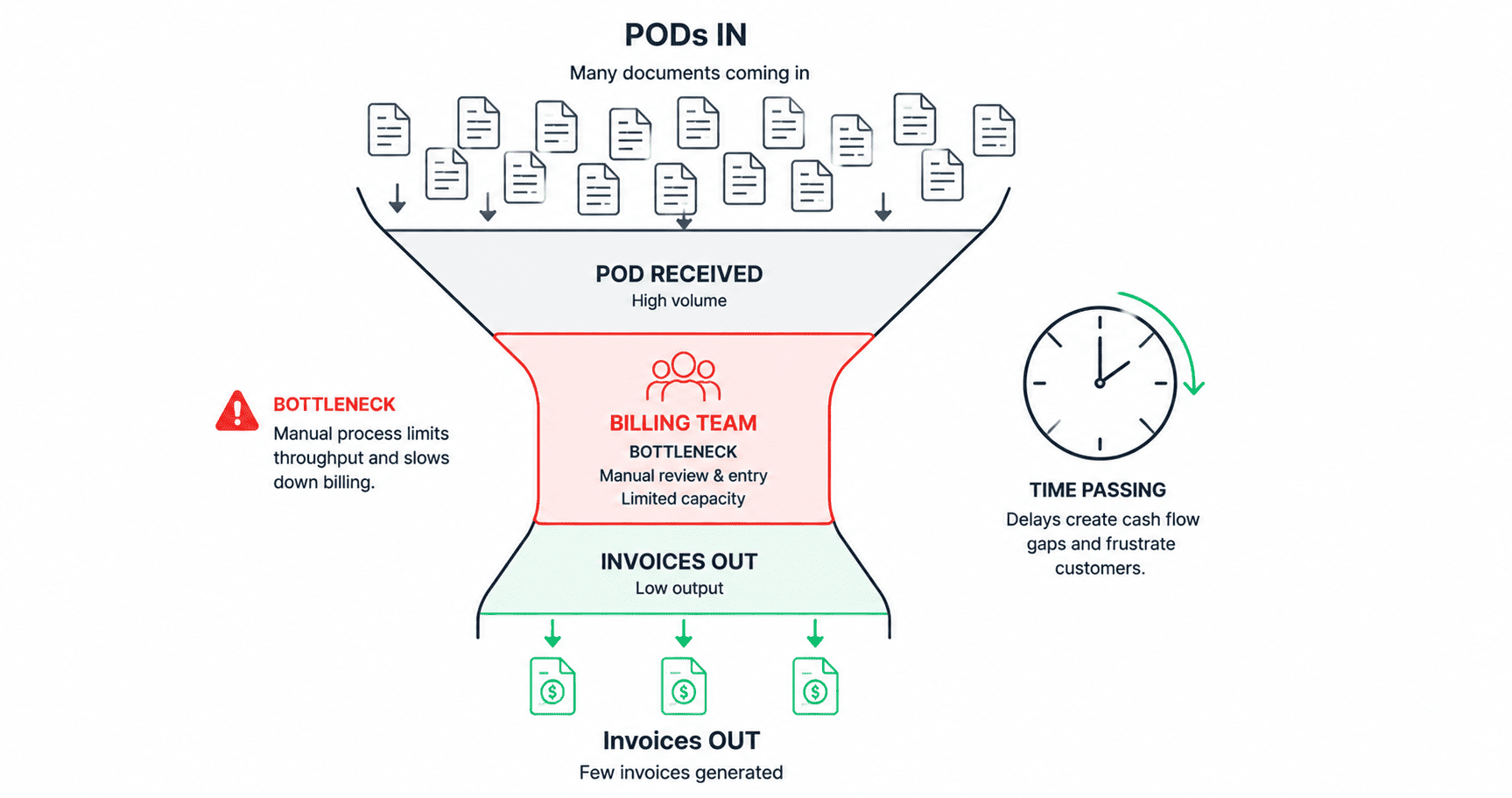
The billing team at a growing freight brokerage doesn’t usually look like a bottleneck. People are busy. Invoices are going out. Payments are coming in. From the outside, the function appears to be working.
The bottleneck becomes visible only when you measure the time between when a load is ready to be invoiced (POD received and verified) and when the invoice actually goes out. That gap (the billing queue) is where days disappear from the payment cycle.
At a well-optimized operation, the billing cycle from POD receipt to invoice submission should be 8 to 12 hours for routine loads (same-day or next-morning billing). At brokerages where the billing team is at or above capacity, that cycle stretches to 48 to 72 hours, sometimes longer for loads with complex billing requirements or accessorial charges.
Each hour in the billing queue is an hour added to DSO. The invoice isn’t late because the shipper is slow to pay. It’s late because it sat in a queue waiting to be prepared. The payment clock doesn’t start until the invoice goes out, so billing queue time is pure DSO inflation, and it’s entirely within the brokerage’s control.
What Are the Five Signs of a Freight Billing Bottleneck?
Billing bottlenecks develop gradually. The team doesn’t wake up one morning overwhelmed. The queue grows slowly as load volume increases, billing complexity expands, and the team’s capacity stays flat. Here’s what the gradual buildup looks like in measurable terms.
Invoice cycle time is trending upward. Track the average hours from POD receipt to invoice submission over the last six months. If the number is increasing, even by a few hours per quarter, the billing team’s capacity is falling behind the inbound volume. A single snapshot isn’t diagnostic, but a trend over three to six months tells a clear story.
PODs are sitting in the TMS without invoices attached. This is the most direct indicator. If you can pull a report showing loads with verified PODs that are more than 24 hours old and no corresponding invoice, those loads are in the billing queue. The number of loads in this state at any given time is effectively the queue depth. If it’s growing week over week, the billing team is falling behind.
The billing team is consistently working overtime. Occasional overtime during peak seasons or after a staff absence is normal. Consistent overtime (every week, every month) is a capacity signal. The team doesn’t have enough throughput during regular hours to process the inbound volume, so they’re extending hours to keep up. This is unsustainable and leads to the next sign.
Error rates are climbing. When the billing team is rushing to clear a queue, accuracy suffers. Wrong PO numbers, missing documentation, incorrect rates, and overlooked accessorial charges all become more frequent when speed is prioritized over verification. The irony is that billing errors create more work downstream: each dispute adds 10 to 14 days to the payment cycle and requires staff time to research and resolve, further consuming the capacity that was already insufficient.
Lower-priority work is being deferred. When the billing team is at capacity, something has to give. Usually it’s the work that doesn’t have an immediate deadline: pre-billing audits (checking for missed accessorials before the invoice goes out), complex billing reconciliations, carrier invoice deep dives, and documentation organization. This deferred work represents missed revenue, unresolved discrepancies, and compliance gaps that accumulate quietly.
Why Does the Billing Bottleneck Form at Growing Freight Companies?
The billing bottleneck at freight brokerages forms for a specific structural reason: billing capacity scales linearly with headcount, but billing workload scales with both load volume and complexity.
When a brokerage grows from 1,500 to 3,000 loads per month, the billing workload doesn’t just double. It more than doubles, because growth typically brings more shippers (each with different billing requirements), more carriers (each with different invoice formats), more accessorial charges (as the load mix becomes more complex), and more exceptions (as the system handles a broader range of scenarios).
A billing team that was appropriately sized at 1,500 loads per month isn’t just 50% short at 3,000 loads. They’re likely 60 to 70% short, because the per-load billing effort has increased along with the volume.
And the cost of adding capacity creates a natural hesitation. The fully loaded cost of a billing specialist is $75,000 to $95,000 annually. For a brokerage owner who’s watching margins during a growth phase, that’s a significant investment, especially when the billing team says they can handle the volume if they just work harder.
They can. For a while. Until they can’t. And by the time they can’t, the DSO has already moved and the error rate has already climbed.
How Much Does the Billing Queue Cost in DSO and Working Capital?
The financial impact of the billing bottleneck is directly calculable.
A brokerage processing 3,000 loads per month at an average invoice of $1,000 generates $3 million in monthly billings. If the billing queue adds an average of two days to the invoice cycle: loads that should be invoiced on Day 1 after POD receipt are invoiced on Day 3. That two-day delay adds two days of DSO across the entire portfolio.
Two days of DSO at $3 million in monthly billings represents roughly $200,000 in receivables outstanding two days longer than necessary. As long as the queue stays two days deep, that $200,000 in working capital stays tied up in the billing queue, not in disputed invoices, not in slow-paying customers, but in invoices that are ready to be prepared and are simply waiting in line.
If the queue stretches to four days (which happens during peak periods, staff absences, or rapid growth), the working capital impact doubles to roughly $400,000.
And the billing bottleneck creates a secondary DSO impact through increased error rates. If the error rate climbs from 2% to 5% because the team is rushing, those additional errors create disputes that add 10 to 14 days each. At 3,000 invoices per month, a 3-percentage-point increase in error rate means 90 additional disputes per month, each adding roughly two weeks to the payment cycle.
The Fixes
Addressing the billing bottleneck comes down to three approaches, applied individually or in combination.
Add dedicated billing capacity. The most direct fix is more people, either in-house hires or an external team dedicated to invoice preparation and submission. The timeline difference matters: an in-house hire takes 8 to 16 weeks from decision to full productivity. An external dedicated team can be operational in 4 to 5 weeks.
The capacity addition should be sized against the queue depth, not the current headcount. If 200 loads consistently arrive in the billing queue per day and the team processes 150 per day, the gap is 50 loads per day, roughly one additional person’s capacity. If the queue is growing, the gap is wider.
Separate the pre-billing audit from the billing function. When the billing team does both invoice preparation and quality verification, the verification step gets compressed under time pressure. Separating the pre-billing audit into a distinct function, with dedicated capacity, means invoices get verified without slowing the billing throughput. The audit team catches errors and missed accessorials; the billing team focuses on preparation and submission speed.
Standardize and template customer billing requirements. Much of the per-invoice billing effort comes from navigating different customer requirements: different portals, different documentation formats, different reference number structures, different backup document requirements. Documenting these requirements in standardized templates and creating customer-specific billing checklists reduces the per-invoice effort and makes it possible for any team member to process any customer’s invoices without specialized knowledge.
This standardization work is a one-time investment that pays off on every subsequent invoice. It also makes it feasible to add capacity (whether in-house or outsourced) because the new team members can follow documented procedures rather than relying on institutional knowledge.
Measuring the Fix
Once additional capacity is in place, the measurement is straightforward:
POD-to-invoice time should be tracked daily. The target is same-day or next-morning billing for routine loads. If the number is trending down from 48-72 hours toward 12-24 hours, the queue is clearing.
Queue depth (loads with PODs but no invoice) should be measured daily at end of business. A shrinking queue means capacity is exceeding inbound volume. A stable queue means capacity matches volume. A growing queue means you’re still short.
Error rate should be tracked weekly. If the error rate decreases as the queue clears (which it should, because the team has time for quality work instead of rushing), the DSO benefit compounds: faster invoicing plus fewer disputes.
ClearLane provides dedicated billing capacity as part of the full post-dispatch pipeline. The billing function runs alongside POD retrieval, carrier invoice verification, pre-billing audit, and accounts receivable (AR) management, so the entire pipeline is staffed to keep its slowest function from setting the pace for the rest.
Frequently Asked Questions
Measure POD-to-invoice time on every load. If it consistently exceeds 12 hours for routine loads, the billing team doesn’t have enough throughput. Other signs: PODs sitting without invoices, consistent overtime, climbing error rates, and deferred lower-priority work.
At a brokerage doing $3 million in monthly billings, each day of billing queue delay ties up roughly $100,000 in working capital. A two-day queue means $200,000 outstanding that doesn’t need to be.
Billing capacity scales linearly with headcount, but billing workload scales with both load volume and complexity. Growth brings more shippers (different requirements), more carriers (different formats), and more exceptions, increasing per-load effort alongside volume.
Three approaches: add dedicated billing capacity (in-house or outsourced), separate the pre-billing audit from billing so verification doesn’t slow throughput, and standardize customer billing requirements in templates to reduce per-invoice effort.
Think your billing team might be the bottleneck? Talk to our team to walk through your current billing metrics. Or email us at info@getclearlane.com.
Related reading: the anatomy of a billing error and preventing shipper payment disputes. See shipper billing for how invoicing runs when it is handed off.