
How Much Does It Cost to Outsource Your Freight Back Office?
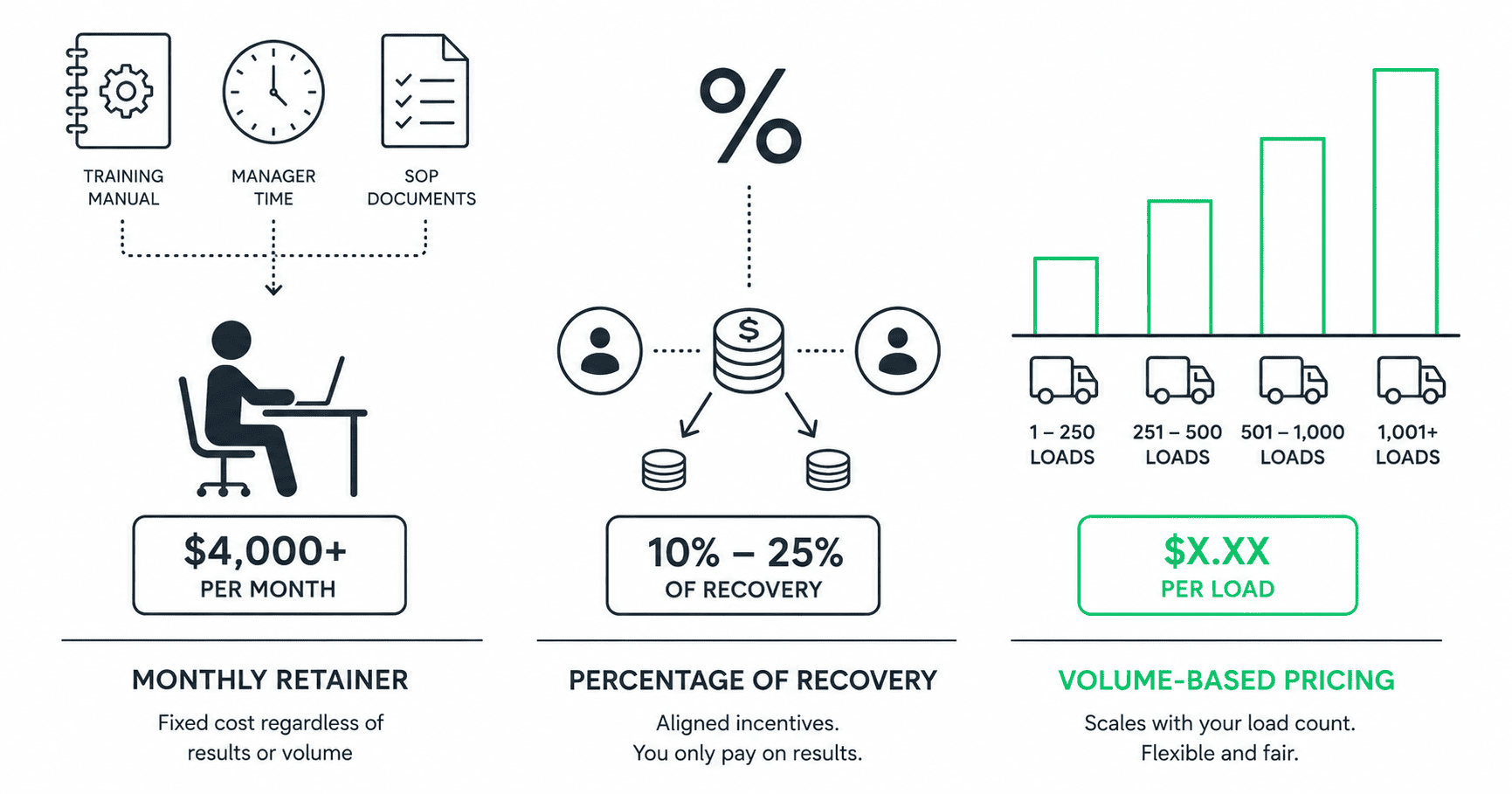
Nobody publishes real numbers on this, so here is the honest version: what freight back-office outsourcing costs depends on which of three pricing models you are buying, and the cheapest-looking one is usually the most expensive by the time it actually works.
What does an in-house back office cost first?
Before comparing vendors, price the thing you are replacing. A billing or accounts receivable (AR) clerk runs $45,000 to $65,000 in base salary in most U.S. markets. Add payroll taxes, benefits, software seats, equipment, and the management time nobody bills for, and the fully loaded cost lands at $75,000 to $95,000 per person annually. A three-person team: $225,000 to $285,000 a year, before turnover costs and coverage gaps. The full in-house math is here.
What are the three outsourcing pricing models?
- Per-seat staffing. You rent a dedicated person, commonly quoted in the low thousands of dollars per month per seat. It looks cheap against a loaded salary, but training, SOPs, quality control, and management stay with you, and those were most of the cost in the first place.
- Percentage and contingency. Common for audit and collections work: the vendor takes a share of what gets recovered or collected. Incentives align, but the spend is hard to budget and the scope is narrow.
- Managed team. scaled to your operation. The provider assigns dedicated people to your account and adds capacity as your volume grows. The difference from per-seat staffing: the provider owns the training, SOPs, quality control, and management. You are buying completed work against accuracy standards, not hours you have to supervise. This is how ClearLane works: dedicated teams that scale with your business, with the operational management built in.
The three models, compared honestly
What each pricing model optimizes for, and where each one bites:
| Per-seat staffing | Per-transaction pricing | Scoped team engagement | |
|---|---|---|---|
| What you buy | A person’s hours | A unit price per load or invoice | A function with an outcome attached |
| Looks cheapest when | Compared against a loaded salary | Volume is low | Rarely; the scope is visible upfront |
| Hidden cost | Training, SOPs, QC and management stay with you | Fees scale with every load, good months cost more | Scoping it wrong at the start |
| When volume drops 30% | You still pay the seat | Cost falls with it | Scope adjusts at review |
| When volume doubles | Second seat, same training burden | Cost doubles | Team grows inside the engagement |
| Who owns quality | You | Nobody, per the contract | The provider |
Worked comparison. Take a brokerage at 2,000 loads a month replacing one billing clerk and one AR clerk. In-house, that is two loaded salaries: using BLS wage data for the base and the roughly 1.4x load for taxes, benefits and software, call it $130,000 to $180,000 a year before turnover risk. Per-seat pricing undercuts that on paper and quietly hands you back the training and quality burden. Per-transaction pricing at any plausible unit rate crosses over the seat cost as volume grows. The scoped model prices the team and the outcome, which is why serious quotes require your load data first. Model your own in-house baseline in the in-house back-office cost calculator before reading any quote.
What actually determines your quote?
Four inputs move every serious quote: load volume and how document-heavy each load is, which services you are handing off (POD chase only is a different engagement than billing through collections), how many customers require portal or EDI submission, and the current state of your process documentation. A vendor who quotes before asking these questions is guessing, and you will pay for the guess later.
Why is cost only half the equation?
Companies operating without a structured pre-billing audit leave 2-5% of billable revenue uncaptured. On a $30 million book, that is $600,000 to $1.5 million a year in detention, layover, TONU, and lumper fees that were earned but never invoiced. An outsourced operation that includes revenue capture on every load is not a cost line competing with salaries; it is a margin line. Here is where that revenue hides.
How should you compare quotes?
Normalize everything to annual total cost of ownership: the vendor fee, plus the management time you still spend, plus the training you still own, plus the revenue capture you gain or forgo. Then stress-test the result: what happens to each number if volume drops 30% in a soft market? Fixed seats keep billing you. Scope-based pricing scales down with the freight.
One more filter: ask where the work happens. If the team operates inside your TMS, switching costs stay low and your data stays yours. If the work happens on the vendor’s platform, add the cost of getting out to every quote. Here is how onboarding works when the team works inside your system instead.
What should a real quote process look like?
A serious vendor asks for data before naming numbers: monthly load count and its seasonality, documents per load, how many customers bill through portals or EDI, current DSO, and which functions are actually moving to the vendor. If you can hand over a month of anonymized load data, the quote gets sharper and so does the vendor’s credibility, because they have to commit to assumptions you can verify. A quote produced from a five-minute call is a price for a hypothetical company.
Three pricing traps to check before signing
- Minimums that do not scale down. A per-seat or minimum-fee floor converts your variable cost back into a fixed one the first soft quarter. Ask what the invoice looks like when volume drops 30%.
- Scope boundaries around exceptions. If clean loads are included but disputes, rebills, and collections escalations bill hourly, the quote covers the easy 80% and meters the 20% you actually needed help with.
- Auto-renewal with a long notice window. Standard in BPO paper, easy to miss, and it converts a trial into a commitment. Negotiate the exit terms while you still have leverage, which is before signing.
None of these make a vendor disqualifying; they make the comparison honest. Normalize every quote to a full year at your real volume curve, including the metered extras, before putting it next to the $75,000 to $95,000 fully loaded cost of each hire it replaces.
Frequently Asked Questions
It depends on the pricing model. Per-seat staffing is commonly quoted in the low thousands of dollars per month per person. Contingency models take a percentage of recoveries. Scope-based models scale with your freight. Benchmark any quote against the $75,000 to $95,000 fully loaded annual cost of each in-house back-office hire it replaces.
Usually, once you count everything: salary, benefits, software, training, turnover, and coverage gaps. But the bigger swing is revenue capture. An operation that catches the 2-5% of billable revenue that typically goes unbilled changes the math from cost savings to margin improvement.
Defined services (for example POD chase, carrier invoice audit, shipper billing, AR follow-up) delivered as completed work against accuracy standards, with reporting. The provider handles hiring, training, and quality control. As your volume grows, the team grows with it.
Most operations see the first measurable effects inside 60 days: faster POD turnaround unblocks billing, and the pre-billing audit starts capturing charges immediately. Payback depends on your volume and how much revenue was leaking before.
Because the honest inputs vary too much: load volume, documents per load, portal and EDI mix, and which functions actually transfer. A published flat rate either overcharges simple operations or underprices complex ones. A quote built from a month of your real load data is the credible version.
Want a real number instead of a model? Request a demo. Or email us at info@getclearlane.com.