
Hiring a GM to Run Your Freight Company: The Reporting Structure That Makes It Work
Every freight company founder eventually hits the same wall: the business needs them less than the business consumes them. The standard answer is hiring a general manager, and the standard outcome is disappointment within eighteen months. Not because the GM was wrong, but because the owner handed over the keys without building the structure that makes a handoff work.
The structure has three parts: a clean division of decisions, a reporting arrangement both sides trust, and a first hundred days that transfers knowledge instead of just authority. Miss any one of them and the relationship decays into either micromanagement or blindness.
Why Do GM Handoffs Fail in Freight Companies?
The usual failure is structural, and it hides in the reporting. After the handoff, the owner learns about the business from numbers the GM prepares. The GM is now grading their own exam, and even a fully honest manager frames results: a soft quarter becomes a market story, a billing backlog becomes a staffing question. The owner senses the framing, starts calling dispatchers to check, the GM feels undermined, and eighteen months later everyone agrees it did not work.
None of that requires bad faith. It requires nothing more than a reporting line that runs through the person being measured.
What Should the Owner Keep, and What Goes to the GM?
The GM runs the operation: dispatch, hiring below the leadership level, carrier and customer management day to day, and pricing inside agreed bands. The owner keeps the balance sheet: capital purchases above a threshold, credit lines and banking, insurance renewals, leadership compensation, and any decision that changes what the company is, new entities, new terminals, exiting a line of business.
Write the split down. Ambiguity about who decides what is where handoffs rot, because every gray-zone decision either waits for the owner or surprises the owner, and both outcomes erode the arrangement.
What Reporting Structure Keeps Both Sides Honest?
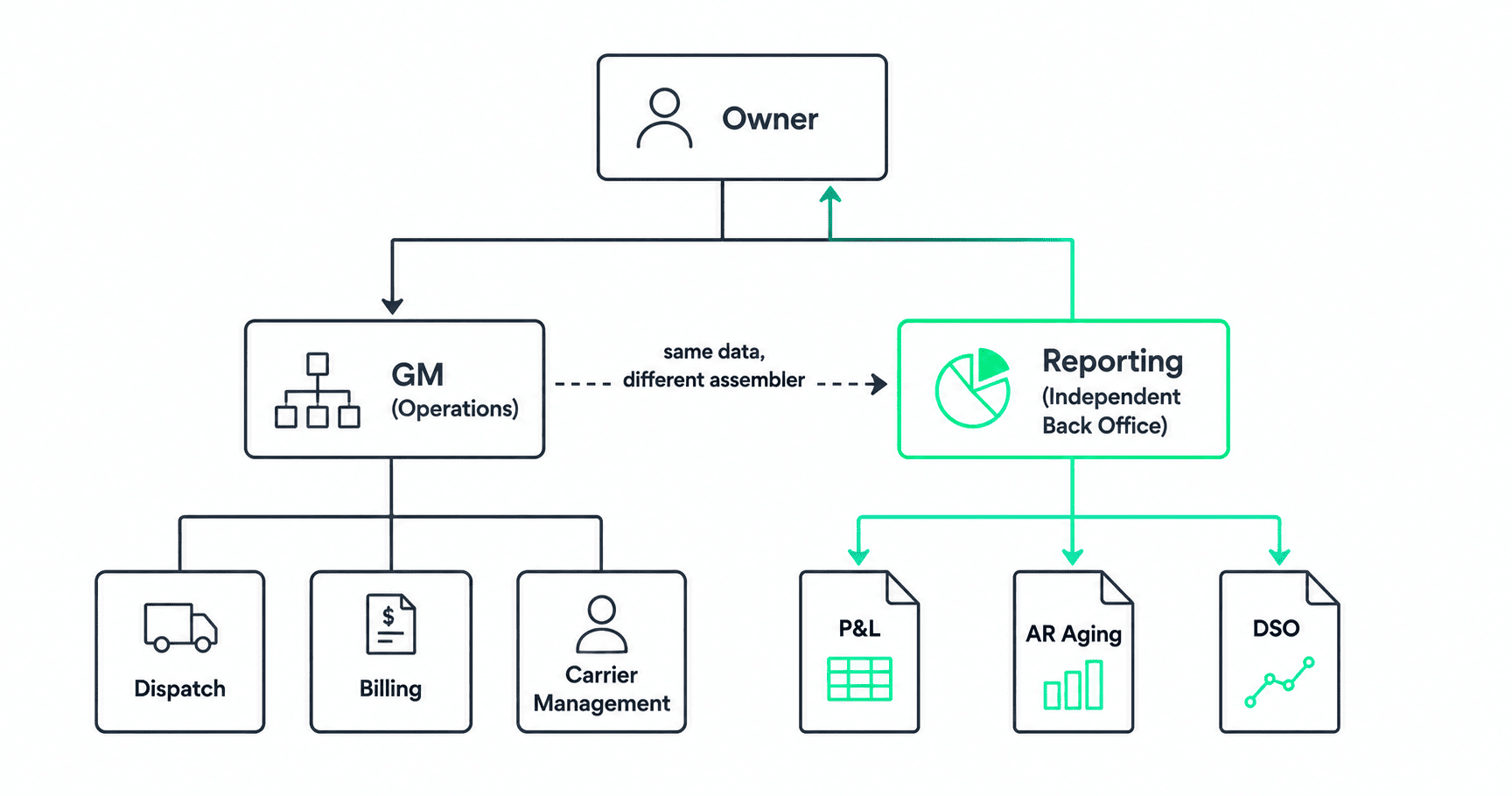
Separate the operating of the business from the reporting on it. The GM runs operations and explains results. The reporting itself, the P&L, the cash position, the accounts receivable aging, the DSO trend, the exceptions list, gets assembled by a party that does not report to the GM: an independent reporting desk working from the books.
This is not surveillance, and positioning it as surveillance kills it. The honest framing, which is also the true one: the GM gets out of the report-building business entirely, gains hours back every month, and stops being suspected of framing numbers, because the numbers arrive from outside. Both sides argue from the same page, which is the entire point.
How Do You Evaluate and Pay a GM Fairly?
Bonus structures fail when the metrics come from spreadsheets the GM controls. Tie compensation to a small set of numbers produced independently: operating margin, DSO against the 45 to 65 day freight benchmark, billing accuracy, and whatever growth measure fits the strategy. Set them jointly at the start of the year, measure them from the independent package monthly, and the annual comp conversation becomes arithmetic instead of negotiation.
What Should the First 90 Days Look Like?
Three transfers, in order. Process: the undocumented decisions in the owner’s head become written standards, from carrier exceptions to customer credit. Relationships: key customers and the banker meet the GM with the owner in the room, then without. Rhythm: the reporting cadence goes live in month one, weekly flash and monthly package, so the owner steps back onto a platform instead of into silence. The owner who leaves before the reporting exists always comes back, and never at a good moment.
Where ClearLane Fits
We run the independent side of the arrangement: books kept current, the monthly ownership package assembled and delivered on schedule, and the metrics that drive the GM’s scorecard produced by a team with no stake in how they land. For owners running more than one company, the same desk covers the whole group; the mechanics are in our multi-entity back office guide. The GM runs the freight. The owner reads the truth. Everyone knows which is which.
What If the GM Does Not Work Out?
Some percentage of first hires miss, and the structure is what makes a miss survivable. Documented standards mean the operation keeps its shape while you search again. Banking controls mean a leadership change never touches the money. And independent reporting means the numbers were never hostage to the departing manager, so the owner steps back in with current, trustworthy books instead of a quarter of reconstruction.
Owners who skip the structure experience a failed GM hire as a crisis. Owners who built it experience the same event as an inconvenient recruiting problem. The difference is not the manager. It is everything that was set up around the manager.
Frequently Asked Questions
The reporting layer behind all of this is what ClearLane runs as independent owner reporting: the owner, lender, and board packages produced as a desk, so stepping back does not mean losing sight of the numbers. For the judgment layer itself, fractional CFO services are available directly, in a limited number of engagements.
Daily operations: dispatch, staffing below leadership, customer and carrier management, and pricing inside agreed bands. The owner typically keeps capital decisions, banking and credit, insurance renewals, leadership compensation, and structural changes to the business. The split works when it is written down.
Through reporting assembled independently of the GM: a monthly package with per-entity P&L, cash, accounts receivable aging, DSO trend, and an exceptions list, delivered directly to ownership on a fixed date. The GM explains results; the numbers arrive from outside the chain of command.
A short list produced independently: operating margin, DSO against the 45 to 65 day freight benchmark, billing accuracy, and one growth measure that fits the strategy. Metrics the GM computes personally invite framing; independently produced metrics make the comp conversation arithmetic.
Framed correctly, the opposite. The GM sheds hours of monthly report assembly and stops being suspected of massaging numbers. Resentment comes from surveillance framing or from owners who use the reports to micromanage rather than to stay informed.
Before the owner steps back, ideally in the GM’s first month. Handoffs where reporting is bolted on after a bad quarter start from distrust. Handoffs where the cadence ran from day one never have to have that conversation.
Handing day-to-day to a manager this year? Request a demo and we will show you the reporting arrangement that keeps owners informed without hovering. Or email us at info@getclearlane.com.