
Brokerage, Trucking, Warehouse: How the Back Office Works When One Company Is Three Entities
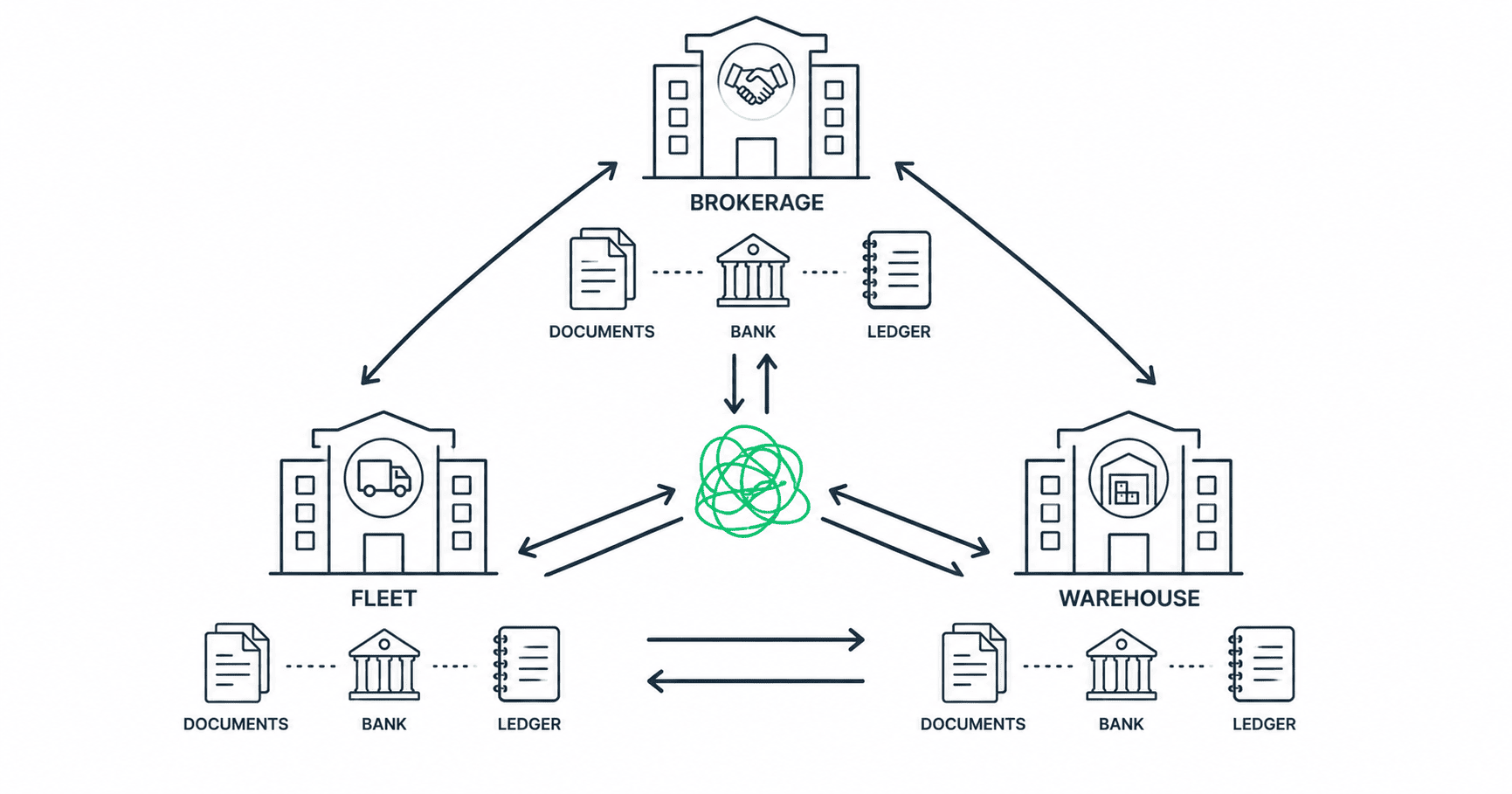
A freight company rarely stays one company. The brokerage that started in a spare office adds a few trucks because a customer wanted dedicated capacity. The trucks need a yard, the yard grows a warehouse, and the warehouse starts billing storage. Ten years in, one operation has become two or three entities under common ownership.
The structure varies. Some owners run the brokerage and the fleet inside one company under one MC, holding both authorities. Some split every business into its own LLC for insurance and liability reasons. A warehouse entity has no MC at all. The freight moves the same way regardless. The back office is where the structure starts to cost money.
This post walks through the four places multi-entity operations get harder to run: customer billing, intercompany transactions, the books, and compliance.
Why Do Freight Companies End Up With Multiple Entities?
The reasons are usually good ones. An asset fleet carries a different liability profile than a brokerage, and keeping them separate protects one business from the other. Insurance can price better when exposures are isolated. An acquired company keeps its entity because its customer contracts and credit history live there. A warehouse gets its own LLC because the building loan required it.
None of that is bad structure. It usually reflects sound legal and tax advice. The operational bill comes due in the back office, where every additional entity multiplies the paperwork: more receivables to track, more payables to verify, more bank accounts to reconcile, more year-end packages for the accountant.
What Makes a Multi-Entity Back Office Harder to Run?
Each entity has its own customers, its own receivables, its own carrier or vendor payables, its own bank accounts, and its own books. In most operations the same small office staff handles all of it, switching between companies all day inside shared spreadsheets and inboxes.
The failure patterns are predictable. An invoice goes out under the wrong entity and the customer rejects it or short-pays. A payment lands in one company’s bank account against another company’s invoice and sits unapplied for weeks. AR aging gets reviewed as one blended list, so nobody can say which company is collecting well and which one is quietly financing its customers. The staffing cost of doing this properly in-house grows faster than load count, because every hire has to learn every entity.
One number worth measuring: what percentage of your unapplied cash traces back to payments that crossed entities? At most multi-entity operations it is higher than anyone expects.
How Does Intercompany Billing Work Between Sister Companies?
The most common flow is the brokerage tendering a load to its own fleet. That move needs the same paper trail an outside carrier would get: a rate confirmation from the brokerage to the fleet, a carrier invoice from the fleet back to the brokerage, and a shipper invoice from the brokerage to the customer.
When the intercompany paperwork gets skipped because the money all lands in the same pocket eventually, two things break. Entity-level margin becomes fiction: the brokerage looks more profitable than it is and the fleet looks worse, or the reverse. And the accountant loses the documentation needed to support pricing between related companies at year-end.
The fix is discipline, not complexity. Treat the fleet like any carrier in the workflow. Rate confirmation issued, carrier invoice submitted, both sides recorded. Intercompany billing is only painful when it is improvised load by load.
How Do You Keep Books Clean Across Multiple Entities?
Separate legal entities mean separate books. Each company gets its own chart of accounts, its own bank and credit card reconciliations, and its own month-end close. Intercompany transactions are recorded on both sides and reconciled monthly, so the balance one company shows as owed matches what the other shows as owing.
If both operations run inside one company under one MC, it gets simpler: one set of books with divisional tracking usually does the job. The moment a second legal entity exists, there is no shortcut. Mixed books are the most expensive thing to untangle at tax time, and they make outsourced bookkeeping the first function multi-entity operators tend to hand off.
What Happens to Compliance When Only Some Entities Have Authority?
A brokerage holds broker authority. A fleet holds motor carrier authority. Sometimes both sit on one company, sometimes on two, and the warehouse holds no operating authority at all. Each authority carries its own FMCSA record, its own filings, and its own insurance stack: auto liability and cargo on the fleet, contingent cargo and the surety bond on the brokerage, warehouse legal liability on the storage entity.
The back-office consequence is that certificates, renewals, and monitoring run per entity. A customer asking for a COI needs it from the entity that actually holds their freight, and a carrier packet sent under the wrong company creates exactly the kind of confusion fraud checks flag. Compliance tracked as one pile stops working the day the second authority appears.
How a Dedicated Team Runs a Multi-Entity Back Office
The workflows are the same ones a single-entity back office runs: POD collection, carrier invoice verification, customer billing, AR follow-up, bookkeeping, compliance monitoring. The difference is that every workflow carries an entity dimension, and the rules per entity are documented instead of remembered.
ClearLane runs this inside the TMS platforms that support multi-entity profiles, following billing and documentation rules per company: which letterhead, which remit-to, which bank account, which tax treatment. AR is worked per payor per entity, books are kept per company with intercompany transactions recorded on both sides, and reporting comes per entity, consolidated, or both. For a broker-led structure, start with the freight broker solutions page; for a fleet-led one, see trucking solutions.
Frequently Asked Questions
Yes, and it usually works better than splitting staff by company. One team with documented rules per entity keeps processes consistent and coverage continuous. What matters is that every task is tracked by entity, so invoices, payments, and documents never cross companies.
Intercompany billing is invoicing between companies under common ownership, most often a brokerage tendering a load to its affiliated fleet. Each side records the transaction in its own books: rate confirmation out, carrier invoice back, both entries reconciled monthly. Skipping it distorts the margin of every entity involved.
If both operate inside one legal entity under one MC, one set of books with divisional tracking is usually enough. If they are separate companies, each needs its own books, its own reconciliations, and its own close, with intercompany transactions recorded on both sides.
Per entity first. A blended number hides which company is slow. Measuring each entity against the 45 to 65 day freight benchmark shows where the working capital problem actually lives, and which collections process needs attention.
Yes. Dedicated teams work inside TMS platforms that support multi-entity or multi-company profiles, following the billing and documentation rules of each entity. No data migration and no new software.
Per-entity reports come first: billing volume, AR aging, and close status per company. A combined view sits on top. ClearLane also prepares combined management reporting across related companies, including packages delivered directly to owners, lenders, or shareholders who want an independent view. Audited and tax-basis consolidation stays with your CPA, and clean per-entity books are what make that fast.
Running more than one entity and watching the back office multiply with it? Request a demo to see how one dedicated team runs billing, books, and compliance across all of your companies. Or email us at info@getclearlane.com.