
How to Read an Aging Report and Actually Act on It
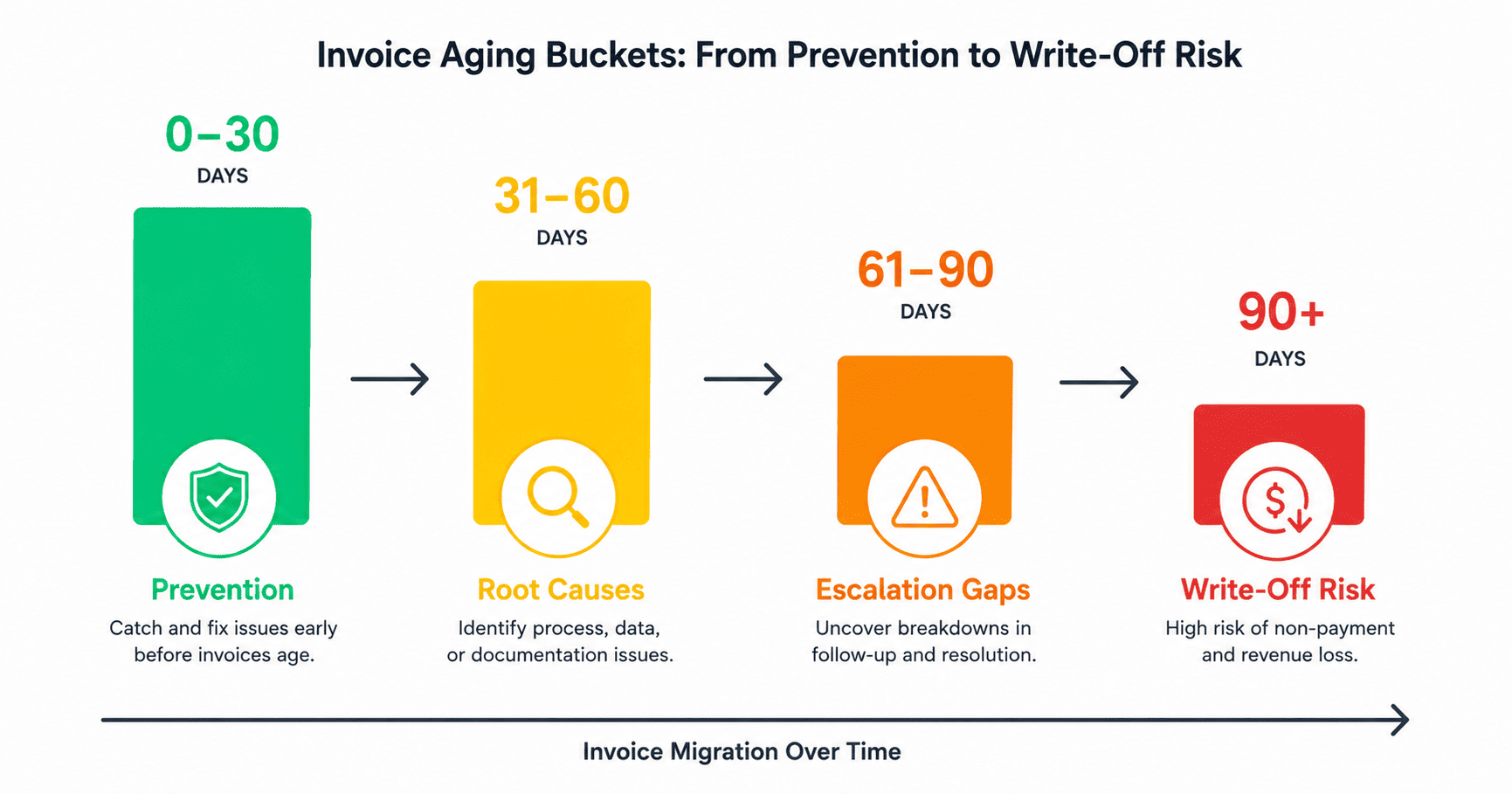
Why Should You Read Your Aging Report as a Diagnostic Tool?
The accounts receivable aging report is the most widely used and least fully utilized document in freight back-office operations. Every brokerage pulls one. Most use it the same way: sort by balance or days outstanding, identify the biggest overdue invoices, make calls, send emails, move on to the next week.
That approach collects some of the money. It doesn’t diagnose why the money is late, whether the same issues will recur next month, or where the billing process is creating preventable delays.
The aging report, read properly, is a diagnostic tool. It tells you not just who owes money, but where your billing process is breaking down, which customers have systemic issues versus one-time delays, where your DSO is being inflated by preventable causes, and where the collections cadence has gaps.
This post walks through how to read each section of the aging report as a diagnostic, what the data in each bucket actually tells you, and what specific actions each finding should trigger.
What Does the 0-30 Day Bucket Tell You About AR Prevention?
The 0-30 day bucket contains invoices that aren’t overdue yet (assuming net 30 terms). If the receivable has been assigned to a factor, UCC 9-406 redirects payment to the factor, so check before you chase. Most collections teams ignore this bucket because the invoices aren’t late. That’s a mistake.
The 0-30 bucket is where the Day 15 confirmation contact from the accounts receivable (AR) cadence does its most important work. Invoices in this bucket that will become 31-60 day problems are already showing signals. They just haven’t been checked yet.
What to look for in the 0-30 bucket:
Invoice age distribution. How many invoices are at day 1-10 versus day 20-30? A healthy 0-30 bucket has most invoices in the early range, with the count tapering off as invoices approach the due date (because most shippers pay before terms). If you see a large number of invoices clustered at day 25-30, it means either shippers are consistently paying at the last minute or invoices are approaching due date without confirmation that they’re in the shipper’s payment system.
Invoices without payment activity. If your accounting system tracks payment status (received, in process, scheduled), check how many 0-30 invoices show no payment activity at all. An invoice at day 22 with no indication that the shipper has received and entered it is at high risk of going overdue, and a Day 15 confirmation contact would have caught this at day 15.
Invoices with open notes or holds. Some invoices in the 0-30 bucket may already have documentation requests, dispute flags, or shipper-side holds that haven’t been resolved. These are invoices heading for the 31-60 bucket unless someone acts now.
The action for the 0-30 bucket is the Day 15 confirmation contact on every invoice that reaches the halfway point without confirmed payment activity. This single action prevents more overdue invoices than any other step in the collections process.
What Root Causes Hide in the 31-60 Day Aging Bucket?
The 31-60 bucket is where invoices land when something went wrong, and the “something” matters more than the balance.
An invoice in the 31-60 bucket is overdue. But the reason it’s overdue determines the correct action. Treating every 31-60 invoice as a “call and ask for payment” misses the diagnostic value.
What to look for in the 31-60 bucket:
Root cause categorization. For every invoice in this bucket, determine why it’s here. Common root causes include: the shipper never received the invoice (submission failure), the invoice was rejected for a billing error and the corrected version hasn’t been submitted, the shipper is holding the invoice pending documentation that wasn’t attached, the shipper’s payment cycle is longer than 30 days and this is normal for them, or the shipper has a genuine cash flow issue and is delaying payment.
Each root cause has a different resolution. A submission failure needs a resubmission, not a collection call. A documentation hold needs the missing document, not a payment reminder. A customer with a naturally longer payment cycle needs a terms renegotiation conversation, not repeated follow-up on every invoice.
If you’re not categorizing root causes, you’re treating symptoms instead of problems, and the same issues will recur next month on different invoices.
Repeat customers in 31-60. If the same customer appears in the 31-60 bucket month after month, there’s a systemic issue. It might be on the customer’s side (their payment process is slow) or on the brokerage’s side (invoices to this customer consistently have documentation or formatting issues that delay payment). The pattern tells you which.
Dispute-related invoices versus aging-related invoices. An invoice that’s in 31-60 because of a billing dispute is a different problem than an invoice that’s in 31-60 because the shipper is slow. Dispute-related overdue invoices point to billing quality issues. Aging-related overdue invoices point to either customer payment behavior or collections cadence gaps.
The action for the 31-60 bucket is root cause categorization on every invoice, followed by the specific resolution for each category. Generic “please pay” outreach on invoices that are overdue because of a documentation gap wastes everyone’s time.
What Does It Mean When Invoices Reach 61-90 Days?
An invoice that reaches 61 days outstanding means the collections cadence didn’t work. Either the Day 15, Day 30, or Day 45 contacts didn’t happen, didn’t produce a resolution, or identified an issue that wasn’t acted on.
What to look for in the 61-90 bucket:
Contact history. For each invoice, review the collection contact history. Were the cadence contacts made? If they weren’t, the issue is cadence execution: the contacts were skipped or delayed. If they were made and didn’t produce a resolution, the issue is either the contact approach (wrong person, wrong channel, wrong message) or the underlying problem (a dispute that can’t be resolved at the accounts payable level).
Escalation status. By day 45, the invoice should have escalated beyond the shipper’s accounts payable (AP) team to an operations or logistics contact. By day 60, if unresolved, it should be at a senior level. If the invoice reached 61 days without escalation, the cadence has a gap at the escalation step.
Customer concentration. If the 61-90 bucket is dominated by one or two customers, the issue may be less about the collections process and more about the customer relationship. A major customer who is consistently 60+ days late needs a contract-level conversation about payment terms, not just more aggressive collection activity.
The action for the 61-90 bucket is twofold: resolve the individual invoices through senior escalation, and audit the cadence to identify why these invoices weren’t resolved earlier. If the cadence contacts were made and didn’t work, the escalation triggers or the contact approach needs adjustment. If the contacts were skipped, the capacity or accountability for the cadence needs attention.
The 90+ Day Bucket: Where Write-Off Risk Lives
The 90+ bucket holds the most expensive receivables on two counts at once: the collection probability drops by the week, and the staff time consumed by prolonged recovery keeps climbing while it does.
What to look for in the 90+ bucket:
Total balance and trend. What’s the total dollar amount in 90+, and is it growing or shrinking month over month? A growing 90+ balance means invoices are migrating from 61-90 faster than they’re being resolved. That’s a systemic problem, not a customer-specific one.
Collectibility assessment. Not every 90+ invoice is collectible. Invoices where the shipper has gone out of business, where the brokerage can’t produce the required documentation, or where the dispute is unresolvable should be assessed for write-off rather than consuming ongoing collection effort. Continuing to chase an uncollectible invoice is an opportunity cost: the time spent on it could be spent on collectible receivables.
Legal or escalation status. Invoices in 90+ should have a defined disposition: in active senior-level negotiation, referred to legal or collections agency, approved for write-off, or in a payment plan. If an invoice is in 90+ with no defined disposition, it’s in limbo, and limbo is the most expensive status because it consumes attention without producing resolution.
The action for the 90+ bucket is disposition assignment on every invoice, followed by the appropriate action for each disposition. The goal is to move every invoice out of 90+ (through collection, write-off, or formal recovery process) and prevent new invoices from arriving by fixing the upstream cadence gaps.
Reading the Report as a Whole
Beyond the individual buckets, the aging report as a whole tells a story about the health of the billing and collections pipeline.
Bucket distribution reveals the overall pipeline health. We treat 75-85% of outstanding receivables in the 0-30 bucket, 12-18% in 31-60, under 5% in 61-90, and under 2% in 90+ as a healthy target. If the distribution is skewed toward the older buckets, the pipeline has issues that won’t be solved by working harder on individual invoices.
Month-over-month migration rate shows whether the problem is getting better or worse. Track how many dollars migrate from each bucket to the next each month. If the 0-30 to 31-60 migration rate is increasing, the front-end prevention (Day 15 contacts, billing accuracy) isn’t keeping pace. If the 31-60 to 61-90 migration rate is increasing, the mid-cadence follow-up (Day 30, Day 45) isn’t working.
Customer-level analysis identifies which customers drive the most AR aging. Often, 20% of customers drive 80% of overdue balances. Addressing the payment patterns of those top 20% of customers will have more impact on DSO than improving the collections cadence across the full portfolio.
Average days to resolution by root cause tells you where the process is slowest. If billing errors take 18 days to resolve but documentation gaps take 8 days, the billing accuracy function needs more attention than the documentation process.
From Diagnostic to Action
The aging report should produce three outputs every time it’s reviewed:
Immediate actions: specific contacts to make, documents to send, escalations to initiate on individual invoices. This is the collection list, but informed by root cause, not just sorted by balance.
Process improvements: patterns identified in the data that point to upstream fixes. Recurring PO errors with a specific customer → fix the PO data in the TMS. Consistent documentation gaps on accessorial charges → improve the pre-billing audit checklist. Regular payment delays from a top-10 customer → initiate a terms conversation.
Metric updates: refresh the DSO trend, bucket distribution, and migration rates. Use the DSO calculator to quantify the working capital impact of any changes.
ClearLane’s accounts receivable outsourcing service includes aging report analysis as part of the structured collections cadence: not just chasing overdue invoices, but diagnosing patterns and feeding root cause data back to the billing and pre-billing audit functions to prevent recurrence.
Frequently Asked Questions
As a diagnostic tool, not just a collection list. Each bucket tells a different story: 0-30 is where prevention lives, 31-60 is where root causes hide, 61-90 is where escalation failed, and 90+ is where write-off risk lives.
The Day 15 confirmation contact on invoices in the 0-30 bucket. This single action catches submission errors, documentation gaps, and PO mismatches before they become overdue, preventing more 60-day problems than any other step.
A healthy target we work to: 75-85% in 0-30 days, 12-18% in 31-60, under 5% in 61-90, and under 2% in 90+. If the distribution skews toward older buckets, the pipeline has issues that individual collection calls won’t solve.
Monitor month-over-month migration rates: how many dollars move from each bucket to the next. Decreasing migration from 0-30 to 31-60 means the front-end prevention is working. Decreasing migration from 31-60 to 61-90 means the escalation cadence is effective.
An AR aging report groups unpaid invoices by how long they have been outstanding, typically 0-30, 31-60, 61-90, and 90+ day buckets. It is the primary tool for spotting slow-paying customers and invoices that need escalation before they become write-offs.
Want help turning your aging report into a working collections process? Talk to our team to walk through it. Or email us at info@getclearlane.com.