
When the Owner Steps Back: Independent Reporting for Freight Companies in Transition
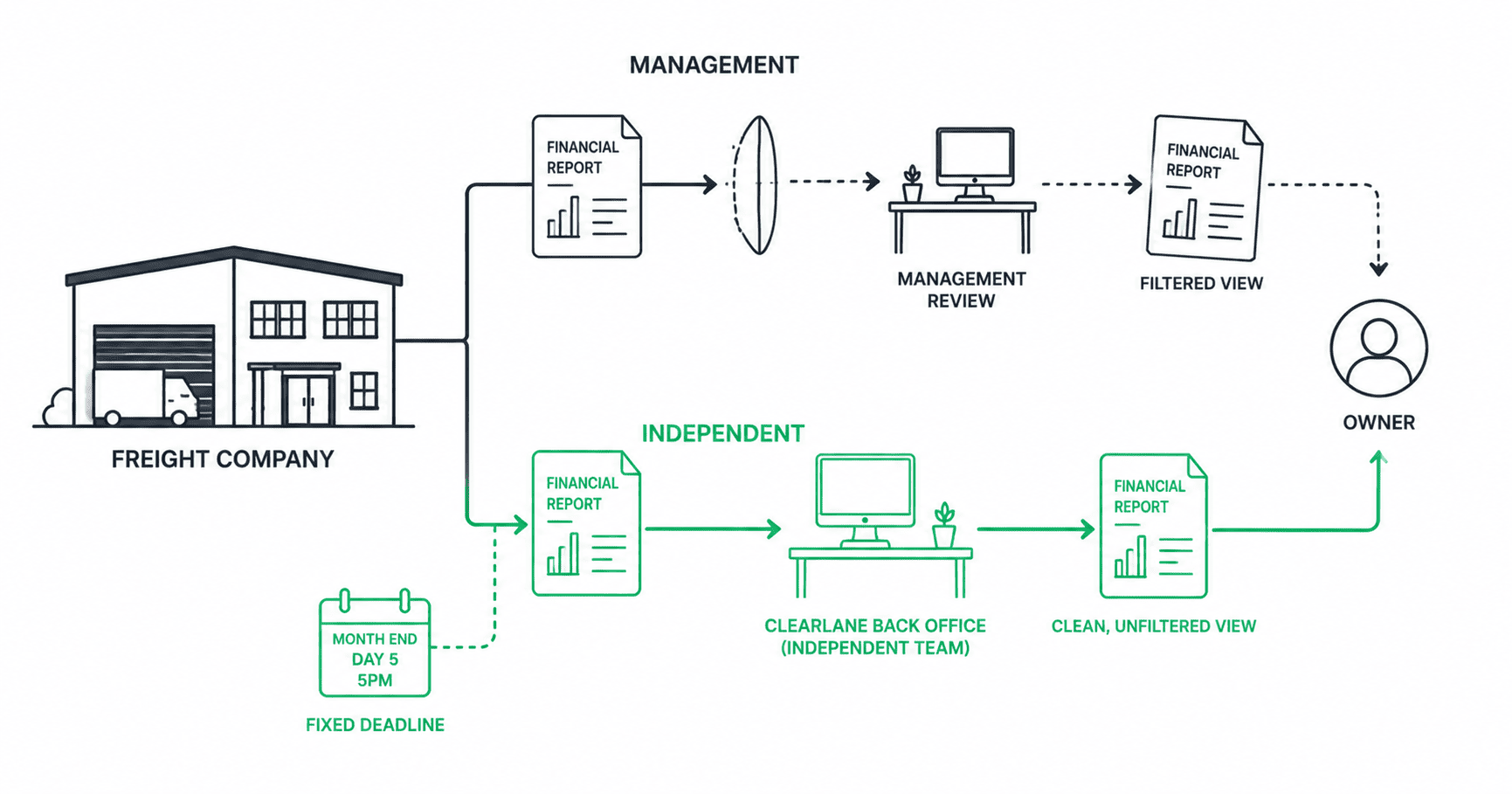
At some point, most freight company owners want the business to run without them. Some retire outright. Some hire a general manager and move to an oversight role. Some sell a stake and keep a seat at the table. In every version, the same problem shows up within a few months: the owner now learns about the business from reports prepared by the people the reports are measuring.
That is not an accusation of anyone. It is a structural problem. Management assembles the numbers, management presents the numbers, and management naturally frames the numbers. An owner who signed the loan guarantees and still carries the risk deserves a view that does not depend on that framing.
Why Do Owners Lose Visibility When They Step Back?
While the owner sits in the building, visibility is ambient. They hear the phones, see the trucks, sign the checks, and catch problems by walking past them. Step out, and all of that gets replaced by a monthly meeting and a spreadsheet someone else built.
The information does not have to be dishonest to be distorted. Slow-paying customers get described as fine. A billing backlog becomes a staffing story. AR aging gets summarized instead of shown. Small framings compound, and by the time a real problem surfaces, it is six months old.
What Is Independent Owner Reporting?
A monthly reporting package prepared by a party that does not report to day-to-day management: the back-office team that keeps the books. Same underlying data, assembled on a fixed calendar and delivered directly to ownership. It is management reporting, not an audit. There is no opinion attached, and audited or tax-basis statements remain CPA work. What changes is separation: the people producing the numbers are not the people being evaluated by them.
What Should the Monthly Owner Package Contain?
Less than most owners expect, delivered more consistently than most owners get. A P&L per entity and combined for multi-entity operations, the balance sheet view that matters (cash, receivables, payables), full AR aging with the largest past-due accounts named, DSO trend against the 45 to 65 day freight benchmark, and a short exceptions list: what changed, what slipped, what needs an ownership decision.
The format matters as much as the content. Same layout every month, same delivery date every month. Owners stop reading packages that arrive late and look different every time.
| Report | The question it answers | The red flag it surfaces |
|---|---|---|
| P&L, per entity and combined | Is each company actually making money? | One entity quietly subsidizing another |
| Balance sheet | What does the business own and owe? | Liabilities growing faster than the receivables that fund them |
| AR aging summary | Is revenue turning into cash? | The over-90 bucket creeping up while sales look fine |
| Cash position and near-term commitments | Can the next six weeks be paid for? | Payroll and carrier payments converging on the same week |
| Covenant and lender metrics | Are we inside the credit agreement? | A ratio drifting toward its limit with quarters of warning |
| Operating counts | Loads, margin per load, claims open | Volume up while margin per load erodes |
| Exceptions note | What broke this period and who owns it? | The same exception appearing three periods running |
Cadence is set by the owner, not the calendar: weekly, monthly, or quarterly, per your SOP. Owners in an active transition usually start weekly and relax the cadence as trust in the numbers builds.
Does Independent Reporting Undermine the Management Team?
Handled correctly, it does the opposite. The general manager gets out of the report-building business entirely, which is hours back every month and one less way to be second-guessed. Management runs operations and explains results. The back office assembles the results. Everyone argues from the same independently prepared numbers instead of arguing about whose spreadsheet is right.
Who Else Uses This Kind of Reporting?
Lenders, first. A credit line usually comes with a reporting calendar: monthly or quarterly statements, AR aging, covenant metrics. A back office that produces the owner package can produce the lender package on the same cycle, so covenant season stops being a scramble.
Shareholder groups, second. Partners who are not in the building daily, family members with inherited stakes, or minority investors all face the same structural problem the stepped-back owner faces, and solve it the same way: third-party numbers on a fixed cadence.
And increasingly, buyers and sellers. The same records discipline that produces a clean monthly package is what makes a brokerage saleable, and what lets a buyer validate what they are acquiring. Clean books are an asset in every one of these conversations.
What does the first quarter of independent reporting look like?
The first period is definitional, not analytical. Which entities are in scope, which accounts feed which line, what counts as an exception, and who receives the package on what day. Skipping this step is how reporting projects turn into arguments about whose number is right.
The second period produces the first full package, and it usually produces questions. A receivable the owner thought was collected. A recurring charge nobody remembers approving. This is normal. The package is surfacing what ambient visibility used to catch, and the first few cycles are the backlog clearing.
By the third period the rhythm holds and the review takes the owner an hour: scan the exceptions note first, check the AR aging against last period (reading it well is a skill worth having; see how to read a freight AR aging report), then the cash line. The point was never more paper. It is that one hour, on a fixed date, from a party whose numbers do not pass through the people being measured.
How ClearLane Runs Owner Reporting
We prepare this type of financial reporting as standing work: per-entity and combined statements built from books we keep current, AR aging from collections we work daily, and delivery straight to ownership on the agreed cadence: weekly, monthly, or quarterly, per your SOP. The package reflects the freight operation underneath it, from multi-entity closes to intercompany balances, because the same team runs those workflows.
Frequently Asked Questions
The reporting layer behind all of this is what ClearLane runs as independent owner reporting: the owner, lender, and board packages produced as a desk, so stepping back does not mean losing sight of the numbers. For the judgment layer itself, fractional CFO services are available directly, in a limited number of engagements.
A monthly management package prepared by the back-office team that keeps the books, delivered directly to ownership rather than through day-to-day management. It typically includes per-entity and combined P&L, cash and receivables position, full AR aging, DSO trend, and an exceptions list.
No. It is management reporting: numbers assembled on a fixed cadence with separation between the people producing them and the people being measured by them. Audits, reviews, and tax-basis statements remain the work of your CPA.
Usually the opposite, once it starts. The manager stops spending hours building reports and stops being suspected of framing them. Operations stay with management; assembly of the numbers moves to the back office; conversations start from shared facts.
Monthly is the standard: frequent enough to catch problems while they are small, spaced enough to show real trends. Lender packages follow the credit agreement calendar, monthly or quarterly.
Yes. Each entity gets its own statements, intercompany balances are reconciled, and a combined view sits on top so ownership sees both the parts and the whole. Multi-entity structures are where independent assembly matters most, because the moving pieces multiply.
Stepping back from day-to-day but not from the risk? Request a demo to see what a monthly owner package looks like for your operation. Or email us at info@getclearlane.com.