
Intercompany Freight Billing: How Sister Companies Bill Each Other Without Losing Margin Visibility
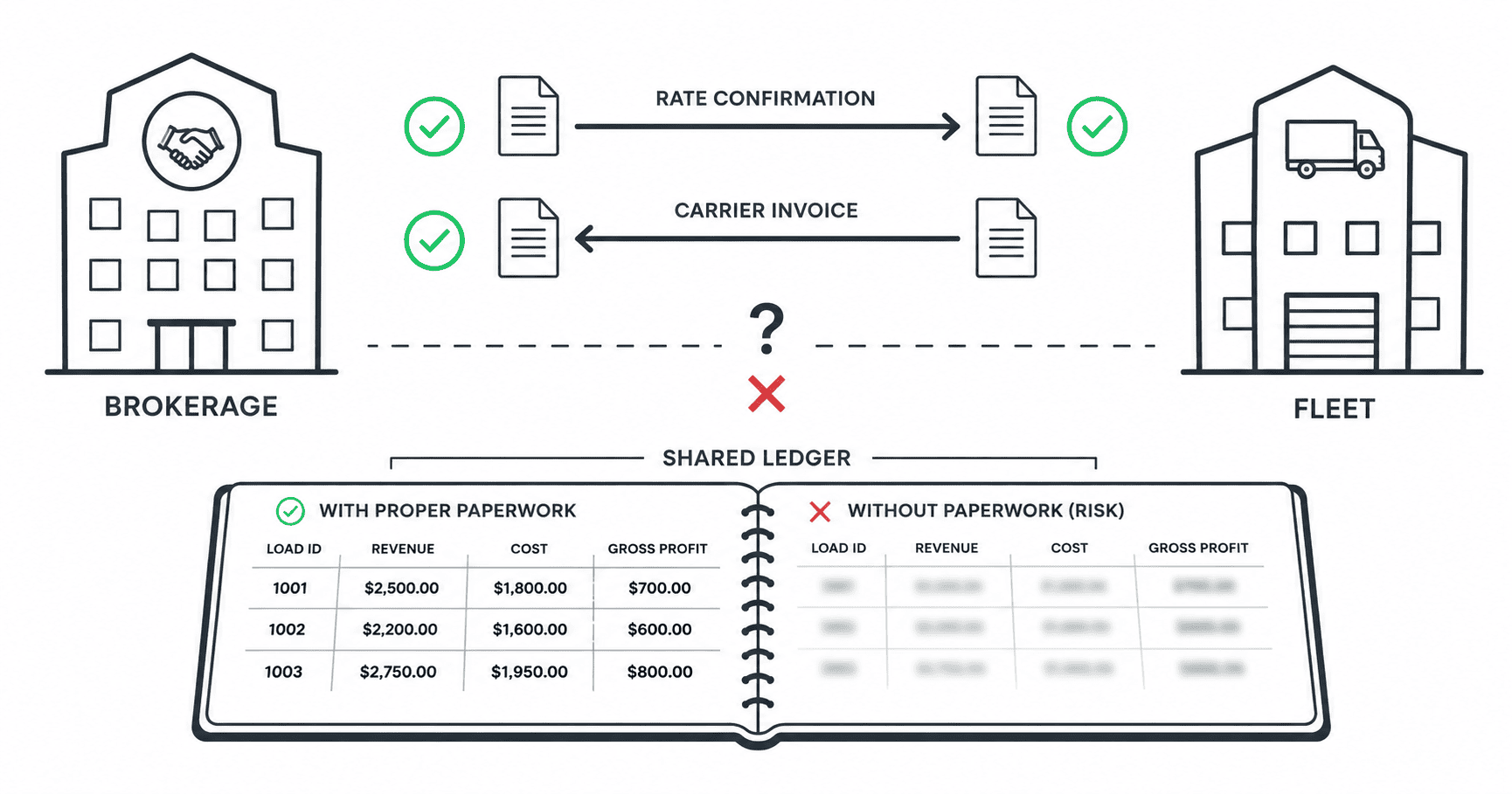
Every multi-entity freight company has the same load somewhere in its history: the brokerage covered a customer shipment with its own truck, the driver delivered clean, the customer paid, and nobody ever wrote anything down between the two companies. The money ended up in the family, so it felt like a detail.
It is not a detail. Intercompany billing is where multi-entity operations either keep their numbers honest or quietly lose track of which company actually makes money. This post covers how the flow should work, what breaks when it gets skipped, and how to run it without slowing dispatch down.
What Is Intercompany Billing in Freight?
Intercompany billing is invoicing between companies under common ownership. In freight it shows up in three main places: a brokerage tendering loads to its affiliated fleet, a warehouse entity billing storage or cross-dock work to a sister company, and a parent company charging management fees or allocating shared costs like rent, software, and insurance down to the operating companies.
The first one carries the most volume and the most risk, because it looks exactly like normal freight. The load moves, the POD comes back, the customer gets invoiced. The only missing piece is the paper between the two related companies, and nothing operational forces anyone to create it.
Why Do Sister Companies Skip the Paperwork?
Speed, mostly. Dispatch is moving, the fleet is trusted by definition, and issuing a rate confirmation to your own truck feels like bureaucracy. There is also usually no owner for the task: the brokerage billing team works customer invoices, the fleet office works outside brokers, and loads between the two fall into the gap.
The reasoning underneath is always the same sentence: it all ends up in the same pocket anyway. At the consolidated level that is true. At the entity level it is how margins turn into guesses.
What Breaks When Intercompany Loads Go Undocumented?
Entity margin becomes fiction first. If the brokerage never records what it owes the fleet for covered loads, the brokerage P&L looks inflated and the fleet looks like it hauls for free. Every decision built on those numbers, from pricing to whether the fleet should grow, is built on bad data.
The books break next. Payments move between company bank accounts without invoices behind them, so reconciliation turns into archaeology at month-end close. And at year-end, the accountant needs support for pricing between related companies. A stack of rate confirmations and carrier invoices is that support. A shrug is not.
Lenders and outside shareholders feel it too. Anyone reading entity-level statements, a bank with a line of credit against one company or a minority owner in another, is reading numbers that intercompany gaps have quietly bent.
What Does a Clean Intercompany Billing Flow Look Like?
Treat the fleet like a carrier. The brokerage issues a rate confirmation for every tendered load, the same document an outside carrier would get. The fleet submits a carrier invoice with the POD attached. The brokerage runs it through the same carrier invoice verification as any other invoice: rate matches the confirmation, accessorials documented, no duplicates.
Both sides record the transaction in their own books, payable on one, receivable on the other. Once a month the intercompany balances get reconciled and settled, so what one company shows as owed matches what the other shows as owing. Run this way, intercompany billing adds minutes per load, not hours, because it rides the workflows that already exist.
How Should Management Fees and Shared Costs Be Handled?
The same discipline, lower volume. If the parent company pays the rent, the software, and the insurance, those costs get allocated to the operating companies on a documented method, the same way every month. Your accountant sets the method. The back office applies it consistently, which is the part that usually fails when it lives in someone’s head.
Consistent allocations are also what make ownership reporting believable. An owner who has stepped back from day-to-day operations, or a shareholder group reading monthly packages, can trust entity numbers only if the costs between companies move by rule instead of by memory.
Where a Dedicated Team Fits
None of this requires new software. It requires the intercompany flow being someone’s actual job. ClearLane runs it inside your existing TMS and accounting systems: rate confirmations issued on tendered loads, fleet invoices verified like any carrier, both sides recorded, balances reconciled monthly, and allocations applied on the documented method. The multi-entity back office stays one connected workflow instead of three companies improvising at each other.
What Should the Intercompany Rate Be?
The rate between sister companies is a policy question your accountant answers, but the operational requirements are universal: documented, consistent, and defensible. The most common approach in freight is market-based pricing, paying the affiliated fleet what an outside carrier would have received on the same lane, drawn from your own recent rate confirmations. It keeps both P&Ls honest and makes the fleet’s performance measurable against the market it actually competes with.
Cost-plus is the usual alternative: the fleet’s operating cost per mile plus a documented margin. It is easier to administer at low volume but drifts from reality when the market moves, so most operations that start there migrate to market-based pricing as intercompany volume grows. Either way, the method gets written down once and applied on every load, because a rate that changes with whoever booked the load is not a policy, it is an argument waiting for year-end.
Settlement matters as much as the rate. Whether the companies exchange actual payments monthly or net the balances on the ledger, do it on a fixed schedule. Lenders reading entity statements trust intercompany accounts that clear regularly; balances that grow for quarters look like what they usually are, a number nobody is watching.
Frequently Asked Questions
Any billed activity between companies under common ownership: a brokerage tendering a load to its affiliated fleet, a warehouse billing storage to a sister company, or a parent allocating shared costs like rent and software to operating companies. Each one needs paper on both sides.
Pricing between related companies is a policy your accountant sets, and the important part operationally is that it is documented and applied the same way on every load. Consistent, supportable pricing is what keeps entity margins meaningful and satisfies whoever reviews the books later.
Monthly, as part of each entity close. The payable one company carries should match the receivable the other carries. Reconciling monthly keeps mismatches small and traceable; letting them run to year-end turns them into a project.
They can distort it. Track intercompany receivables separately from customer receivables, or exclude them from the DSO calculation, so the number reflects how real customers actually pay. A blended figure hides slow collections behind sister-company balances.
Yes. Tendered loads to the affiliated fleet get rate confirmations, fleet invoices are verified like any carrier invoice, and both sides are recorded and reconciled monthly. The work runs inside the TMS and accounting systems you already use.
Loads moving between your companies without paper behind them? Request a demo and we will walk through how the intercompany flow runs inside your TMS. Or email us at info@getclearlane.com.