
Month-End Close for Freight Companies: The 7-Day Benchmark
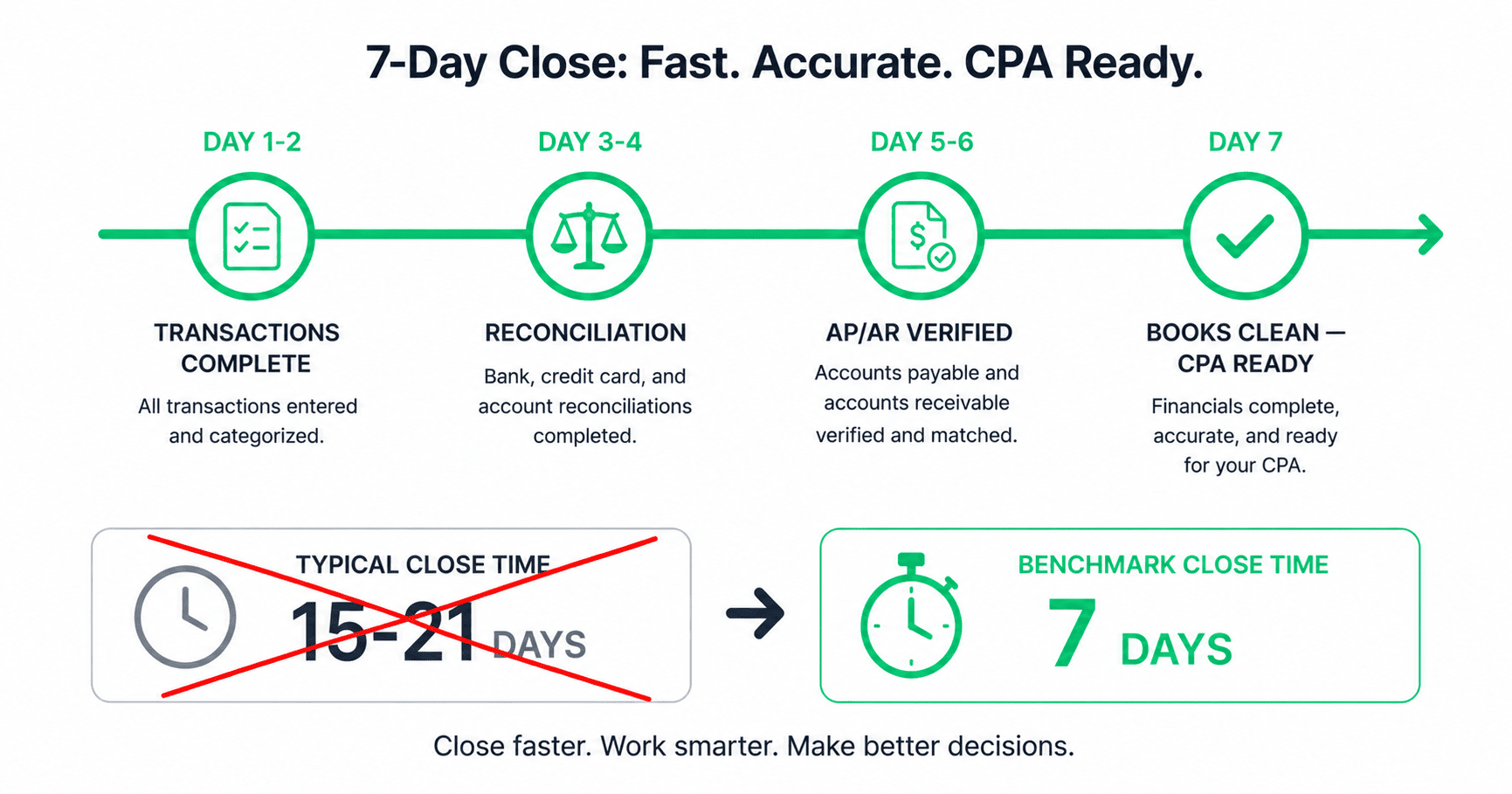
At most freight companies under $80 million in revenue, the month-end close happens sometime between the 15th and 21st of the following month, if it happens at all. Some brokerages don’t formally close their books monthly. They reconcile when the CPA asks for data, which usually means a scramble at quarter-end or year-end.
The 7-day benchmark means having all transactions recorded, all bank and credit card accounts reconciled, and clean books ready for CPA review within seven business days of month-end. It is achievable for any freight company. It doesn’t require a bigger team or better software. It requires keeping the books current throughout the month so there’s no backlog to clear when the calendar turns.
This post breaks down what the 7-day close process looks like, why most freight companies fall short of it, and what to change to make it the standard.
Why Does Month-End Close Take So Long at Freight Companies?
The answer is almost always the same: the books aren’t current during the month, so month-end becomes a catch-up exercise.
Transactions accumulate without being recorded. Carrier payments go out but don’t get posted to the accounting system for days or weeks. Shipper payments come in but sit unmatched in the bank account. Credit card charges pile up without being categorized. Operating expenses get paid but not recorded.
By the time someone sits down to “close the month,” they’re not closing. They’re reconstructing. They’re reconciling four weeks of unrecorded transactions, chasing receipts that should have been categorized when they were incurred, and trying to match bank activity to accounting entries that don’t exist yet.
This is the fundamental difference between freight companies that close in 7 days and those that close in 21. The fast closers keep books current throughout the month. The slow closers batch everything at month-end.
For freight companies that already outsource accounts payable (AP) and accounts receivable (AR) operations, the transaction data is already flowing through the back-office team in real time. Carrier invoices are verified and recorded. Shipper payments are tracked and posted. The operational data that bookkeeping needs to record is already available. It just needs to be entered into the accounting system as it happens, not batched at month-end.
What Does the 7-Day Close Process Look Like?
The 7-day close isn’t a month-end sprint. It’s the natural result of a process that runs continuously.
During the month, the bookkeeping function handles transactions as they occur. Bank transactions are reconciled daily or weekly. Carrier payments are recorded when processed. Shipper payments are posted when received. Credit card charges are categorized weekly. Operating expenses are recorded when paid.
If this continuous recording happens throughout the month, the month-end close becomes a verification exercise rather than a reconstruction project.
Days 1-2 after month-end: final transaction sweep. Ensure every transaction through the last business day of the month is recorded. This catches any late-posting bank transactions, carrier payments processed on the last day, and shipper payments received at month-end. The sweep should be small (a handful of transactions, not hundreds), because the books have been kept current.
Days 3-4: reconciliation verification. Confirm all bank accounts and credit card accounts are fully reconciled through the end of the month. Every transaction in the bank matches an entry in the accounting system. Every credit card charge is categorized. Any discrepancies identified during the sweep are resolved.
Days 5-6: AP and AR verification. Confirm that accounts payable reflects all outstanding carrier and vendor invoices. Confirm that accounts receivable reflects all outstanding shipper invoices and matches the AR aging report. Verify that no invoices are missing from either side.
Day 7: clean books delivered. The trial balance is clean. All accounts are reconciled. No unmatched transactions. The books are ready for the CPA to review, make adjusting entries, and prepare statements.
What Gets in the Way of a 7-Day Close?
Three things prevent freight companies from hitting the 7-day benchmark consistently.
The bookkeeping function doesn’t have dedicated capacity. When bookkeeping is someone’s side task (the office manager, the AR person, the owner), it happens when there’s time. During the month, there’s never enough time because billing, POD retrieval, compliance, and customer fires take priority. The bookkeeping backlog grows week by week, and month-end becomes the deadline that forces the catch-up.
The operational and financial data isn’t connected. When the back-office team processes carrier payments through one workflow and the bookkeeper records them through a separate workflow, there’s a handoff gap. The payment happens on Monday. The bookkeeper finds out about it on Thursday, or next week. Every day of lag between the transaction and the recording adds to the month-end backlog.
This is why adding bookkeeping to existing back-office operations makes the 7-day close achievable. The team processing the transactions is the same team recording them. No handoff gap. No data lag.
Receipts and documentation are missing. Credit card reconciliation requires receipts. Expense categorization requires context. When receipts aren’t collected in real time (driver fuel receipts, office purchases, subscription charges), the month-end reconciliation stalls while someone chases documentation that should have been captured weeks ago.
How Does Fast Month-End Close Benefit Freight Companies?
The financial visibility benefit is the most obvious. When the books close within seven business days, the owner and management team have accurate financial data for the previous month around the 9th to 11th of the current month. They can see revenue, expenses, margin, and cash flow while the information is still actionable, not three weeks later when the decisions have already been made.
A close that lands on a predictable date is also what makes reporting to people outside the operation possible. Owners who have stepped back from daily management, boards, and lenders working to a credit agreement calendar all need figures on a fixed schedule rather than whenever the books happen to be ready. That timing is what ownership and lender reporting is built on.
The CPA relationship improves. CPAs charge by the hour. When they receive clean, current books, they spend their hours on judgment work: adjustments, tax strategy, advisory. When they receive a backlog of unreconciled transactions, they spend their hours doing bookkeeping at CPA rates. A 7-day close reduces the CPA’s billable hours on low-value work, which reduces the client’s accounting costs.
DSO management becomes data-driven. When the books are current, the DSO calculation is accurate. When the books are three weeks behind, the DSO number is based on stale data that doesn’t reflect current reality. Financial decisions based on stale data are guesses, not management.
Year-end becomes uneventful. A freight company that closes in 7 days every month doesn’t have a year-end crisis. The December close follows the same process as every other month. The CPA receives 12 months of clean, reconciled data and prepares the return from a solid foundation, not from a reconstruction project.
How Should Freight Companies Measure Month-End Close Performance?
Close timeline. Measure the number of business days from the last day of the month to when the books are declared “clean and ready for CPA.” Track monthly. The trend matters more than any single month.
Unreconciled items at month-end. Count the number of transactions that haven’t been recorded or matched when the close process begins. This number should be small (under 20 for a mid-size brokerage) if the books are being kept current throughout the month. If it’s over 100, the monthly bookkeeping isn’t happening during the month.
CPA adjustment volume. How many adjusting entries does the CPA need to make after receiving the books? A high adjustment count means the bookkeeping is missing classifications, categorizations, or transactions that the CPA has to clean up. The number should decrease over time as the bookkeeping process matures.
Reconciliation accuracy. What percentage of bank and credit card transactions match accounting entries without manual intervention? The target is above 95%. Below 90% indicates that transaction recording during the month isn’t keeping pace with the actual transactions.
ClearLane’s bookkeeping service targets the 7-day close as a standard deliverable, with continuous transaction recording throughout the month so month-end is a verification exercise, not a catch-up project.
Want to get your month-end close under 7 days? Talk to our team to see how ClearLane handles bookkeeping for freight companies. Or email us at info@getclearlane.com.
Frequently Asked Questions
The benchmark is 7 business days: clean, reconciled books ready for CPA review around the 9th to 11th of the following month. Most freight companies currently close in 15-21 days because they batch bookkeeping at month-end instead of recording continuously.
Because the books aren’t kept current during the month. When bookkeeping is a side task for someone with other priorities, transactions accumulate unrecorded. Month-end becomes a reconstruction exercise rather than a verification exercise.
Month-end close is the process of finalizing all financial transactions for the period: reconciling accounts, posting adjustments, and generating accurate financial statements. In freight companies, the complexity comes from high transaction volume and the AP/AR timing mismatches between carrier payments and shipper collections.
For freight companies: reconcile bank and credit card accounts, verify all carrier invoices are posted, confirm all shipper invoices are sent and recorded, reconcile AP and AR subledgers to the general ledger, review the aging report, post adjusting entries, and run financial statements. The benchmark for a well-run freight operation is completing this within 7 business days.
The 7-day close keeps books current throughout the month: transactions recorded as they happen, reconciliation done weekly. The 21-day close batches everything at month-end, creating a backlog that takes weeks to clear.
When the team processing AP and AR transactions is the same team recording them in the accounting system, there’s no handoff gap. Transactions get recorded in real time, so month-end has no backlog to clear.
Yes. CPAs who receive clean, current books spend their hours on adjustments, tax strategy, and advisory, not on bookkeeping at $150-$400/hour. Fewer hours on data cleanup means lower quarterly and year-end bills.