
Shipper Payment Disputes: The 5 Most Common Causes and How to Prevent Them
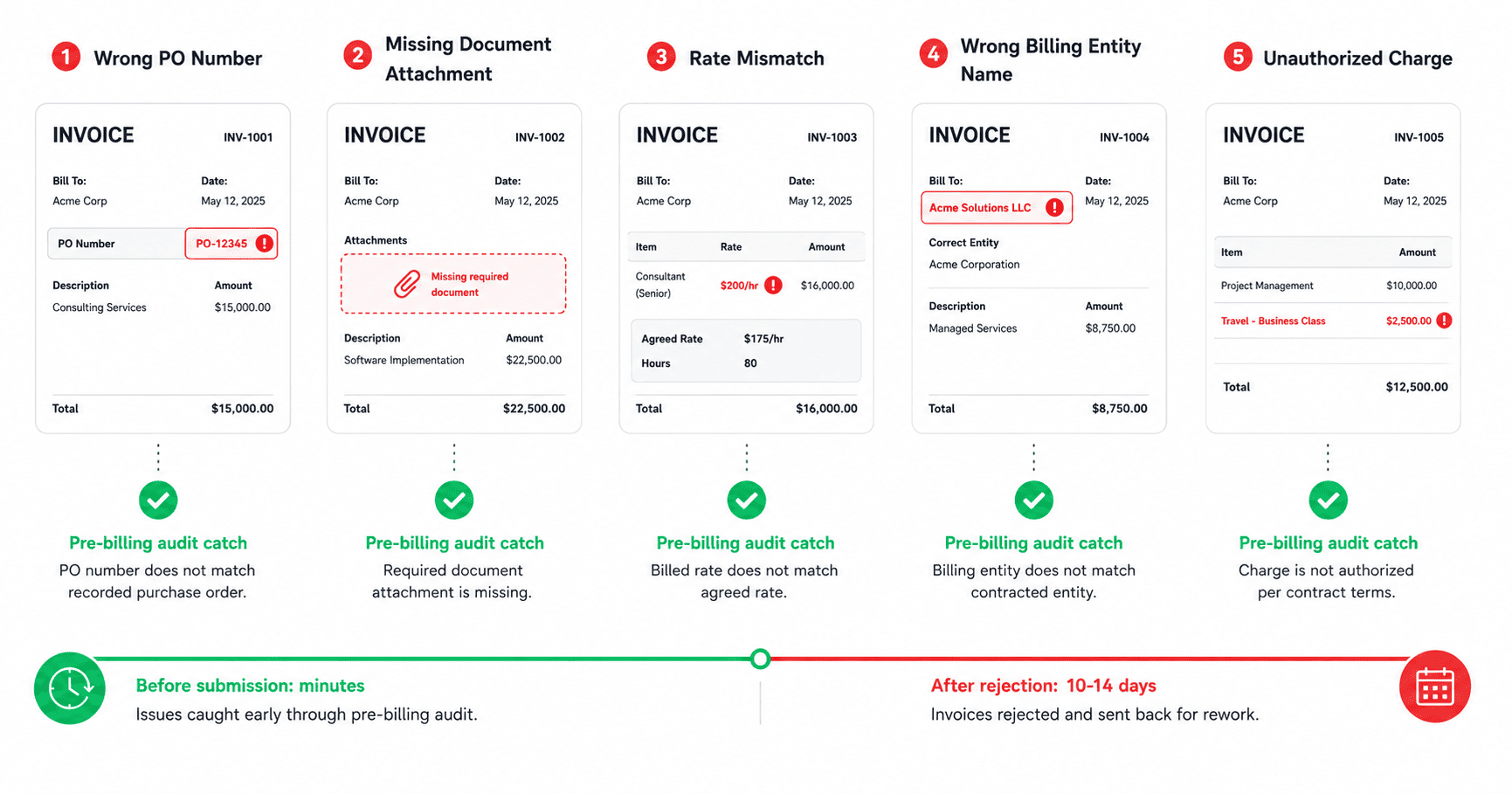
How Much Does a Single Billing Dispute Cost a Freight Company?
A billing dispute is one of the most expensive events in freight back-office operations, not because of the dollar amount at risk, but because of the time it consumes.
When a shipper’s accounts payable (AP) system rejects an invoice, the rejection triggers a multi-step resolution process. The broker receives a dispute notification. Someone researches the issue. The root cause is identified. A corrected invoice is prepared. The corrected invoice is submitted. The shipper’s payment cycle restarts from the new submission date.
Each step involves a queue: the dispute sits in the broker’s inbox, the research waits for someone to get to it, and the corrected invoice waits for review. The total elapsed time from initial rejection to corrected resubmission is typically 5 to 7 business days. The shipper’s payment terms (usually Net 30) restart from the resubmission date. The combined time penalty: 10 to 14 additional days added to the payment cycle on that invoice.
At a brokerage processing 3,000 loads per month with a 5% dispute rate, that’s 150 invoices per month going through this cycle. At an average invoice of $1,000, that’s $150,000 in receivables outstanding 10 to 14 days longer than necessary, every month.
The dispute rate is the single most controllable driver of DSO inflation. Unlike payment terms (negotiated with the customer) or customer payment speed (controlled by the customer), the dispute rate is determined by the accuracy and completeness of the invoice the broker submits. It’s within the broker’s control to reduce, and the return on reducing it is direct and measurable.
Why Do PO Number Mismatches Cause the Most Billing Disputes?
PO mismatches are the most common cause of invoice disputes in freight billing. They’re also the simplest to prevent and the most frustrating when they occur, because the rest of the invoice may be perfectly correct.
Large shippers and enterprise customers operate automated AP systems that match incoming invoices against open purchase orders. The match is typically done on the PO number field. If the PO on the invoice doesn’t match an open PO in the shipper’s system, the invoice is auto-rejected. No human reviews it. The rejection notification goes back to the broker.
PO mismatches happen for several reasons. The TMS auto-populates the PO from a previous load on the same lane, but the shipper issued a new PO for this shipment. The PO was entered incorrectly at booking (a transposed digit, a missing prefix, an old format). The shipper changed their PO format or numbering system and the broker’s records weren’t updated.
Prevention: verify the PO on every invoice against the shipper’s load tender or portal before submission. If the TMS auto-populates the PO, that auto-populated value should be checked, not assumed correct. The pre-billing audit should include PO verification as a standard check.
Why Does Missing Backup Documentation Trigger Disputes?
Many shippers require specific backup documents attached to the invoice: signed POD, BOL, lumper receipts, detention documentation, weight tickets. If any required document is missing, the shipper’s AP team either rejects the invoice entirely or approves the base rate and rejects the charges that lack documentation. (Billing deductions are not freight claims: cargo loss and damage claims follow their own investigation and disposition rules under 49 CFR Part 370.)
The documentation requirements vary by shipper. Some require only a POD. Some require POD plus BOL. Some require photos of the signed delivery receipt. Some require specific documentation for each accessorial charge: a signed detention log, a lumper receipt with the facility name and date, a weight ticket for overweight charges.
The challenge isn’t knowing what’s required: most brokerages have this information somewhere. The challenge is ensuring that every document is attached to every invoice before it goes out, across hundreds of invoices per week with different customers who have different requirements.
Prevention: maintain a customer-specific documentation checklist that lists every required document for each shipper. The billing team (or the pre-billing audit team) checks the invoice against the customer’s checklist before submission. Missing documents are flagged and resolved before the invoice goes out, not after the shipper kicks it back.
How Do Rate Discrepancies Trigger Shipper Payment Disputes?
Rate disputes occur when the invoiced rate doesn’t match the rate the shipper has on file: their purchase order amount, their contract rate, or their expected charge based on the rate they agreed to.
Rate discrepancies can originate from TMS auto-population errors (the rate from the previous load on the same lane, not the current contract rate), fuel surcharge calculation differences (the broker used the wrong DOE reference period or the wrong formula), mid-cycle contract adjustments that weren’t reflected in the invoice, or simple data entry errors (typing $2,380 instead of $2,830).
Rate disputes are particularly expensive because they often require research on both sides: the broker pulls the customer contract or load tender, the shipper pulls their purchase order, and the two parties reconcile the difference. This back-and-forth can add a week to the resolution timeline beyond the standard dispute cycle.
Prevention: verify the invoiced rate against the current customer contract or load tender for every load. Not the TMS rate field: the actual rate agreement. Check the base rate, fuel surcharge, and any accessorial rates individually. The pre-billing audit checklist should include line-item rate verification.
How Does the Wrong Billing Entity Cause a Dispute?
Large shippers frequently have multiple billing entities (subsidiaries, divisions, locations), each with their own AP department and PO system. An invoice that’s correct in every other respect but sent to the wrong billing entity gets rejected because the receiving entity doesn’t have the corresponding purchase order.
This happens most often when a shipper operates multiple facilities and the billing entity for a specific facility changes, when a shipper reorganizes their corporate structure and billing entities are reassigned, or when the booking team enters the shipper name generically (“Acme Corp”) instead of the specific billing entity (“Acme Corp – Southeast Division”).
Prevention: maintain a shipper-to-billing-entity mapping that specifies which entity receives invoices for which facilities or load types. Update the mapping whenever the shipper communicates a change. The billing team should verify the billing entity on every invoice against this mapping, especially for shippers with multiple entities.
Why Do Unauthorized Accessorial Charges Get Disputed?
When a shipper’s AP system receives an invoice with accessorial charges that don’t match an approved PO or pre-authorization, the accessorial charges get disputed, even if the base freight rate is approved and paid.
This happens when detention, layover, or other charges are included on the invoice but the shipper didn’t issue a separate PO or pre-authorization for the accessorial. Some shippers require a separate approval process for accessorial charges: the broker needs to submit a pre-approval request with supporting documentation before the accessorial can be invoiced. If the broker skips this step and includes the accessorial on the invoice without pre-approval, the charge gets rejected.
It also happens when accessorial charges are included without supporting documentation: a detention charge with no arrival and departure times, a lumper fee with no receipt, a layover charge with no evidence of the delay. The shipper’s AP team can’t verify what they can’t see.
Prevention: understand each shipper’s accessorial billing process. Some shippers accept accessorials on the freight invoice with documentation attached. Some require a separate invoice for accessorials. Some require pre-approval before the accessorial can be billed. The billing process should match the customer’s requirement, and the pre-billing audit should verify that every accessorial charge has the required documentation and follows the customer’s approval process.
How Can Freight Companies Prevent Billing Disputes Before They Happen?
All five dispute causes share a common characteristic: they’re preventable with a verification step before the invoice goes out. After submission, each one costs 10 to 14 days and hours of staff time. Before submission, each one costs a few minutes of checking.
The pre-billing audit checklist should include these five checks on every invoice:
PO number verified against the shipper’s load tender or portal. Rate verified against the current customer contract or load tender: base rate, fuel surcharge, and accessorial rates. All required backup documentation attached per the customer’s documentation requirements. Billing entity confirmed against the shipper-to-entity mapping. Accessorial charges supported by documentation and compliant with the customer’s approval process.
A billing team processing 3,000 invoices per month needs roughly 150 to 250 hours of audit capacity to run these checks on every invoice. That’s the capacity investment. The return is the reduction in disputes, which directly reduces DSO, frees staff time from dispute resolution, and improves the customer’s experience of the billing relationship.
ClearLane runs these checks on every invoice as part of the pre-billing audit. The goal is zero disputes from preventable causes.
Frequently Asked Questions
The five most common: PO number mismatches, missing documentation, rate discrepancies, wrong billing entity, and unauthorized accessorial charges.
Each dispute adds 10-14 days, because the corrected invoice restarts the shipper’s payment terms from the resubmission date, not the original invoice date.
At 3,000 loads per month with a 5% dispute rate and $1,000 average invoice, $150,000 in receivables sits outstanding 10-14 days longer than necessary every month.
A pre-billing audit that checks every invoice for PO accuracy, rate correctness, documentation completeness, billing entity, and accessorial authorization before submission. A few minutes of verification prevents 10-14 days of dispute resolution.
Want fewer invoices coming back disputed? Talk to our team to walk through it. Or email us at info@getclearlane.com.