
Billing Accuracy Went from 91% to 99% at a Trucking Company: What Changed
Note: This case study uses anonymized data from a composite of freight operations. Company details have been generalized to protect confidentiality.
What Does 91% Billing Accuracy Actually Cost a Freight Company?
A mid-size trucking company, roughly 1,500 to 2,000 loads per month and $40 to $45 million in annual revenue, operating a mix of dry van and flatbed across regional lanes, was tracking a metric most freight companies don’t measure explicitly: first-pass invoice accuracy rate.
First-pass accuracy is the percentage of shipper invoices that are accepted by the shipper’s accounts payable (AP) system without triggering a dispute, rejection, or documentation request. It measures billing quality at the point of submission.
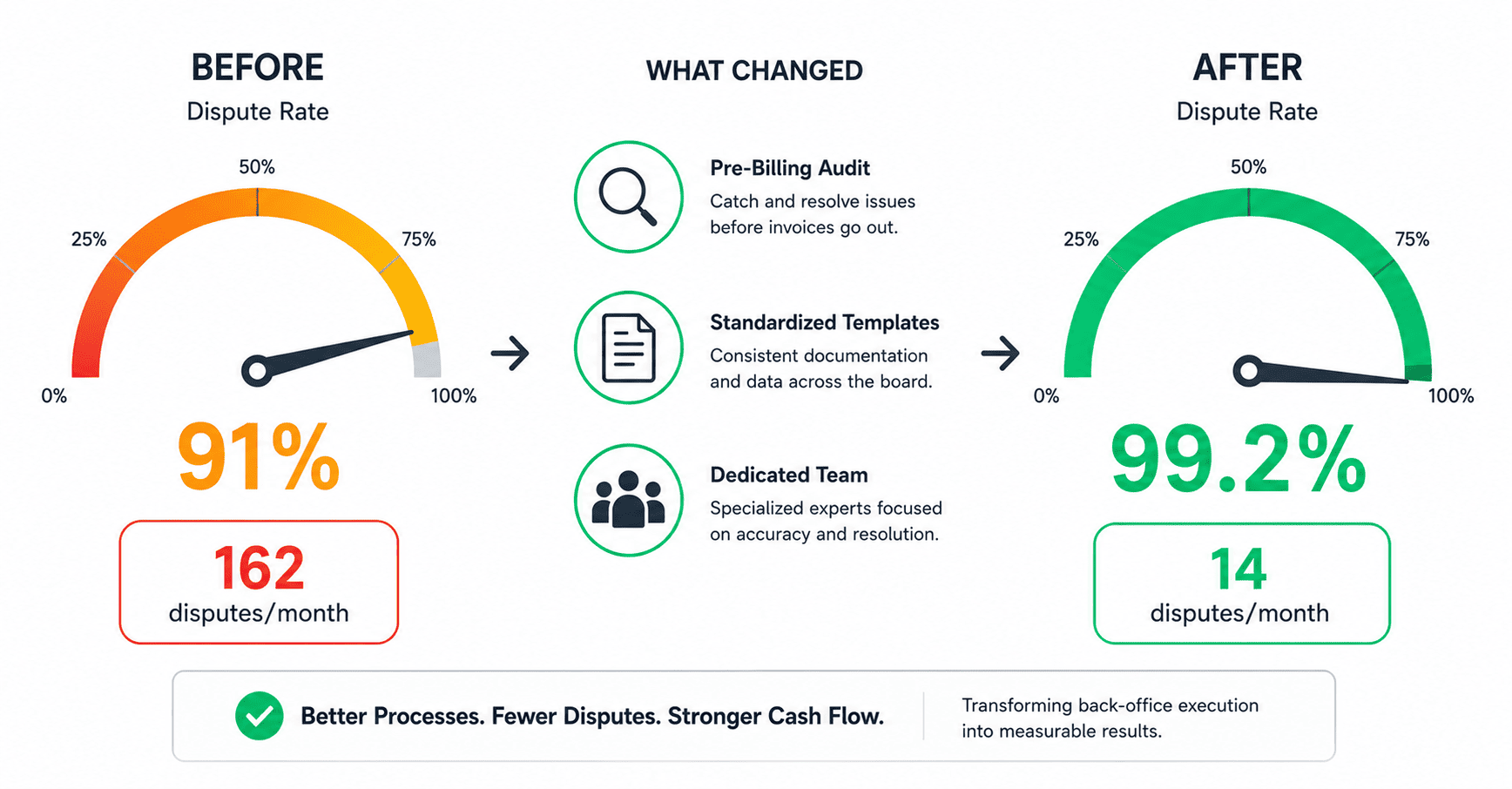
The company’s rate was 91%. That sounds reasonable: nine out of ten invoices going out correct on the first try. But at 1,800 loads per month, 9% means 162 invoices per month with errors.
Each disputed invoice triggered a resolution cycle: rejection notification, root cause research, correction, resubmission. Average resolution time: 12 days. During those 12 days, the invoice was in limbo, not in the shipper’s payment queue, not accruing toward payment terms, just sitting in dispute status.
At 162 disputes per month with an average invoice of $2,100, the company had roughly $135,000 in receivables perpetually stuck in the dispute cycle (162 invoices a month, each held for 12 days). That’s $135,000 in working capital that was effectively inaccessible, not because customers wouldn’t pay, but because the invoices had errors that prevented payment.
The DSO impact was measurable. The dispute-related invoices added approximately 1 day to the company’s overall DSO: 162 disputed invoices, each delayed by 12 days, spread across the full 1,800-load portfolio (162 × 12 ÷ 1,800 = 1.08 days).
What Types of Billing Errors Were Causing the Disputes?
The company conducted a 60-day analysis of every disputed invoice to categorize the error types. The distribution was consistent with what most freight companies see:
PO number or reference errors accounted for roughly 35% of disputes. The most common: TMS auto-populating the PO from a previous load on the same lane when the shipper had issued a new PO. The PO looked correct in the system. It just wasn’t the right one for this load.
Missing or incomplete documentation accounted for roughly 25% of disputes. The shipper required a signed POD, and the POD attached to the invoice was a preliminary scan, not the final signed version. Or the shipper required a BOL and the billing team attached only the POD. Or an accessorial charge was included without the supporting receipt.
Rate discrepancies accounted for roughly 20% of disputes. The invoiced rate didn’t match the shipper’s purchase order, sometimes because the contract rate changed and the TMS wasn’t updated, sometimes because the fuel surcharge was calculated on the wrong reference period, sometimes because an accessorial rate had changed between contract cycles.
Wrong billing entity accounted for roughly 10% of disputes. The company’s larger customers had multiple billing entities, and invoices sent to the wrong entity were auto-rejected.
Formatting and submission errors accounted for roughly 10% of disputes. Invoices submitted to the wrong portal, in the wrong format, or missing required fields that the shipper’s EDI system needed.
The root cause analysis revealed something important: none of the errors were caused by incompetence or carelessness. They were caused by a billing team working at volume without enough time to verify each invoice against the customer’s specific requirements before hitting submit.
What Three Changes Took Billing Accuracy from 91% to 99%?
The company implemented three changes over a 60-day period.
A pre-billing audit was added as a distinct step between invoice preparation and invoice submission. Every invoice was reviewed against a standardized checklist before going out: PO verified against the shipper’s load tender, rate verified against the current customer contract, all required documentation attached per the customer’s requirements, billing entity confirmed, and format/submission method verified.
The audit was performed by a different person than the one who prepared the invoice. This separation of preparation and verification is important: the person who prepared the invoice is less likely to catch their own errors than a second set of eyes reviewing the work.
Customer-specific billing templates were documented for every active shipper. Each template specified: the billing entity, the required documentation, the submission method (portal, email, EDI), the PO format, any unique fields or reference numbers, the fuel surcharge formula and reference period, and the accessorial billing process (included on freight invoice, separate invoice, pre-approval required).
Before this documentation existed, the billing team relied on memory and experience. The senior billing person knew each customer’s requirements. When they were out, or when a new team member processed an unfamiliar customer’s invoice, errors spiked. The templates made the knowledge explicit and available to anyone on the team.
The billing function was separated from other responsibilities. The same team that had been handling billing, POD retrieval, and some compliance work was restructured so that billing and the pre-billing audit became dedicated functions. POD retrieval and compliance were handled separately, either by a different in-house person or by an external team.
This separation was the most impactful change because it addressed the root cause behind many of the errors: the billing team had been rushing through invoices to keep up with volume while also chasing PODs and handling compliance requests. When billing became their sole focus, they had the time to use the customer templates, perform the pre-billing checks, and submit invoices that were correct on the first pass.
The Results
The improvement was tracked weekly from day one.
First-pass accuracy rate climbed from 91% to 95% within the first 30 days, primarily from the pre-billing audit catching the most obvious errors (wrong POs, missing documents) before submission.
By day 60, accuracy reached 97.5%. The customer billing templates were fully documented and in use, catching the billing entity errors and submission format issues that the audit alone didn’t address.
By day 90, accuracy stabilized just above 99%, where it remained through the four-month measurement period. The remaining 0.8%, roughly 14 invoices per month, were errors that even the pre-billing audit didn’t catch, typically involving unusual customer requirements or one-off situations that weren’t covered by the templates.
The dispute volume dropped from 162 per month to 14. The $135,000 in receivables that had been perpetually stuck in dispute resolution cleared within 60 days as the existing disputes resolved and new disputes stopped arriving at the old rate.
DSO decreased by approximately 5 days over the four-month period. The roughly 1 day of DSO inflation caused by dispute-related delays was largely eliminated. The remaining 4 days or so came from the billing team submitting invoices faster (because they weren’t spending time on dispute resolution) and the accounts receivable (AR) cadence having fewer overdue invoices to chase.
The billing team’s workload decreased. This was counterintuitive: adding a pre-billing audit step should have added work. But the time saved on dispute resolution more than offset the time added by the audit. The team estimated that dispute research and correction had been consuming roughly 30% of one person’s capacity. That capacity was freed up when disputes dropped from 162 to 14 per month.
Why Is First-Pass Billing Accuracy the Most Controllable DSO Lever?
Billing accuracy is the most controllable driver of DSO improvement because it’s entirely within the brokerage’s or trucking company’s control. Payment terms are negotiated with the customer. Customer payment speed is the customer’s decision. Accessorial capture depends on dispatch documentation. But whether the invoice goes out correct on the first pass (right PO, right rate, right documentation, right billing entity, right submission format) is a function of the billing process alone.
Each percentage point of accuracy improvement has a calculable DSO impact. At 1,800 loads per month:
91% accuracy = 162 disputes/month × 12 days average delay ÷ 1,800 loads = 1.1 days added to DSO
95% accuracy = 90 disputes/month × 12 days ÷ 1,800 loads = 0.6 days added to DSO
99% accuracy = 18 disputes/month × 12 days ÷ 1,800 loads = 0.1 days added to DSO
The difference between 91% and 99% accuracy is about 1 day of DSO. At $45 million in annual revenue, one day of DSO represents approximately $123,000 in working capital.
Applying This to Your Operation
If you’re not currently tracking first-pass accuracy rate, start. The measurement is straightforward: count the number of invoices submitted in a month, then count the number that were accepted without a dispute, rejection, or documentation request. Divide the second number by the first.
If the number is below 95%, the investment in a pre-billing audit and customer billing templates will pay for itself through dispute reduction alone, without any other changes to the billing process.
If the number is between 95% and 98%, the pre-billing audit will still produce measurable improvement, and customer template documentation will prevent the gradual accuracy degradation that happens when experienced billing staff leave and new team members learn on the job.
If the number is above 98%, the billing process is working well. The focus should shift to maintaining that rate during volume growth and staff transitions, which is where documented templates and a defined audit process provide insurance against regression.
ClearLane’s pre-billing audit runs these checks on every invoice as part of the full post-dispatch pipeline, targeting first-pass accuracy rates above 99%.
Frequently Asked Questions
First-pass accuracy is the percentage of shipper invoices accepted by the shipper’s AP system without triggering a dispute, rejection, or documentation request. It measures billing quality at the point of submission.
98% or higher. Below 95%, the investment in a pre-billing audit and customer billing templates pays for itself through dispute reduction alone.
Each percentage point of accuracy improvement has a calculable DSO impact. Going from 91% to 99% accuracy reduces DSO by approximately 1 day, worth roughly $123,000 in working capital at $45 million in revenue.
A pre-billing audit on every invoice (catches errors before submission), documented customer billing templates (makes requirements explicit instead of relying on memory), and dedicated billing capacity (so the team has time for quality work instead of rushing through queues).
Each invoice is checked against the customer contract rate for base rate and accessorials, matched to a legible POD, and validated against the customer’s billing requirements such as PO numbers, reference formats, and portal rules before it goes out. That pre-send verification is what moved accuracy in this case.
Want to see what a pre-billing audit would catch in your invoices? Talk to our team to walk through it. Or email us at info@getclearlane.com.