
Building an AR Collections Process from Scratch for a Growing 3PL
When Does Informal AR Collections Stop Working at a Freight Company?
At every growing freight company, there’s a phase where accounts receivable (AR) collections is handled informally and it works. The owner or controller knows the customers. They track payment patterns in their head. When an invoice is late, they notice, because they’re close enough to the billing to see it, and they pick up the phone.
This informal approach works when the company is processing 300 to 800 loads per month. The customer base is small enough to know personally. The invoice volume is low enough to track mentally. The relationships are direct enough that a phone call resolves most issues.
Somewhere between 1,000 and 1,500 loads per month, informal collections breaks. Not because anyone does anything wrong, but because the math changes. The customer base expands from 20 to 50 to 100 accounts. The invoice portfolio grows from 300 to 1,500 active invoices. The person who was tracking payments mentally is now also managing a growing billing operation, handling compliance, and dealing with operational exceptions.
Invoices start falling through the cracks. Not the big ones. The owner still notices when a major customer is late. The small and mid-size invoices that age from 30 to 45 to 60 days without anyone asking about them. The new customer whose payment cycle is 40 days but nobody discovered that until the invoice hit 55 days. The dispute that was flagged by the shipper at day 10 and sat in an inbox until day 38 because nobody was monitoring it.
By the time the informal approach visibly fails, when DSO has crept up by 8 or 10 days and the 60-day aging bucket has grown to an uncomfortable percentage of total receivables, the problem has been building for months.
This post is for the freight company or 3PL that’s at that inflection point: formal collections isn’t happening yet, the aging numbers are showing it, and the question is how to build a process from zero.
What Is the Right Accounts Receivable Collections Cadence for Freight Companies?
The four-trigger cadence is the foundation of a formal collections process. Each trigger defines when an action happens and what that action is.
Day 15: Confirmation contact. Verify the invoice was received and is in the shipper’s payment system. This is the single highest-ROI contact in the entire cadence: it catches submission failures, documentation gaps, and PO errors before the invoice is overdue.
The Day 15 contact is not a collection call. It’s a customer service contact: “We submitted invoice #12345 on [date] for load #67890. Can you confirm it’s been received and entered in your accounts payable system? Please let us know if anything else is needed for processing.”
Day 30: First follow-up. The invoice is at the due date. Contact the shipper’s accounts payable (AP) team to confirm payment status. “Invoice #12345 is due today per our net 30 terms. Can you confirm the expected payment date?”
If the Day 15 contact was made and the invoice was confirmed in the system, the Day 30 contact is brief, just confirming the payment cycle. If the Day 15 contact wasn’t made (because the process is just starting and there’s a backlog), the Day 30 contact needs to do double duty: confirm receipt and ask about payment timing.
Day 45: Escalation. The invoice is 15 days past due. Contact escalates beyond AP to someone with more internal influence: the shipper’s logistics coordinator, operations manager, or the person who manages the relationship with the freight company on the operational side.
“We have invoice #12345 for $2,400 that’s currently 15 days past due. We’ve been in contact with AP, but haven’t been able to confirm a payment date. Can you help us understand if there’s an issue that needs to be resolved?”
Day 60+: Senior escalation. The invoice is 30+ days past due. The freight company’s account manager or leadership contacts the shipper’s management. At this stage, the conversation shifts from payment inquiry to relationship and contractual discussion.
What Templates Does Each Collections Trigger Need?
Each trigger needs a contact template, both an email version and a call script. Templates serve two purposes: they ensure consistency (every contact delivers the same information in the same professional tone), and they reduce the per-contact effort (the person making the contact doesn’t need to compose a message from scratch every time).
The templates should include: the specific invoice number and amount, the load number or reference for context, the specific ask (confirm receipt, confirm payment date, escalate for resolution), and a clear next step (reply to this email, call us at this number, contact your AP team).
Templates should be adjusted for customer sensitivity. Top-10 accounts may get softer language. Transactional accounts may get more direct language. The templates provide the baseline; the person executing the cadence applies judgment on tone.
Building the templates takes a few hours. Once built, they’re used thousands of times over the following months. The investment-to-return ratio is enormous.
Who Should Own the AR Collections Cadence?
The cadence only works if someone is responsible for running it, and “responsible” means it’s a defined daily task, not a background expectation.
The assignment can take several forms depending on the company’s size and staffing:
A dedicated AR person, either an existing team member whose role is redefined to include daily cadence execution, or a new hire specifically for AR. This is the ideal, but may not be feasible at smaller companies.
A shared responsibility with a defined time block, an existing team member who dedicates the first 90 minutes of every day to running the cadence before switching to other work. The time block must be protected, not “I’ll get to it after billing,” but “AR cadence first, every day, non-negotiable.”
An outsourced team, a dedicated external team that runs the cadence as part of a broader post-dispatch service. This provides the consistency without adding in-house headcount.
Whichever model is chosen, the accountability should be visible. The person (or team) running the cadence should report daily: how many invoices crossed each trigger today, what actions were taken, what issues were identified, what’s unresolved and needs escalation.
What Does the Daily AR Workflow Look Like?
The daily workflow for the person running the cadence is straightforward:
Morning: pull the AR status report from the accounting system. Identify every invoice that crossed a trigger threshold in the last 24 hours. The report should show: invoices hitting Day 15 (for confirmation contacts), invoices hitting Day 30 (for first follow-up), invoices hitting Day 45 (for escalation), and invoices hitting Day 60+ (for senior escalation).
Mid-morning: execute the defined action for each invoice on the list. Day 15 contacts are typically emails (batch-sendable with the template). Day 30 contacts may be emails or calls depending on the amount and customer. Day 45 and 60+ contacts are typically phone calls.
Afternoon: follow up on any morning contacts that received responses requiring action: corrected invoice submissions, documentation to send, payment commitments to log. Update the notes in the accounting system for each contact made.
End of day: identify any invoices where the defined action couldn’t be completed (couldn’t reach the contact, shipper asked for information that needs to be gathered, dispute identified that needs billing team input). Flag these for next-morning follow-up.
The daily workflow takes one to two hours at 1,000-1,500 loads per month, assuming the Day 15 cadence is catching most issues early and reducing the number of invoices that reach the 30+ triggers. At 2,000-3,000 loads per month, the workflow scales to two to three hours daily.
How Do You Measure and Adjust the Cadence Each Week?
The weekly review is where the process gets refined. Every week, review four metrics:
Trigger migration rate. How many invoices moved from one bucket to the next? Specifically: how many 0-30 invoices became 31-60 invoices this week? If that number is decreasing week over week, the Day 15 cadence is working. If it’s stable or increasing, the Day 15 contacts aren’t catching enough issues: either the contacts aren’t being made consistently, or the issues they’re finding (often shipper payment disputes) aren’t being resolved fast enough.
Resolution rate by trigger. What percentage of invoices were resolved at each trigger level? A healthy cadence resolves 60-70% of issues at the Day 15 or Day 30 stage. If a high percentage of invoices are reaching Day 45 and Day 60, the early-stage contacts aren’t effective enough: either wrong person, wrong channel, or wrong message.
Aging bucket distribution. What’s the percentage split across 0-30, 31-60, 61-90, and 90+? Track this weekly. The 61-90 and 90+ buckets should be shrinking as the cadence takes effect. If they’re not, the escalation process at Day 45 isn’t working.
Overall DSO trend. Track monthly using the DSO calculator. The DSO improvement from formalizing collections typically appears within 60 to 90 days of implementation, because the cadence prevents new invoices from aging past 30 days while the existing backlog gets worked down through escalation.
How Quickly Does a Formal AR Process Produce DSO Results?
Building a collections process from scratch doesn’t produce instant results. Here’s a realistic timeline.
Days 1-30: the process is new and the team is building the habit. The daily cadence is running, but there’s a backlog of existing overdue invoices that pre-date the formal process. The first month is about getting the cadence operational and starting to work down the backlog. DSO may not improve yet.
Days 31-60: the cadence is established. The Day 15 contacts are catching issues on new invoices before they go overdue. The existing backlog is being worked through the escalation process. The 31-60 bucket should start shrinking as fewer new invoices migrate in and the escalation contacts resolve older ones.
Days 61-90: the cadence is producing measurable results. The aging bucket distribution is shifting toward the 0-30 bucket. DSO is trending down. The backlog of pre-formal-process invoices is largely resolved. The cadence is now running on current invoices rather than catching up.
By day 90, most freight companies that implement a formal cadence see a DSO improvement of 3 to 7 days, depending on where they started and how much of the aging was caused by cadence gaps versus customer payment behavior.
When to Scale
The minimum viable version described above works for 1,000 to 2,000 loads per month with one person dedicating 90 minutes to 2 hours daily. Beyond 2,000 loads, the daily workflow starts requiring more capacity than one person’s morning block can provide.
That’s the point where the decision between a dedicated in-house AR hire and a dedicated external team becomes relevant. The cadence doesn’t change: the same four triggers, the same templates, the same weekly review. What changes is the capacity to execute it at volume.
ClearLane’s AR management runs this cadence as part of the full post-dispatch pipeline, scaling the execution capacity with load volume while maintaining the daily consistency that drives DSO improvement.
Frequently Asked Questions
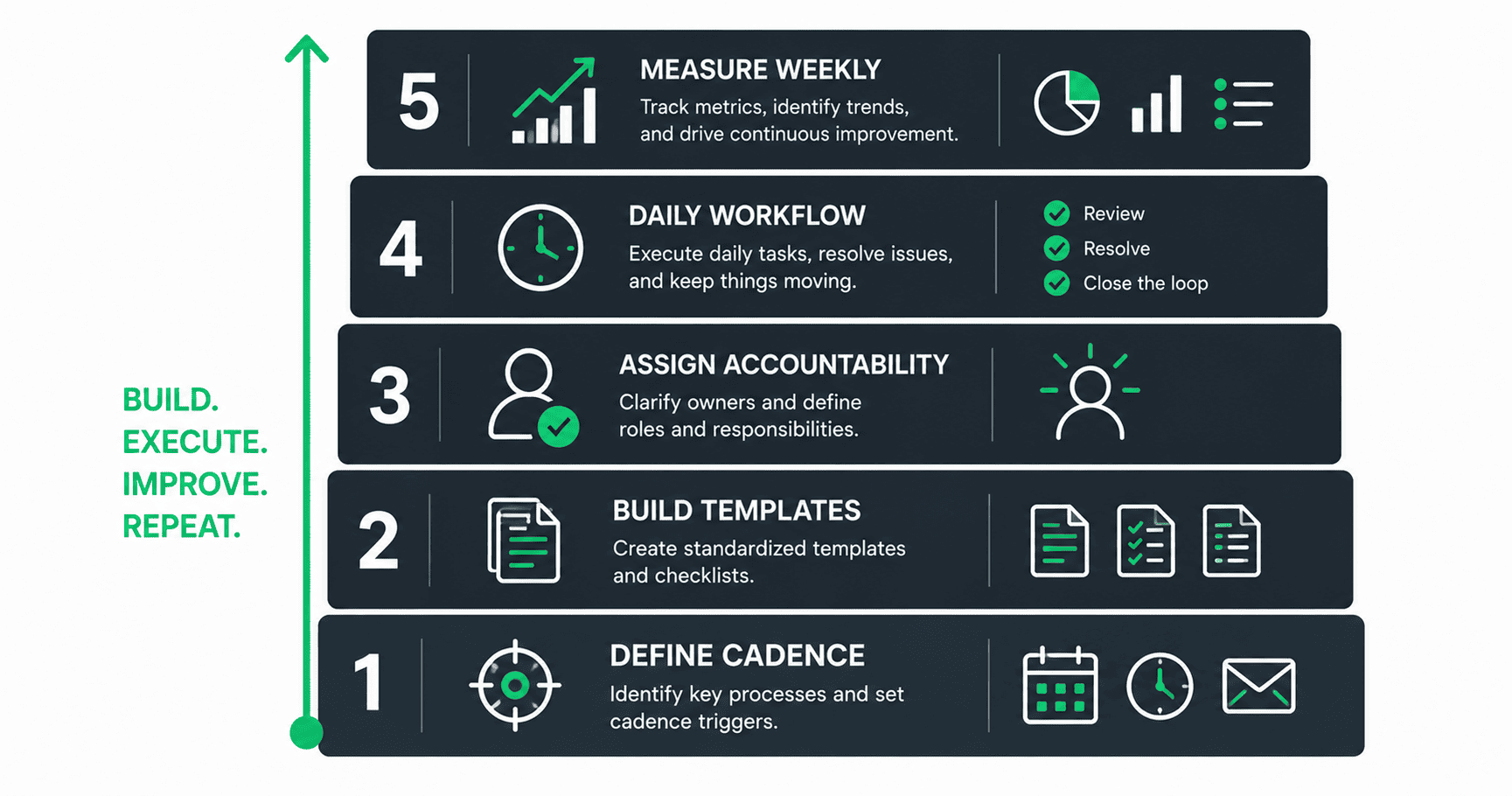
Five steps: define a four-trigger cadence (Day 15/30/45/60), build email and call templates for each trigger, assign someone to run the cadence daily, build the daily workflow, and measure results weekly.
When load volume exceeds 1,000-1,500 per month and the informal approach (the owner tracking payments mentally) can no longer cover the invoice portfolio. Signs: invoices aging past 45 days without anyone noticing, growing 60-day bucket.
Days 1-30: building the habit, working down the backlog. Days 31-60: cadence is established, 31-60 bucket starts shrinking. Days 61-90: measurable DSO improvement of 3-7 days, depending on starting point.
No, the cadence runs on discipline, not technology. The accounting system you already have can generate the daily status report. Templates are simple documents. The process requires consistent daily execution, not a new tool.
Building out your own AR process and want a benchmark from our DSO calculator? Talk to our team to walk through it. Or email us at info@getclearlane.com.