
AR Collections for Freight Companies: The Follow-Up Cadence That Works
Why Does Weekly Batch AR Processing Hurt DSO?
At most freight brokerages, accounts receivable (AR) collections works like this: once a week (usually Monday or Friday), someone pulls the aging report from the accounting system. They review the overdue invoices, sort by dollar amount or days outstanding, and start making calls and sending emails. They work through as many as they can, then move on to the rest of their responsibilities for the week.
This approach has been the standard for years, and at low volume it works. When a brokerage is processing 500 loads a month, the aging report is manageable. The person doing collections knows the customers, remembers the recent conversations, and can prioritize effectively.
At 2,000 to 4,000 loads per month, weekly batch processing creates structural problems that directly affect DSO and cash flow.
The most significant problem is the gap between when an invoice triggers a threshold and when someone acts on it. If the aging report is pulled on Monday and an invoice went overdue on Tuesday, that invoice sits for six days before anyone looks at it. During those six days, nothing happens: no contact, no follow-up, no resolution.
At 3,000 loads per month with an average invoice of $1,000, even a small percentage of invoices sitting in the gap between overdue and first-contact represents meaningful receivables that are aging unnecessarily. If 200 invoices per month are overdue at any given time and the average gap between triggering the threshold and first contact is four days, that’s $200,000 in receivables outstanding four days longer than they need to be, not because the shipper won’t pay but because nobody asked.
The second problem is prioritization bias. When the collections person is looking at 200 overdue invoices and has a few hours to work them, they prioritize the biggest balances and the most overdue accounts. This is rational but creates a long tail of smaller invoices and moderately overdue accounts that never get attention until they’re seriously past due. By the time someone calls about a $1,200 invoice that’s 52 days old, the shipper’s response is often “we never received it” or “it was rejected for missing documentation”, issues that could have been caught at Day 15 with a simple confirmation contact.
What Accounts Receivable Collections Cadence Actually Reduces Freight DSO?
The AR cadence that produces measurable DSO improvement isn’t more aggressive. It’s more structured and more consistent. The goal isn’t to pressure shippers into paying faster. It’s to eliminate the delays that occur because of process gaps, communication failures, and inattention.
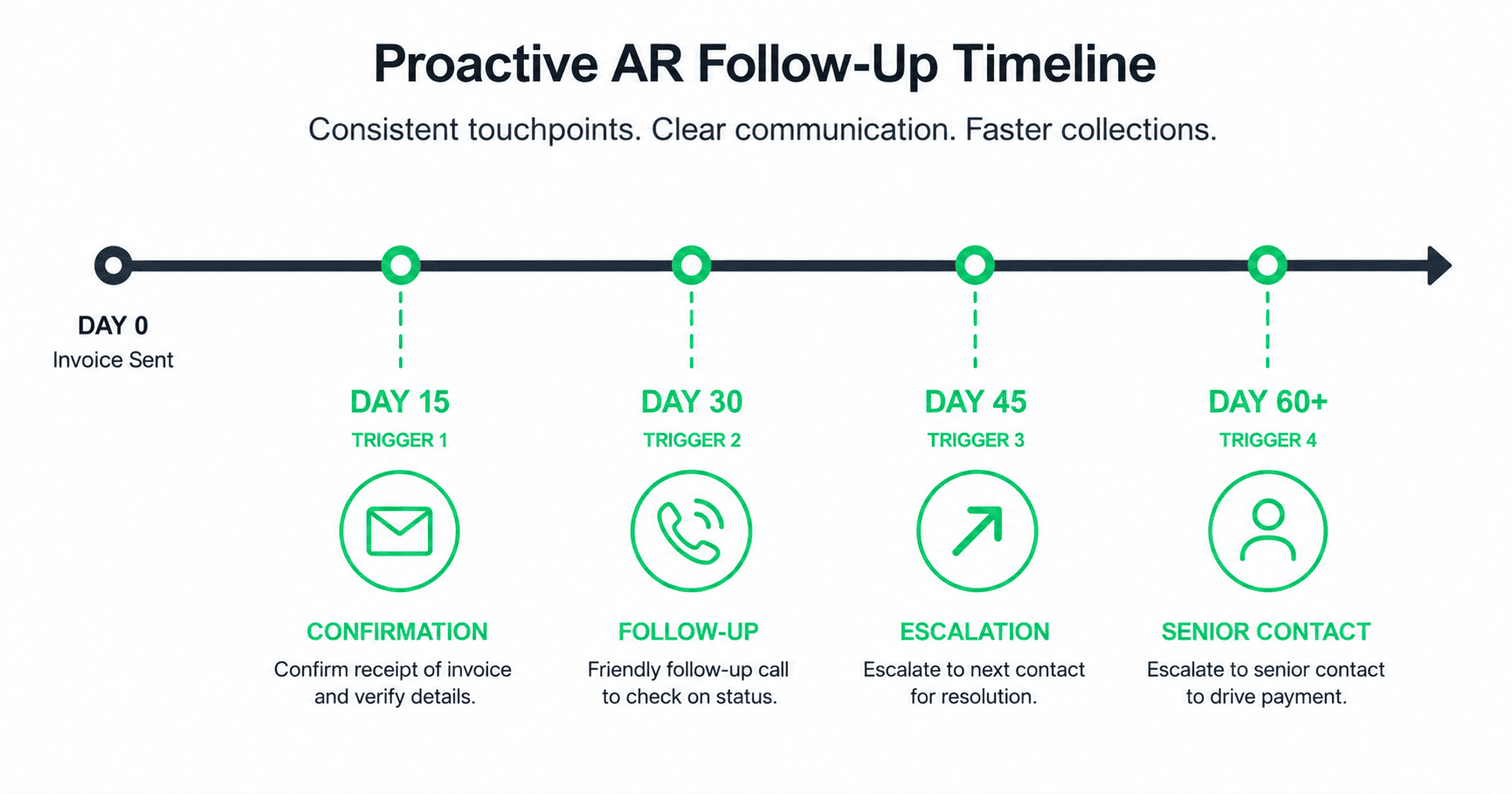
The cadence operates on four defined triggers, with a specific action at each one.
Day 15 after invoice submission: the confirmation contact. This is the single most impactful step in the entire cadence, and it’s the one most brokerages skip.
The purpose of the Day 15 contact isn’t to ask for payment. The invoice isn’t due yet (assuming net 30 terms). The purpose is to confirm that the invoice was received, is in the shipper’s accounts payable (AP) system, and doesn’t have any issues that would prevent payment on schedule.
This contact catches three categories of problems that, left unchecked, add 15 to 30 days to the payment cycle:
Submission errors. The invoice was submitted to the wrong portal, sent to the wrong email, or rejected by the shipper’s AP system for a formatting issue. The shipper’s AP team doesn’t typically notify the broker when a submission fails. The invoice just doesn’t enter their system, and nobody knows until it’s 45 days old and the broker calls asking where the payment is.
Documentation issues. The shipper requires a specific backup document (signed POD, BOL, lumper receipt) that wasn’t attached to the invoice. The shipper’s AP team flagged it as incomplete and put it in a dispute queue. Without the Day 15 check, the broker doesn’t learn about the missing document until the invoice is overdue.
PO or reference number mismatches. The invoice has a wrong PO number or incorrect reference that the shipper’s automated system rejected. The rejection happened on Day 1, but without the Day 15 check, the broker doesn’t find out until Day 35.
Each of these problems is simple to resolve, often a corrected resubmission or a supplemental document. But each one adds 15 to 30 days to the payment cycle if it’s not caught early. The Day 15 confirmation contact is the cheapest, fastest DSO reduction tool available.
Day 30: the first follow-up. For invoices that confirmed clean at Day 15 and are now at the due date, the Day 30 contact is a direct follow-up with the shipper’s AP team. The question is simple: is this invoice in the payment queue, and when is the expected payment date?
Most shippers running net 30 terms have an internal payment cycle: checks run weekly or biweekly. The Day 30 contact confirms which cycle the invoice is in and when the broker can expect payment. If the invoice isn’t in the queue, the contact identifies why and initiates resolution.
For invoices that had issues identified at Day 15 and were corrected and resubmitted, the Day 30 contact confirms the corrected invoice is in the system and proceeding normally.
Day 45: the escalation contact. If an invoice reaches Day 45 without payment or a confirmed payment date, the contact escalates beyond the shipper’s AP team. This typically means contacting the shipper’s logistics coordinator, operations manager, or the person who manages the relationship with the broker on the operational side.
The escalation isn’t adversarial. It’s informational: “We have an invoice from [date] that’s 45 days outstanding. AP hasn’t been able to confirm a payment date. Can you help us understand if there’s an issue we need to address?”
The operations-side contact often has more internal influence than AP and can push the invoice through the approval process. They also have a direct incentive to maintain the relationship with the broker. They need freight moved, and an unresolved billing dispute creates friction on both sides.
Day 60+: senior escalation. Invoices that reach 60 days without resolution get elevated to senior-level contact: the broker’s account manager or leadership reaching out to the shipper’s management. At this stage, the conversation shifts from “can you confirm payment timing” to “we need to resolve this balance to maintain the relationship.”
Most invoices should never reach this stage. The Day 15 confirmation and Day 30 follow-up catch the majority of issues that would otherwise age into the 60-day bucket. The Day 60 escalation exists as a defined last resort, not a routine step.
Why Does Daily AR Monitoring Outperform Weekly Batch Processing?
The cadence above only works if invoices are monitored daily against the defined triggers, not weekly. The difference between daily and weekly monitoring is the response gap.
With daily monitoring, an invoice that hits the Day 15 mark today gets a confirmation contact today or tomorrow. With weekly monitoring, it might sit until the next aging report review, potentially four to six days later. Those four to six days, multiplied across hundreds of invoices per month, represent the structural DSO drag that weekly batch processing creates.
Daily monitoring doesn’t mean someone spends all day on AR. It means someone reviews the AR status every day, identifies which invoices have crossed a trigger threshold in the last 24 hours, and takes the defined action on each one. On a typical day, this might mean 10 to 20 actions: confirmation emails, follow-up calls, escalation notes. That’s one to two hours of focused work, not a full-time job.
But it does require dedicated capacity. If the person doing AR also handles billing, POD retrieval, and compliance, the daily monitoring gets skipped when other priorities take over. Consistency is the variable that matters most, and consistency requires either dedicated in-house capacity for AR or a team that handles collections as a defined workstream.
The DSO Impact
The measurable impact of shifting from weekly batch processing to a daily structured cadence typically shows up within 60 to 90 days.
The Day 15 confirmation contact alone reduces the percentage of invoices that age past 45 days by catching submission errors, documentation gaps, and PO mismatches before they become overdue. For brokerages where 8 to 12% of invoices had issues that weren’t discovered until 30+ days after submission, the Day 15 check can cut that rate by more than half.
The daily monitoring cadence reduces average days past due on overdue invoices by eliminating the response gap. If the previous approach meant overdue invoices sat an average of four days before first contact, and the new approach reduces that to one day, the DSO improvement flows directly, roughly three days off DSO from the response gap alone.
And the escalation cadence reduces the percentage of invoices that reach 60- and 90-day aging buckets. When invoices get attention at Day 30 and again at Day 45, fewer reach the point where senior escalation is needed. The 60-day bucket (which represents the most expensive receivables from a working capital perspective) shrinks.
At a brokerage processing 3,000 loads per month at an average of $1,000, a five-day DSO improvement is worth roughly $500,000 in working capital freed up. For a brokerage using the DSO calculator, the impact of a cadence change is directly quantifiable.
Building the Cadence
Implementing the four-trigger cadence requires three things:
A system for daily monitoring. This can be as simple as a filtered view in the accounting system that shows invoices hitting each trigger threshold today. Most accounting platforms and TMS-integrated billing systems can generate this view. The tool doesn’t matter as much as the habit of checking it every day.
Templates for each trigger action. The Day 15 confirmation is a standard email or call script. The Day 30 follow-up is a standard inquiry. The Day 45 escalation is a standard email to the operations contact. Having templates means each action takes 3 to 5 minutes rather than 10 to 15, which is the difference between the cadence being sustainable at volume and being too time-consuming to maintain.
Dedicated capacity. Someone needs to own this cadence as a defined responsibility, not a side task. That can be an in-house AR specialist, a shared responsibility with defined time blocks, or an outsourced accounts receivable team that runs the cadence as part of a broader post-dispatch service.
The cadence runs the same whether the brokerage is processing 1,000 loads or 5,000. The volume of daily actions scales with load count, but the structure doesn’t change.
Frequently Asked Questions
In freight, the AR collection process is a structured follow-up cadence on each invoice rather than a once-a-week batch. A proven version uses four triggers: a Day 15 confirmation contact to verify the invoice was received and has no issues, a Day 30 follow-up, a Day 45 escalation, and a Day 60+ senior escalation. Consistency at each step is what reduces DSO.
The AR collection period is the average number of days it takes to collect payment after invoicing, essentially the same measure as DSO. For freight brokers it commonly runs 45 to 65 days. Shortening it depends on removing delays early: confirming receipt by Day 15 catches the ‘we never got it’ and ‘missing paperwork’ problems that otherwise add weeks.
The primary methods are phone calls, emails, and escalation contacts, but the method matters less than the cadence and consistency. The biggest gains come from the Day 15 confirmation contact (verifying invoice receipt before it’s due), not from more aggressive collection tactics later.
A four-trigger cadence: Day 15 confirmation (verify invoice received), Day 30 follow-up (confirm payment timing), Day 45 escalation (contact outside AP), Day 60+ senior escalation. Run daily, not weekly.
The Day 15 contact catches submission failures, documentation gaps, and PO errors before the invoice is overdue, problems that would otherwise add 15 to 30 days to the payment cycle if discovered at Day 35 or 40.
Freight companies that shift from weekly batch processing to a daily structured cadence typically see 3-7 days of DSO improvement within 60-90 days of implementation.
At 1,000-1,500 loads per month, the daily cadence takes roughly 1-2 hours. At 2,000-3,000 loads, it scales to 2-3 hours daily. The time investment is significantly less than the working capital freed by the DSO improvement.
Want to see what a structured AR cadence would look like for your operation? Talk to our team to walk through your current AR process. Or email us at info@getclearlane.com.