
Buying a Trucking Company: The Back-Office Diligence That Protects You
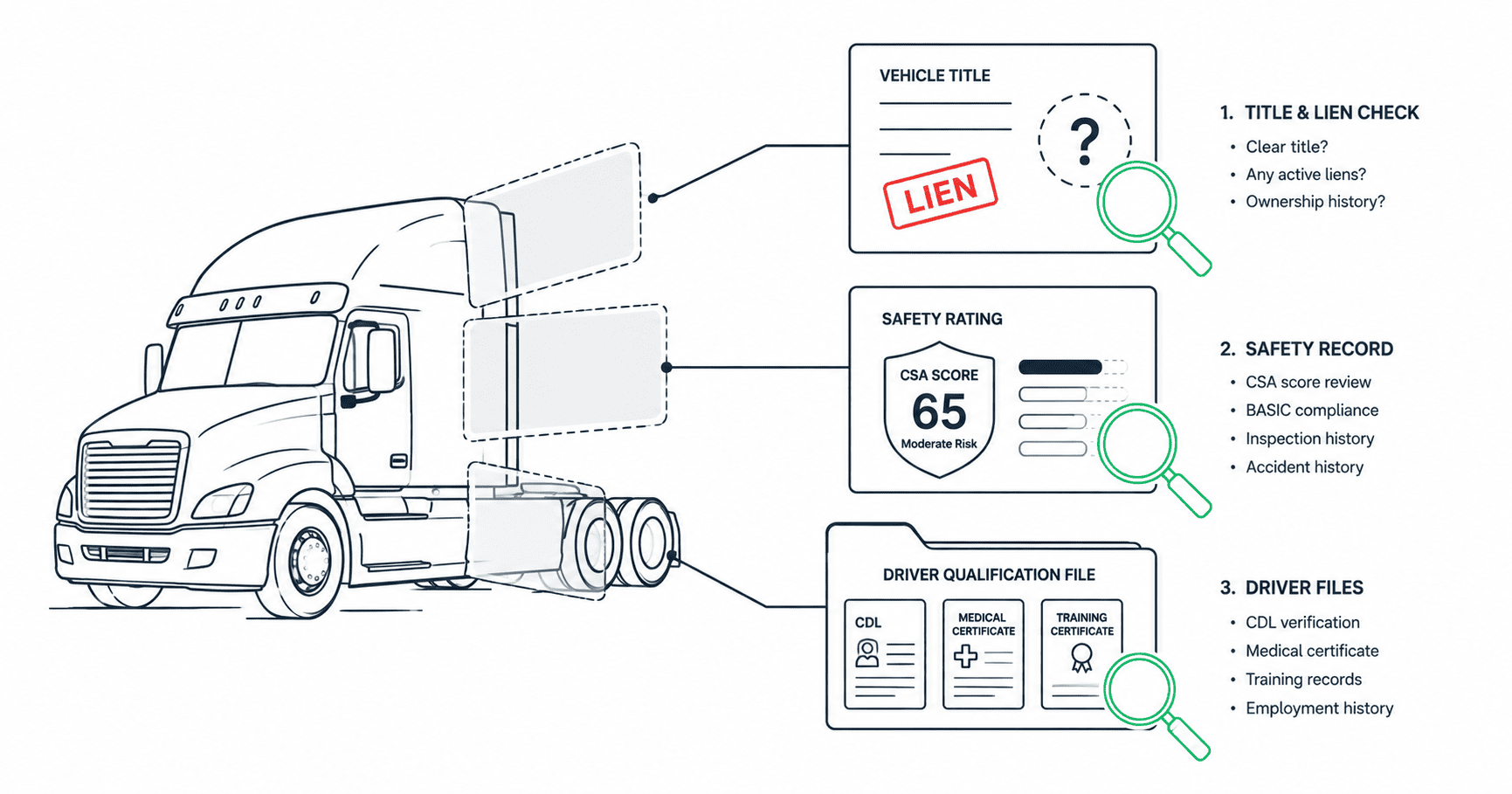
A trucking company looks like the easiest freight business to buy. The assets are parked in the yard, the drivers are on the payroll, and the revenue shows up in bank statements. That visibility is exactly what makes carrier acquisitions dangerous: the trucks are easy to see, and everything that determines whether the deal works is buried in files.
Brokerage diligence is mostly a financial records exercise. Carrier diligence adds three layers on top: assets that can be encumbered, a safety history that transfers with the authority, and a workforce with its own compliance file. Here is how to work through each one before the price becomes final.
How Is Buying a Carrier Different From Buying a Brokerage?
A brokerage is contracts, receivables, and relationships; the diligence approach is covered in our guide to validating a freight brokerage. A carrier adds physical assets with liens, an insurance and safety history that follows the company, and drivers whose files are a regulatory obligation. The financial side still matters, but in a carrier deal the balance sheet is only half the risk.
How Do You Validate the Equipment List?
Match three documents per unit: the title, the lien record, and the maintenance file. Titles prove the selling entity owns what it is selling, and it is common in multi-entity groups for trucks to sit in an equipment entity the purchase agreement never mentions. Liens need payoff letters, not assurances. Maintenance files per VIN tell you whether the fleet was maintained on a program or run until something broke, and the difference is a six-figure adjustment on a mid-size fleet.
Then compare the list against reality: units in the yard, units on the road, units cannibalized for parts that still appear on the books. Depreciation schedules that include ghosts flatter the balance sheet and understate the capital spend you are about to inherit.
What Does the Safety and Insurance File Tell You?
Pull the FMCSA record and five years of loss runs before anything else, because they price the deal twice: once in risk and once in premium. Crash history and inspection trends follow the authority, and your insurance quote after close will be built on the loss history you are buying. Get that quote during diligence, not after, since a carrier that only pencils at the seller’s legacy premium is not the carrier you will be operating.
Open claims need a schedule with reserves, and the drug and alcohol program records need to be complete. Gaps there are not paperwork issues; they are the liability you inherit with the MC number.
How Do You Test the Revenue Side?
Carrier revenue quality lives in a handful of measures: rate per mile trend against the market cycle, deadhead percentage, fuel surcharge pass-through, customer concentration, and how much of the book is contract versus spot. Then read the accounts receivable aging the way a collector would, because receivables usually transfer and their real value is their age. A carrier billing through factoring adds one more step: the buyout figure and the notification mechanics belong in the closing checklist, not the surprise column.
What About the Drivers Themselves?
Driver files are a compliance asset or a compliance debt. Qualification files must be complete per driver, and turnover history tells you whether the workforce transfers or evaporates at close. Pay packages need comparing against the current market, because a fleet priced on below-market driver pay is a fleet about to get more expensive. If any of the fleet runs as owner-operators, the classification structure deserves scrutiny, since misclassification exposure follows the company you are buying.
Where a Records Team Fits in Carrier Diligence
ClearLane runs the records layer of acquisition validation: books reviewed per entity, receivables tested against the aging, billing files sampled, intercompany balances reconciled when the target is a group, and the add-back schedule tied to documents. Equipment inspections, legal review, and quality of earnings opinions stay with your inspector, counsel, and CPA. What we deliver is the organized, verified paper those advisors price from, which is the difference between six weeks of diligence and six months of it.
A prepared seller is working from the same list you are. The sale readiness checklist sets out what a target should already have assembled, which makes a useful benchmark for judging how far along the other side actually is.
The carrier diligence file, itemized
| File | Match against | Red flag |
|---|---|---|
| Titles and liens, per unit | The equipment list and the selling entity’s name | Units titled to the owner personally, or liens with no payoff letters |
| Maintenance history, per VIN | DOT inspection results and the age of the fleet | Gaps that line up with the units doing the most miles |
| Safety record | The public FMCSA SAFER snapshot and five years of loss runs | A loss-run trend the insurance market has already priced and the seller has not |
| Driver qualification files | 49 CFR Part 391 requirements, file by file | Files assembled last month for drivers hired years ago |
| Revenue and rate history | Rate per mile against market indices for the same lanes | Revenue held up by two shippers or one fuel-surcharge formula |
| AR aging | The customer list in the deck | The anchor customer paying at 75 days |
The middle column is the discipline: nothing in a carrier data room is validated by reading it alone, only by matching it against a second source the seller does not control. Titles against the state record, safety against SAFER, drivers against Part 391, rates against the market. A target that survives six matches is a business; one that survives two is a fleet with paperwork. The full buyer’s sequence is in the sale readiness checklist, which reads just as well from the buy side.
What Does a Clean Target Look Like?
It is worth knowing the green flags as well as the red ones, because clean carriers attract multiple buyers and reward speed. The title schedule matches the yard. Maintenance runs on a program with records per unit, not on breakdowns. Loss runs trend flat or down across five years. The aging is worked, with notes on anything past 60 days. The books close monthly, per entity, and the add-back schedule comes with documentation attached rather than promises to find it.
When a target looks like that, diligence is confirmation instead of excavation, and the buyer who can verify fastest usually wins the deal. That is the practical payoff of doing the records work early: it converts caution into speed exactly when speed is worth money.
Frequently Asked Questions
Titles and liens per unit, maintenance records per VIN, five years of loss runs and the FMCSA safety record, complete driver qualification files, open claims with reserves, customer concentration and rate trends, the AR aging, and per-entity books with a consistent close history. Price follows the completeness of that file.
The safety history stays with the DOT and MC numbers, so buying the entity means inheriting its record. Insurance pricing after close is built on that history, which is why loss runs and an insurance quote belong in diligence rather than after closing.
Every financed unit carries a lien that must be paid off or assumed at close. Titles that do not match the selling entity, or payoff amounts that surface late, delay closings and change the economics. A title-and-lien schedule per VIN is a first-week diligence request.
Yes. Your premium will be priced on the loss history you are acquiring, not on your intentions. A quote during diligence tells you the real operating cost of the company; discovering it after close is how deals that penciled stop penciling.
We prepare the validation layer: per-entity books, tested receivables, sampled billing files, and a documented add-back schedule, organized for your CPA and counsel to work from. Formal quality of earnings opinions, legal review, and equipment appraisals remain with your advisors.
Looking at a carrier acquisition? Request a demo and we will walk through what the validation file should contain before you price the deal. Or email us at info@getclearlane.com.