
Buying a Freight Brokerage: How to Validate the Back Office Before You Close
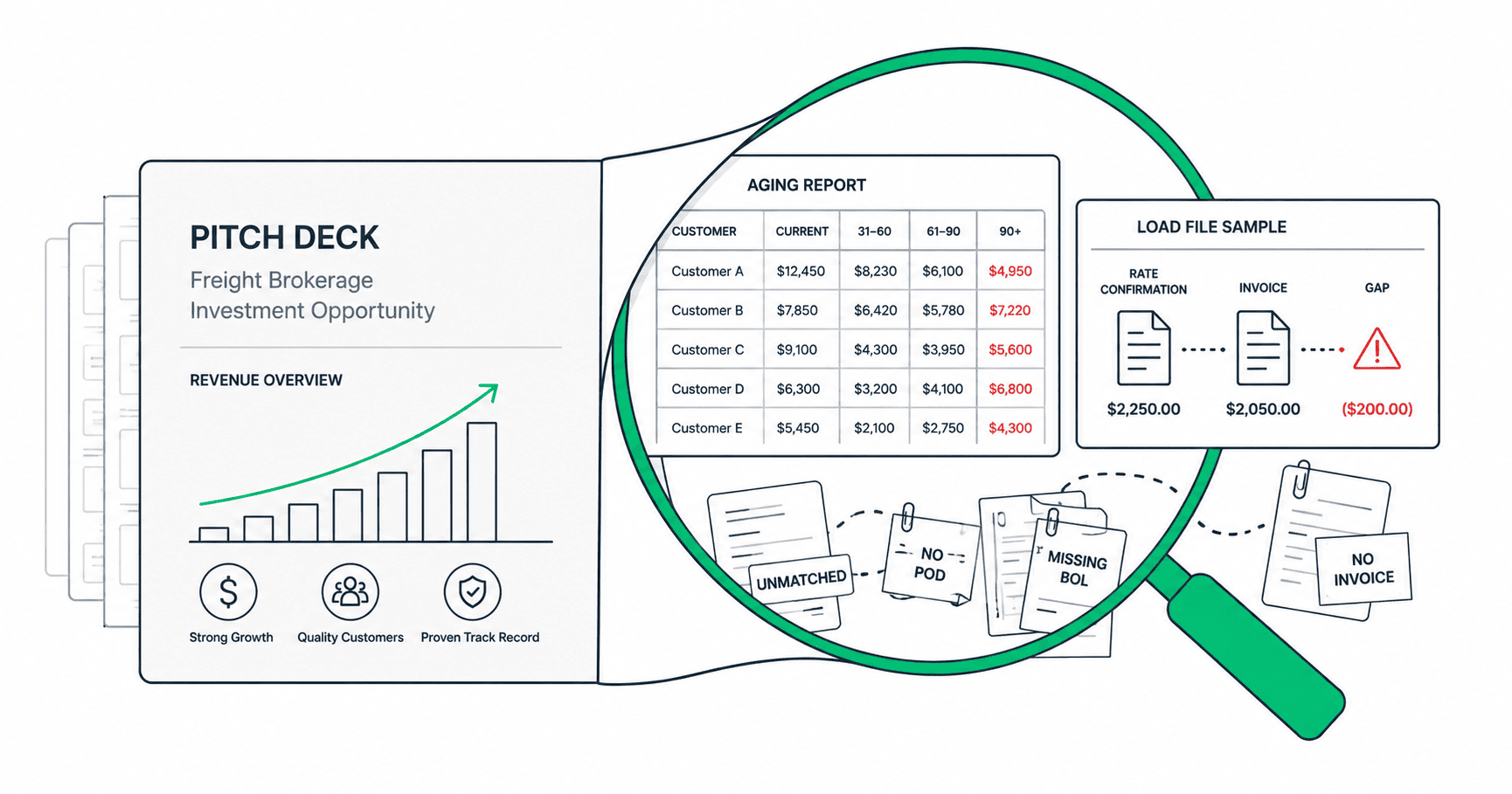
A freight brokerage for sale always looks clean in the deck. Revenue chart up and to the right, a customer list with recognizable names, an adjusted EBITDA figure with a defensible multiple attached. The deck is marketing. What you are actually buying lives in the back office: the billing files, the receivables, the carrier records, and the books.
Buyers validate the story before they wire the money, and in freight, the back office is where the story either holds or falls apart. Here is where to look.
What Does the P&L Hide at a Freight Brokerage?
Revenue recognition timing, first. A brokerage with a billing backlog can show strong months that are really just earlier months finally invoiced. Second, unbilled accessorials: detention, layover, and TONU that were earned but never captured are revenue that exists in theory and nowhere else. Third, margin per load can be inflated by intercompany activity if the target is part of a multi-entity structure and the paper between companies is thin.
How Do You Validate the Receivables?
The AR file is the closest thing to truth in the data room. Pull the full aging report and read it the way a collector would: how much sits past 60 days, which customers are chronically slow, and what share of the balance is in dispute. Compare stated DSO against the 45 to 65 day freight benchmark, and check the calculation itself, since a DSO computed on a rolling high-revenue quarter flatters the number.
Concentration matters as much as age. A brokerage where one shipper is 40 percent of receivables is a different purchase than one with the same revenue spread across thirty accounts.
How Do You Validate the Billing Records?
Sample loads end to end: rate confirmation to carrier invoice to customer invoice to payment. The questions are mechanical. Does the invoiced rate match the confirmation? Were accessorials billed with backup? How often do invoices get disputed, and why? A target with clean load files closes fast. A target where the sample keeps surfacing mismatches is telling you what the first year of ownership looks like.
What Do EBITDA Normalization and Owner Earnings Mean in a Freight Deal?
Small and mid-size freight companies are usually priced off adjusted earnings, either normalized EBITDA or owner discretionary earnings. Normalization means removing what does not transfer with the business: above or below market owner salary, family members on payroll, personal vehicles and travel, one-time legal or claim costs, rent paid to a related entity at a non-market rate.
Every add-back needs a document behind it. As a buyer, your job is to test the schedule line by line, because each unsupported add-back moves the price at a multiple. The cleaner the books underneath, the shorter that argument gets.
What Liabilities Hide in the Carrier File?
Carrier compliance is the quiet risk in brokerage acquisitions. Loads moved on carriers with lapsed insurance or downgraded authority are exposure that follows the book of business. Review how the target verified carriers at onboarding and whether monitoring continued afterward, and check open cargo claims against what the reserves assume.
The validation sequence, in order of what kills deals
| Check | What you are testing | Deal-killer version of the finding |
|---|---|---|
| AR aging, read like a collector | Whether revenue turns into cash | Over-90 concentration in the two customers the deck calls anchors |
| Load-file sampling, end to end | Whether billing matches the paper | Invoiced rates that do not match rate confirmations at scale |
| Revenue timing | Whether strong months are real | A billing backlog dressed up as growth |
| Add-back support | Whether adjusted EBITDA survives scrutiny | Add-backs with no documentation, priced at a full multiple |
| Carrier compliance file | Inherited liability | Loads moved on lapsed insurance; verify carrier status yourself against FMCSA SAFER |
| Working capital normality | What the peg should actually be | A peg negotiated off a quarter the seller window-dressed |
Each row is cheap to check and expensive to skip. The order matters because early findings compound: if the aging fails, the revenue timing check becomes mandatory rather than optional, and the add-back review turns adversarial. A seller with nothing to hide will have anticipated this sequence, which is itself a signal. The mirror-image preparation list, what a well-advised seller assembles before you arrive, is the sale readiness checklist.
How ClearLane Supports Buy-Side Validation
We prepare acquisition validation as a records exercise: receivables tested against the aging, billing files sampled load by load, books reviewed per entity with intercompany balances reconciled, and the add-back schedule tied to documents. The output is an organized package you and your advisors can price from. Formal quality-of-earnings opinions and legal due diligence stay with your CPA and counsel; we make sure the records they and you rely on are actually true to the operation. If the target runs multiple entities, that structure gets validated too.
What Does the Working Capital Peg Mean for a Buyer?
Most freight deals set a working capital peg: a normal level of receivables, payables, and cash the business must deliver at close, with the price adjusted dollar for dollar against it. The peg turns AR quality from an accounting detail into purchase price. Receivables that look collectible but are not, aged balances counted at face value, or disputed invoices sitting in the aging all shift real money from buyer to seller at the closing table.
That is why the diligence request list should go beyond the financial statements: the full AR aging with collection notes, the AP aging with any carrier payment disputes, three years of monthly close history, bank statements to tie cash movements to the books, the customer contracts behind the top ten accounts, and the intercompany schedule if the target is part of a group. A seller who produces that list quickly is telling you something. A seller who cannot is telling you something louder.
Timing matters as much as the documents. Freight revenue is seasonal, and a target priced on an annualized strong quarter is a different purchase than one priced on twelve trailing months. Ask for monthly revenue and margin by customer for at least two years, and read it against the market cycle: a book that held margin through a soft market is worth more than one that only performed while rates were rising. The records make that case or they do not.
Frequently Asked Questions
The AR aging. It shows how the business actually collects, which customers are slow, and how much of the balance is disputed. It is the fastest reality check against the revenue story in the deck, and it is hard to dress up on short notice.
Adjusting reported earnings to what transfers to a buyer: removing above-market or below-market owner compensation, family payroll, personal expenses run through the business, one-time costs, and related-party rent at non-market rates. Every adjustment should have documentation behind it.
A measure used for smaller companies: earnings before interest, taxes, depreciation, and amortization plus one full-time owner’s total compensation and personal expenses. It reflects what a single owner-operator actually takes out of the business and is commonly the pricing basis below roughly $5 million in revenue.
Billing backlogs that inflate recent revenue, receivables aging past 90 days with no collection notes, undocumented add-backs on the EBITDA schedule, missing rate confirmations in load files, and carrier compliance gaps that carry liability into the new ownership.
No. Quality of earnings opinions belong to your CPA firm. ClearLane prepares the validation layer underneath: tested receivables, sampled billing files, reconciled per-entity books, and a documented add-back schedule, organized so your advisors can work faster.
Looking at a freight acquisition? Request a demo to talk through what an acquisition validation package covers. Or email us at info@getclearlane.com.