
How to Onboard a Carrier Without Creating a Compliance Hole
Why Do Freight Brokerages Struggle to Balance Speed and Compliance at Onboarding?
Carrier onboarding at a freight brokerage operates under a constant tension. Operations needs carriers approved quickly, a load picks up tomorrow, and the carrier that can cover it needs to be in the system today. Compliance needs carriers verified thoroughly, authority status, insurance coverage, safety record, driver qualifications, and identity verification all checked before the carrier moves freight under the brokerage’s name.
Speed usually wins. Not because compliance doesn’t matter, but because the consequences of a slow onboarding process are immediate (lost load, unhappy customer, missed revenue) while the consequences of an incomplete compliance check are delayed (liability exposure that may never materialize, or may materialize months later).
This tension creates what amounts to compliance debt: carriers approved on a quick-check basis, with the intention of completing a thorough review later. At many brokerages, “later” doesn’t arrive, the carrier is in the system, they’re moving loads, and nobody circles back to complete the verification that was deferred at onboarding.
Over time, this compliance debt accumulates. A carrier database with 500 active carriers, 30% of whom were onboarded on quick checks that were never completed, has 150 carriers whose compliance status hasn’t been fully verified. Each one represents an unknown risk, and in the current enforcement environment, that unknown can become a known problem faster than in prior years.
What Does a Fully Verified Carrier Look Like?
The gap between a quick check and a thorough verification is specific and measurable. Here’s what each level covers.
A quick check, what most brokerages do under time pressure, typically includes confirming active FMCSA operating authority on SAFER, checking that an insurance filing (BMC-91 or BMC-34) exists, collecting a signed carrier agreement and W-9, and a quick look at the carrier’s safety snapshot for obvious disqualifiers (unsatisfactory rating, out-of-service orders).
This check takes 10 to 15 minutes and confirms the minimum: the carrier exists, has authority, and has some form of insurance on file. It’s sufficient for a same-day approval under urgent circumstances.
A thorough verification adds several layers that the quick check skips.
COI cross-reference against FMCSA filings. The Certificate of Insurance the carrier provides should match what the insurance company has filed with FMCSA. If the COI shows one insurer and the FMCSA filing shows another, or if the FMCSA filing shows a cancellation date that’s already passed, there’s a discrepancy that needs resolution. The quick check doesn’t compare these two sources.
Insurance limits verification. The carrier’s insurance limits should meet both the federal minimum ($750,000 for general freight, higher for certain commodities) and the brokerage’s own requirements or specific shipper requirements. The quick check confirms insurance exists; the thorough verification confirms the limits are adequate and the coverage type matches the freight the carrier will be hauling.
Drug and Alcohol Clearinghouse query. A pre-employment query confirms whether the carrier’s drivers have unresolved drug or alcohol violations. Clearinghouse violations have risen, over 200,000 CDL drivers are currently in prohibited status. A carrier whose drivers haven’t been cleared through the Clearinghouse represents a compliance and safety risk.
Ownership and authority history review. With change-of-ownership fraud surging (169% increase in Q1), verifying that the carrier’s authority hasn’t recently changed hands is increasingly important. A recently purchased MC number may indicate a legitimate business acquisition, or it may indicate a fraud scheme where a bad actor purchased a clean authority to pass vetting.
Safety data deep dive. Beyond the safety snapshot, a thorough review looks at BASIC scores across all categories, recent inspection results, crash history, and any open enforcement cases. A carrier with a clean snapshot but deteriorating BASIC scores may be trending toward a compliance event.
Driver qualification verification. Confirming that the carrier maintains valid CDLs for all drivers, medical certificates are current, and drivers meet English Language Proficiency requirements (now an out-of-service enforcement item).
Each of these additional checks adds time, a thorough verification takes 30 to 45 minutes per carrier versus 10 to 15 for a quick check. That time difference is the reason thorough verification gets deferred: at 20 new carriers per week, the additional 20 to 30 minutes per carrier represents 7 to 10 hours of additional weekly work. For a team that’s also handling billing, accounts receivable (AR), and POD retrieval, that time doesn’t exist.
How Does a Two-Step Carrier Approval Process Work?
The practical solution is a two-step onboarding process that gives operations the speed they need while ensuring compliance gets the thoroughness it requires.
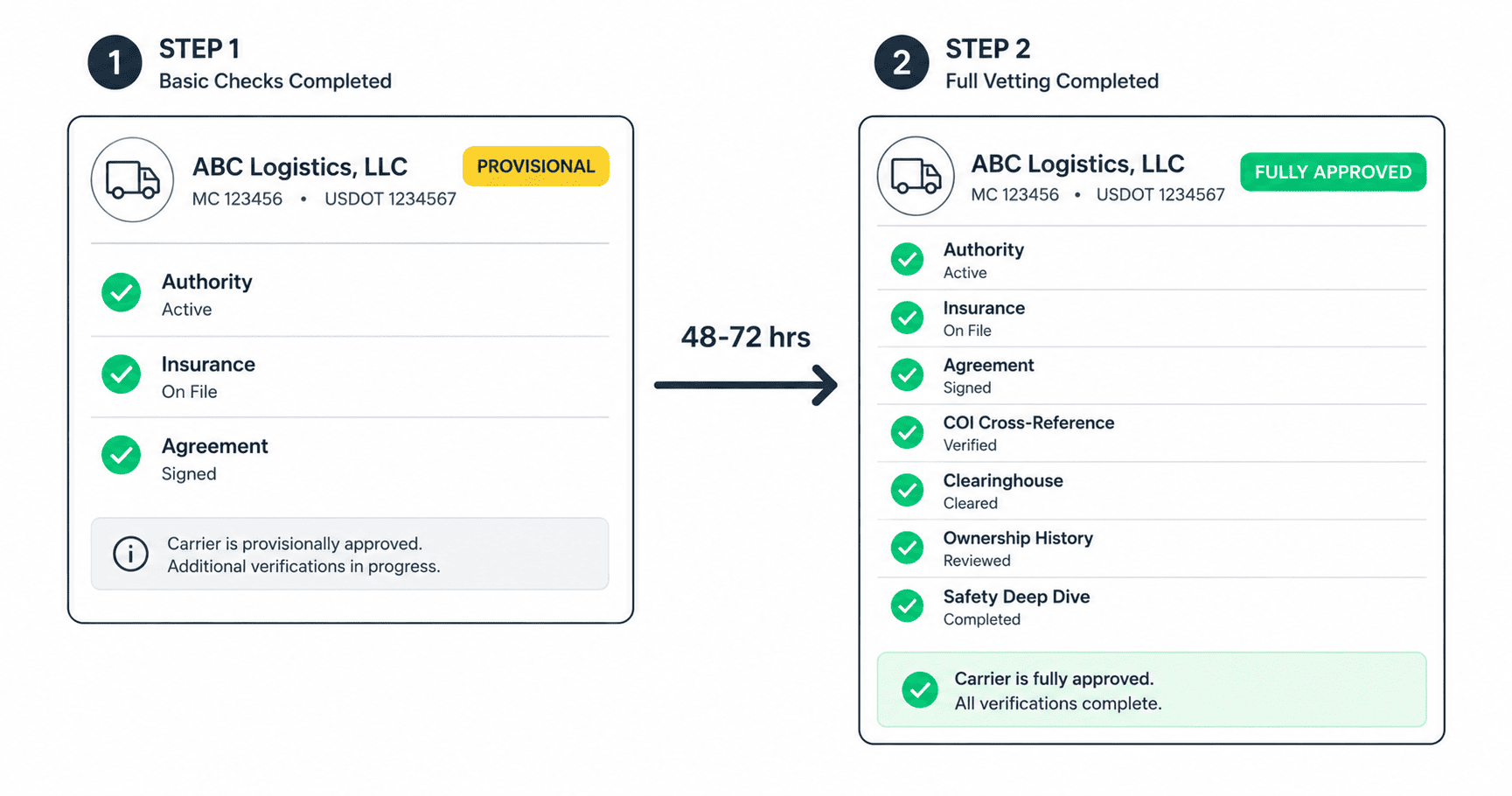
Step one is provisional approval. The quick check covers the minimum, active authority, insurance filing exists, carrier agreement signed, no obvious disqualifiers. The carrier is approved for immediate use with a “provisional” status flag. This takes 10 to 15 minutes and can be completed same-day.
Step two is full verification. Within 48 to 72 hours of provisional approval, the thorough verification is completed, COI cross-reference, insurance limits, Clearinghouse query, ownership history, safety deep dive, driver qualification check. Upon completion, the carrier’s status upgrades from “provisional” to “fully approved.”
If the thorough verification reveals an issue, a COI discrepancy, an insurance gap, a Clearinghouse violation, a recent ownership change that needs investigation, the carrier’s status changes to “hold pending review.” No new loads are tendered until the issue is resolved.
The two-step model works because it separates urgency from thoroughness. Dispatch gets the carrier approved for the immediate load. Compliance gets the full verification completed within a defined window. And the system tracks which carriers are provisional versus fully approved, ensuring that the deferred verification actually happens.
What Causes the Two-Step Onboarding Process to Fail?
The two-step model only works if step two actually gets completed. The most common failure mode is that provisional approvals pile up without progressing to full verification, because the person responsible for the thorough check is also responsible for other work, and step two doesn’t have the same urgency as step one.
Preventing this requires three things.
A tracking mechanism that surfaces provisional carriers daily. Whether it’s a TMS report, a spreadsheet, or a compliance platform, someone needs to see a list of carriers in provisional status every morning, with the date of their provisional approval and the number of days elapsed. Carriers that have been provisional for more than 72 hours should be flagged for immediate attention.
Defined accountability for step two completion. A specific person or team is responsible for completing thorough verifications, and that responsibility is measured. If 30 carriers were provisionally approved this week, 30 thorough verifications should be completed by the end of next week. The completion rate is a tracked metric, not a suggestion.
Consequences for unresolved provisional status. If a carrier remains provisional beyond the defined window (72 hours, one week, whatever the standard), there should be a defined action. A common approach: carriers provisional for more than 5 business days are automatically placed on tender hold until the full verification is completed. This creates a natural forcing function, dispatch wants the carrier available, which motivates the team to complete the verification.
The Ongoing Monitoring Connection
Thorough onboarding is the first step, but compliance doesn’t stop at approval. Every data point verified at onboarding can change after the carrier is in the system, authority can be revoked, insurance can lapse, safety scores can deteriorate, drivers can fail Clearinghouse checks.
This is why onboarding and ongoing monitoring are connected functions. The onboarding verification establishes a baseline. Ongoing monitoring catches changes to that baseline. Without ongoing monitoring, even a perfectly thorough onboarding degrades over time as the carrier’s status evolves.
The carrier compliance template on the ClearLane site covers both onboarding and ongoing monitoring checks, providing a framework for building or evaluating your current process.
Building It Without Overwhelming the Team
The onboarding and compliance workload scales with carrier count, more new carriers per week means more verifications, more ongoing monitoring, more COI tracking, more exception handling. For growing brokerages that are adding carriers to support new lanes and customers, the compliance workload grows alongside the operational workload.
This is the function that most frequently justifies dedicated compliance capacity, either a designated in-house compliance specialist or an external team that handles the verification volume. The operational team handles step one (provisional approval under time pressure). The compliance team handles step two (thorough verification within the defined window) and the ongoing monitoring cadence.
ClearLane’s carrier compliance service covers both onboarding verification and ongoing monitoring as part of the full post-dispatch pipeline, authority verification, insurance filing checks, COI tracking, safety data review, and Clearinghouse compliance.
Frequently Asked Questions
Step one is provisional approval (quick check of authority, insurance, basic safety, 10-15 minutes). Step two is full verification within 48-72 hours (COI cross-reference, Clearinghouse query, ownership history, safety deep dive). The carrier can haul loads during provisional status while full verification completes.
Beyond basic authority and insurance, thorough verification includes COI cross-reference against FMCSA filings, Drug and Alcohol Clearinghouse query, ownership and authority history review, BASIC score deep dive, and driver qualification verification including CDL and English Language Proficiency status.
A thorough verification takes 30-45 minutes per carrier versus 10-15 for a quick check. At 20 new carriers per week, the additional time represents 7-10 hours of weekly work.
Because speed wins, dispatch needs the carrier now, and the detailed verification gets deferred. Once a carrier is approved as “provisional,” they stay approved until someone actively circles back. Without accountability and tracking, step two doesn’t happen.
Want a second set of eyes on your carrier onboarding process? Talk to our team to walk through it. Or email us at info@getclearlane.com.