
In-House vs Outsourced Carrier Compliance: What Growing Freight Companies Need to Know
Why Is Carrier Compliance the First Function That Gets Deprioritized?
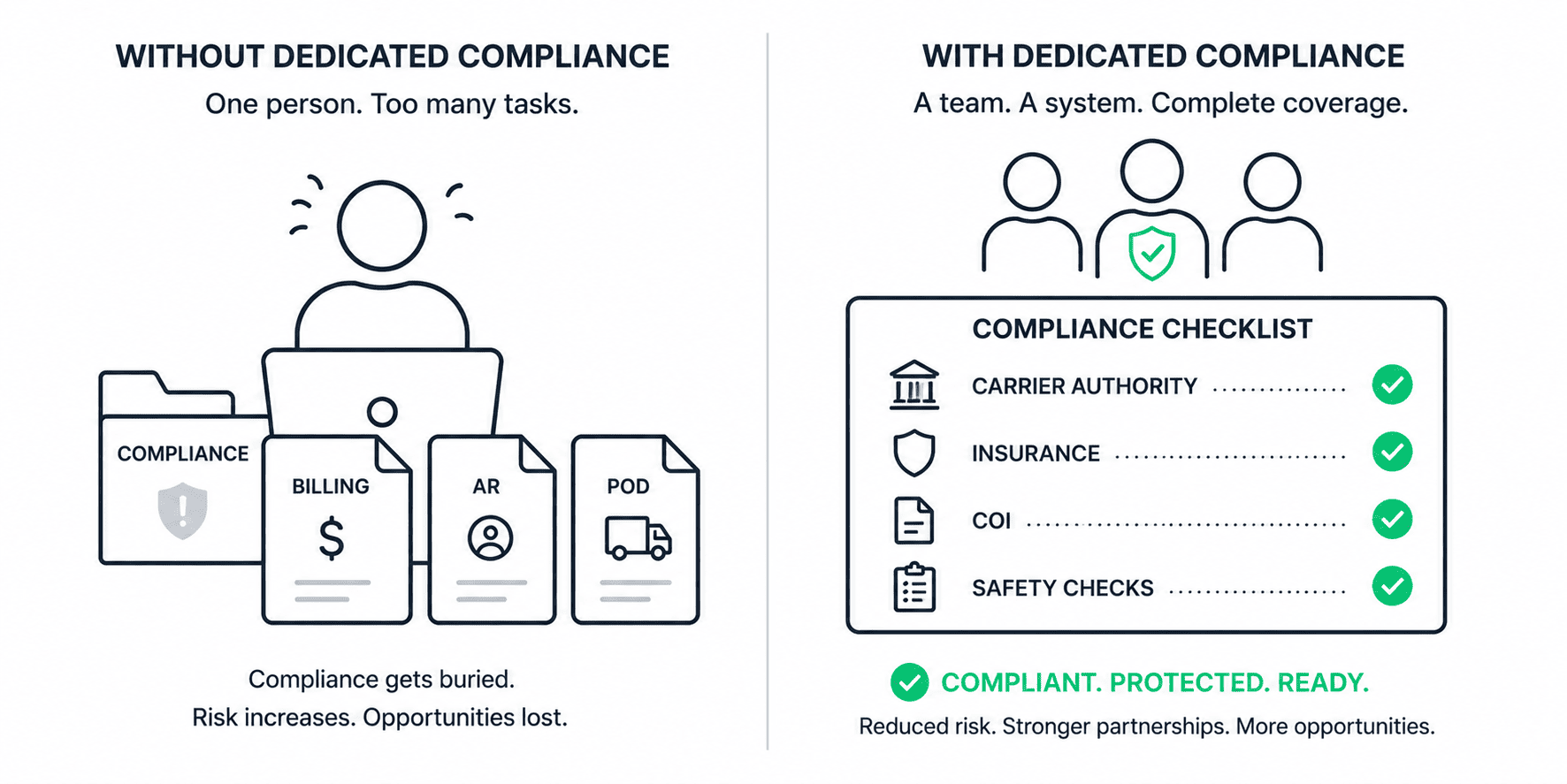
Most back-office functions in freight (billing, accounts receivable (AR), POD retrieval) have immediate, visible consequences when they fall behind. A late invoice means delayed payment. A late POD means a delayed invoice. An overdue AR balance means a difficult phone call.
Carrier compliance monitoring is different. When it falls behind, nothing happens (at least not immediately). The consequences are delayed and invisible until they’re suddenly not. An insurance lapse goes unnoticed for three weeks. An authority revocation isn’t caught until after a load is tendered. A certificate of insurance (COI) expires and nobody follows up for two months.
The delayed-consequence nature of compliance monitoring makes it uniquely vulnerable to deprioritization. When the back-office team is triaging (which they always are during busy periods), compliance monitoring is the first thing that gets deferred because nothing bad happens today if it waits until tomorrow. The problem is that “tomorrow” turns into next week, which turns into next month, and by then the compliance data is stale.
This characteristic also makes compliance monitoring uniquely suited for a structured, systematic approach, whether that’s in-house with dedicated capacity or outsourced to a team whose sole function is running the checks. The comparison between the two models is worth understanding clearly.
What Are the Pros and Cons of In-House Carrier Compliance?
At most growing freight brokerages, carrier compliance sits with the operations team. Often it’s the same person who handles carrier onboarding, carrier payment, and carrier relationship management. They manage compliance as one of several responsibilities.
The advantages are significant. The in-house person knows the carriers. When a carrier’s safety score dips, the in-house person may know the context: a single roadside inspection that skewed the numbers, a new driver who had an issue that’s been addressed, a seasonal pattern in a specific lane. That context informs better decisions about whether to restrict a carrier or continue working with them.
The in-house person also has direct access to carrier contacts. When a COI needs to be updated or an insurance question needs to be resolved, they can pick up the phone and talk to someone they know. That personal relationship often produces faster results than a formal request from an unknown third party.
And the in-house model gives the brokerage complete control over compliance standards. What BASIC score threshold (FMCSA’s Behavior Analysis and Safety Improvement Categories) triggers a review? How quickly does an insurance lapse result in a tender hold? What documentation is required for reinstatement? These are business decisions that benefit from the judgment of someone who understands the brokerage’s risk tolerance and customer requirements.
The challenges are equally real and nearly always come down to capacity and consistency.
At 200 active carriers, systematic compliance monitoring is manageable as a part-time function. Check authority status monthly, track COI expirations, review safety data quarterly. A few hours per week covers it.
At 500 to 1,000 active carriers (which a growing brokerage can easily reach), the monitoring workload scales beyond what a part-time function can handle. Each carrier needs authority verification, insurance filing checks, COI expiration tracking, and safety data review. If authority and insurance are checked weekly (which is appropriate in the current enforcement environment), that is thousands of checks a month, more than anyone can run by hand. In practice the checks run through automated alerts, and the time goes to reviewing the exceptions, chasing updated COIs, and documenting decisions. That runs 20 to 40 hours per month, roughly a quarter of one person’s capacity, dedicated solely to compliance.
Most brokerages don’t have a quarter of a person’s capacity available for dedicated compliance monitoring. The work gets compressed, shortcuts develop, and monitoring frequency drops from weekly to monthly to “when we get to it.”
The other challenge is coverage. When the person who handles compliance is on vacation, sick, or leaves the company, the monitoring stops. There’s typically no backup process, no documented checklist, and no second person who knows which carriers are due for review. The coverage gap may be a week or two, but in the current regulatory environment, where carrier authority changes, insurance lapses, and CDL status shifts are happening faster than in prior years, even a short gap creates exposure.
What Are the Pros and Cons of Outsourced Carrier Compliance?
An outsourced compliance monitoring operation provides dedicated capacity for the systematic checks: running on a defined schedule, covering every active carrier, producing regular reports on compliance status.
The advantages center on consistency and capacity. The dedicated team runs the same checks on the same schedule regardless of what else is happening in the brokerage’s operation. Billing spikes, seasonal volume increases, staff vacations: none of these affect the compliance monitoring cadence. Every carrier gets checked at the defined frequency, every flag gets documented, every exception gets reported.
The capacity scales with the carrier count. Adding 100 new carriers to the active roster doesn’t create a compliance backlog. The monitoring team absorbs the additional volume as part of their regular workflow.
And the coverage is built-in. An outsourced team doesn’t have single-person dependency. If someone is out, the monitoring continues through team depth. There’s no vacation-driven gap in compliance checks.
The economics typically mirror the broader pattern for outsourced back-office functions: below the fully loaded cost of equivalent in-house capacity, because the utilization rates are higher when the team is focused on a single function rather than splitting across multiple responsibilities.
The challenges of outsourced compliance monitoring are specific and worth naming.
The outsourced team doesn’t know the carriers personally. They can’t make the contextual judgment calls that an experienced in-house person makes: “that carrier’s score dipped but I know why, and it’s not a concern.” The outsourced team flags the threshold crossing because that’s what the process requires. The brokerage then needs to apply judgment to decide what action to take.
This means the brokerage still needs someone in-house who reviews compliance reports, makes decisions on flagged carriers, and manages the carrier relationship when a compliance issue arises. The outsourced team provides the monitoring data; the in-house person provides the judgment.
Communication cadence matters. The outsourced team needs clear instructions on what thresholds trigger flags, what frequency of checks applies to different carrier tiers, and how to escalate urgent findings (like an authority revocation on a carrier with loads in transit). These rules need to be defined upfront and maintained as the brokerage’s standards evolve.
And there’s a data access consideration. Compliance monitoring requires access to FMCSA databases, insurance verification systems, and the brokerage’s carrier records. The outsourced team needs appropriate access to these systems, which means the brokerage needs to be comfortable sharing carrier data with the provider.
What Compliance Monitoring Model Works Best for Growing Freight Companies?
The model that works for most growing freight companies combines in-house judgment with outsourced monitoring capacity.
The in-house operations manager or compliance lead owns the compliance standards: defining thresholds, making decisions on flagged carriers, managing carrier relationships when compliance issues arise, and handling shipper audit documentation.
The outsourced team provides the monitoring capacity: running systematic checks on authority, insurance, COI expiration, and safety data at defined intervals across the full carrier database. They produce reports, flag exceptions, and escalate urgent findings.
The division is clean: monitoring is outsourced and decision-making stays in-house. The outsourced team surfaces the data. The in-house person acts on it. The same model works for other functions that require consistency over judgment: bookkeeping, for example, benefits from the same dedicated-capacity approach.
This hybrid avoids the two most common failure modes: the in-house model where monitoring degrades because the person responsible is overloaded with other work, and the fully outsourced model where a critical carrier relationship decision gets made by someone without enough context.
What to Track
Whether compliance monitoring is handled in-house, outsourced, or hybrid, these metrics tell you whether the function is working:
Carrier compliance coverage rate. What percentage of active carriers have been verified within the defined monitoring cycle? If the target is weekly verification and only 60% of carriers have been checked this week, there’s a coverage gap.
Time to flag resolution. When a compliance flag is raised (insurance lapse, authority change, safety threshold crossing), how long does it take to resolve, either by updating the carrier’s status or by placing a hold on new tenders? Flags that sit unresolved for more than 48 hours represent exposure.
COI currency rate. What percentage of active carriers have a COI on file that is current (not expired)? A number below 90% means the expiration tracking process isn’t working.
Carrier status changes caught proactively vs. reactively. How many authority or insurance changes were caught through systematic monitoring versus discovered after a load was tendered or a problem occurred? The ratio tells you whether your monitoring is ahead of the risk or behind it.
The carrier compliance template on the ClearLane site provides a framework for these checks. ClearLane’s compliance monitoring runs these checks as part of the full post-dispatch pipeline.
Frequently Asked Questions
Most growing freight companies benefit from a hybrid model: outsourced monitoring capacity (checking authority, insurance, COI, safety data on a defined schedule) with in-house judgment on flagged carriers and relationship decisions.
In-house compliance provides relationship context and judgment. Outsourced compliance provides consistency and coverage. The hybrid combines both: outsourced monitoring surfaces the data, in-house leadership acts on it.
In-house compliance as a dedicated function requires roughly 20-40 hours per month of alert review and follow-up at 500+ active carriers. Outsourced compliance typically costs less than equivalent in-house capacity: no recruiting, no ramp time, no coverage gaps, and no competition from billing deadlines.
Carrier compliance coverage rate, time to flag resolution, COI currency rate, and the ratio of proactive catches (found through monitoring) versus reactive discoveries (found after a problem occurred).
Want to evaluate your current compliance monitoring coverage? Talk to our team to see how ClearLane handles carrier compliance for freight companies. Or email us at info@getclearlane.com.
Related reading: common carrier compliance gaps and FMCSA compliance changes for 2026. The full check sequence is on the carrier onboarding and compliance page.