
FMCSA Compliance Changes in 2026: What Brokers and Carriers Need to Know
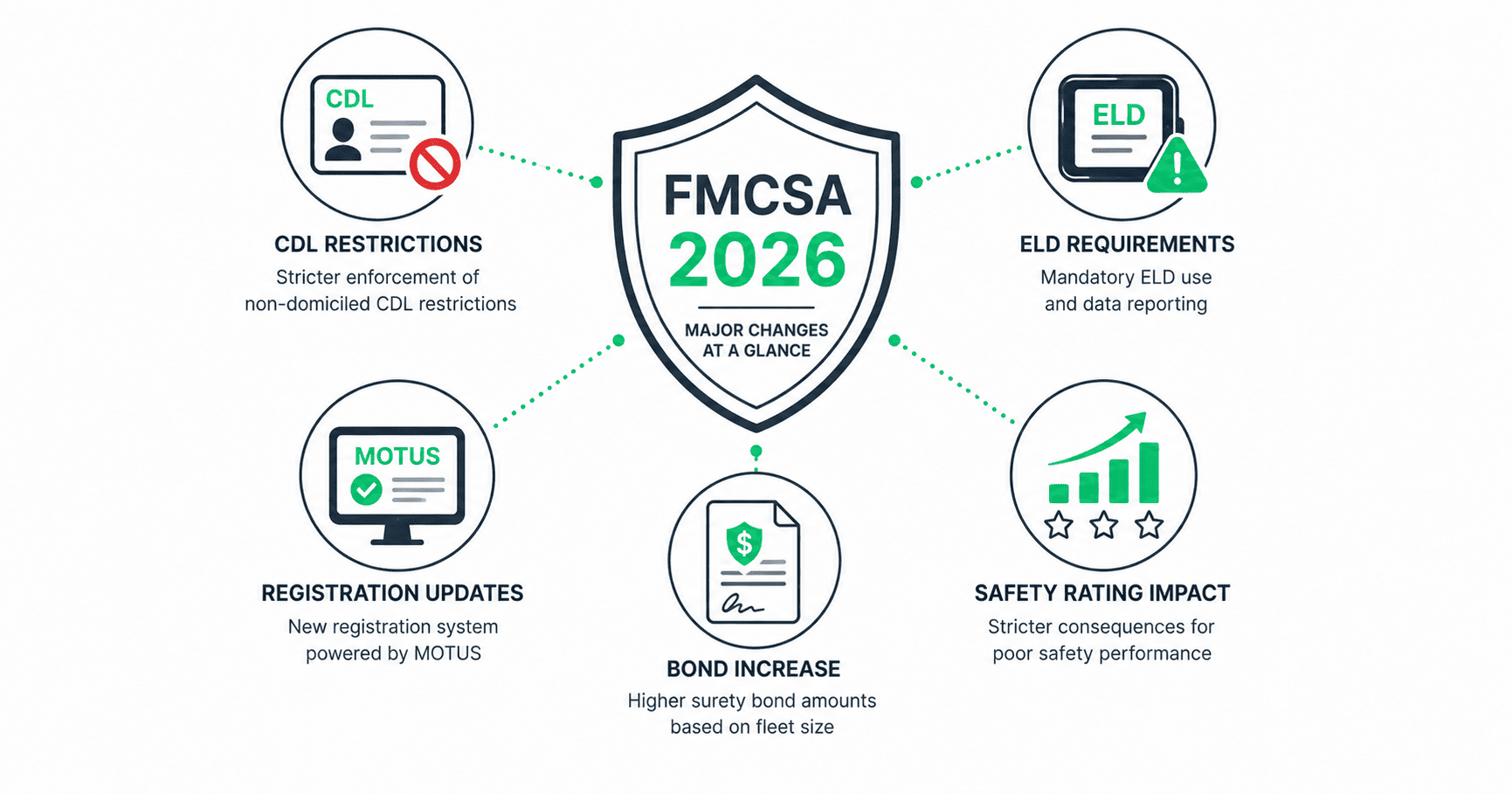
What FMCSA Compliance Changes Are Happening in 2026?
The Federal Motor Carrier Safety Administration has made 2026 one of the most active enforcement years in recent memory. Between new rules taking effect, existing rules being enforced more aggressively, and major system overhauls going live, the compliance landscape for freight brokers, carriers, and 3PLs has shifted significantly in a short period.
This post covers the major changes, what they mean in practice for freight companies, and where broker compliance programs need to adjust.
How Do Non-Domiciled CDL Restrictions Affect Carriers and Brokers?
This is the biggest workforce-affecting change of 2026. On February 13, FMCSA issued a Final Rule restricting eligibility for non-domiciled Commercial Driver’s Licenses. The rule, effective March 16, limits non-domiciled CDL eligibility to holders of three specific visa types: H-2A, H-2B, and E-2. Previously, anyone with an Employment Authorization Document could qualify.
These rules land on both sides of the load. Brokers have to verify them, and carriers have to satisfy them while keeping their own paperwork and billing current, which is the work behind back-office support for trucking companies.
FMCSA estimates roughly 194,000 current non-domiciled CDL holders could be affected as their licenses come up for renewal. The impact will be gradual rather than immediate. Most existing licenses have validity periods of up to five years, but any licensing transaction (renewal, upgrade, transfer, even an address change) can trigger the new verification requirements.
The enforcement is real. California was found to have improperly issued more than 25% of its non-domiciled CDLs. The federal government withheld $160 million in highway funding. Approximately 13,000 of those California licenses were canceled in March 2026. Other states are following with their own audits and revocations.
What this means for brokers: carriers employing drivers with non-domiciled CDLs may face sudden workforce disruptions as licenses come up for renewal and fail to meet the new eligibility criteria. A carrier that had 10 qualified drivers last month might have 7 next month. That affects capacity, reliability, and compliance status. Broker compliance monitoring needs to account for the possibility that a carrier’s workforce qualifications have changed since onboarding.
English Language Proficiency Enforcement
English Language Proficiency requirements have existed in federal regulation since the 1930s. What changed is how hard they are enforced.
Following an executive order in April 2025, ELP enforcement shifted from written guidance to active roadside enforcement. CVSA added English language qualification to its out-of-service criteria. The result: more than 26,000 drivers have been placed out of service since active enforcement began, per DOT figures as of August 2026.
The standard requires drivers to demonstrate the ability to converse in English, read traffic signs, and respond to official inquiries during inspections. A CDL does not equal proof of English proficiency. Drivers must demonstrate real-time communication ability.
For brokers, this means another compliance variable that can change a carrier’s operational status without warning. A driver who passes the CDL test but can’t demonstrate English proficiency during a roadside inspection gets placed out of service on the spot. The load is stranded.
ELD Decertifications and Enforcement
Carriers using Electronic Logging Devices that have been removed from FMCSA’s approved list face immediate out-of-service orders during roadside inspections. The enforcement date of February 7, 2026 means this is already active.
FMCSA maintains a registered ELD list. Devices get removed when they fail to meet technical requirements or when the manufacturer goes out of business. Carriers using revoked devices may not know their ELD has been decertified until an inspector checks the device during a roadside stop.
The compliance action item is straightforward: verify that every ELD in the fleet is on the current FMCSA registered list. For brokers, this falls under carrier qualification: asking carriers to confirm ELD compliance during onboarding and periodic reviews.
What Is the MOTUS Registration System and How Does It Affect Brokers?
FMCSA’s new MOTUS registration system officially launches May 14, 2026, replacing legacy registration platforms. This is the most significant registration technology upgrade FMCSA has undertaken.
MOTUS centralizes sensitive registration data, limits system access to verified users, and validates registration data in real time. MC, FF, and MX numbers were retained at launch; any change to them would need separate rulemaking. Insurance and bond filing lapses can trigger faster enforcement actions under MOTUS than under the previous system. The margin for error on maintaining current filings is smaller.
The rollout is phased: supporting organizations (compliance service providers, insurance filers, process agents) get access first, followed by motor carriers, brokers, and freight forwarders. Until FMCSA formally moves a company into MOTUS, existing registration systems remain active.
For brokers, MOTUS means two things: first, ensure your own registration, bond filings, and process agent designations are current before the transition. Second, expect that carrier compliance data in FMCSA systems will become more current and more accurately reflect real-time status. That makes systematic monitoring more valuable, not less.
Broker Financial Responsibility Rule
Effective January 16, 2026, FMCSA implemented stricter financial responsibility requirements for brokers and freight forwarders. The rule requires updated documentation through the FMCSA registration system, with a 30-day compliance window for remediation.
The intent is to ensure intermediaries have sufficient financial backing to cover unpaid carrier invoices, reducing freight fraud and protecting carriers from broker insolvency. Compliance costs may increase for smaller brokerage firms as they shift to qualifying trust or bond structures that meet the updated requirements.
CSA Scoring System Updates
FMCSA continues rolling out updates to the Safety Measurement System (SMS) that underpins CSA scores. The updates include consolidating violation codes into fewer categories, simplifying severity weights, placing greater emphasis on violations from the most recent 12 months, and refining peer group comparisons.
No official effective date has been finalized for the full overhaul, but the directional changes are clear: recent performance matters more, and the scoring will be simpler to interpret but potentially more volatile as it becomes more responsive to recent data.
For brokers monitoring carrier safety, the practical implication is that carrier BASIC scores may shift more frequently as the new weighting takes effect. A carrier’s score profile could look different quarter to quarter even without a change in their actual safety performance, simply because the scoring methodology is changing.
Other Changes on the Horizon
Several additional proposals are in the FMCSA pipeline for 2026:
A second proposed rule on broker transparency is scheduled for May 2026. The first NPRM was issued in November 2024, and the second will build on that foundation.
Hours of Service pilot programs are underway (a split duty period program and a flexible sleeper berth program) with roughly 500 CDL drivers participating. Results will inform potential future rulemaking.
FMCSA is targeting May 2026 for a proposed rule on inspection, repair, and maintenance standards for automated driving systems.
Drug and Alcohol Clearinghouse revisions are expected in 2026, with changes that would increase the availability of driver violation information.
None of these are finalized, and FMCSA has historically missed some projected timelines. But they represent the agency’s direction: more data transparency, more real-time monitoring, and higher compliance standards.
How Should Freight Brokers Adjust Their Compliance Programs?
The cumulative effect of these changes is that carrier compliance status is more volatile in 2026 than it has been in years. A carrier that was fully compliant at onboarding may have drivers with restricted CDLs, a decertified ELD, or an insurance filing lapse that appeared after the MOTUS transition, any of which changes their compliance status.
The carrier compliance monitoring function at a freight brokerage needs to match the pace of these changes. That means moving from periodic reviews to ongoing monitoring: checking authority status, insurance filings, and safety data frequently enough to catch changes before a load gets tendered to a non-compliant carrier.
The carrier compliance template on the ClearLane site provides a framework for evaluating what your current monitoring covers and where the gaps are.
ClearLane’s compliance monitoring service tracks authority status, insurance filings, COI expirations, and safety data as part of the full post-dispatch pipeline, so compliance isn’t an afterthought that gets deprioritized when billing volume spikes.
Frequently Asked Questions
Major changes include non-domiciled CDL eligibility restrictions (effective March 16), English Language Proficiency as an out-of-service offense, ELD decertification enforcement, the MOTUS registration system launch (May 14), and updated broker financial responsibility requirements (January 16).
FMCSA estimates roughly 194,000 current non-domiciled CDL holders could be affected as their licenses come up for renewal. Over 13,000 licenses were canceled in California alone in March.
MOTUS is FMCSA’s new registration platform replacing legacy systems. It centralizes registration data, limits access to verified users, and validates filings in real time, with faster enforcement actions for filing lapses.
Tie the check to the load, not the calendar: re-verify authority and insurance before every tender to that carrier, and track COI expiration dates on the carriers you actually use. The pace of authority changes, insurance events, and CDL-related compliance shifts has accelerated significantly, which makes a periodic review schedule the wrong instrument.
Questions about how 2026 FMCSA changes affect your compliance program? Talk to our team to see how ClearLane handles carrier compliance monitoring. Or sign up for the newsletter for ongoing regulatory updates. Email us at info@getclearlane.com.
Also on compliance: rising insurance costs and COI monitoring and what the double-brokering crackdowns mean. See carrier onboarding and compliance.