
Chassis Fees, Splits, and Billing in Drayage: A Complete Breakdown
What Is a Chassis Fee in Drayage?
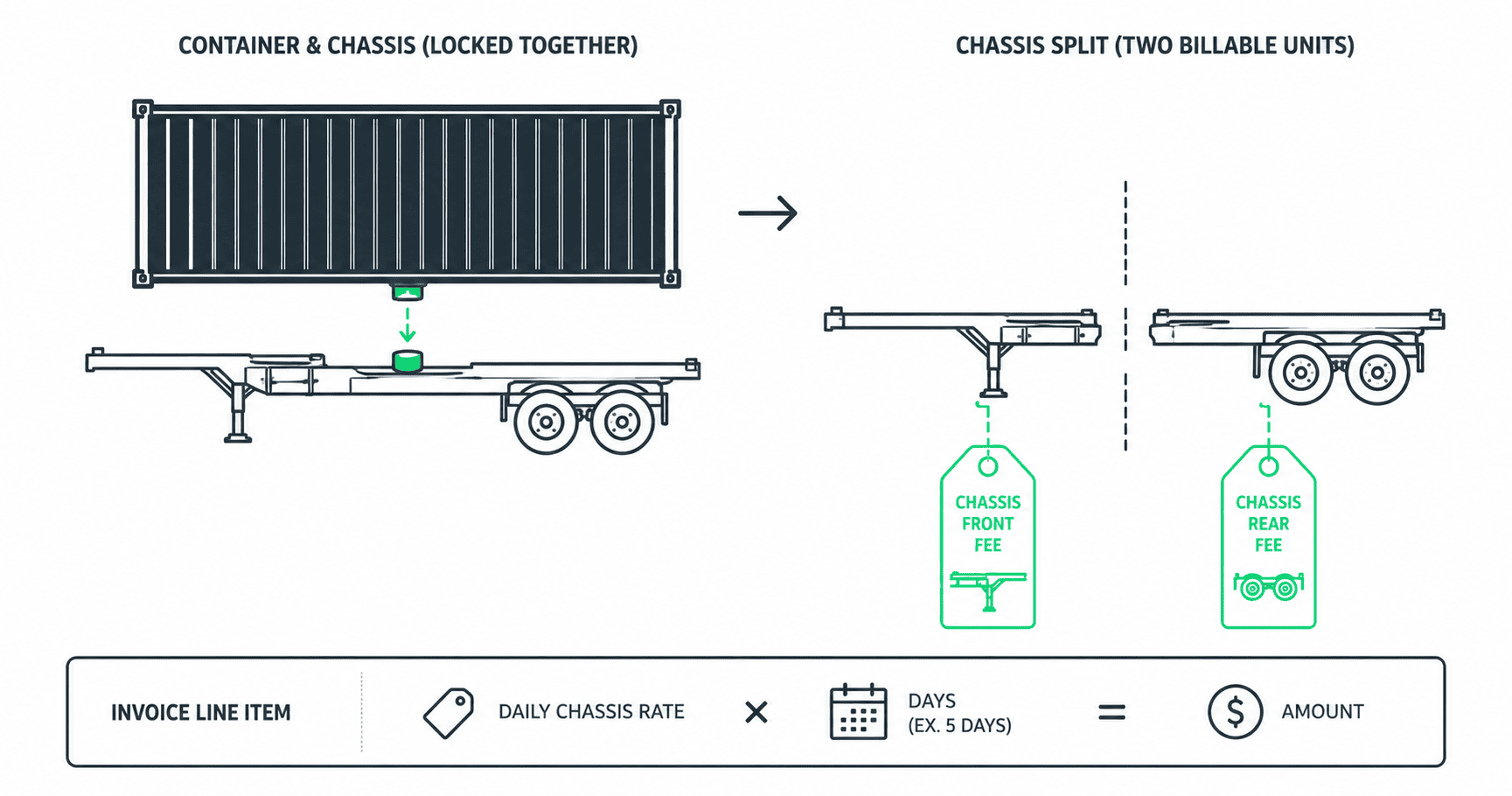
A shipping container has no wheels. It is a steel box that sits on a vessel, gets craned onto a terminal stack, and waits for a truck to pick it up. To move that container over the road, you need a chassis: a wheeled steel frame that carries the container from the port or rail ramp to the delivery location and back.
The chassis is rented. Every day the chassis is in use, a daily rental fee accrues. That fee is the chassis fee, and it applies from the moment the driver pulls the chassis out of the pool until it is returned. In a clean drayage move, the chassis fee is a straightforward operating cost that gets passed through to the customer on the invoice. In practice, it is one of the most frequently misbilled charges in drayage operations.
Chassis fees typically range from $18 to $35 per day depending on the provider, the location, and the equipment type. A container held at a warehouse for three extra days on a chassis at $28 per day is $84 that somebody is paying. If the billing team invoices the customer at an old rate of $22, or does not bill the chassis days at all, the drayage company absorbs the difference.
Who Provides the Chassis and Why It Matters for Billing?
There is no single chassis provider. The chassis attached to a drayage load could come from any of several sources, and each one has a different rate structure.
The largest chassis pools at U.S. ports and rail ramps are operated by intermodal equipment providers (IEPs). DCLI, TRAC Intermodal, and Flexi-Van are the three major IEPs. They own and maintain chassis fleets positioned at terminal locations. Motor carriers pull chassis from these pools on a per-use basis, paying a daily rental rate that varies by market. A DCLI chassis at the Port of Newark might carry a different daily rate than a DCLI chassis at the Port of Savannah. TRAC’s rates at the same port might differ from DCLI’s. The rate also depends on equipment type: a standard 20/40 chassis costs less per day than a tri-axle or an extendable chassis for 45-foot containers.
Some steamship lines still maintain their own chassis fleets, though this has become less common. And some drayage carriers own their own chassis, building the cost into their operating rate. But the majority of moves rely on pool chassis from IEPs, and that is where the billing complexity lives.
The Intermodal Association of North America (IANA) manages several cooperative chassis pools, and IEPs operate proprietary pools alongside them. From the billing team’s perspective, the critical data point is which provider’s chassis was used and for how many days. That determines the rate. But that information does not always flow cleanly from dispatch to billing.
What Is a Chassis Split?
A chassis split occurs when the container and the chassis are not at the same location. The driver cannot simply pick up a container and a chassis in one stop. Instead, the driver picks up the chassis at one location, drives to the container terminal, mounts the container, and then proceeds with the delivery.
Splits happen for practical reasons. A terminal might be short on chassis and direct drivers to an off-site chassis depot. A specific chassis type required for the container might only be available at a different pool location. The steamship line’s container might be at Terminal A, but the chassis pool that handles that line’s equipment is at Terminal B. The result is an extra move, with extra miles, extra time, and usually a repositioning charge from the chassis provider on top of the regular daily rental rate.
Why Do Chassis Splits Create Billing Problems?
Chassis splits are a billing problem because they are an unplanned event that generates a charge the billing team does not expect.
Here is the typical sequence. The load is dispatched with a standard chassis fee built into the rate. The driver gets to the terminal and finds out the chassis is not co-located with the container. Dispatch tells the driver where to pick up the chassis. The driver makes the extra trip. The load delivers. A note might go into the TMS (“chassis split, picked up at off-site depot”) but it is often a free-text comment, not a coded event that triggers a billable accessorial.
When billing processes the load, they work from the rate confirmation and whatever is coded in the TMS. If the split is buried in a comment field, it does not appear as a charge. The chassis provider sends a separate invoice weeks later that includes the split fee. The drayage company pays it and never recovers it from the customer.
One chassis split on one load might be $50 to $150. But splits are common at congested ports where chassis availability is uneven. A carrier running 100 drayage loads a month might see 15 to 25 chassis splits. At $75 each, that is $1,125 to $1,875 per month in charges that go unbilled.
What Are Street Turns and How Do They Affect Billing?
A street turn is when a chassis is returned to a different location than where it was picked up. Instead of bringing the chassis back to Terminal A’s pool after delivering a container, the driver returns it to Terminal B because there is another load to pick up there, or because pool logistics require it.
Street turns are operationally efficient. They reduce empty repositioning and speed up the overall cycle. But some chassis pools charge a street turn fee when equipment moves between locations. One pool might allow street turns at no charge within a port complex. Another might charge $30 to $75 for a cross-terminal return. Like chassis splits, street turn fees are situational, and billing teams rarely have visibility into the details unless someone at dispatch logs the event.
Why Does Chassis Billing Go Wrong?
Five specific failure points cause the majority of chassis billing errors. Each one is a data flow problem. The people involved know what they are doing. The systems just do not connect the right information to the right process at the right time.
First, fee schedules change and billing uses outdated rates. IEPs update their rate schedules periodically. If the TMS still has last quarter’s rate loaded, every invoice between the rate change and the next system update is billed at the wrong amount. This is the same class of problem that creates contract rate discrepancies across all freight modes. In drayage, it is amplified because chassis rates vary by provider, by port, and by equipment type.
Second, the chassis provider invoice arrives weeks after the move. IEPs bill on a monthly or statement cycle. The chassis usage invoice for September loads might arrive in mid-October. By then, billing has already invoiced the customer. If the chassis charge does not match what was billed, the difference gets absorbed or requires a painful rebilling process.
Third, dispatch knows the provider but does not always log it for billing. The driver picks up a TRAC chassis. Dispatch knows this. But when the load is entered into the TMS, the chassis provider field might be blank or filled with a default value. Billing does not know whether to apply the DCLI rate, the TRAC rate, or the Flexi-Van rate.
Fourth, chassis splits are noted informally. Splits get recorded as free-text comments rather than billable accessorial codes. The information is in the system, just not in a format that billing can use to generate a charge.
Fifth, there is no reconciliation against the provider invoice. The chassis provider sends a monthly statement listing every usage event, daily rates, split fees, and street turn charges. If nobody matches that statement against customer invoices, there is no way to know what was underbilled. The statement goes to AP, gets paid, and the cost lands on the P&L unchecked.
The Passthrough Problem
Chassis fees are a passthrough cost. The drayage company pays the chassis provider and bills the customer. In theory, the company is neutral on chassis cost. In practice, every gap in the billing process turns chassis fees into an unrecovered expense.
The passthrough breaks in two ways. The rate is wrong (customer billed at $22 per day, actual rate was $28), or the charge is missing entirely (a chassis split occurred and never appeared on the customer invoice). For operations doing significant drayage volume, the chassis passthrough gap can run $2,000 to $8,000 per month.
This pattern mirrors the broader challenge of missed drayage accessorials between port and warehouse. Chassis fees are just one of several accessorial categories that leak when the billing process does not account for charges originating outside the TMS.
What Does a Reliable Chassis Billing Process Look Like?
Fixing chassis billing means closing the data gaps between dispatch, billing, and accounts payable. A reliable process has four components.
First, capture the chassis provider at dispatch. Every drayage load should have a chassis provider field in the TMS that dispatch fills in at the time of the move. A dropdown with the active providers at each terminal (DCLI, TRAC, Flexi-Van, steamship line-owned, carrier-owned) determines which rate table billing uses. Without it, everything downstream is a guess.
Second, maintain current fee schedules. IEP rate schedules should be reviewed and updated in the billing system at least quarterly. When a rate change notice arrives, it gets applied immediately. The old rate gets archived with an effective date. A pre-billing audit checklist should include a step that confirms the chassis rate matches the current fee schedule for the applicable provider and location.
Third, code chassis splits as billable events. A chassis split is a billable accessorial, not a comment field note. When dispatch learns that a split occurred, it gets entered as a coded event in the TMS, the same way a detention charge would be coded. That code triggers a charge on the customer invoice. This is the single highest-impact change for most operations. Moving splits from free-text notes to billable codes recovers revenue that was previously invisible to billing.
Fourth, reconcile against the provider statement. When the monthly chassis provider statement arrives, someone matches it against customer invoices for the same period. Every chassis usage event on the provider’s statement should have a corresponding charge on a customer invoice. This reconciliation catches everything the upfront process missed and creates a feedback loop for dispatch training.
How Shipper Billing Connects to Chassis Cost Recovery
Chassis cost recovery is ultimately a shipper billing problem. The charges originate with the chassis provider, but recovery happens on the shipper invoice. Every drayage load going through shipper billing should have three chassis checkpoints: correct provider identified, current rate applied, and any splits or street turns coded as accessorials. Those checks take less than a minute per load when the data is clean.
The same discipline applies to per diem charges and other accessorials that arrive after the initial invoice. The common thread is a pre-billing verification step that catches charges before the invoice goes out, rather than chasing them after.
Frequently Asked Questions
Daily chassis rental rates from IEPs like DCLI, TRAC, and Flexi-Van typically range from $18 to $35 per day, depending on the provider, the port or rail ramp location, and the chassis type. Specialty equipment like tri-axle or extendable chassis costs more.
A chassis split means the container and chassis are not at the same location, requiring the driver to make a separate trip to pick up the chassis before mounting the container. A street turn means returning the chassis to a different location than where it was picked up. Splits generate repositioning charges. Street turns may or may not generate fees depending on the pool’s policy for cross-terminal returns.
The motor carrier or drayage company pays the chassis provider directly. Chassis fees are then passed through to the customer as a line item on the drayage invoice. The rate confirmation should specify chassis terms. When the passthrough breaks down and the correct rate is not billed, the drayage company absorbs the cost.
IEPs typically update rate schedules one to four times per year. Changes are communicated through rate change notices or updated fee schedules. There is no standard change cycle across the industry, so billing teams need a process for incorporating rate changes as soon as they are published.
Pull three months of chassis provider statements from accounts payable. Total all daily rental charges, split fees, and street turn fees. Compare that total against the chassis-related revenue you billed to customers over the same period. The gap is your leakage. Operations without a reconciliation process typically find 10% to 25% of chassis costs going unbilled.
Questions about chassis fees and splits eating into your margin? Request a demo to see how ClearLane catches missed drayage accessorials before billing. Or email us at info@getclearlane.com.