
The True Cost of Delayed Bookkeeping at a Freight Company
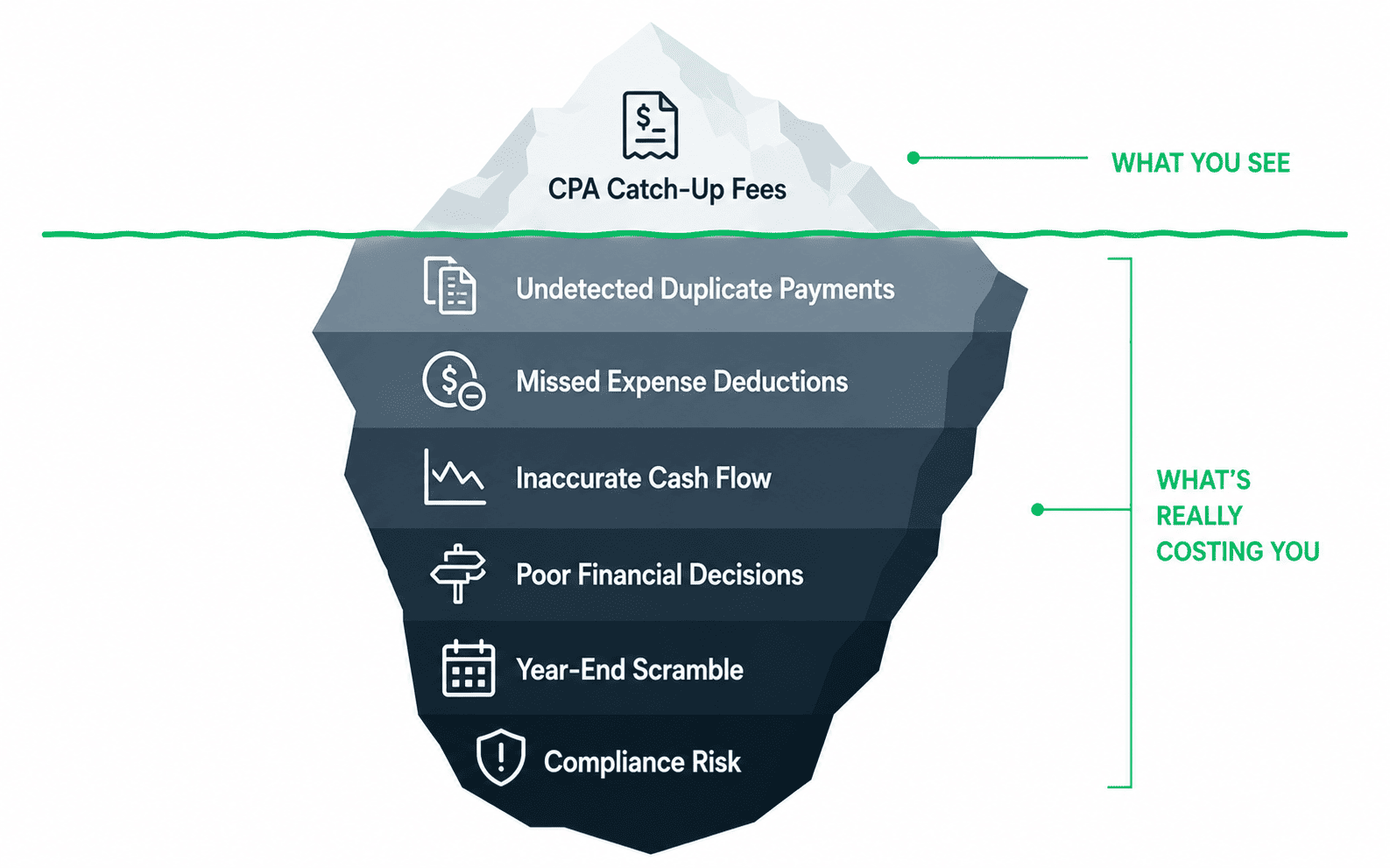
Delayed bookkeeping at a freight company doesn’t feel expensive in the moment. Nobody calls about it. No customer complains. No carrier is affected. The books are behind by a few weeks. It’ll get caught up eventually.
The cost shows up later, spread across line items and decisions that are hard to trace back to a bookkeeping gap. The CPA bills extra hours for year-end catch-up. A duplicate carrier payment goes undetected for three months. A financial decision is made based on data that turned out to be wrong. A tax deduction is missed because a receipt was lost before the expense was ever recorded.
Each of these costs is real. None of them are dramatic enough to trigger a crisis. Together, they add up to significantly more than the cost of keeping the books current in the first place.
What Does Delayed Bookkeeping Actually Cost?
The costs fall into six categories, roughly in order from most visible to least visible.
CPA catch-up charges are the cost most freight companies notice first. When the CPA receives a backlog of unreconciled transactions at quarter-end or year-end, they spend hours sorting, categorizing, and reconciling before they can start the work the client is actually paying them for: adjustments, statements, and tax preparation. At $150-$400 per hour, CPA time spent on bookkeeping tasks is expensive bookkeeping.
A freight company that delivers clean, current books monthly might spend 10-15 CPA hours per year on adjustments and tax preparation. The same company delivering a year-end backlog might spend 40-60 CPA hours. The difference is 25-45 hours at CPA rates, or $3,750 to $18,000 in additional annual accounting costs.
Undetected payment errors are the second most expensive category. Duplicate carrier payments, bank fees that shouldn’t have been charged, and vendor overcharges all show up in bank reconciliation. When reconciliation is current, these errors are caught within days and resolved quickly. When reconciliation is weeks or months behind, the same errors sit in the bank account undetected, and recovery becomes harder the longer they go undiscovered.
At a freight company processing $2 million in monthly carrier payments, even a 0.3% undetected error rate represents $6,000 per month in payments that are incorrect but unnoticed. Over a quarter of delayed reconciliation, that’s $18,000 in potential errors that could have been caught with weekly bank matching.
Inaccurate cash flow data leads to suboptimal decisions. The owner or controller who checks the bank balance to decide whether to pay carriers early, take on a new customer, or reduce factoring usage is making a decision based on incomplete information when the books aren’t current. The bank balance might show $200,000, but if $80,000 in unrecorded expenses is sitting in the pipeline, the actual available cash is $120,000. Decisions made on the $200,000 number create commitments the company can’t comfortably cover.
For freight companies where DSO and working capital management are critical (which is most of them), financial decisions based on stale data are a recurring risk when bookkeeping is delayed.
Missed expense deductions happen when transactions aren’t categorized promptly. A fuel expense that should be a deduction sits uncategorized for two months. A software subscription that qualifies as a business expense gets lumped into a general category. An equipment purchase that should be depreciated is missed entirely because the receipt wasn’t recorded. Each missed or miscategorized deduction has a tax impact: small individually, potentially significant in aggregate across a full year.
Year-end scramble costs include not just the CPA’s additional hours but the freight company’s internal time. The office manager spends two weeks gathering receipts. The owner reviews six months of unreconciled bank statements. The accounts receivable (AR) person reconstructs payment records that should have been recorded in real time. This internal time has a cost, even if it doesn’t show up as a line item. The people doing catch-up bookkeeping aren’t doing revenue-generating work.
Compliance risk exists at the margin. While bookkeeping delays don’t typically create direct regulatory violations, consistently late or inaccurate financial records can complicate lender relationships, bonding requirements, and broker financial responsibility documentation. A lender reviewing financial data for a credit line expects current, accurate books. Stale books raise questions about financial management quality.
How do the six costs stack up?
Pulled into one view, using the figures above:
| Cost category | Where it lands | Scale |
|---|---|---|
| CPA catch-up charges | Quarter-end and year-end invoice | $3,750-$18,000 a year in extra CPA hours |
| Undetected payment errors | Bank account, silently | At 0.3% of $2M monthly carrier spend, about $6,000 a month |
| Stale cash flow data | Every decision made on the bank balance | Unpriced, and often the largest of the six |
| Missed deductions | Tax return | Small individually, compounds across a year |
| Year-end scramble | Internal time in Q1 | Weeks of staff time doing catch-up instead of revenue work |
| Lender and bonding friction | Credit line reviews, broker bond renewals | Questions, delays, and worse terms |
Worked example. A brokerage paying carriers $2M a month with books running 60 days behind carries roughly $12,000 in undetected payment errors at any moment, is heading toward the high end of the CPA catch-up range, and is making every cash decision against a bank balance that overstates available cash whenever unrecorded expenses sit in the pipeline. Against that, the cost of keeping books current is one bookkeeper on a weekly reconciliation cadence. For what that looks like in-house versus handed off, when to outsource freight bookkeeping walks the decision, and BLS wage data for bookkeeping clerks grounds the in-house salary side.
One definitional note: when this site quotes month-end close timing, it means business days from the last calendar day of the month to a reconciled reporting package, excluding items held for your CPA. The full definition sits on the methodology page.
Why Does Delayed Bookkeeping Persist?
For the same reason every back-office function gets deferred at growing freight companies: the urgent work wins over the important work, and bookkeeping is never urgent until it’s a crisis.
The fix is the same as for every other capacity-constrained function: either dedicate specific in-house capacity to bookkeeping (with protected time that doesn’t get consumed by operational priorities) or bring in dedicated bookkeeping capacity through an outsourced team that keeps the books current as part of a broader financial operations service.
The cost of keeping books current is predictable and modest. The cost of catching up is variable and always higher than it needed to be.
Books falling behind? Talk to our team to see how ClearLane keeps freight company bookkeeping current. Or email us at info@getclearlane.com.
Frequently Asked Questions
The costs include CPA catch-up charges ($3,750-$18,000 extra annually), undetected payment errors ($6,000+ per month), decisions based on inaccurate cash flow data, missed tax deductions, and internal staff time spent on year-end reconstruction.
Because current bookkeeping takes minutes per day (fresh context, few transactions). Catching up takes days (stale context, accumulated volume). And the errors that go undetected during the delay (duplicate payments, missed deductions, inaccurate data) have their own cost.
CPAs who receive a backlog spend 25-45 additional hours on bookkeeping tasks at $150-$400/hour. CPAs who receive clean monthly books spend that time on adjustments, statements, and tax strategy: the work the client is actually paying them for.
Daily or weekly bank reconciliation (15-30 minutes/day), transaction categorization as expenses occur, and month-end close within 7 business days. When bookkeeping is bundled with outsourced AP and AR, the data flows continuously and the books stay current by default.
Current enough that the bank reconciliation is never more than a week old. Weekly reconciliation catches duplicate payments and bank errors while they are recoverable, keeps the cash position trustworthy, and makes month-end close a routine instead of an archaeology project.
Behind on the books and want a path back to current? Talk to our team to walk through it. Or email us at info@getclearlane.com.