
What Outsourced Bookkeeping Covers vs What Your CPA Does
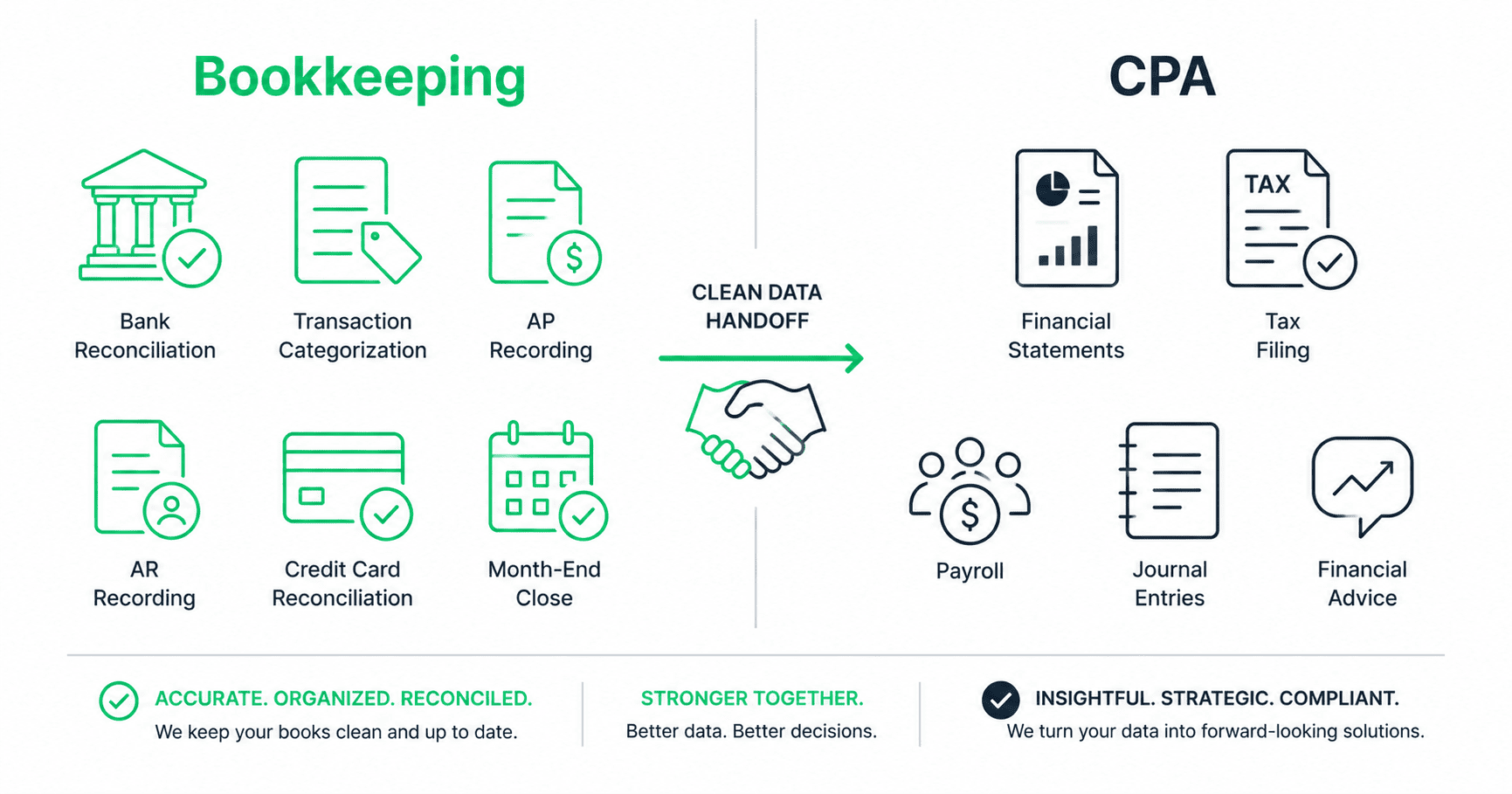
One of the most common questions freight companies ask when considering outsourced bookkeeping is where the bookkeeper’s work ends and the CPA’s work begins. The confusion is understandable. Both touch the financial records, both work in the accounting system, and both contribute to the accuracy of the company’s financial picture.
But the roles are distinct, and getting the boundary wrong creates problems in both directions. A bookkeeper who tries to make accounting judgments is overstepping their scope. A CPA who’s spending time categorizing transactions and reconciling bank accounts is doing work that should have been handled before the books reached them.
This post draws the line clearly: what outsourced bookkeeping handles, what the CPA handles, and how the two work together to keep a freight company’s financial records accurate and current.
What Does Outsourced Bookkeeping Handle?
Outsourced bookkeeping covers the data recording and reconciliation layer of accounting. This is the operational work that keeps the books current, ensuring every transaction is recorded, categorized, and reconciled so the financial records accurately reflect what happened in the business.
Bank account reconciliation is the core function. Every deposit, withdrawal, and transfer across all company bank accounts is matched against the corresponding entry in the accounting system. Discrepancies (a deposit that doesn’t match an invoice, a withdrawal that isn’t recorded, a bank fee that wasn’t categorized) are identified and resolved. For freight companies with high transaction volumes from carrier payments and shipper collections, bank reconciliation is a daily or weekly task, not a monthly one.
Transaction categorization ensures every income and expense transaction goes to the correct chart of accounts category. Carrier payments go to the right expense account. Shipper payments get applied against the open invoice in accounts receivable (AR). Fuel costs, insurance premiums, software subscriptions, office expenses: each transaction is classified consistently following the client’s existing category structure.
Accounts payable (AP) recording ensures all carrier payments, vendor invoices, and operating expenses are properly recorded. For freight companies that already outsource carrier invoice verification, the verified invoice data flows directly into the accounting record. The same team that verified the payment records it.
AR recording ensures all shipper payments received are matched to invoices and recorded accurately. When the AR management team tracks a payment receipt, the bookkeeping function applies it against the open invoice.
Credit card reconciliation matches corporate credit card statements against receipts and categorizes expenses. Fuel cards, maintenance costs, office supplies, software: each charge is verified, categorized, and recorded.
Month-end reconciliation is the completeness check. All transactions for the month are recorded, all bank and credit card accounts are reconciled, and no transactions are missing. The result: a clean set of books ready for the CPA to review.
What Does the CPA Handle?
The CPA handles the judgment layer: the work that requires professional accounting expertise, interpretation, and legal responsibility.
Financial statement preparation is CPA territory. The P&L, balance sheet, and cash flow statement are generated from the data the bookkeeper recorded, but the CPA reviews them, makes adjustments, and ensures they comply with accounting standards. The bookkeeper provides the raw data. The CPA turns it into statements that are meaningful and compliant.
Tax preparation and filing are handled by your CPA (or another credentialed tax preparer). Sales tax calculation, quarterly estimated taxes, year-end tax returns, and any tax-related decisions (depreciation methods, deductions, credits) require professional tax expertise. The bookkeeper doesn’t touch taxes. They provide the categorized data that the CPA needs to prepare the returns.
Payroll is typically handled by a dedicated payroll provider (ADP, Gusto, or similar) that integrates with the accounting software. The CPA may oversee payroll tax compliance, but the bookkeeper doesn’t run payroll. At most, the bookkeeper records the payroll entries from the provider’s reports.
Accounting adjustments are CPA decisions. Accruals, deferrals, prepaid expense allocations, depreciation entries, and any other adjusting journal entries require accounting judgment about timing, recognition, and classification. These are not data recording tasks. They’re interpretive decisions that affect the financial statements.
Financial advice and forecasting are CPA or CFO functions. Cash flow projections, budget analysis, financial strategy, and business advisory all require professional judgment that’s outside the bookkeeping scope.
Where Do Freight Companies Get the Line Wrong?
The most common mistake is expecting the bookkeeper to do CPA work, or expecting the CPA to do bookkeeping work.
When the bookkeeper is expected to make accounting judgments, problems compound. A bookkeeper who decides how to handle an accrual, how to classify an unusual transaction, or whether to capitalize or expense a purchase is making decisions that affect the financial statements, without the training or professional liability coverage to make them correctly. Small judgment errors in bookkeeping compound into significant corrections at year-end.
When the CPA is stuck doing bookkeeping, the client is overpaying for data entry. CPAs bill at $150-$400 per hour. Having a CPA categorize transactions, reconcile bank accounts, and chase missing receipts is the equivalent of hiring a surgeon to take blood pressure readings. The work gets done, but the cost structure is wrong.
The right model: the bookkeeper handles all data recording and reconciliation at a fraction of the CPA’s rate. The CPA receives clean, current books and spends their time on the work that actually requires their expertise: adjustments, statements, tax strategy, and advisory.
For freight companies that already outsource back-office operations, adding bookkeeping to the same team means the CPA receives books that are not only clean but also connected to the operational data: carrier payments match verified invoices, shipper collections match billed invoices, and the DSO and working capital metrics are based on reconciled data.
How Do the Two Work Together?
The handoff between bookkeeper and CPA should be defined and predictable.
Monthly, the bookkeeper delivers: reconciled bank and credit card accounts, all transactions categorized and recorded, AP and AR entries current, and a clean trial balance showing no unreconciled items. This is the data package the CPA works from.
The CPA then reviews the trial balance, makes any necessary adjusting entries (accruals, deferrals, depreciation), prepares or reviews financial statements, and addresses any tax-related items. The CPA’s work starts from a clean baseline rather than from a backlog of unreconciled transactions.
Quarterly and annually, the same flow applies at a larger scale. The bookkeeper ensures the quarter’s or year’s data is complete and reconciled. The CPA prepares the quarterly estimates or annual return from clean data. No year-end scramble to catch up on 11 months of unreconciled books.
The communication between bookkeeper and CPA should also be defined. The bookkeeper flags unusual transactions, questions about classification, and items that may require CPA judgment. The CPA provides guidance on classification rules, adjusting entries, and any changes to the chart of accounts. This back-and-forth should happen regularly, not just at year-end.
What Should Freight Companies Ask When Evaluating Outsourced Bookkeeping?
If you’re considering outsourced bookkeeping, whether as a standalone service or as an add-on to existing back-office operations, these questions help evaluate the scope:
Does the provider clearly define what’s included and what’s excluded? The line between bookkeeping and CPA work should be explicit in the service agreement. If the provider is vague about scope, the boundary will be unclear in practice.
Will the provider work within your existing accounting software? The bookkeeper should work in your system (QuickBooks, Xero, FreshBooks, Sage), not a separate system that requires data exports. The CPA should be able to log in and see the same books the bookkeeper maintains.
How does the provider handle items that require CPA judgment? There should be a defined process for flagging transactions that need CPA input, not a bookkeeper making accounting decisions independently.
What’s the month-end close timeline? A clear benchmark (five to seven business days after month-end) ensures the books are current when the CPA needs them. If the provider can’t commit to a timeline, the monthly close will drift.
ClearLane’s bookkeeping service is scoped explicitly to the data recording and reconciliation layer. The CPA relationship stays with the client. ClearLane keeps the books clean and current. The CPA gets a solid foundation to work from.
Questions about how bookkeeping fits with your CPA? Talk to our team to walk through the scope. Or email us at info@getclearlane.com.
Deciding between hiring and outsourcing the function entirely? The full breakdown is in our in-house vs outsourced bookkeeping comparison.
Frequently Asked Questions
The bookkeeper handles data recording and reconciliation: bank reconciliation, transaction categorization, AP/AR recording, and month-end close. The CPA handles accounting judgments, financial statements, tax preparation, and advisory. The bookkeeper keeps the data clean; the CPA interprets it.
No. Outsourced bookkeeping handles the operational recording layer. The CPA handles adjustments, financial statements, tax filings, and accounting decisions. They work together: the bookkeeper provides clean data, the CPA provides professional judgment.
In our experience, CPAs at many freight companies spend a large share of their billable hours on bookkeeping tasks: categorizing transactions, reconciling accounts, chasing missing data. At $150-$400/hour, that’s expensive data entry. Outsourced bookkeeping handles this at a fraction of the cost.
ClearLane supports QuickBooks Online, QuickBooks Desktop, Xero, FreshBooks, and Sage. The bookkeeper works directly in the client’s system so the CPA has access to the same books.
For freight companies, outsourced bookkeeping typically runs significantly less than the fully loaded cost of an in-house bookkeeper ($72,000 to $85,000 fully loaded). The scope drives the engagement: whether it covers just reconciliation and categorization or extends to recording accounts payable (AP) and accounts receivable (AR) activity and the month-end close. Payroll and tax stay with your payroll provider and CPA.
More on this: when to outsource freight bookkeeping. See bookkeeping and ownership and transaction reporting.