
Why Freight Companies Add Bookkeeping to Their Back-Office Operations
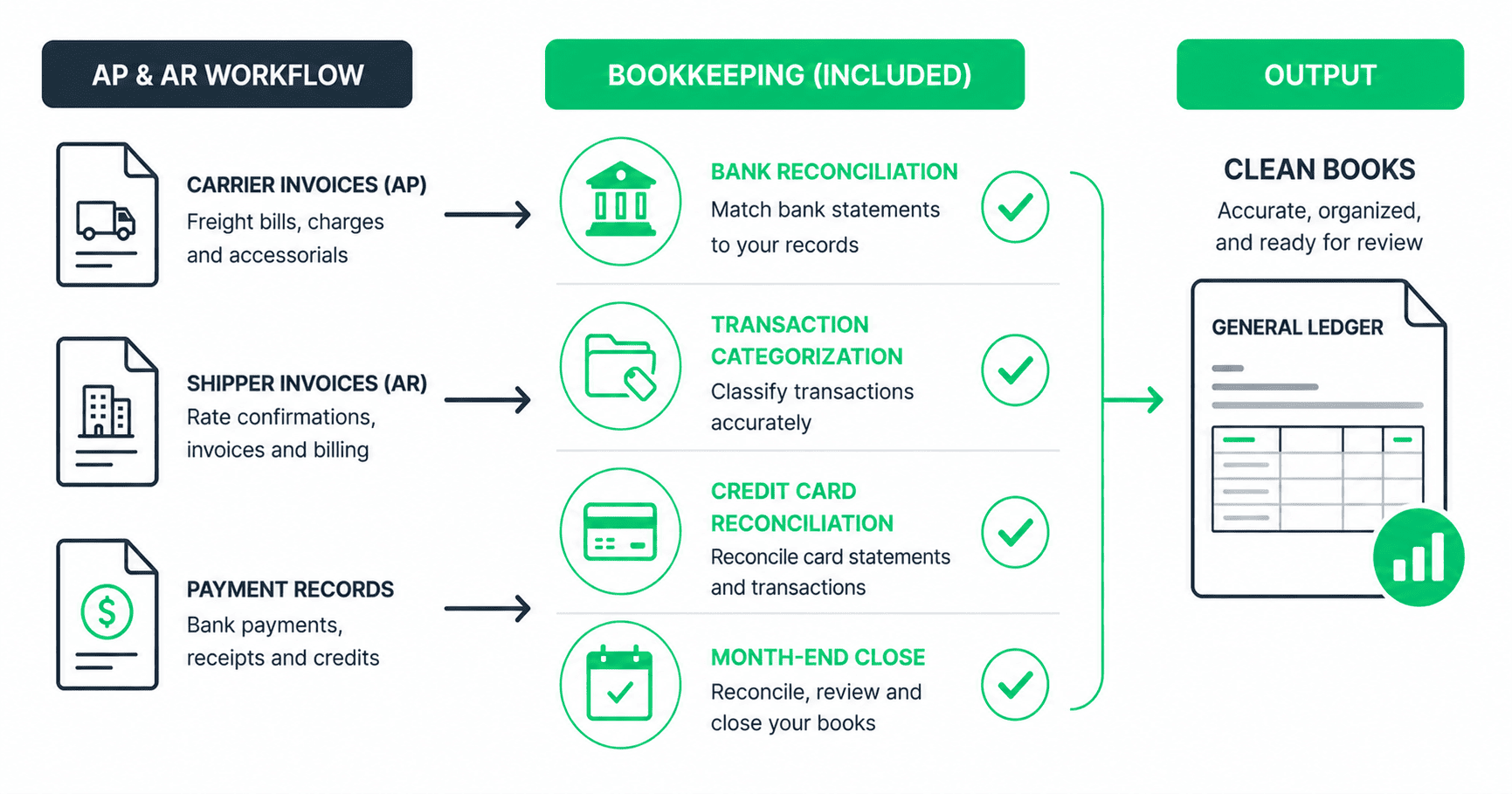
Freight companies that outsource accounts payable (AP), accounts receivable (AR), and billing already have an external team embedded in their financial workflows. That team processes carrier invoices, prepares shipper bills, manages collections, and handles the documentation that drives cash flow.
Bookkeeping is the natural next step, because the same transaction data that flows through AP and AR is the data that needs to be recorded, categorized, and reconciled in the accounting system. The team already touching the money is the logical team to record where it went.
ClearLane now offers outsourced bookkeeping as an add-on service for freight brokers, 3PLs, and transportation companies. This post explains what the service covers, what it explicitly does not cover, and why freight companies are adding it to their existing back-office operations.
Why Is Bookkeeping a Natural Extension of Freight Back-Office Operations?
At most freight companies, the bookkeeping function sits awkwardly between two worlds. It’s not strategic enough to justify the owner’s time, but it’s too important to ignore. It requires accounting knowledge but not CPA-level expertise. And it touches every transaction that the AP and AR teams already handle.
The result at many brokerages: bookkeeping is done by whoever has bandwidth. The office manager reconciles bank accounts when they can. The AR person categorizes expenses between collection calls. The owner reviews credit card statements on Sunday evenings. Month-end close happens sometime around the 15th of the following month, or later.
When a freight company already outsources AP and carrier invoice verification, shipper billing, and AR management, the outsourced team is already processing the transactions that bookkeeping needs to record. The carrier payments are flowing through AP. The shipper payments are flowing through AR. The documentation is already in the system.
Adding bookkeeping to that same engagement means the team recording the transactions in the accounting system is the same team that processed the transactions in the first place. There’s no handoff gap, no data translation, no waiting for someone else to send over the carrier payment file so the bookkeeper can record it. The information flows continuously from operations into accounting.
What Does Outsourced Freight Bookkeeping Actually Cover?
ClearLane’s bookkeeping service is scoped to data recording and reconciliation: the operational layer of accounting that keeps the books current and accurate. Here’s what’s included:
Bank account reconciliation. Matching bank transactions to accounting records across all company bank accounts, daily, weekly, or monthly depending on the client’s preference. Every deposit, withdrawal, and transfer is verified against the corresponding entry in the accounting system.
Transaction categorization. Classifying all income and expense transactions into the correct chart of accounts categories. The bookkeeping team follows the client’s existing category structure, not a generic template. Carrier payments go to the right expense account. Shipper payments get matched to the right revenue account. Operating expenses are categorized consistently.
Accounts payable recording. Ensuring all carrier payments, vendor invoices, and operating expenses are properly recorded in the accounting system. This connects directly to the carrier invoice verification the team is already performing. The verified invoice data flows into the accounting record.
Accounts receivable recording. Ensuring all shipper payments received are matched to invoices and recorded accurately. Again, this connects to the AR management the team is already handling. Payment receipts are matched to the invoices the team prepared and submitted.
Credit card reconciliation. Reconciling corporate credit card statements against receipts and categorizing expenses. Fuel cards, office expenses, software subscriptions, and other operating costs are matched, categorized, and recorded.
Month-end reconciliation. Ensuring all transactions for the month are recorded, all bank and credit card accounts are reconciled, and no transactions are missing. This is a data completeness check, making sure the books are current and nothing fell through the cracks.
What Does Outsourced Bookkeeping Not Cover?
This distinction matters. ClearLane is explicit about it. The bookkeeping service handles the data recording layer. It does not handle the judgment layer that belongs to the client’s CPA or accountant.
Financial statement preparation is not included, whether audited, reviewed or tax-basis. P&L, balance sheet, and cash flow statements are generated by the client’s accounting software or prepared by their CPA using the data the bookkeeping team records. The bookkeeping team keeps the data clean and current; the CPA interprets it.
Payroll processing is not included. Payroll is handled by the client’s payroll provider (ADP, Gusto, or similar) which feeds directly into the accounting software. The bookkeeping team does not run payroll; payroll entries reach the books through the provider’s feed.
Tax preparation and remittance are not included. Sales tax calculation, filing, and year-end tax preparation are CPA responsibilities. The bookkeeping team does not make tax-related decisions or filings.
Accounting judgments are not included. Accruals, deferrals, adjustments, journal entries, and financial advice are not part of the service. These require accounting expertise and professional judgment that belongs with the client’s CPA.
The line is clean: ClearLane records and reconciles. The CPA adjusts, interprets, and files. The client’s CPA gets clean, current books to work with instead of a backlog of unreconciled transactions at year-end.
Why Do Freight Companies Outsource Bookkeeping?
The reasons mirror the same capacity and consistency dynamics that drive outsourcing of other back-office functions.
The work is important but not strategic. Bookkeeping doesn’t generate revenue. It doesn’t win customers. It doesn’t move freight. But when it falls behind, the consequences compound: bank accounts don’t reconcile, expenses get miscategorized, month-end close takes two weeks instead of five days, and the CPA gets a mess at year-end instead of clean books.
The person doing it usually has other priorities. At most freight companies under $50 million in revenue, bookkeeping isn’t anyone’s primary job. It’s a side task for the office manager, the AP person, or the owner. When billing volume spikes, or a carrier dispute needs attention, or a shipper audit lands, bookkeeping gets pushed to next week.
The skill set is specific. Bookkeeping requires someone who understands debits and credits, chart of accounts structure, reconciliation procedures, and the client’s accounting software. Not every back-office person has this skill set. Hiring a dedicated in-house bookkeeper costs $72,000 to $85,000 fully loaded, which is significant for a mid-size brokerage that needs 15-20 hours per week of bookkeeping work, not 40.
The data connection to AP and AR is direct when it’s the same team. When the team processing carrier invoices and shipper payments is also the team recording those transactions in the accounting system, the handoff gap disappears. There’s no monthly export-and-import cycle, no reconciliation backlog from transactions that operations processed but bookkeeping didn’t record yet.
How Does It Work in Practice?
The bookkeeping team works within the client’s existing accounting software: QuickBooks Online, QuickBooks Desktop, Xero, FreshBooks, or Sage. If the client uses a different platform, compatibility is assessed during onboarding.
Each bookkeeping client is assigned a dedicated bookkeeper who becomes familiar with their chart of accounts, recurring transactions, and reconciliation preferences. This isn’t a rotating pool. The same person handles the books month after month, building familiarity with the client’s financial patterns.
The cadence depends on the client’s volume and preference. High-volume brokerages (2,000+ loads per month) typically benefit from weekly reconciliation. Smaller operations may do biweekly or monthly. The month-end close happens on a defined schedule, typically within five to seven business days of month-end.
The deliverable each month: reconciled bank and credit card accounts, all transactions categorized, AP and AR entries current, and a clean set of books ready for the CPA to review. No backlog. No surprises at year-end.
How Does Bookkeeping Connect to the Full Post-Dispatch Pipeline?
The connection is operational, not just organizational.
Clean books are the input for everything above them. Once transactions are recorded and reconciled on a schedule, the same data supports independent reporting to owners, boards, and lenders, including combined statements across related companies.
On the AP side, the bookkeeping team records carrier payments that the AP team has already verified and approved. The carrier invoice verification process ensures the payment is correct. The bookkeeping process ensures it’s recorded correctly in the accounting system. Same data, two functions, one team.
On the AR side, the bookkeeping team records shipper payments that the AR team has tracked and collected. The AR cadence ensures invoices are followed up on time. The bookkeeping process ensures the cash receipt is matched to the right invoice and posted to the right revenue account. Again: same data, continuous flow.
For DSO analysis and cash flow management, accurate bookkeeping is the foundation. You can’t assess working capital impact, measure DSO trends, or evaluate the business case for operational improvements if the books aren’t current. Clean bookkeeping makes every other financial metric reliable.
Who Should Consider Adding Bookkeeping?
Bookkeeping as an outsourced add-on makes the most sense for freight companies that already outsource at least some back-office functions: AP, AR, billing, or compliance. The operational connection between those services and bookkeeping creates a natural efficiency.
Multi-modal operations reach this point earliest. When billing runs across truckload, LTL, and intermodal with a different rate structure behind each, the books get harder to keep clean, which is part of why bookkeeping travels alongside 3PL back-office operations.
It also makes sense for companies where bookkeeping is currently done by someone whose primary job is something else. If the office manager, the AR person, or the owner is spending 10-20 hours per week on bookkeeping instead of on revenue-generating or customer-facing work, the opportunity cost is real.
And it makes sense for companies approaching CPA season (year-end, quarterly filings) with a backlog of unreconciled transactions. Bringing books current retroactively is more expensive and more error-prone than keeping them current in real time.
ClearLane’s bookkeeping service is available as an add-on to any service package. It’s priced separately by monthly transaction volume, not by load count, because bookkeeping volume tracks with the total number of financial transactions, not just freight loads.
Want to see how bookkeeping fits with your current back-office operations? Talk to our team to walk through the integration. Or email us at info@getclearlane.com.
For the staffing side of this decision, see the in-house vs outsourced bookkeeping comparison, which walks through the cost and capacity math role by role.
Frequently Asked Questions
Bank and credit card reconciliation, transaction categorization, recording accounts payable (AP) and accounts receivable (AR) activity, and the month-end close. The bookkeeper keeps the books current and reconciled so your CPA works from clean data.
Tax preparation and filing, running payroll, financial statement preparation (audited, reviewed or tax-basis), and accounting judgments. Those stay with your CPA and payroll provider.
A dedicated bookkeeper assigned to your account, working inside the accounting system you already run: QuickBooks, Xero, FreshBooks, or Sage. No migration and no new software.
Carrier invoices approved through the AP process post to the books. Shipper invoices and cash receipts from the AR desk post as they are recorded. Reconciliation then ties both to the bank. When one team runs all three, the numbers match without a month-end scramble.