
Double Brokering Crackdowns: What Legitimate Brokers and Carriers Should Know
How Has Double Brokering Changed in the Freight Industry?
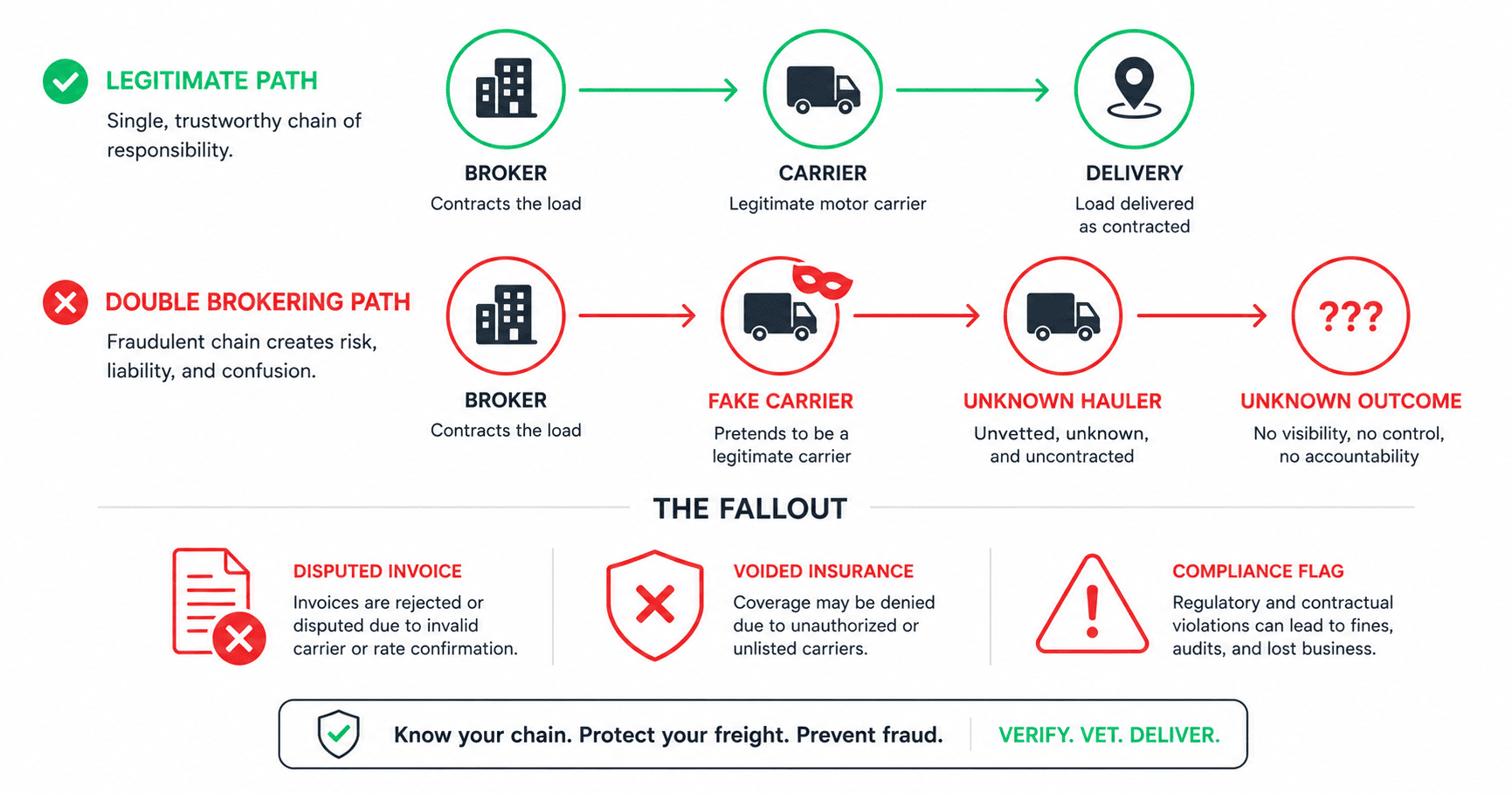
Double brokering has been a known issue in the freight industry for years. A contracted carrier accepts a load from a broker, then re-tenders it to another carrier without the broker’s or shipper’s knowledge. The middleman collects payment, the actual hauler may or may not get paid, and the broker and shipper have no visibility into who actually moved the freight.
What’s changed is the scale and sophistication. Double brokering is no longer primarily a scheme run by marginal operators cutting corners. It’s become a tool of organized fraud networks that steal legitimate carrier identities, pass standard vetting processes, and exploit the gaps between how carriers are verified and how freight is tendered.
The Q1 fraud data tells the story clearly: roughly 50% of theft incidents involved carriers with legitimate MC numbers and previously clean operating histories. Identity theft reports rose sharply. Change-of-ownership fraud, where criminals purchase old MC numbers from legitimate companies to acquire clean operating histories, rose even faster.
For legitimate freight brokers, the double brokering problem creates risk on multiple fronts: liability exposure when fraud is discovered, billing complications when payments are disputed, compliance concerns when shipper audits reveal the broker used a compromised carrier, and reputational damage from association with a fraud incident.
How Do Modern Double Brokering and Identity Theft Schemes Work?
Understanding the mechanics of modern double brokering is important for understanding why traditional vetting processes fail to catch it.
In the identity theft version, a criminal organization obtains a legitimate carrier’s MC number, insurance documentation, and company information. This can happen through compromised email accounts (giving the criminal access to the carrier’s communications), FMCSA contact manipulation (changing the phone number and email on the carrier’s FMCSA record), or purchasing data from the dark web.
With the stolen identity in hand, the criminal contacts brokers, either through load boards or direct outreach, presenting as the legitimate carrier. They provide the real MC number, the real insurance certificate, and a phone number that now routes to them instead of the real carrier. The broker runs a standard check: active authority, insurance on file, clean safety record. Everything checks out, because the identity they’re checking is real. It’s just not the person they’re talking to.
The load is booked. The criminal either dispatches a truck (which may be uninsured, uninspected, or operated by an unqualified driver) or re-brokers the load to an unsuspecting legitimate carrier at a lower rate, pocketing the difference. In the worst cases, the freight is diverted entirely, rerouted to a cross-dock where it’s relabeled and sold.
In the change-of-ownership version, a criminal purchases an existing MC number from a carrier who is leaving the industry. The MC number comes with a clean operating history, established FMCSA filings, and an aged authority, all of which make it appear legitimate to vetting processes. The new “owner” then uses the clean authority to book loads and execute fraud schemes.
Both versions exploit the same gap: the vetting process verifies the authority, not the person behind it. A standard SAFER check confirms that MC number 123456 has active authority and insurance. It doesn’t confirm that the person calling the broker is actually the operator of MC 123456.
The Legislative Response
Congress is responding to the escalation of freight fraud through the SAFER Transport Act, introduced in February by Senator Todd Young. The bill includes several provisions designed to close the gaps that fraud networks exploit.
The bill would establish a Freight Fraud and Theft Advisory Committee under the Secretary of Transportation. It would require motor carriers, brokers, and freight forwarders to notify FMCSA of any ownership change within 30 days. It proposes to phase out MC numbers entirely within five years, removing a primary tool that criminals use to acquire clean operating histories through change-of-ownership transactions. The SAFER Transport Act remains introduced legislation, not law, and MOTUS retained MC numbers at launch.
FMCSA’s MOTUS registration system, which launched in May, also addresses some of these gaps by centralizing registration data, limiting system access to verified users, and enabling faster enforcement actions when fraud is detected.
These are important structural changes, but they’re working through regulatory and legislative timelines. The fraud risk exists today, and the operational defense needs to exist today.
What Is the Billing and Compliance Impact of Double Brokering on Legitimate Brokers?
When a double brokering incident is discovered, either during the shipment or after, the billing and compliance consequences for the legitimate broker are significant.
Insurance coverage may be voided. The broker’s contingent cargo insurance and the carrier’s primary liability coverage are predicated on the contracted carrier hauling the freight. When the freight was actually hauled by an unknown third party, the insurance coverage may not apply. If there’s a cargo claim or an accident, the coverage question becomes a legal dispute that takes months to resolve.
Shipper invoice disputes are likely. When a shipper learns that their freight was handled by someone other than the carrier they were told, they have grounds to dispute the invoice, even if the freight was delivered successfully. The broker needs to demonstrate that the shipment was handled properly and that their vetting process was sound. If they can’t, the invoice may go unpaid.
Carrier payment disputes create competing claims. The actual hauler, the legitimate carrier who was hired by the double broker to move the freight, will demand payment. The broker has already paid (or committed to pay) the entity they contracted with, which was the fraudulent carrier. Now there are two parties claiming payment for the same load, and the broker is in the middle.
Compliance documentation gaps appear during shipper audits. Large shippers audit their freight providers’ carrier vetting and compliance processes. A double brokering incident raises questions about the effectiveness of the broker’s vetting, and a single incident can trigger a review of the broker’s entire carrier compliance program.
How Can Freight Brokers Defend Against Double Brokering?
While legislative and regulatory reforms work through the system, the practical defense against double brokering operates at the brokerage level through enhanced vetting and monitoring.
Contact verification should be standard on every new carrier. The phone number the carrier provides should be verified against the number on their FMCSA record and against historical contact data for the carrier. If they don’t match, that’s not a minor discrepancy. It’s a flag. Email domains should be verified against the company’s known digital presence. Because fraudsters can change the contact details on an FMCSA record, confirmation calls should go to a number obtained independently (from historical contact data or a past verified record), not only the FMCSA-listed number, to confirm the carrier is aware of the load booking.
Ownership history should be checked on every new carrier. How long has the current entity owned this authority? If the ownership changed recently (within the last 6 to 12 months), that warrants additional verification. The change-of-ownership fraud vector makes recent authority transfers a meaningful risk signal.
Carrier onboarding should include identity verification beyond standard SAFER checks. This might include verifying the carrier’s physical address, cross-referencing their equipment data, checking their digital footprint (website, social media presence, load board history), and confirming their insurance directly with the insurer rather than relying on a certificate of insurance (COI) the carrier provided.
Ongoing compliance monitoring should include watching for unauthorized changes to FMCSA contact information, insurance filing status, and authority details. A carrier whose FMCSA email address or phone number changes without explanation may have had their identity compromised.
In-transit verification adds a layer of protection. Confirming the actual driver and equipment at pickup against the carrier’s records can catch situations where the carrier who accepted the load dispatched a different truck, or where a double broker sent an entirely different carrier to the pickup point.
These verification steps add time and cost to the onboarding and tendering process. The alternative (the billing disputes, insurance complications, compliance exposure, and reputational risk of a double brokering incident) costs significantly more.
Building the Verification Into Operations
For brokerages that want to strengthen their defense against double brokering without slowing operations to a halt, the approach is layered.
Enhanced vetting at onboarding covers new carriers. Contact verification and ownership history checks happen before the first load is tendered. Identity checks and direct insurance verification complete the two-step onboarding process (provisional approval for the immediate load, thorough verification completed within 72 hours).
Ongoing monitoring catches changes to existing carriers. Authority modifications, FMCSA contact changes, insurance filing disruptions, and ownership transfers are tracked across the active carrier database. When a change is detected, the carrier is flagged for re-verification before new loads are tendered.
Load-level verification adds protection on high-risk lanes or high-value freight. Confirming driver identity and equipment at pickup, monitoring in-transit GPS against expected routes, and verifying delivery to the contracted destination.
ClearLane’s carrier compliance monitoring includes authority verification, insurance filing checks, and ongoing status monitoring as part of the post-dispatch pipeline. When a carrier’s status changes, whether through an FMCSA action, an insurance event, or an ownership transfer, the change is flagged before the next load is tendered.
Frequently Asked Questions
Double brokering occurs when a carrier accepts a load from a broker and illegally re-tenders it to another carrier without the broker or shipper knowing. The broker thinks their contracted carrier is hauling the freight; the actual hauler doesn’t know the load was re-brokered.
Roughly 50% of theft incidents involve carriers with legitimate MC numbers and previously clean operating histories. Identity theft reports and change-of-ownership fraud both rose sharply in the first quarter.
It creates shipper invoice disputes (shipper refuses to pay when they learn the load was mishandled), competing carrier payment claims (the actual hauler demands payment from the broker), and insurance complications (coverage may be voided if the contracted carrier wasn’t the hauler).
Legislation introduced in February targeting freight fraud, requiring ownership change notifications within 30 days, enhancing fraud penalties, and proposing to phase out MC numbers over five years.
Re-brokering a load without the original broker’s knowledge or consent typically violates the broker-carrier agreement, and when it involves fake identities or diverted payments it crosses into fraud prosecuted under federal statutes. Disclosed, contract-permitted co-brokering is a different and legitimate arrangement. The distinction is consent and transparency.
Want tighter carrier vetting without adding headcount? Talk to our team to walk through it. Or email us at info@getclearlane.com.