
Freight Fraud Is Rising: How It Affects Billing and Collections Across the Industry
How Bad Is Freight Fraud in the Current Market?
Freight fraud is not a new problem, but it’s accelerating. Fraudulent activity targeting freight brokers, carriers, and shippers rose sharply in 2024 by industry accounts, and Q1 2026 set new records across nearly every fraud category.
According to Highway’s Q1 2026 Freight Fraud Index (figures as of Q1 2026), the platform blocked over 527,000 fraudulent inbound emails during the quarter, a 49.9% increase year-over-year. Change-of-ownership fraud surged 169.6%, with 399 ownership changes flagged across carrier profiles. The network intercepted over 71,000 spoofed phone calls and recorded more than 2,200 instances of identity theft, up 89.6% year-over-year.
Separately, Verisk CargoNet reported that estimated cargo theft losses surged 60% in 2025 to nearly $725 million, with organized criminal groups becoming more selective and targeting higher-value freight.
The industry conversation around fraud tends to focus on cargo theft: the dramatic headline of stolen goods and diverted shipments. That’s a real and serious problem. But for freight brokerages, the billing and collections impact of fraud is equally significant and far less discussed.
How Has Freight Fraud Evolved Beyond Cargo Theft?
The fraud landscape in freight has shifted from physical theft to strategic deception. The distinction matters for understanding the downstream impact on billing and operations.
Traditional cargo theft involved breaking into trailers, stealing from warehouses, or targeting unattended trucks. The damage was physical and the insurance process, while painful, was relatively straightforward: a claim for lost goods.
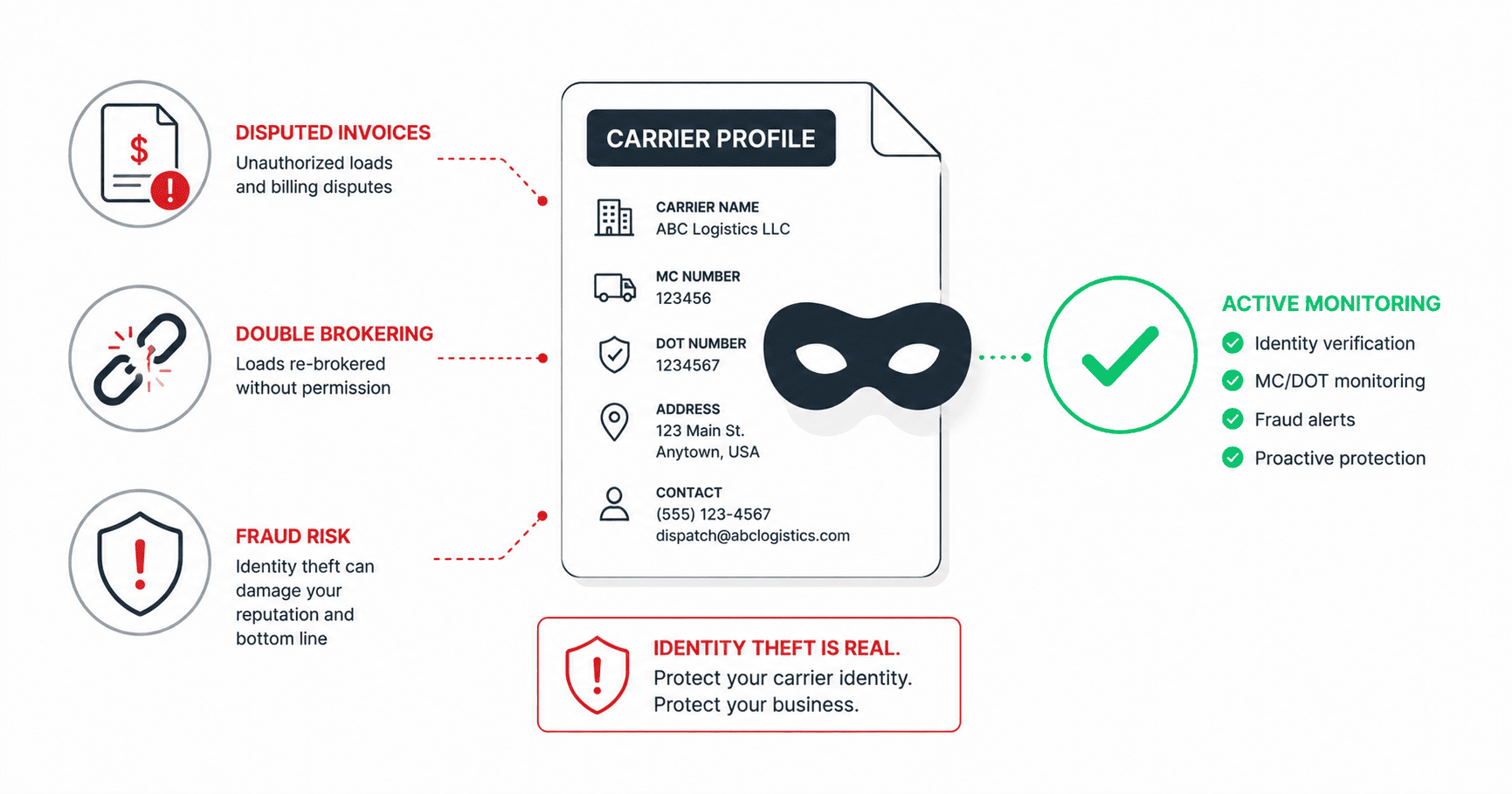
Strategic fraud operates differently. Identity theft, double brokering, change-of-ownership schemes, and social engineering don’t physically steal cargo in most cases. They manipulate the documentation and relationships that the billing and payment process depends on.
One of the most alarming findings from the Q1 2026 data is that roughly 50% of all theft incidents involved carriers holding legitimate MC numbers and previously clean operating histories. These aren’t obviously fraudulent entities. They passed standard vetting processes. The fraud was enabled by stolen identities, compromised email accounts, and purchased authorities. These tactics are difficult to detect through traditional onboarding checks.
The SAFER Transport Act, introduced in February 2026, specifically targets these gaps, including proposals to require notification of ownership changes within 30 days and to phase out MC numbers entirely within five years. But legislative solutions take time. In the meantime, the fraud environment is a present-tense problem for every freight brokerage.
How Does Freight Fraud Affect Billing and Collections?
When a load is handled by a fraudulent carrier (whether through double brokering, identity theft, or a compromised authority), the billing and collections consequences extend well beyond the value of the cargo.
Shipper invoice disputes are the most immediate impact. When a shipper learns that their freight was handled by someone other than the carrier they were told, the invoice gets disputed. The shipper may refuse to pay until the broker can demonstrate that the load was handled properly, that insurance was in place, and that the shipper’s cargo was never at risk. Even if the load was delivered successfully, the dispute can hold up payment for weeks or months.
Carrier payment complications arise because the entity that performed the work may not be the entity on the rate confirmation. In a double-brokering scenario, the broker pays the carrier they contracted with. But that carrier re-brokered the load to someone else. The actual hauler may contact the broker demanding payment, creating a situation where the broker faces competing payment claims for the same load.
Regulators have started moving on this specific scheme. Our breakdown of the double-brokering crackdowns covers what the enforcement push means for brokers and carriers.
Insurance claim complexity increases when fraud is involved. If the carrier’s authority or insurance coverage was fraudulent or compromised, the broker’s contingent cargo insurance may need to cover the loss. Filing and resolving those claims takes time and documentation that pulls staff away from their regular work.
Accounts receivable (AR) aging takes a hit that’s disproportionate to the number of affected loads. A single fraud-related dispute that ties up a $15,000 invoice for 90 days has the same DSO impact as 10 standard invoices of the same size being delayed by 9 days each. And fraud-related disputes tend to resolve slowly because they involve multiple parties, insurance carriers, and sometimes law enforcement.
The compliance aftermath is equally costly. A shipper audit that reveals the broker used a carrier whose identity was compromised triggers a documentation review, sometimes across all loads, not just the affected one. The broker needs to demonstrate that their vetting process is sound, that compliance monitoring is ongoing, and that the incident was an exception rather than a systemic failure.
How Does Rising Fraud Change Back-Office Workload?
The back-office impact of rising fraud goes beyond individual incidents. It changes the workload and complexity of several core functions.
Carrier invoice verification gets harder. When fraud is prevalent, accounts payable (AP) teams need to add verification steps: confirming that the carrier who submitted the invoice is the carrier who actually hauled the load, checking that the MC number and insurance match current FMCSA records, and verifying that no ownership change or authority modification has occurred since the load was tendered.
Carrier onboarding and compliance monitoring requires more diligence. Traditional vetting (checking FMCSA authority, insurance filings, and safety ratings) is necessary but no longer sufficient when roughly half of theft incidents involve carriers with clean records. Ongoing monitoring needs to catch changes in ownership, contact information, and authority status between onboarding and tendering. The FMCSA changes in 2026 (particularly the MOTUS system launch) should improve real-time visibility, but the monitoring still needs to happen.
Billing documentation requirements increase. Shippers who have experienced fraud-related issues (either with their own freight or within their carrier network) may require additional documentation with each invoice: proof of carrier identity, compliance verification at time of tendering, and confirmation of insurance coverage. Meeting those documentation requirements adds time to the billing process.
And exception handling consumes more staff capacity. Every fraud-related incident generates hours of research, communication, and documentation work. At a brokerage processing thousands of loads per month, even a small number of fraud incidents can consume a disproportionate share of the back-office team’s time. That time comes at the expense of processing regular invoices, following up on AR, and maintaining compliance monitoring.
What Brokerages Can Do
Fraud prevention is a front-office and technology conversation: better vetting, identity verification platforms, real-time monitoring tools. That conversation is important and well-covered by providers like Highway, Truckstop, and the FMCSA’s own modernization efforts.
Fraud defense is documentation defense, and documentation is a back-office function before it is a security one. That overlap is why carrier verification, compliance monitoring, and billing tend to end up on the same desk in brokerage back-office operations.
The back-office conversation is different. It’s about building processes that minimize the billing and collections impact when fraud does occur, because in the current environment, prevention reduces but doesn’t eliminate incidents.
Systematic carrier compliance monitoring that checks authority, insurance, and identity data on an ongoing basis, not just at onboarding, reduces the likelihood that a compromised carrier gets through to tendering. ClearLane’s compliance monitoring runs continuous checks as part of the post-dispatch pipeline.
Carrier invoice verification that includes identity confirmation, not just rate and charge matching, catches discrepancies between who was contracted and who submitted the invoice. This is an AP step that traditionally hasn’t been part of standard invoice processing, but the fraud environment now demands it.
Documentation discipline on every load (maintaining a complete file with rate confirmation, carrier identity verification, POD, BOL, and compliance snapshot at time of tendering) creates the evidence base needed to resolve disputes quickly when they arise and to satisfy shipper audit requirements.
And defined escalation workflows for fraud-related incidents (who handles the investigation, who communicates with the shipper, who files the insurance claim, who manages the carrier dispute) prevent fraud incidents from consuming the entire team’s capacity while regular work piles up.
The Bigger Picture
Freight fraud is an industry-wide problem that no individual brokerage can solve alone. Legislative efforts like the SAFER Transport Act, system modernization through MOTUS, and technology platforms for carrier identity verification are all moving in the right direction.
But the billing and collections impact of fraud is a back-office problem that each brokerage needs to manage at the operational level. Rising fraud means more verification work, more dispute resolution, more compliance documentation, and more exception handling, all hitting a back-office team that’s already handling billing, AR, POD retrieval, and carrier compliance.
Building the processes and capacity to absorb that workload, without letting it degrade billing speed, DSO, or compliance quality, is the operational challenge that growing brokerages need to plan for.
Frequently Asked Questions
Freight fraud is any scheme where a party in the supply chain misrepresents identity, authority, or services to steal loads, payments, or data. The most common forms in brokerage are double brokering, identity theft (using a legitimate carrier’s MC number), and fictitious pickup, all of which create billing and collections exposure for the broker.
Fraudulent activity rose sharply in 2024 by industry accounts, and Q1 2026 set new records. Identity theft reports rose 89.6%, change-of-ownership fraud surged 169.6%, and estimated cargo theft losses reached nearly $725 million.
Fraud creates shipper invoice disputes (shippers refuse to pay when they learn freight was mishandled), carrier payment complications (competing payment claims for the same load), insurance claim complexity, and AR aging from prolonged dispute resolution.
Criminals steal a legitimate carrier’s MC number, insurance documentation, and contact information to pass broker vetting. Roughly 50% of theft incidents involve carriers with legitimate MC numbers and previously clean operating histories.
Systematic carrier compliance monitoring that checks authority, insurance, and identity data on an ongoing basis, plus carrier invoice verification that confirms the entity who submitted the invoice is the entity who hauled the load.
Want to evaluate your carrier vetting and compliance monitoring process? Talk to our team to see how ClearLane handles ongoing compliance verification. Or subscribe to the newsletter for industry updates that affect freight operations. Email us at info@getclearlane.com.