
EDI 810 Invoice Rejected: Why Freight Invoices Fail in Transmission and How to Rework Them Same Day
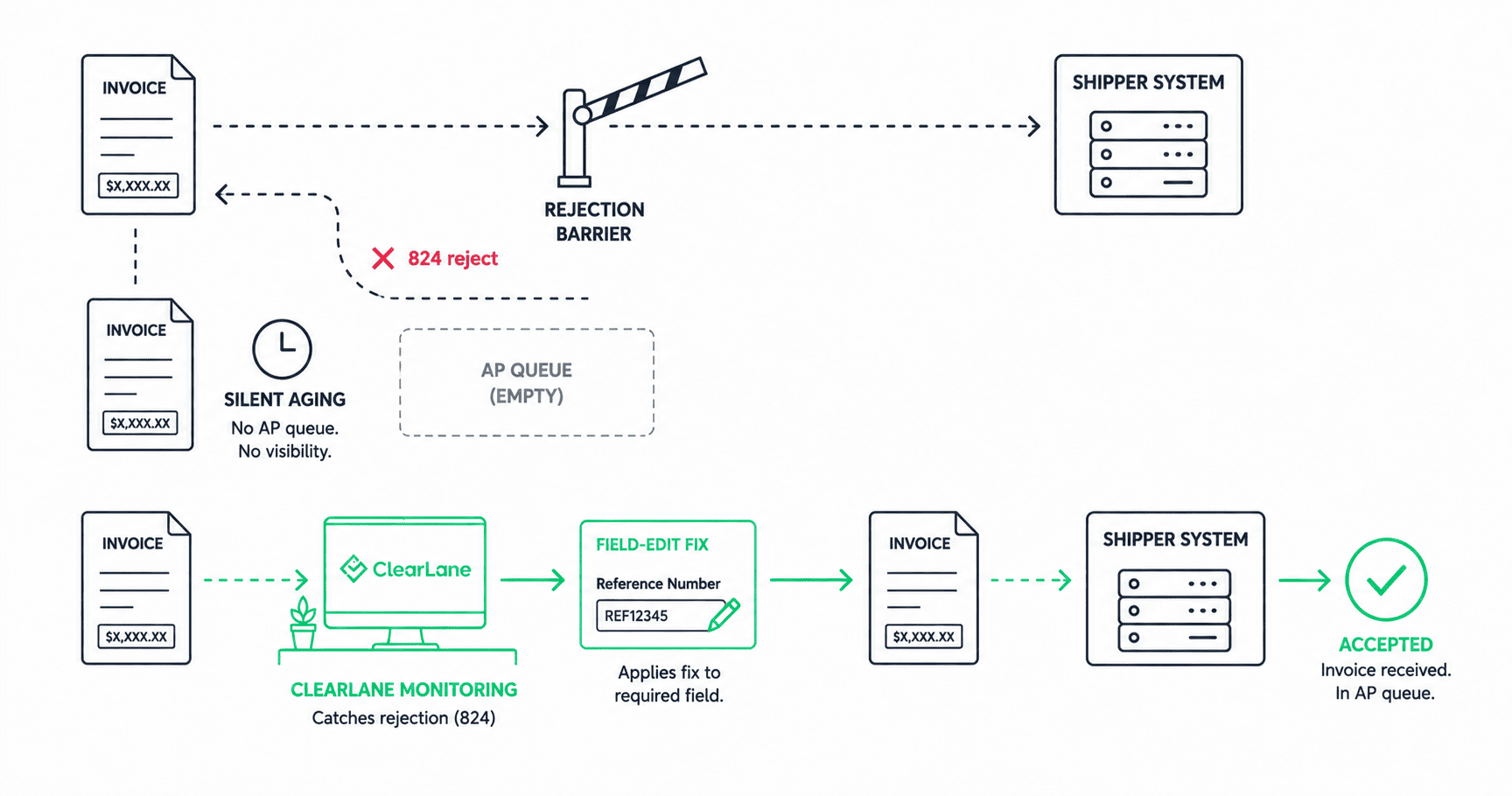
The invoice went out through the shipper’s EDI channel and the billing clerk moved to the next load. Three weeks later the aging report shows 21 days outstanding, the AP contact says the invoice was never received, and the approval clock starts over from zero. Nothing about the load was wrong. The transmission failed, and nobody was watching the channel where it said so.
This is one of the quietest ways a freight invoice ages, because a rejected electronic invoice does not look like a problem. It looks like silence.
What is an EDI 810, and how does freight billing use it?
EDI is structured electronic data exchange between your system and the shipper’s. An EDI 810 is the standard electronic invoice document; motor carriers billing freight charges often use the 210, the motor carrier freight details and invoice transaction, instead. When your invoice transmits, the shipper’s system answers with acknowledgments: a 997 functional acknowledgment confirms the file was received and readable, and an 824 application advice reports whether the invoice was accepted into their payables system or rejected. Many shippers run the same logic through a web portal, with an on-screen status playing the role of the 824.
Why do freight invoices get rejected in EDI?
Most rejections are reference-data mismatches rather than disagreements about money. The PO, BOL, or shipment reference on the invoice does not match what the shipper’s system expects. The rate or an accessorial charge differs from what their system has on file for the lane. A required field or segment is missing or formatted wrong. The invoice number duplicates one already submitted, often left over from an earlier resubmission attempt. Or the charge codes on your side are mapped to codes their system does not recognize.
Each customer has its own requirements, which is why an invoice that transmits cleanly to one shipper can fail at another with identical data. Disagreements about the charges themselves are a different problem, covered in shipper payment disputes: causes and prevention.
The most common rejections, and the same-day fix for each
Almost every rejection falls into one of seven buckets. The fix is usually minutes of work; the cost comes from nobody doing it the day it happens.
| Rejection | Common cause | Same-day fix |
|---|---|---|
| Reference mismatch | PO, BOL, or shipment number formatted differently than the shipper system expects | Correct to their format from the routing guide and resubmit |
| Rate variance | Rate changed after booking, or an accessorial was rolled into the linehaul | Rebill to match the contract, or attach written approval for the difference |
| Missing required field | A customer-specific segment or field your mapping does not populate | Add it to that customer’s mapping sheet, then resubmit |
| Duplicate invoice number | A resubmission sent under the original number | Issue a suffixed number and reference the original in the notes |
| Charge code unmapped | An accessorial coded in your system with no match in theirs | Map it to their published code list and resubmit |
| Date logic | Invoice date earlier than the delivery date in their system | Align the dates to the POD and resubmit |
| Missing document | A POD or weight ticket required at submission but not attached | Attach the document and resubmit the same day |
Notice the pattern: every fix ends in “resubmit,” and every resubmission restarts the approval clock. The cheapest rejection is the one you catch the same afternoon.
How does a silent rejection age into DSO?
A rejected invoice is not in anyone’s AP queue, so no approval clock is running and no payment is scheduled. Unless someone reconciles the acknowledgment traffic, the first sign of trouble is a follow-up call at 30 days past due, and the answer is the worst one available: we never received it. The invoice gets reworked and resubmitted, terms effectively restart, and a load delivered in week one gets paid in week eleven. A few of these a month move the whole portfolio’s DSO, which is why acceptance tracking belongs inside the AR follow-up cadence rather than outside it.
What silent rejections cost
Published composite ranges put first-pass electronic rejections at 2 to 6 percent of submissions; the freight DSO and AR benchmarks carry the full figures. On a thousand invoices a month, that is 20 to 60 invoices, and at freight’s average load value of about $1,000, a rolling $20,000 to $60,000 that is not in anyone’s payment queue.
The deeper cost is the restart. A rejection discovered at day 30 does not add 30 days to that invoice; it adds 30 days plus a full fresh approval cycle, which is how a single quiet transmission failure turns one load into a 70 day receivable.
How do you catch rejections the same day?
Treat every transmission as open until acceptance is confirmed. That means reconciling 997s and 824s, or portal statuses, daily against everything submitted; a submission with no acknowledgment at all is itself a flag, because silence can also mean the file never arrived. Rework rejections the same day, while the load file is open and the fix is a five minute field edit rather than an investigation. Keep a per-customer mapping sheet of reference formats, required fields, and charge codes so the same rejection does not repeat. And log rejection reasons over time: a customer whose requirements quietly changed shows up as a pattern, not a one-off.
A daily acceptance reconciliation, step by step
The whole discipline fits into one short routine at the end of each billing day:
- Pull the list of everything submitted electronically today and yesterday, by customer and channel.
- Match each submission to its acknowledgment: a 997 or portal receipt confirming arrival, then the 824 or portal status confirming acceptance.
- Flag anything with no acknowledgment at all. Silence is a rejection you have not seen yet, so treat it as one.
- Rework every rejection now, while the load file is open and the person who rated it remembers the load.
- Log the rejection reason. Weekly, sort the log by customer: a requirement that changed will show up as a cluster, and one mapping fix ends it.
Fifteen minutes a day. The alternative is finding out at day 30, one invoice at a time, from an AP contact who never received them.
What does clean electronic invoicing look like?
Every invoice submitted through the channel the customer requires, acceptance confirmed the same day, rejections reworked before the load file goes cold, and an aging report where every open invoice is actually sitting in a payables queue. That last part is the point: a collection cadence only works on invoices the shipper actually has.
Submission and acceptance tracking is part of ClearLane’s shipper billing and invoicing desk, and the follow-up side is run by the AR management desk. To see what transmission delays cost in working capital, run your numbers in the DSO calculator.
Both are electronic invoices. The 810 is the general invoice transaction used across industries; the 210 is the motor carrier freight details and invoice transaction, built for freight charges specifically. Which one a shipper requires depends on their system, and their EDI specification will say.
A receipt confirmation. The 997 says the shipper’s system received your file and could read it. It does not mean the invoice was accepted for payment; that verdict typically comes on an 824 application advice or a portal status. An invoice can clear the 997 and still be rejected.
Do not wait, and do not resubmit blind. Fix the stated rejection reason first, because resubmitting the same data usually produces the same rejection plus a possible duplicate invoice number. A same-day corrected resubmission keeps the invoice inside the customer’s normal approval cycle.
If acceptance tracking sounds like one more daily job nobody has time for, that is what a dedicated billing desk is for. Request a demo. Or email us at info@getclearlane.com.