
What Happens in the First 30 Days of Outsourcing Back-Office Operations
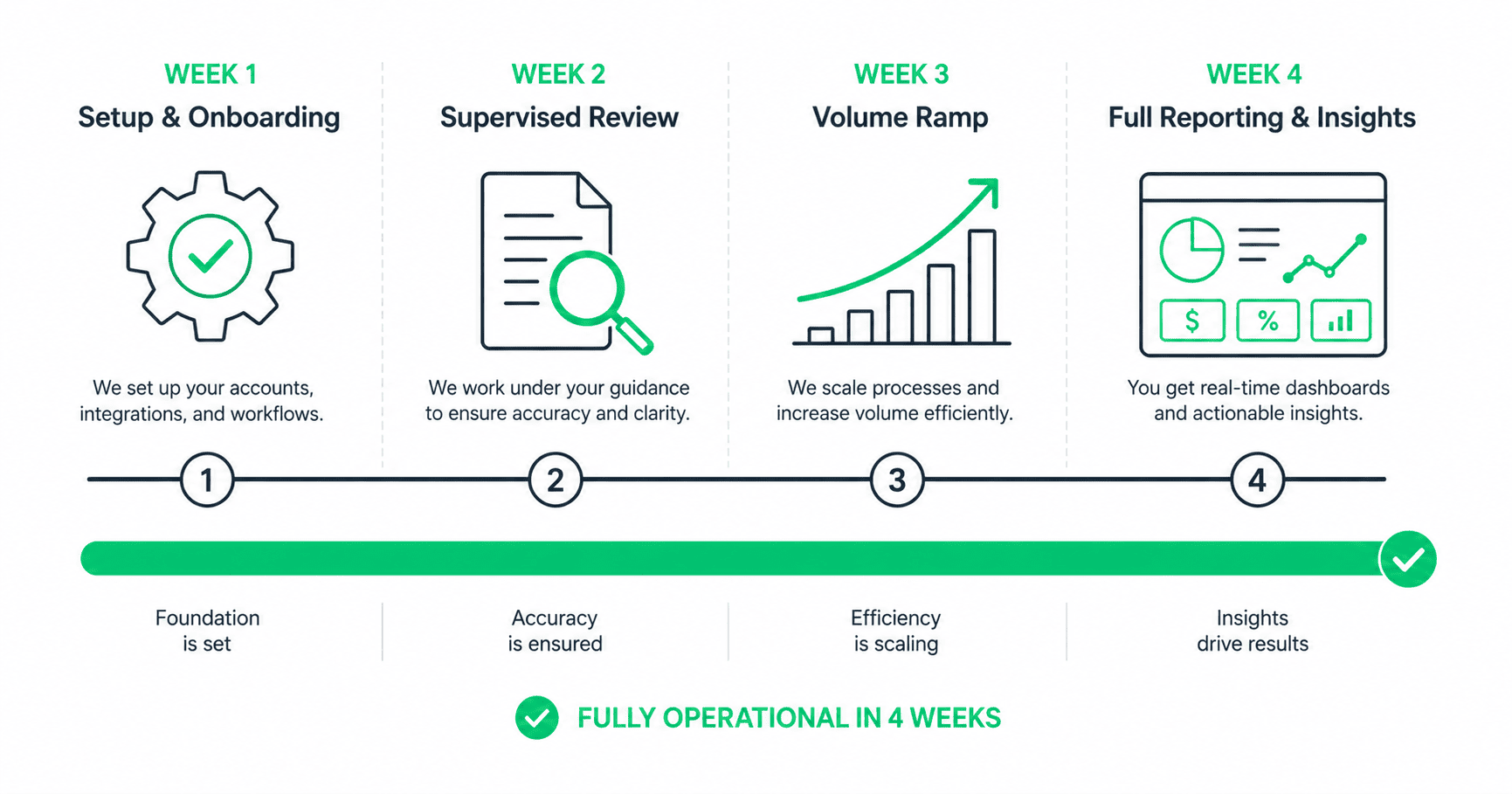
When a freight company decides to bring in an external team for back-office operations (POD retrieval, carrier invoice audit, shipper billing, accounts receivable (AR) follow-up, carrier compliance), the operational question that matters most isn’t about pricing or scope. It’s about the transition.
How does the team learn our systems? What happens to our billing while they ramp up? How do we maintain quality during the changeover? How long before they’re actually productive?
These questions come up in almost every conversation about outsourcing freight back-office work, and they deserve straightforward answers. The transition period is real. It’s not instant, and pretending otherwise would be dishonest. But it’s also structured, predictable, and significantly faster than the alternative of recruiting and training new in-house staff.
This post walks through what actually happens during the first 30 days when a freight company brings on a dedicated external team for post-dispatch operations.
What Happens Before the Outsourced Team Starts Working?
Before the team starts working, there’s a discovery phase that typically takes three to five business days. This is where the external team learns the brokerage’s specific operation, not freight in general (the team already knows freight workflows), but the particular way this brokerage handles its post-dispatch processes.
The discovery covers several areas. TMS configuration: which system the brokerage uses, how loads are structured in the system, where billing data lives, how documents are uploaded and stored, and any custom fields or workflows that affect post-dispatch processing.
Customer billing requirements are documented customer by customer. Different shippers have different invoicing requirements: specific portal submissions, EDI formats, required backup documentation, PO number formats, billing entities, and payment terms. Large shippers often have unique requirements that need to be documented before the billing team can process their invoices accurately.
Carrier communication patterns are mapped. Which carriers use portals, which respond to email, which require phone calls, which have automated POD processes. The carrier mix determines the POD retrieval approach.
Exception handling rules are defined. What happens when a carrier invoice doesn’t match the rate confirmation? When a POD comes back with damage noted? When a shipper disputes a charge? Each exception type needs a defined escalation path before the team starts processing live work.
And the current state is baselined. What’s the current POD turnaround time? What’s the invoice error rate? What’s the DSO trend? What does the AR aging profile look like? These baselines provide the measurement framework for tracking improvement.
What Does Week 1 of the Transition Look Like?
The first week is primarily about system access, workflow documentation, and supervised observation.
The team gets access to the TMS, billing platforms, carrier portals, and communication channels. They observe the current team processing live work, watching how invoices are prepared, how PODs are retrieved, how carrier invoices are verified, how exceptions are handled. This observation phase is important because every brokerage has informal workflows and institutional knowledge that doesn’t show up in documentation.
During this week, the external team is building process documentation that captures both the formal procedures and the informal practices. How does the billing team handle a specific shipper’s unique requirements? What’s the workaround for that one carrier whose portal doesn’t work on Mondays? Where do dispatch notes actually live for detention documentation?
No live work is processed in Week 1. The current team continues handling all operations normally. The transition hasn’t created any additional workload or risk yet.
Week 2: Supervised Production
In Week 2, the external team starts processing real loads. Every output is reviewed before it goes to a customer or a carrier.
For POD retrieval, the team begins chasing PODs on live loads, following the escalation cadence documented during the discovery phase. Retrieved PODs are verified against the BOL and rate confirmation, then reviewed by a supervisor before being uploaded to the TMS.
For shipper billing, the team prepares invoices on live loads. Each invoice is reviewed for accuracy before submission: correct rate, correct PO, correct billing entity, complete documentation, any applicable accessorial charges.
For carrier invoice verification, the team begins processing carrier invoices against rate confirmations, flagging discrepancies. Flagged exceptions are reviewed with the brokerage’s operations manager before any action is taken.
The error rate during Week 2 is tracked and addressed in real time. Every correction becomes a learning point. The team’s process documentation gets updated daily based on what they’re encountering in live work.
The current in-house team is still involved during this week, answering questions, reviewing output, and handling the exceptions that the external team isn’t yet equipped to manage independently. This overlap period is the most labor-intensive part of the transition for the in-house team, but it typically lasts only five to seven business days.
Week 3: Volume Ramp
By Week 3, the external team is processing 60 to 70% of target volume independently. The review cadence shifts from every invoice to exception-based. Routine loads are processed without review, while exceptions and unusual situations still get a second look.
The team has now seen most of the common scenarios: the standard billing templates for each major shipper, the carrier communication patterns for the most frequent carriers, the typical exception types and their resolution paths. The learning curve on routine work has flattened.
The remaining 30 to 40% of volume that’s still being handled by the in-house team is typically the most complex work: unusual billing requirements, new customer setups, and carrier relationship issues that require institutional knowledge the external team hasn’t fully developed yet.
POD retrieval is usually the first function to reach full capacity, because the workflow is highly standardized and the escalation cadence is the same across all loads. Shipper billing ramps second, as the team becomes fluent with each customer’s specific requirements. Carrier invoice verification and AR follow-up typically reach full capacity by the end of Week 3 or early Week 4.
When Does the Outsourced Team Reach Full Production?
By Week 4, the external team is handling full volume across all functions. SLAs are defined and being measured. Regular reporting begins, typically weekly at first, shifting to monthly once the operation stabilizes.
The reporting covers the core metrics: POD turnaround time, invoice cycle time (delivery to invoice submission), invoice accuracy rate (percentage submitted without errors), dispute rate, carrier invoice exception rate, and AR aging profile.
The in-house team shifts from doing the work to managing the work. The operations manager or controller reviews reports, handles strategic exceptions, and maintains the customer and carrier relationships that benefit from internal ownership. The daily processing work (the volume-driven, repetitive, high-throughput work) is now handled by the external team.
For most brokerages, the in-house team’s workload drops significantly once the external team is at full capacity. That freed-up time either gets redeployed to higher-value work (carrier relationship management, customer service, business development) or allows the brokerage to absorb growth without adding in-house headcount.
What the Timeline Looks Like Compared to In-House Hiring
The 30-day ramp for an outsourced team is worth comparing to the timeline for adding in-house capacity.
Recruiting a qualified back-office hire with freight experience takes 4 to 8 weeks in most markets. Training that person to full productivity takes 30 to 60 days after their start date. So the total time from “we need more capacity” to “the new hire is fully productive” is typically 8 to 16 weeks.
The outsourced timeline is roughly 4 to 5 weeks from engagement to full production, including the discovery phase. And the output at the end of that period is a team with built-in coverage for absences, not a single person who creates a capacity gap when they take a vacation.
For brokerages in growth mode, where the need for additional capacity is immediate, the time difference between 5 weeks and 12 to 16 weeks can be the difference between supporting growth and choking on it.
Common Concerns and Honest Answers
A few concerns come up consistently when freight companies evaluate the transition:
“What if the team makes mistakes during the ramp?” They will. That’s what the supervised production phase in Week 2 is designed to catch. Every error during the ramp is a learning opportunity that gets documented and addressed. The error rate during Week 2 is typically higher than steady-state; by Week 4, it should be at or below the rate the in-house team was running.
“What if a major customer has a problem during the transition?” The in-house team remains involved throughout the transition, specifically to handle sensitive customer situations. The external team doesn’t interact directly with shippers during the first two weeks. By Week 3 or 4, customer-facing activities (like billing portal submissions) are handled by the external team, but the in-house relationship manager is always available for escalation.
“How do we maintain quality control after the transition?” Through reporting, SLAs, and regular review. The same metrics that are tracked during the ramp period continue in steady-state operation. If POD turnaround slips, if error rates increase, if dispute rates change, the data shows it, and the escalation path is defined.
“What if it doesn’t work?” A well-structured engagement includes defined exit provisions. The documentation created during the discovery and ramp phases means the brokerage has better-documented processes than it did before. That makes transitioning back to in-house or to a different provider feasible.
The ClearLane Approach
ClearLane’s onboarding follows this structured 30-day framework. The how it works page outlines the process from discovery through full production.
The team is trained in freight workflows before they start: TMS navigation, billing documentation, carrier communication, and compliance monitoring are baseline skills. The ramp period is about learning the brokerage’s specific operation, not about learning freight.
The full post-dispatch pipeline (POD retrieval, carrier invoice verification, pre-billing audit, shipper billing, carrier compliance, and AR management) is handled by a dedicated team that works inside the brokerage’s TMS and follows the brokerage’s documented processes.
Frequently Asked Questions
The typical timeline is 30 days from engagement to full production, including a discovery phase, supervised production in Week 2, volume ramp in Week 3, and full production with defined SLAs by Week 4.
The in-house team continues handling all operations during Week 1 while the outsourced team learns the systems. In Week 2, the outsourced team starts processing with every output reviewed. The overlap ensures no disruption to billing or customer-facing operations.
During the discovery phase (3-5 business days before Week 1), the team documents each customer’s billing portal, documentation requirements, PO formats, rate structures, and submission processes in standardized templates.
Outsourcing reaches full production in approximately 5 weeks. In-house hiring takes 4-8 weeks to recruit plus 30-60 days to train, a total of 8-16 weeks for one person, versus a full team operational in 5.
Ready to see what the transition would look like for your operation? Talk to our team to walk through the onboarding process. Or email us at info@getclearlane.com.